A MONTH later....
- Micron $MU : from $724.66 ---> $1,141.75 [+57.5%] 📈
- SK hynix : from €1,080 ---> €1,580 [+46%] 📈
- Sandisk $SNDK : from $1,407.61 ---> 2,200.67 [+56%] 📈
Sorry not sorry for the former Memory Bulls turned... clowns, and a real sorry for the Memory Panicans 😌
Share
Copied
Alex A.C.@AnalysisOp
I'm seeing a new kind of Memory Panicans, but much worse: the former Memory Bulls that have sold their Memory names recently and now are saying:
"ey, the cycle! downturn is near!"🤦♀️
Preaching against the ones we're holding. You're pathetic and know nothing🤷
$MU SK hynix $SNDK
I'm seeing a new kind of Memory Panicans, but much worse: the former Memory Bulls that have sold their Memory names recently and now are saying:
"ey, the cycle! downturn is near!"🤦♀️
Preaching against the ones we're holding. You're pathetic and know nothing🤷
$MU SK hynix $SNDK
As more ppl talk about the Memory tightness, and the timelines are pushed to 2029, now to 2030 and beyond, the final trigger to a complete Re-rate of the Memory stocks can be the new products coming to the Market: 3D DRAM, HBM-on-Logic, etc.
Exciting times ahead $MU $SKHY
Share
Copied
Damnang@damnang2
🚨🚨 There will be no memory oversupply, even beyond 2030
As you all know, HBM demand is enormous, and meeting that demand is constraining the production capacity available for conventional DRAM. HBM already requires far more wafers than conventional DDR5 to produce the same number of bits.
So what happens when new 3D stacked DRAM architectures, integrating DRAM directly with logic, begin to scale around 2029 or 2030?
Could that put even more pressure on conventional DRAM supply? As far as I know, the memory companies have not even finalized which DRAM process nodes they will use for these architectures. And if my understanding of the architecture is correct, 3D stacked DRAM could impose even greater constraints on bit output than the DRAM used in today’s HBM.
I think many analysts still aren’t even considering the supply constraints from 3D stacked DRAM. We’ll probably only start hearing about this next year.
Many companies in the industry are already collaborating with memory vendors on 3D stacked DRAM. These are things I already discussed in my articles two months ago, but I’m bringing them up again.
With SK hynix posting strong results, this seems like a good time to revisit the topic 😊
"If you’re serving agents, the number that is the most important is cache footprint, not tokens per day. GPU compute for the fresh work is real but modest. What scales with agent traffic is the cache tier, the high speed memory plus the storage that feeds it"
$MU $SKHY $SNDK
Share
Copied
dylan ツ@demian_ai
most of those trillions of tokens on OpenRouter are not fresh work for GPUs, they’re agents repeatedly rereading the same convo
OpenRouter’s daily numbers for the main Deepseek models sit around 10 trillion tokens. On the biggest one (V4.1 Flash), roughly 99% of that is input, and about 95% of the input is a cache hit.
so that leaves something like:
- 114 billion tokens the model actually generates
- 460 billion tokens it has to process from scratch
- 8.9 trillion tokens that are just the model being shown context it already saw earlier
Agents do this constantly. Every turn they resend the entire session so far. The Openrouter counter counts all of it.
-> but the GPU part is surprisingly small
The fresh work (the 460B + 114B) is what actually needs compute. Spread over a full day that works out to a few million tokens per second. A single GB300 rack (so around 72 GPUs, roughly $7 million of hardware) can handle that load. So you could serve nearly all of Openrouter’s Deepseek traffic with one of these racks.
where does the real cost shows up?
Those 8.9 trillion cached tokens don’t rerun the model. They come back from Deepseek’s longer lived cache (something they started talking about in 2024). The model has already squeezed the stored state down to about 7 KB per token, yet the traffic still writes roughly 4 petabytes of new cache data every day. Keep just the last hour and you’re looking at around 165 TB (several times more than the high speed memory sitting inside the entire rack)
In other words, the Openrouter meter is mostly measuring agents rereading their own history. It tells you less about GPU demand than it first appears, and more about the memory and storage sitting next to those GPUs.
If you’re serving agents, the number that is the most important is cache footprint, not tokens per day. GPU compute for the fresh work is real but modest. What scales with agent traffic is the cache tier, the high speed memory plus the storage that feeds it.
What would make this wrong: routing and caching get good enough that almost everything stays inside the GPUs’ own memory and the storage layer becomes a rounding error. But right now, that isn’t the case.
"The tightest bottlenecks are power generation equipment for data centers and INFERENCE COMPUTE (ESPECIALLY MEMORY/CACHE for coding workloads)" - $GOOGL expert
Exact in line with the @demian_ai post above 🫡
[info. by @pequityresearch ]
“New hardware is always more performant, but you need the software to use it. Who’s got the best software? Probably the company with the top engineers and the best model.”
It's not as simple as to buy the last GPUs. The team matters a lot for efficiency gains
$NBIS
Share
Copied
SemiAnalysis@SemiAnalysis_
Anthropic’s S-1 shows inference revenue per megawatt nearly quadrupling in a year.
“Inference revenue per megawatt went from sixteen million last year to sixty plus currently, across the entire fleet. AI model businesses scale extremely well.”
“Revenue grew 1,368% year over year for the three months ended June 30, compared to compute and infrastructure expenses that grew 300% during the same period.”
“How much of that is Anthropic being geniuses versus market-wide efficiency? We’re seeing GB be 50x better than Hopper.”
“They have TPU, Trainium, NVIDIA GPU and AMD GPU all online. New hardware is always more performant, but you need the software to use it. Who’s got the best software? Probably the company with the top engineers and the best model.”
RT @jukan05: Aletheia is the best research house. Their industry intelligence is truly impressive.
Aletheia: Anthropic has increased its AMD GPU orders for 2028 to 3 GW—three times its original deployment target of 1 GW.
Aletheia: OpenAI has increased its total planned AMD GPU deployments over 2026–2028 from 6 GW to 8–9 GW.
RT @pequityresearch: Goldman Sachs on HBM pricing:
"TrendForce expects blended HBM ASP to increase 122% YoY to $3.7/GB in 2027, driving HBM industry revenue growth of more than 230% YoY to exceed $200 billion. TrendForce said that pricing may vary materially by supplier and customer, with a wide variance where the high-end of the pricing for HBM4 could reach over $5/GB while the low-end closer to $3/GB for next year."
"TrendForce believes 8-hi HBM4 could command 5–10% premium over 12-hi on a per-bit basis due to higher base-die cost per memory unit, while pricing for HBM4E next year could be materially higher than HBM4 pricing. We believe TrendForce's view to be consistent with our expectations, as we currently estimate HBM ASP for next year to rise 100-160% YoY for the major suppliers."
$MU $DRAM $EWY
"The Security Market could be divided between AI Labs and incumbent security platforms like $CRWD $NET $PANW " 👀🔥🔥
Along with the immense potential growth for the AI models Revenue for cybersecurity ⬇️
Share
Copied
Illiquid@illyquid
AI model revenue from cybersecurity work could grow 10x as the cadence of response and remediation work increases.
The incremental opportunity for security vendors from model revenue alone could be equal to the combined 2026 revenue of $net $panw and $crwd.
AI model revenue from cybersecurity work could grow 10x as the cadence of response and remediation work increases.
The incremental opportunity for security vendors from model revenue alone could be equal to the combined 2026 revenue of $net $panw and $crwd.
RT @TheBigBerbowski: $SKHY during earnings call:
"We believe our share price today is undervalued, not adequately reflecting our earnings and cash flow. That is why we decided that share acquisition and cancellation would be an effective way of raising the per share value.
The acquisition will continue every quarter within the annual size, and the size of the quarterly acquisition will be determined by the board of directors considering such factors as the share price, valuation, cash flow, and so forth."
Couldn't agree more.
It was undervalued even in June.
You choose frens, the Michael Burried way ("bubble bubble!!" "The cycle!!"), or the $LITE CEO one:
"Order book essentially full through 2029" 😱🔥
Ie., the most important Western Photonics company is telling you they won't have products available for new clients until year 2029
Share
Copied
Carrio@carrioresearch
$LITE
🚨 LUMENTUM'S CEO SAYS IT IS BOOKED OUT THROUGH 2029 AND IS STILL ADDING CAPACITY: FIVE WAFER FABS NOW, AND CAPEX PLANNED FOR FOUR TO FIVE MORE YEARS OF AI DEMAND
SANTA CLARA, Calif. - Lumentum ($LITE) is "essentially booked out through 2029" and is investing "as if this will continue for another four or five years," chief executive Michael Hurlston told SiliconANGLE's theCUBE at CASPA's 35th annual conference, in an interview published Oct. 27. He said the bigger constraint in AI infrastructure now is laser chips: "The indium phosphide problem is becoming more acute as we see co-packaged and near-packaged optics technologies come to bear."
- Five wafer fabs now "under Lumentum's jurisdiction," and the company is weighing whether to add more
- Supply sits about 70% below the demand signal
- Order book essentially full through 2029
- Capex sized for four to five more years of demand, plus a packaging investment he called "underappreciated in the optics industry"
- Copper reach: about 10 meters at 800G, 1 to 2 meters at 1.6T, "far less than a meter" at 3.2T
Hurlston described Lumentum as "sort of the TSMC and the NVIDIA at the same time." Laser chips mix process and design, so the company has to run its own fabs and add capacity "way upstream of when the demand signal hits." He called NVIDIA, which agreed in March to invest $2 billion in Lumentum, "a great teaching customer" that started on co-packaged optics before anyone else. The rest of the industry is now taking its own route, he said, "which is generally NPO rather than the co-packaged optics."
I set this interview next to his Sept. 24 keynote in Malaga. There he put the 2027 laser shortfall at 70% and said he hoped for "some level of balance" by 2029 or 2030. On Oct. 9 he told Bloomberg Television in Tokyo that its components were effectively sold out through early 2029, according to coverage of that interview. Lumentum's revenue in the quarter ended June 27 was $1.006 billion, up from $480.7 million a year earlier.
The order book runs to 2029, and the balance he expects arrives in 2029 or 2030. His capex plan runs to 2030 or 2031, past both.
Not only $LITE saying that its products are sold until 2029, now $SKHY is saying the same!
"Volumes are virtually sold out for the next three years through 2029" 😱🔥🔥
So no pew pew pew and no Memory for the next 3 years 😱
Share
Copied
Jukan@jukan05
SK HYNIX:
DRAM AND HBM VOLUMES ARE VIRTUALLY SOLD OUT FOR THE NEXT THREE YEARS THROUGH 2029. APPROXIMATELY 50% OF 2027–2028 CAPACITY IS COVERED BY LONG-TERM AGREEMENTS (LTAS), AND THE COMPANY EXPECTS TO MAINTAIN A SIMILAR SHARE GOING FORWARD.
SK HYNIX:
DRAM AND HBM VOLUMES ARE VIRTUALLY SOLD OUT FOR THE NEXT THREE YEARS THROUGH 2029. APPROXIMATELY 50% OF 2027–2028 CAPACITY IS COVERED BY LONG-TERM AGREEMENTS (LTAS), AND THE COMPANY EXPECTS TO MAINTAIN A SIMILAR SHARE GOING FORWARD.
RT @firesidealpha: Gavin Baker predicts cloud revenue growth will keep accelerating and more of the 2027 AI build-out than people think will be financed out of cash flow
“So all these clouds, they signed contracts at well below market values. And as those contracts reprice higher, as they bring on more compute with more spot, like we discussed, the same thing that CoreWeave is trying to do, I do think you’re going to see, like, there’s a pretty big acceleration in the clouds last quarter.”
“And forget relative to expectations, this or that, but I think you’re gonna see a pretty continuous acceleration in the sum of the big hyperscalers’ cloud revenue growth, the neoclouds. That number is just going to continue to accelerate.”
“And then it’s dropping down at very high margins so that operating cash flow is following. And then you’re gonna be able to finance probably more than people think of the 2027 build-out out of cash flow. I don’t know if we’ve seen the peak of external financing, but I think we’re getting close.”
Share
Copied
Fireside Alpha@firesidealpha
Gavin Baker says Elon Musk giving every child in America a share of SpaceX is way better for America than a foundation, and more wealthy people should do what Elon, Michael Dell, and Brad Gerstner have done
“And maybe some of them will do what Elon did. You know, every child in America is going to have a share of SpaceX. That’s awesome. I think that’s way better for America than setting up some foundation that, you know, a board or a bunch of bureaucrats are going to decide how to allocate the money.”
“You know, just give people the money. Just let people make individual decisions. And I would encourage more companies and more wealthy people in America to do what Elon and Michael Dell and, of course, my friend Brad Gerstner have done.”
RT @Gaetano2026: Cignal AI expects line systems to overtake coherent pluggables in spending on AI networks connecting multiple data-center sites by 2028.
$CIEN $NOK
Its October 21 forecast puts the line-system share at
29% in 2026
57% in 2030
These are the systems that carry and amplify the optical signals along the fiber routes between sites.
The total market for this specific application is forecast to reach $9.1B in 2030.
Applying the 57% share gives roughly $5.2B for line systems, my calculation from Cignal’s estimates.
I think that puts a lot more weight on the equipment along the route when evaluating the opportunity for Ciena and Nokia.
There’s also a component readthrough for $LITE.
Cignal identifies Raman amplification as a major cost driver and its pump lasers as one of the tightest parts of the supply chain. Lumentum offers those lasers and the amplifiers built around them.
As clusters spread across more sites, the distance between them can change how the optical budget gets divided.
In this specific forecast, the majority eventually goes into the line systems.
$SKHY SK hynix Outlook from the Q3-2026 Report:
"Demand expected to outpace supply through 2030" 👀🔥🔥
Limited Supply additions; very strong Demand. And not a vague sentence. Literally saying that Memory tight Market is here until where they can see 🙌
Let's go RE-RATING 🚀
AI Compute rules the contango now 😤 Take note old commodity #Oil
$NBIS 🔥
Share
Copied
Fireside Alpha@firesidealpha
Gavin Baker says the compute market is now in contango per Silicon Data and his portfolio companies are shocked at how much more they have to pay for clusters in 2027
“You know, Silicon Data, which I do think is, my firm is an investor in them, but I do think they’re the most authoritative data source. Carmen Li, the founder, stood up at GTC and said that the compute market is now in contango. It’s not just that the spot market is tight. If you want a cluster a year from now, you have to pay a lot of money."
"And then this is maybe another discontinuity between public and private markets. But just the number of companies we have in our portfolio who are like, okay, we got a cluster of 4,000 Blackwells, and we got it in May or June ‘26, and we wanna bring on another cluster of 4,000 in September 2027, and they’re shocked by how much more they have to pay in the future."
"And it’s not like everybody is unaware of this. Everybody’s aware of the supply that’s coming on. But even with all of that supply coming on, it is hard for the companies in our portfolio to find compute even well into ‘27. So for, you know, all the commodity experts who are focused on backwardation and what that implied, I got news for you. We’re not in backwardation anymore.”
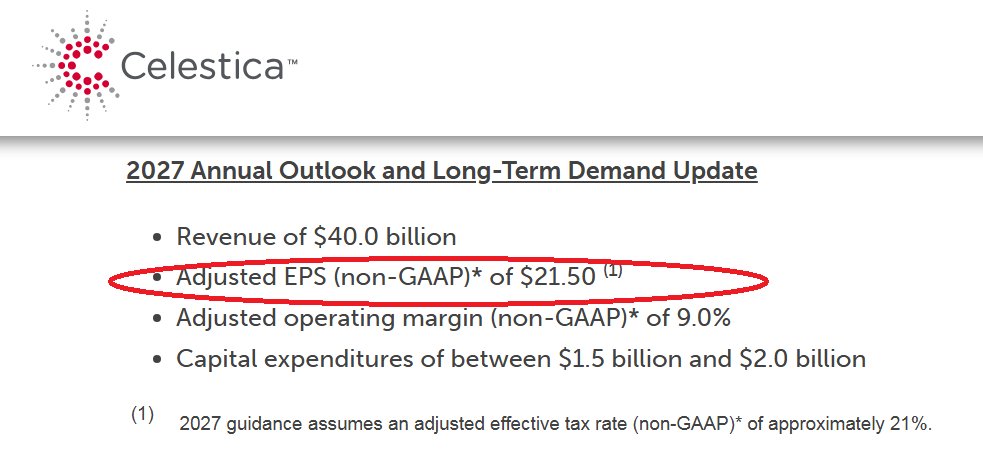
Celestica $CLS 🇨🇦
Q3-2026 Report dropped. I only highlight the 2027 Guidance. Almost a x2 in the figures; imagine the Demand for those shells.... and the things that connect 😉 🔥🔥
WS consensus at almost +100% PT 👀
AI Revolution is not stopping $MU $LITE $SNDK
" $CLS Celestica's M. Chawla reveals customer conversations are running into 2029 and 2030 as "demand visibility is getting longer and longer," and says customers are already awarding Celestica programs for 2028 on silicon that has not yet been developed"
[@firesidealpha info]
RT @firesidealpha: BREAKING: Verizon CEO admits he assumes everything SpaceX says it will do, it will do, and execute flawlessly, and says he takes its terrestrial moves "quite seriously"
Dan Schulman (CEO): “I also operate under the assumption that everything SpaceX says they will do, they will do, and that they will execute flawlessly. That’s my operating assumption on it. I think to assume anything else, makes no sense from my perspective."
"And everything that we’ve seen so far, all of their announcements, everything we’re hearing in the market, and I’ll talk about that in just a second, is so far the path that we’ve basically predicted that they would do."
"We always knew that they needed a terrestrial network to have any chance at providing a competitive service. I don’t really need to re-review the satellite beam physics, but just suffice to say that without a terrestrial network, their addressable market for broadband services is relatively small.”
"It’s in very rural areas, and their service just can’t compete with a terrestrial network. In suburban and urban areas where like 98% of our revenues are, we’re somewhere between 100 to 1,000 times more efficient than they are. And when you think about wireless, it’s even more difficult with them to compete on a satellite basis."
"And so I think that SpaceX realizes this, and they’re exploring a potential path to creating a terrestrial network. It’s not surprising they said it on their call, so I think we should take it quite seriously.”
Share
Copied
Fireside Alpha@firesidealpha
Elon Musk explains how to build AI satellites on the moon from lunar silicon and aluminum, and says 500 to 1,000 terawatts a year cannot be launched from Earth
“Well, the lunar soil is 20% silicon or something like that. So you can mine the silicon on the moon, refine it, and create the solar cells and the radiators on the moon. So get the radiators out of aluminum. So there’s plenty of silicon and aluminum on the moon to make the cells and the radiators. The chips you could send from Earth because they’re pretty light. But maybe at some point you make them on the moon, too."
"Like I said, it does seem like a sort of a video game situation where it’s difficult but not impossible to get to the next level. I don’t see any way that you could do 500 to 1,000 terawatts per year launched from Earth.”
RT @carrioresearch: $GLW
🚨 CORNING'S AI FIBER BUSINESS IS NOW ITS PROFIT ENGINE: OPTICAL EARNS 1.6X WHAT GLASS DOES, AND EVEN THE LOW END OF THE Q4 GUIDE CLEARS THE STREET
CORNING, N.Y., Oct. 27 - Corning ($GLW) reported third-quarter 2026 results before the open. Core sales grew 19% to $5.08 billion, its fastest growth since the Springboard plan began, and core EPS grew 36% to $0.91, against a $0.88 consensus.
- Optical Communications sales $2.38 billion, up 44% from a year earlier and 15% from Q2
- Enterprise Networks up 84%, with Gen AI product sales more than doubling
- Core gross margin 40.5%, up 150 bp; core operating margin 22.7%, up 310 bp
- Q4 guide: core sales $5.2 billion to $5.3 billion, core EPS $0.96 to $1.00, against a $0.93 consensus
- Four long-term, multibillion-dollar customer agreements signed in Q3, including Verizon and AT&T
CEO Wendell Weeks said Gen AI sales doubled in the quarter, "outpacing GPU unit growth."
I put this quarter's segment table next to Q3 2025. A year ago Glass Innovations, the old display and specialty glass businesses, earned $363 million and optical earned $295 million. This quarter optical earned $532 million and glass earned $328 million. Optical also supplied about 90% of Corning's sales growth, both from a year earlier and from Q2.
A year ago glass paid the bills and fiber was the growth story. Now fiber is both.