Eric Basmajian✓

@EPBResearch

Founder, EPB Research. Business cycle research that helps investors separate economic noise from changes that materially alter recession and market risk.

288 Following131K Followers15.2K Posts
  1. Eric Basmajian✓@EPBResearch
    EPB Research tells you when changing economic conditions actually matter for your capital, and what would change the view. Make fewer costly macro mistakes with your capital. Start a 7-day free trial here
    3066K

  2. Eric Basmajian✓@EPBResearch
    New-home supply is 8.5 months, higher than 93% of non-recession months since 1963. But only 23% of those homes are completed. In 2009, it was 48%.
    Eric Basmajian @EPBResearch
    67479.5K
  3. Eric Basmajian✓@EPBResearch
    Eric Basmajian
    RT @SoberLook: New-home inventory stands at 8.5 months of supply, but completed new homes represent just two months of supply, compared with 5.8 months in early 2009. Source: @EPBResearch
    0601.5K
  4. Eric Basmajian✓@EPBResearch
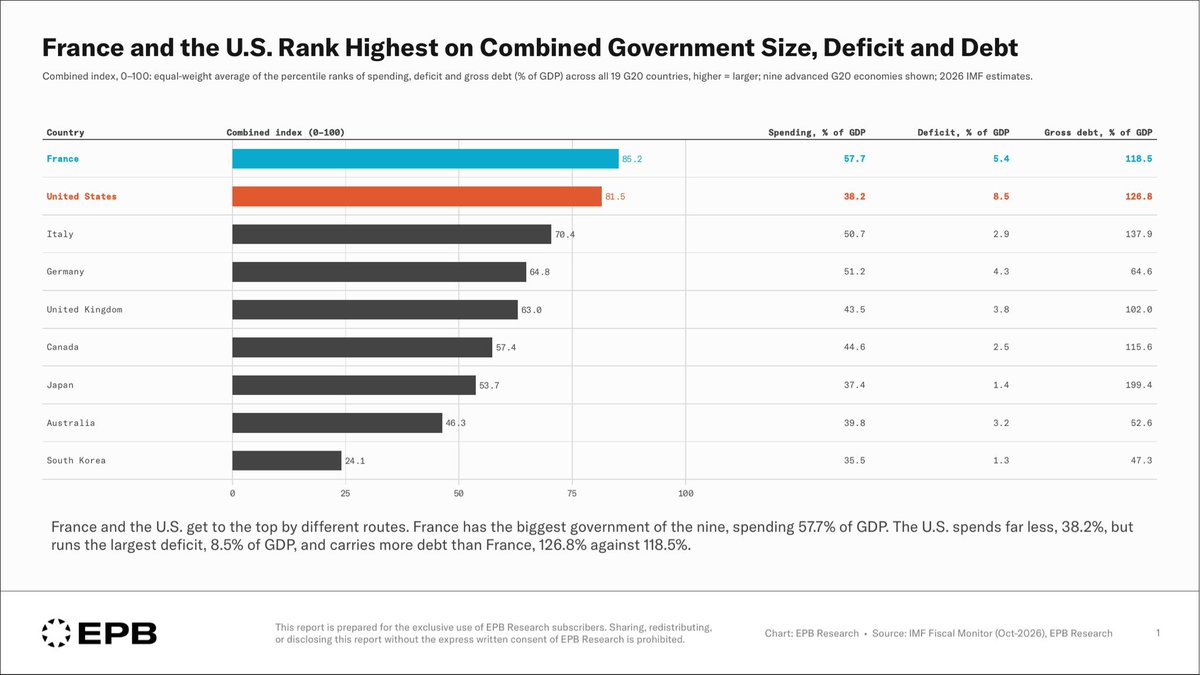
    France has the highest government spending to GDP of the major developed countries. But total spending to GDP is just one measure of the government's impact on the economy, which, at increasingly high levels, is negative. It's important to look at all three: government spending to GDP, the deficit to GDP, and total debt to GDP. Spending tells you the raw size of government outlays. The deficit shows whether that spending is funded by taxes or borrowing. Total debt tells you the accumulated deficits. All three follow the same general finding in economics. A little is necessary. A little more is generally good. But there's a point where the benefits level off. Eventually, the improvement in the standard of living flatlines and then turns negative. Taken together, France is the worst of the developed countries, but the United States is not far behind. The US actually runs a bigger deficit. Of course, one important difference is the reserve currency, but this speaks more to capacity vs negative impact of increasing government size. Looking at all three also exposes the inflation fallacy. Inflation can reduce debt to GDP, but with most government spending indexed to inflation, the deficit and spending to GDP don't improve, and those carry consequences too. As the deficit gets bigger, government borrowing crowds out other borrowers. Many point to AI funding getting crowded out, but I think the impact is downstream. If AI is productive and generates returns, it will keep getting funded, and other sectors get crowded out instead. Housing is the most obvious example. Housing investment has been weak for 4 years, and the recent rise in interest rates will likely make that worse. France is currently the most extreme case, but many developed nations are in a similar position, with a level of government size and command-and-control effects on the economy that negatively impact the standard of living.
    Download
    55346.9K
  5. Eric Basmajian✓@EPBResearch
    France has the highest government spending to GDP of the major developed countries. But total spending to GDP is just one measure of government's impact on the economy, which at increasingly high levels is negative. It's important to look at all three: government spending to GDP, the deficit to GDP, and total debt to GDP. Spending tells you the raw size of government outlays. The deficit tells you whether that spending is funded by taxes or borrowed. Total debt tells you the accumulated deficits. All three follow the same general finding in economics. A little is necessary. A little more is generally good. But there's a point where the benefits level off. Eventually, the improvement in the standard of living flatlines and then turns negative. Measured on all three together, France is the worst of the developed countries, but the United States is not far behind. The US actually runs a bigger deficit. Of course, one important difference is the reserve currency, but this speaks more to capacity vs negative impact of increasing government size. Looking at all three also exposes the inflation fallacy. Inflation can reduce debt to GDP, but with most government spending indexed to inflation, the deficit and spending to GDP don't improve, and those carry consequences too. As the deficit gets bigger, government borrowing crowds out other borrowers. Many point to AI funding getting crowded out, but I think the impact is downstream. If AI is productive and generates returns, it will keep getting funded, and other sectors get crowded out instead. Housing is the most obvious example. Housing investment has been weak for 4 years, and the recent rise in interest rates will likely make that worse. France is currently the most extreme case, but many developed nations are in a similar position, with a level of government size and command and control effects on the economy that negatively impact the standard of living.
    Download
    John Arnold @johnarnold
    French protestors want higher public spending, wages, subsidies and pensions. Meanwhile France has gov’t spending of 57% of GDP (among highest of Western countries), deficits of 5% of GDP, 10 year bond rate >5%, and a currency they don’t control. I don’t understand how this ends.
    6124410.6K
  6. John Arnold✓@johnarnold
    French protestors want higher public spending, wages, subsidies and pensions. Meanwhile France has gov’t spending of 57% of GDP (among highest of Western countries), deficits of 5% of GDP, 10 year bond rate >5%, and a currency they don’t control. I don’t understand how this ends.
    2412483.6K228K
  7. Eric Basmajian✓@EPBResearch
    AI productivity gains are showing up, but only in ~15% of jobs. The three heaviest AI adopters (information, professional services, finance) went from a 2.2% productivity trend to 5.0% since 2022. The rest of the economy: 0.9% to 1.4%.
    Download
    471971.2K142K
  8. Eric Basmajian✓@EPBResearch
    New home supply looks like 2008, but it isn't. In 2009, 48% of new homes for sale were completed. Today, only 23% are completed, and 24% haven't been started. Margins are under pressure, but builders are absorbing it slowly rather than sitting on finished homes.
    Download
    116549K
  9. Eric Basmajian✓@EPBResearch
    Posts @EPBResearch
    I go through the full picture, including builder margins and why construction jobs have held up, in this week's free EPB newsletter. Sign up here:
    0032.6K
  10. Eric Basmajian✓@EPBResearch
    Eric Basmajian
    RT @merrillmatter: The current economic situation has been confounding to me. Eric has been illuminating.
    Eric Basmajian @EPBResearch
    Builders have 279,000 homes approved to build but haven't started. That's 2.37 months of permits, near the highest in 25+ years. Builders don't sit on approvals when demand is strong. Housing is the weakest part of the economy and the path to a downturn, not AI.
    0101.8K
  11. Eric Basmajian✓@EPBResearch
    Builders have 279,000 homes approved to build but haven't started. That's 2.37 months of permits, near the highest in 25+ years. Builders don't sit on approvals when demand is strong. Housing is the weakest part of the economy and the path to a downturn, not AI.
    Download
    6167810.6K
  12. Eric Basmajian✓@EPBResearch
    Jobless claims are running below 2023, 2024, and 2025 for the same week. 172K last week vs. 206K a year ago. Layoffs remain extremely low. Hiring is soft, creating some labor market tension, particularly for youth, but the labor market remains low-fire.
    Download
    97426.9K
  13. Eric Basmajian✓@EPBResearch
    Posts @EPBResearch
    1012.6K
  14. Eric Basmajian✓@EPBResearch
    Posts @EPBResearch
    0023.6K
  15. Eric Basmajian✓@EPBResearch
    zerohedge @zerohedge
    Initial Claims 194K, Exp. 200K Continuing Claims 1728K, Exp. 1710K
    1185.8K
  16. zerohedge✓@zerohedge
    Initial Claims 194K, Exp. 200K Continuing Claims 1728K, Exp. 1710K
    181824395.8K
  17. Eric Basmajian✓@EPBResearch
    Eric Basmajian
    RT @SoberLook: Since late 2022, output per worker in the three most AI-intensive industries has grown 5% annually, more than double its historical pace and well above the 1.3% growth recorded across the rest of the private sector. Source: @EPBResearch
    02901.6K
  18. Eric Basmajian✓@EPBResearch
    The number of apartment units under construction still outpaces single-family units under construction.
    Download
    42355.9K
  19. Eric Basmajian✓@EPBResearch
    Layoffs Are Near Record Lows. So Why Is It So Hard to Find a Job?
    652310K
  20. Eric Basmajian✓@EPBResearch
    Residential construction remains depressed. But housing starts normally decline more sharply ahead of recessionary periods than they have today.
    Download
    353510.8K
  21. Eric Basmajian✓@EPBResearch
    Eric Basmajian
    RT @EPBResearch: The stock market is valued at 34.2x corporate profits. That’s a record, higher than the 33.4x peak in early 2000. But valuations tell you very little about whether a recession is coming. What they do tell you is how much damage a recession does... 1/
    019030K
  22. Show more posts