Enclave

@EnclaveAI

We help AI-native companies deploy fleets of autonomous security agents.

15 Following1.5K Followers232 Posts
  1. Enclave@EnclaveAI
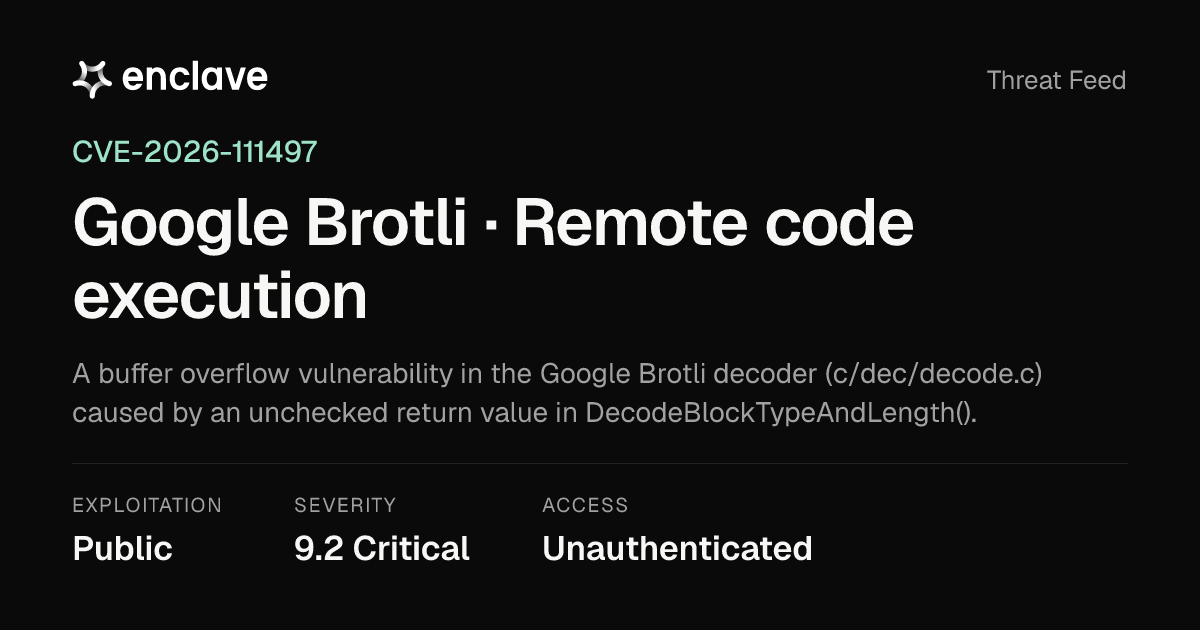
    Node2Shell (CVE-2026-111497) is a memory bug in Brotli, the compression library bundled into Node.js, Python, system libs, Envoy and more. Most teams don't know every place Brotli runs in their stack. It's usually a transitive dependency or an OS package, and pip-audit may not flag it yet. Enclave's agents scan your code, cloud and servers and show you exactly where you're exposed. Advisory + free check:
    Download
    OpenAI @OpenAI
    During this red-teaming exercise, we also found a vulnerability that allows for unauthenticated remote code execution in Brotli, a widely-deployed compression library included in many pieces of software such as Node.js, Bun, and Envoy. The flaw could let an attacker run their own code on affected systems by sending or replying with malicious compressed data, without any need to create a user account. That is, an unpatched server that accepts compressed input could be taken over by a malicious client, and an unpatched client that accepts compressed input (such as “curl --compressed”) could be taken over by a malicious server. This root cause issue was actually fixed in the Brotli source code in February, but it wasn’t known at the time that it gave rise to a security vulnerability and there was no more recent release of Brotli. Since Brotli is built into other software, any software which includes this library needs to take the update too, followed by the users of that software. We disclosed the vulnerability to Brotli and other downstream projects such as Node.js, which released or are currently releasing security updates, and Brotli cut new release versions and published a CVE. More details on the patch and mitigations below:
    1986645.9K
  2. OpenAI✓@OpenAI
    During this red-teaming exercise, we also found a vulnerability that allows for unauthenticated remote code execution in Brotli, a widely-deployed compression library included in many pieces of software such as Node.js, Bun, and Envoy. The flaw could let an attacker run their own code on affected systems by sending or replying with malicious compressed data, without any need to create a user account. That is, an unpatched server that accepts compressed input could be taken over by a malicious client, and an unpatched client that accepts compressed input (such as “curl --compressed”) could be taken over by a malicious server. This root cause issue was actually fixed in the Brotli source code in February, but it wasn’t known at the time that it gave rise to a security vulnerability and there was no more recent release of Brotli. Since Brotli is built into other software, any software which includes this library needs to take the update too, followed by the users of that software. We disclosed the vulnerability to Brotli and other downstream projects such as Node.js, which released or are currently releasing security updates, and Brotli cut new release versions and published a CVE. More details on the patch and mitigations below:
    OpenAI @OpenAI
    Over the past several months, we have substantially hardened the security of our research training environment. We’ve removed live internet access for all frontier models during training and built an offline world for them to use instead—a cached version of the web where they can still learn to browse, search, and use applications. On September 20, after a model exploited a DNS misconfiguration to find a way outside of this offline world, we paused frontier training to strengthen containment further. We assembled teams of agents, powered by our most cyber-capable models, and tasked them with finding weaknesses in our research environments. While they found no route to the internet they could easily exploit while concealing their activity from our monitors, they did find zero-day vulnerabilities, virtual machine escapes, and hardware side-channels for communication between agents. We used their discoveries to further strengthen our defenses and contribute fixes to open-source software. After strengthening our containment architecture, we resumed our frontier RL training and inference on October 1. We’ve reserved substantial compute for continuous red-teaming, and made high-compute red-teaming part of the safety cases we use to decide whether frontier training and evaluation can proceed securely.
    5671K7.1K2.2M
  3. Enclave@EnclaveAI
    Introducing Enclave Red: AI models for offensive security testing, built into Enclave. Ask a model to attempt an attack on a server you own, and it refuses. Explaining that the test is authorized doesn't change the answer, and neither does rephrasing. The refusal stops legitimate security work before it starts. Enclave Red won't turn you down for testing systems you're authorized to test. Your agents get room to investigate and attempt real attack paths, with no separate model provider and no extra account. You confirm you're authorized before anything runs, and you stay responsible for how it's used. We'll add more models to Enclave Red as they become available. Testing your own systems should not require talking a model into it.
    Download
    231497.7K
  4. Enclave@EnclaveAI
    Posts @EnclaveAI
    Check whether a scanner finding is actually exploitable. Test a new service before it ships. Rerun the attack path and verify the fix. If you own the system - try Enclave Red:
    00595
  5. Enclave@EnclaveAI
    Enclave
    RT @TheHackersNews: 🚨 Microsoft Authenticator flaw let malicious Android apps impersonate Teams and obtain work account sign-in tokens. No app permissions needed. Researchers demonstrated access to email, files, and calendars. Microsoft has patched it. 🔗 Read more ↓
    067012
  6. Enclave@EnclaveAI
    Moonshot AI says it curbed Kimi K3.1 Pro's hacking ability, the model verified 7 of 11 vulnerable runs in our AI Hacking Race. It solved 3 of the 4 tasks and went 3 for 3 on the Jenkins command line parser. We ran the same model anyone can call through OpenRouter, with Moonshot's curbs built in.
    3113230K
  7. Enclave@EnclaveAI
    Posts @EnclaveAI
    The fifteen accepted runs cost $39.79. The two Nextcloud runs took $28.10 of that without producing a verified result, about 71% of the bill. Every other run, including all four controls, shared the remaining roughly $11.69.
    105208
  8. Enclave@EnclaveAI
    Posts @EnclaveAI
    For the full details of the runs, including token usage and what this result does and doesn't show, read the write-up:
    00486
  9. Enclave@EnclaveAI
    We’ve added 50+ sources to Enclave’s Threat Feed, and it’s free for everyone. The feed brings together vendor advisories, Linux distributions, CERTs, disclosure programs and exploit databases, including MSRC, Red Hat, CERT/CC, ZDI and Metasploit. Each entry shows which sources reported it, and ZDI reports can appear before a CVE is assigned. We’ve opened it to help everyone keep track of what’s been disclosed or exploited and spot what might affect their stack early. See what's in the feed:
    Download
    15437412K
  10. Enclave@EnclaveAI
    Posts @EnclaveAI
    Want to know whether these CVEs actually affect your code? Sign up for Enclave to check your exposure to anything in the Threat Feed and get help fixing what's exploitable. Try it free for 14 days:
    004232
  11. Enclave@EnclaveAI
    We got Microsoft Authenticator to hand over account tokens to a fake Teams app. The app needed zero Android permissions. It just claimed to be Teams, and Authenticator never checked who was actually asking. The result: full delegated access to mailbox, files, and calendar through Microsoft Graph. Full write-up by @ofekdavidlevin with code and PoC:
    552652K856K
  12. Enclave@EnclaveAI
    Enclave
    RT @stevesi: Suddenly I'm finding myself thinking about GDI+ all over again.
    Enclave @EnclaveAI
    Node2Shell (CVE-2026-111497) is a memory bug in Brotli, the compression library bundled into Node.js, Python, system libs, Envoy and more. Most teams don't know every place Brotli runs in their stack. It's usually a transitive dependency or an OS package, and pip-audit may not flag it yet. Enclave's agents scan your code, cloud and servers and show you exactly where you're exposed. Advisory + free check:
    02016
  13. Enclave@EnclaveAI
    Enclave
    RT @talhof8: Go check against your stack!
    Download
    Enclave @EnclaveAI
    Node2Shell (CVE-2026-111497) is a memory bug in Brotli, the compression library bundled into Node.js, Python, system libs, Envoy and more. Most teams don't know every place Brotli runs in their stack. It's usually a transitive dependency or an OS package, and pip-audit may not flag it yet. Enclave's agents scan your code, cloud and servers and show you exactly where you're exposed. Advisory + free check:
    01015
  14. Enclave@EnclaveAI
    Enclave
    RT @dvirsegev: There's never been an easier way to take a vulnerability and see if you're actually exposed.
    Enclave @EnclaveAI
    Node2Shell (CVE-2026-111497) is a memory bug in Brotli, the compression library bundled into Node.js, Python, system libs, Envoy and more. Most teams don't know every place Brotli runs in their stack. It's usually a transitive dependency or an OS package, and pip-audit may not flag it yet. Enclave's agents scan your code, cloud and servers and show you exactly where you're exposed. Advisory + free check:
    02014
  15. Enclave@EnclaveAI
    Enclave
    RT @Yanir_: This is the quickest way to check your exposure to recent zero days. 1. Connect all your integrations 2. Ask the agents to scan your entire attack surface 3. Get an answer
    Enclave @EnclaveAI
    Node2Shell (CVE-2026-111497) is a memory bug in Brotli, the compression library bundled into Node.js, Python, system libs, Envoy and more. Most teams don't know every place Brotli runs in their stack. It's usually a transitive dependency or an OS package, and pip-audit may not flag it yet. Enclave's agents scan your code, cloud and servers and show you exactly where you're exposed. Advisory + free check:
    02016
  16. Enclave@EnclaveAI
    Enclave
    RT @EnclaveAI: Big news: Enclave is now open to everyone, and today we're launching Threat Feed. Enclave is an autonomous security team for AI-native companies: a fleet of security agents that test your code, cloud, and infrastructure the way an attacker would. We built it on a simple belief. Attackers already use swarms of cheap AI agents to probe for weaknesses around the clock, so defenders need agents of their own to keep up. A small team without a security function should be able to defend like a large one. Threat Feed is the newest piece: a live feed of new vulnerabilities, checked against your stack, so when the next big disclosure drops you know whether it affects you. This week made the case. On Wednesday, PHP2Shell, LiteLLM and Railway all disclosed security issues. PHP2Shell had sat in PHP's code for over a decade until one researcher using frontier AI turned it into a working exploit in about a week. Cloudflare saw thousands of exploit attempts in the 10 hours before disclosure and millions since. Starting today, anyone can sign up. Try it free for 14 days:
    0220807K
  17. Enclave@EnclaveAI
    Enclave
    RT @marting: Big need. Makes sense. Will check out.
    Enclave @EnclaveAI
    Big news: Enclave is now open to everyone, and today we're launching Threat Feed. Enclave is an autonomous security team for AI-native companies: a fleet of security agents that test your code, cloud, and infrastructure the way an attacker would. We built it on a simple belief. Attackers already use swarms of cheap AI agents to probe for weaknesses around the clock, so defenders need agents of their own to keep up. A small team without a security function should be able to defend like a large one. Threat Feed is the newest piece: a live feed of new vulnerabilities, checked against your stack, so when the next big disclosure drops you know whether it affects you. This week made the case. On Wednesday, PHP2Shell, LiteLLM and Railway all disclosed security issues. PHP2Shell had sat in PHP's code for over a decade until one researcher using frontier AI turned it into a working exploit in about a week. Cloudflare saw thousands of exploit attempts in the 10 hours before disclosure and millions since. Starting today, anyone can sign up. Try it free for 14 days:
    02013
  18. Enclave@EnclaveAI
    Enclave
    RT @levie: Agent swarms for cyber defense is about to be one of the biggest categories in AI. We are going to have agents reviewing our code and infra, testing every permutation of risk, processing gobs of data, and more. Security is one of the best use-cases for swarms because it’s an obvious area where more compute in equals more value out. There’s a wide range of testing that people can never get around to - or at least quickly enough - that agents have no problem going after. Going to be a wild time in cyber.
    Enclave @EnclaveAI
    Big news: Enclave is now open to everyone, and today we're launching Threat Feed. Enclave is an autonomous security team for AI-native companies: a fleet of security agents that test your code, cloud, and infrastructure the way an attacker would. We built it on a simple belief. Attackers already use swarms of cheap AI agents to probe for weaknesses around the clock, so defenders need agents of their own to keep up. A small team without a security function should be able to defend like a large one. Threat Feed is the newest piece: a live feed of new vulnerabilities, checked against your stack, so when the next big disclosure drops you know whether it affects you. This week made the case. On Wednesday, PHP2Shell, LiteLLM and Railway all disclosed security issues. PHP2Shell had sat in PHP's code for over a decade until one researcher using frontier AI turned it into a working exploit in about a week. Cloudflare saw thousands of exploit attempts in the 10 hours before disclosure and millions since. Starting today, anyone can sign up. Try it free for 14 days:
    063013
  19. Enclave@EnclaveAI
    Enclave
    RT @vvkgopalan: Every startup needs to run this now!
    Enclave @EnclaveAI
    Big news: Enclave is now open to everyone, and today we're launching Threat Feed. Enclave is an autonomous security team for AI-native companies: a fleet of security agents that test your code, cloud, and infrastructure the way an attacker would. We built it on a simple belief. Attackers already use swarms of cheap AI agents to probe for weaknesses around the clock, so defenders need agents of their own to keep up. A small team without a security function should be able to defend like a large one. Threat Feed is the newest piece: a live feed of new vulnerabilities, checked against your stack, so when the next big disclosure drops you know whether it affects you. This week made the case. On Wednesday, PHP2Shell, LiteLLM and Railway all disclosed security issues. PHP2Shell had sat in PHP's code for over a decade until one researcher using frontier AI turned it into a working exploit in about a week. Cloudflare saw thousands of exploit attempts in the 10 hours before disclosure and millions since. Starting today, anyone can sign up. Try it free for 14 days:
    02013
  20. Enclave@EnclaveAI
    Enclave
    RT @talhof8: Introducing Threat Feed: a live feed of new vulnerabilities, checked against your code, cloud, and infrastructure. Knowing whether a disclosure affects you should not require a security team. @EnclaveAI is now open to everyone.
    Enclave @EnclaveAI
    Big news: Enclave is now open to everyone, and today we're launching Threat Feed. Enclave is an autonomous security team for AI-native companies: a fleet of security agents that test your code, cloud, and infrastructure the way an attacker would. We built it on a simple belief. Attackers already use swarms of cheap AI agents to probe for weaknesses around the clock, so defenders need agents of their own to keep up. A small team without a security function should be able to defend like a large one. Threat Feed is the newest piece: a live feed of new vulnerabilities, checked against your stack, so when the next big disclosure drops you know whether it affects you. This week made the case. On Wednesday, PHP2Shell, LiteLLM and Railway all disclosed security issues. PHP2Shell had sat in PHP's code for over a decade until one researcher using frontier AI turned it into a working exploit in about a week. Cloudflare saw thousands of exploit attempts in the 10 hours before disclosure and millions since. Starting today, anyone can sign up. Try it free for 14 days:
    03011