Canadian astrophysicist focused on extragalactic astronomy & early-universe galaxies. Seeking mountain peaks. Writing through the chaos; riding away from it.
Really sad to hear about Sir Patrick Stewart. From Shakespeare to Professor Xavier, he brought such warmth and conviction to his work. But for those of us who love space, there will always be something special about Captain Picard.
He made curiosity, patience and thoughtful leadership feel exciting. Here was someone who listened, valued evidence and approached the unknown with a desire to understand. For a young person watching Star Trek, that was a wonderful example of what growing up could mean.
Science fiction can have a real place in how we discover science. A story gets you asking questions, and sometimes those questions stay with you through your studies and into your working life. His Picard gave young viewers a future worth being curious about, one where knowledge mattered and people from different backgrounds worked together.
I love that new generations will still get to meet him that way. There’s something comforting about knowing someone can press play tonight and discover all of this for the first time.
Thank you, Patrick. It was a privilege to watch you.
Rest In Peace Sir.
Astronomers using early data from the Vera C. @VRubinObs Observatory have identified 2026 ED138, a large object beyond Neptune that could qualify as a dwarf planet. It currently lies about 46 astronomical units from the Sun, roughly 6.9 billion kilometres. The discovery was announced on 27 October, although further observations are needed to establish its size and physical properties.
Matthew Holman identified the object on 13 October using software developed with Kevin Napier to connect separate detections of moving objects. Mario Jurić then recovered additional observations in Rubin’s data, while searches of other surveys uncovered images dating back to 2016. That archival material gives astronomers more than a decade of observations with which to calculate its orbit. An object can appear in telescope images for years before anyone recognises that those detections belong to the same body.
The estimated diameter is between approximately 600 and 1,500 kilometres. This considerable uncertainty comes from its unknown surface reflectivity, or albedo. At a given distance, a smaller object with a reflective surface can appear as bright as a larger object with a darker surface. The often-mentioned diameter of around 1,000 kilometres therefore depends on an assumed albedo. Follow-up measurements could narrow that range, including observations of a stellar occultation, when the object passes in front of a distant star.
An icy body of this size could have enough gravity to become approximately rounded, one of the requirements for dwarf planet status. Under the International Astronomical Union’s definition, a dwarf planet orbits the Sun, has sufficient self-gravity to achieve a nearly round shape, has not cleared its orbital neighbourhood and is not a satellite. ED138 remains a candidate while its properties are investigated.
ED138 was found against a crowded background of Milky Way stars, which probably helped it escape earlier searches. Rubin’s repeated observations and tracking algorithms allowed researchers to identify its movement through that field. Studying such objects helps reconstruct the early Solar System: their orbits and surface compositions preserve evidence of how the giant planets migrated and redistributed smaller bodies beyond Neptune.
🎃
RT @ExploreCosmos_: Wormholes are hypothetical solutions of general relativity in which spacetime itself forms a tunnel, or throat, connecting distant regions of the Universe, or, in some models, entirely separate universes.
In their simplest realizations, such as the Einstein–Rosen bridge, these structures are not naturally stable: without support from exotic matter with negative energy density, they collapse almost instantly.
Many well-known traversable wormhole solutions therefore rely on violations of classical energy conditions. Observational studies, including the one discussed here (linked below), typically set aside the question of internal stability and instead concentrate on the external spacetime metric, how the geometry of spacetime affects light propagation, because this is what astronomical observations are sensitive to.
The recent theoretical work on electrically charged wormholes examines this external signature through gravitational lensing. Any compact spacetime curvature can bend and amplify light, but the detailed lensing pattern depends on the full metric, not simply on the presence of ordinary mass.
This point is subtle but important: some famous wormhole solutions, such as the Ellis–Bronnikov wormhole, are mathematically “massless” in the usual sense, yet still produce measurable gravitational effects because spacetime curvature itself guides light along nontrivial paths. The study implicitly operates within this broader relativistic framework, focusing on how geometry, rather than mass alone, shapes observable signals.
A central result concerns image multiplicity. Black holes, due to the presence of an event horizon and a photon sphere, can in principle generate an infinite sequence of increasingly faint relativistic images as light loops around the horizon multiple times. In contrast, the electrically charged wormholes considered here are restricted to producing either a single image or, at most, three.
This sharp limitation reflects the different causal and geodesic structure of a wormhole spacetime and provides a potentially clean observational discriminator.
The three-image configuration is particularly distinctive. In this case, the lens produces one extremely bright primary image and two much fainter secondary images with identical brightness.
In the language of observational astronomy, the two secondary images have a flux ratio of exactly 1, a highly restrictive condition that is rare in conventional galaxy-scale lensing, where asymmetries in the lens mass distribution almost always break such equality.
As expected from gravitational lensing theory, these twin images also have opposite parity: one is a mirror image of the other. This combination, unit flux ratio and opposite parity, constitutes a remarkably clean and recognizable lensing signature.
The extreme brightness of the primary image arises only under very specific conditions. Magnifications approaching 100,000 occur when the background source lies extremely close to a caustic of the wormhole lens, a region in the source plane where light rays are strongly focused and amplification formally diverges.
Such near-perfect caustic alignment is rare, but when it occurs, the wormhole would act as an extraordinarily powerful gravitational telescope, briefly elevating otherwise inaccessible distant objects into detectability.
Gravitational lensing is not the only observational handle on exotic compact objects. Another major probe is the shadow produced by strongly curved spacetime.
A true black hole possesses an event horizon that absorbs light completely, yielding a central region of near-total darkness. Wormholes lack an event horizon and instead feature a throat, which could allow some light to pass through or around the central region, potentially leading to residual brightness or a modified ring structure.
While the present study focuses on lensing rather than imaging, these shadow properties offer a complementary route for distinguishing wormholes from black holes.
Finally, the analysis concentrates on electrically charged, non-rotating wormholes, closely related to Reissner–Nordström–type solutions. Rotation, ubiquitous in astrophysical systems, would further modify both lensing and shadow signatures through frame-dragging and asymmetry. Extending these calculations to rotating, Kerr-like wormholes is a natural and necessary next step toward realism.
The study does not claim that wormholes exist, nor that any observed lens must be one. Its significance lies in providing precise, falsifiable predictions.
As lensing surveys become increasingly sensitive to image multiplicities, parities, and flux ratios, they offer a way to test whether spacetime ever arranges itself in forms more exotic than black holes, or whether wormholes remain elegant but unrealized solutions of Einstein’s equations.
☃️
(Conceptual illustration of a wormhole showing the curvature of spacetime; this geometry is responsible for its potential gravitational-lensing effects.)
Betelguese... Betelguese... Betelguese 👻 🕷️
Betelguese’s Great Dimming in late 2019 and early 2020 was linked to an episode in which expelled material cooled and formed dust, obscuring part of the star.
Observations taken before the dimming had already revealed unusually cool gas and changes in the structure of its extended atmosphere, consistent with a shock wave passing through the outer layers.
New research follows what happened afterward, using the Very Large Array and ALMA. Observations collected between 2021 and 2026 cover seven frequencies, from 22 to 485 GHz.
Different radio wavelengths reveal gas at different distances from the visible surface, allowing the team to examine both the temperature profile and the changing shape of the atmosphere.
The measurements show that the outer atmosphere has warmed since the unusually low temperatures recorded in 2019. The researchers found a brightness temperature, a temperature inferred from the radio emission, of around 3,500 K at approximately 2.7 stellar radii from the centre, falling to about 2,220 K closer in, at 1.2 stellar radii. This confirms a cool region between the visible surface and the hotter chromosphere, overlapping the molecular layer known as the MOLsphere. The radio measurements also indicate that relatively cool material remains mixed with hotter gas, which ultraviolet observations preferentially detect.
Another part of the investigation concerns Siwarha, Betelgeuse’s recently identified companion. Its roughly six-year orbit lies within the supergiant’s extended atmosphere, about 2.3 stellar radii from the centre. This orbital period offers an explanation for Betelgeuse’s long brightness cycle, alongside its shorter pulsation cycle of approximately 400 days. Earlier optical and ultraviolet spectroscopy had revealed changes in gas absorption and outflow that followed the expected orbital cycle. Those results support a model in which the companion’s gravity concentrates gas into a trailing, expanding wake as it moves through the atmosphere.
The new radio data add spatial evidence. Betelgeuse’s radio-emitting atmosphere appears slightly more elongated when Siwarha is expected to reach its greatest apparent separation, and rounder when the companion passes in front of or behind the supergiant. Siwarha itself is too faint to detect in these radio observations; the evidence comes from the changing shape of the surrounding gas.
These correlations are consistent with periodic atmospheric disturbances caused by the companion, although more observations across its orbit are needed to test the interpretation.
The study provides a way to investigate how a nearby companion interacts with the extended atmosphere of a massive, evolved star.
🎃
Some of the stars in galaxy clusters lie outside the main bodies of individual galaxies, spread across a faint, extended component known as intracluster light. Many were stripped from galaxies through gravitational interactions. Their distribution and chemical composition can help us understand how clusters assembled and how their galaxies have evolved.
Four coordinated studies using @ESA_Euclid first Quick Data Release examine this diffuse light, from the processing needed to preserve it in images to its shape, abundance and metallicity. A separate study develops faster simulations for assessing how Euclid’s spectroscopic measurements affect our reconstruction of galaxy clustering.
Measuring intracluster light requires particular care because it can be mistaken for background emission and removed during image processing. The methodological study develops a dedicated approach that suppresses background variations while preserving extended structures.
Tests that inject simulated clusters into real Euclid images show that the method can recover diffuse surface brightness with uncertainties of roughly 10% under the conditions examined. This provides a tested basis for the accompanying observational analyses.
A study of 205 clusters finds that the light becomes progressively more elongated away from the central galaxy. Its shape is broadly consistent with halo shapes inferred from gravitational lensing, supporting its usefulness as an indirect tracer of cluster structure. It’s also more closely aligned with the central galaxy than with the distribution of satellite galaxies. These measurements concern the projected stellar light; they don’t directly map the full three-dimensional dark matter distribution.
Another analysis examines approximately 300 clusters between redshifts 0.2 and 1.5. Under the study’s measurement definitions, intracluster light accounts for about 20% of the total cluster stellar light. At fixed cluster mass, that fraction remains approximately constant across the observed redshift range.
This suggests that a substantial diffuse stellar component was already present at earlier epochs. It doesn’t mean individual clusters stopped evolving: the sample compares different systems rather than following the same clusters through time, and the measured fraction depends on wavelength.
The metallicity study combines measurements from 168 clusters to trace their average stellar populations out to around 300 kiloparsecs. The diffuse light becomes bluer than the central galaxy, and stellar population models indicate lower abundances of elements heavier than helium.
This supports a formation scenario in which tidal interactions remove relatively metal-poor stars from the outskirts of massive satellite galaxies. The colour gradient is well established, but converting colour into metallicity depends on the adopted stellar population models.
The fifth paper addresses a different challenge: understanding which galaxies enter Euclid’s spectroscopic sample and how redshift errors affect clustering measurements. Its FastSpec and Pypelid tools reproduce key aspects of the observing and analysis process without requiring full pixel-level simulations. In the baseline simulated selection, redshift purity reaches 74% and completeness 45%, with improvements when photometric colours are included.
These are simulated performance estimates, not measurements of the final survey’s performance. The simplified noise model still omits residual contamination from overlapping spectra and some artefacts already seen in early data.
Together, these studies improve both the recovery of faint stellar structures and the modelling of observational biases.
The spectroscopic simulation paper remains submitted with acceptance not yet confirmed.
👉
👉
👉
👉
👉
RT @ExploreCosmos_: Point Nemo, also known as the "oceanic pole of inaccessibility," is the point in the ocean that is farthest from any land. It is named after Jules Verne's character Captain Nemo from "Twenty Thousand Leagues Under the Sea." Point Nemo is located in the ... 1/
Astronomers using @almaobs have obtained a detailed view of a dense concentration of gas and dust that could help explain how massive stars begin to form.
Known as C2c1a and nicknamed the “dragon egg,” it lies within the Dragon Cloud, an infrared-dark molecular cloud approximately 16,300 light-years away. Earlier observations had already identified it as a promising candidate for a massive stellar core at a particularly early stage of development.
Massive stars, generally defined as those with at least about eight times the Sun’s mass, develop in dense environments where gravity, turbulence, magnetic fields and radiation interact. As they grow, their radiation begins to alter the surrounding gas, making it difficult to reconstruct the conditions that existed before star formation started. Finding a sufficiently young object allows astronomers to investigate how material gathers before this activity becomes dominant.
One central question is whether a massive star begins inside a core that has already accumulated much of the material it needs, or whether a smaller initial object grows substantially by drawing gas from its wider surroundings.
A massive, starless core would provide an important test of the first possibility, but convincing examples have proved difficult to establish. An apparently single object can reveal several smaller condensations when observed more closely, while a deeply embedded protostar can remain difficult to identify.
The new observations resolve six components across the region. Its brightest central component, C2c1a(a), nevertheless remains a single emission peak down to a resolution of approximately 175 astronomical units, with an estimated compact radius of about 87 astronomical units. One astronomical unit is the average Earth–Sun distance. These measurements describe the emitting material around the possible forming star.
Determining its mass requires knowing the dust temperature. Warmer dust emits more strongly per unit mass, so the same measured emission can imply different amounts of material depending on the assumed temperature. Dust opacity introduces another uncertainty, because sufficiently opaque material can conceal emission from deeper layers. These are fundamental limitations when using dust radiation to measure the properties of embedded objects.
In this case, temperature assumptions and the spatial scale examined produce mass estimates ranging from roughly two to thirty solar masses. A central brightness temperature near 40 kelvin, compared with earlier measurements of much colder surrounding gas, also indicates that the structure cannot be described adequately by a single uniform temperature.
The team found little molecular-line emission at the centre and no outflow that could be confidently associated with it. Both findings are compatible with a very young object, although dense dust could obscure activity and a weak outflow could escape detection. The surrounding cold material provides a much larger potential supply of gas for further growth. The study therefore leaves open whether the central source is still prestellar or already contains a very young protostar.
👉
Proxima Centauri is the nearest star to the Sun, ~ 4.24 ly away. That places it ~ 40 trillion km from Earth. Even light takes more than 4 years to cross that distance, which helps explain why reaching another star presents such a different engineering problem from travelling between planets. Proxima Centauri also hosts Proxima b, a planet discovered in 2016 through the small changes its gravitational pull produces in the star’s motion. Its measured minimum mass is close to Earth’s & it completes an orbit every 11.2 days. These properties make it an especially interesting target for studying terrestrial planets outside our Solar System.
Proxima b orbits much closer to its star than Mercury does to the Sun. However, Proxima Centauri is a small, cool red dwarf that emits far less energy than our star, placing the planet within its habitable zone. This means that liquid water could exist on its surface under suitable atmospheric conditions. Whether those conditions actually exist remains uncertain. We haven’t established that Proxima b has an atmosphere, oceans or life & its star produces frequent flares & intense ultraviolet radiation. Models suggest that this radiation could drive substantial atmospheric loss, although the outcome depends on properties of the planet & its atmosphere that remain poorly constrained.
At a constant speed of ~ 75 km/s, covering Proxima Centauri’s present distance would take ~ 17,000 years. For comparison, Voyager 1 travels at roughly 17 km/s relative to the Sun. Dividing the same distance by that speed gives ~ 75,000 years, although Voyager 1 is heading elsewhere. These calculations hold the distance fixed & leave out acceleration, braking and the relative motion of the stars. They illustrate the scale of the journey; an actual mission would require a calculated interception trajectory.
Other spacecraft have achieved much higher speeds. During its close approaches to the Sun, Parker Solar Probe has reached ~ 692,000 km/h. Using that speed & Proxima Centauri’s present distance gives a crossing time of ~ 6,600 y. However, Parker achieves its record speed briefly while moving through the deepest part of its highly elliptical solar orbit. Turning that performance into an interstellar departure speed would require a different mission design. Its speed record provides another useful comparison, while leaving the practical problem of sending a spacecraft to Proxima unresolved.
Transporting ppl would add challenges that a robotic probe doesn’t face. A journey lasting 1000s of years would require many generations to live aboard the spacecraft, with reliable food production, water recycling, medical care, radiation protection & the ability to repair essential equipment. The population would also need to remain healthy & the community would have to function for far longer than any human institution has maintained a technological habitat. Researchers have explored aspects of these generation ships through demographic simulations & engineering studies. Such work examines the conditions a mission might require, but demonstrating a complete, durable system remains an enormous unresolved task.
Much shorter journeys have been proposed for extremely small robotic spacecraft. Breakthrough Starshot’s concept would use a powerful laser array to accelerate lightweight sails carrying instruments towards ~ 20 % of the SoL. At that speed, crossing the present distance to Proxima Centauri would take ~ 21 years, followed by another 4 years for the observations to reach Earth. Achieving this would require solutions to difficult problems involving sail materials, laser control, collisions with interstellar particles, onboard power & communication across interstellar distances. The basic concept involves a fast flyby, with braking at the destination presenting an additional challenge. It remains a research proposal & adapting such an approach to a spacecraft carrying ppl would introduce vastly greater demands.
RT @ExploreCosmos_: .@ESA_Euclid was built to investigate dark matter and dark energy by mapping billions of distant galaxies. While carrying out that survey, ESA’s space telescope has also discovered something much closer to home: its first previously unknown comet, C/2026 S1 (Euclid), recorded in images taken between 16 and 24 September 2026.
The discovery came through software developed by Mikko Pöntinen, a doctoral researcher at the University of Helsinki @helsinkiuni working with the Euclid Consortium’s Solar System Objects Science Working Group. His program searches for moving objects against the background of stars and galaxies. During a long exposure, a comet changes position enough to leave a small streak. Around this one, the images also revealed a diffuse cloud, or coma, indicating that it was releasing dust and gas. The streak itself records its movement during the exposure; it should not be confused with a comet’s physical tail.
With no matching object in existing catalogues, Pöntinen reported it to the Minor Planet Center. Ground-based follow-up helped confirm the discovery on 8 October. The comet lies approximately 1.3 billion kilometres from Earth, high above the planets’ orbital plane. Its journey around the Sun takes many thousands of years, although its orbital period still needs refinement.
Finding it required a fortunate alignment of circumstances. Euclid avoids regions close to the Solar System’s plane, where sunlight scattered by interplanetary dust interferes with its sensitive observations. This comet’s steeply inclined trajectory carried it into the telescope’s Deep Field North, where it appeared in 16 exposures across five fields of view. Those repeated sightings allowed the team to trace its motion and investigate its nature.
Comets contain ice and dust inherited from the formation of the Solar System around 4.6 billion years ago. Studying them helps astronomers investigate the materials from which the planets formed. Euclid’s observations already show activity around this distant object, giving researchers an opportunity to follow how it develops as it continues along its orbit.
The discovery also provides practical experience for ESA’s future Comet Interceptor mission, which will wait in space before travelling towards a suitable comet. C/2026 S1 is unsuitable for that mission, but finding and confirming it has tested the discovery and alert process that could help identify a future target.
When not finding a planet is still a scientific success.
When astronomers search for planets beyond our Solar System, discovering a new world is usually considered a successful result. But sometimes, finding nothing can be just as valuable. A recent study of a nearby binary star system demonstrates why ruling out certain types of planets can help us understand planetary systems and make future searches more effective.
The research focuses on 70 Ophiuchi AB, a binary system located approximately 16.7 light-years from Earth. It consists of two main-sequence stars, both slightly cooler and less massive than our Sun. The primary star, 70 Ophiuchi A, has about 88% of the Sun's mass, while its companion, 70 Ophiuchi B, has approximately 73%. Both stars are thought to be around 6.2 billion years old, making them older than our Solar System.
This system is particularly interesting because binary stars are extremely common throughout the Milky Way, yet detecting planets around them can be challenging. The gravitational interaction between two stars complicates their orbital dynamics, while their combined light can make certain detection methods less effective. Nevertheless, planetary systems can exist around binary stars, and understanding the conditions that allow planets to form and remain in stable orbits is an important part of exoplanet research.
To investigate 70 Ophiuchi AB, the researchers combined more than a century of astronomical observations with new measurements obtained using the Planet Finder Spectrograph on the 6.5-metre Magellan II Clay Telescope in Chile. Between 2023 and 2025, they collected 499 radial velocity measurements of 70 Ophiuchi A and 334 of its companion. These observations were combined with historical radial velocity and astrometric data, including a 27-year radial velocity baseline for the primary star.
The radial velocity technique searches for small changes in a star's motion caused by the gravitational influence of an orbiting planet. As a planet moves around its star, it produces a slight gravitational pull that makes the star move around their common centre of mass. This movement creates tiny Doppler shifts in the star's spectrum, allowing astronomers to infer the possible presence of an unseen planet.
However, not every variation in radial velocity is caused by a planet. Stellar activity, including magnetic phenomena, surface features and rotation, can produce signals that resemble those generated by planetary companions. Distinguishing between these effects is one of the major challenges of precision radial velocity measurements.
In the case of 70 Ophiuchi AB, the researchers detected variations in the radial velocities of both stars, but their analysis showed that these changes were consistent with stellar activity modulated by rotation rather than the gravitational influence of planets. No convincing planetary signals were identified.
At first glance, this might seem disappointing, particularly because the system is relatively close to Earth and represents a promising target for future observations. But the absence of a detection allowed the researchers to establish important constraints on the kinds of planets that could exist there.
Around 70 Ophiuchi A, the observations rule out planets with masses comparable to Jupiter within approximately five astronomical units, assuming their orbits lie in the plane of the binary system. The measurements are also sensitive enough to exclude planets above approximately 0.3 Jupiter masses at one astronomical unit and 0.5 Jupiter masses at two astronomical units. Around 70 Ophiuchi B, planets more massive than about 0.25 to 0.3 Jupiter masses can be excluded within 0.5 astronomical units.
These results do not mean that the system contains no planets. They mean that certain planetary masses and orbital configurations are inconsistent with the observations. Smaller planets, including rocky worlds comparable to Earth, could still remain undetected.
One particularly significant finding concerns the orbital stability of planets around 70 Ophiuchi A. The researchers determined that stable planetary orbits could extend to approximately 2.5 astronomical units from the primary star, a region that includes its habitable zone.
The habitable zone is generally defined as the range of distances from a star where a rocky planet with suitable atmospheric conditions could maintain liquid water on its surface. Its location depends on the luminosity of the host star, and the possibility of habitability also depends on many other factors, including atmospheric composition, planetary mass and geological evolution.
In a binary system, the presence of a second star introduces additional gravitational perturbations that can destabilise planetary orbits over long periods. Establishing which regions remain dynamically stable is therefore essential before evaluating their potential to host habitable worlds.
The new results indicate that planets with masses comparable to Saturn or smaller could occupy stable orbits around 70 Ophiuchi A, including within its habitable zone. This does not establish that any such planets exist, nor that they would necessarily be habitable. It does, however, confirm that the system retains interesting possibilities for future searches, particularly for smaller terrestrial planets that current observations cannot reliably detect.
The study also substantially improves our knowledge of the binary stars themselves. By combining extensive astrometric measurements with radial velocity observations, the astronomers obtained highly precise estimates of the stellar masses and orbital parameters. This matters because even relatively small uncertainties in a binary system's eccentricity or closest orbital separation can affect calculations of where planetary orbits remain stable over billions of years.
The research arrives at an important moment for exoplanet astronomy. Future facilities, including the Extremely Large Telescope and NASA's proposed Habitable Worlds Observatory, are expected to extend our ability to detect and characterise planets around nearby stars. Rather than relying exclusively on indirect evidence, these instruments could allow astronomers to image some planets directly and study the chemical composition of their atmospheres.
But powerful telescopes have limited observing time, and selecting the most promising targets will be essential. Detailed studies of nearby stars, including those that produce no planetary detections, can help astronomers identify which orbital regions remain unexplored, which planets can already be excluded and where future observations are most likely to provide useful results.
70 Ophiuchi AB is particularly suitable for this approach because its proximity makes it an attractive candidate for future high-resolution observations, while its binary nature provides an opportunity to investigate planetary formation and orbital stability in a gravitational environment more complex than that of our Solar System.
There is also a broader methodological lesson in these findings. Stellar activity can imitate the gravitational signature of a planet, and interpreting such signals without sufficiently extensive observations can lead to false detections. Combining different observational techniques and measurements collected over decades provides a much stronger basis for distinguishing genuine planets from changes originating within the stars themselves.
The search for exoplanets is no longer simply about increasing the number of known worlds. It is increasingly concerned with determining how planetary systems form, how their architectures depend on their host stars, and which environments might support conditions compatible with life.
In that context, a non-detection is not necessarily a failed observation. By excluding particular possibilities, astronomers narrow the range of planetary systems that could exist and develop a clearer understanding of where to search next. The study of 70 Ophiuchi AB has not revealed a new planet, but it has made this nearby binary system a better-characterised target for future investigations of smaller worlds, including potentially rocky planets in stable orbits.
The next discovery in this system may still be years away, but the groundwork for recognising it has become considerably stronger.
👉
. @NASARoman Space Telescope has surpassed its optical performance target. Following precise alignment adjustments, including a movement of the secondary mirror by approximately one-sixteenth of a human hair’s width, the Wide Field Instrument achieved an optical error of 63 nanometres RMS, against a requirement of about 90 nanometres. The reported improvement of nearly 30% concerns this optical error; it doesn’t translate directly into 30% finer image resolution.
These measurements are part of commissioning, the period when engineers activate, adjust and calibrate the observatory before routine scientific operations. Roman is undergoing this process during its journey towards the second Sun–Earth Lagrange point, known as L2. Its planned orbit offers favourable conditions for infrared observations, including reduced thermal interference from Earth and a largely unobstructed view of the sky.
The Wide Field Instrument is central to Roman’s scientific programme. Its 18 detectors allow it to photograph a region larger than the apparent area of the full Moon in a single exposure. That combination of a large field of view and detailed infrared imaging will make it possible to survey extensive regions efficiently, studying populations of stars and galaxies rather than relying only on observations of individual targets. Light from distant galaxies is stretched towards infrared wavelengths as the universe expands, making this capability particularly useful for examining cosmic history.
Accurate observations also require a detailed understanding of how the detectors respond to light. Roman carries an internal calibration system that illuminates them with controlled light at different wavelengths and intensities. Comparing those known inputs with the recorded signals helps researchers identify variations in sensitivity and correct their measurements. This matters whenever scientists compare the brightness of astronomical objects: a small instrumental difference could otherwise be mistaken for a physical difference between the sources being observed.
The cosmological significance becomes clearer when considering weak gravitational lensing. Matter between a distant galaxy and the telescope slightly alters the path of its light, producing subtle distortions in the galaxy’s apparent shape. Measuring these patterns across large populations allows astronomers to reconstruct the distribution of matter, including dark matter, and investigate how cosmic structure has developed. Roman will combine this information with measurements of supernovae and galaxy clustering to examine the history of expansion and constrain the behaviour of dark energy.
For that work, researchers must distinguish distortions caused by gravity from patterns introduced by the instrument. Studies of Roman’s detectors have specifically examined how correlated noise and other detector effects could imitate astronomical signals. Better optical performance is therefore encouraging, but reliable cosmological measurements will also depend on continued calibration, careful modelling and control of systematic errors. A sharp image provides a stronger starting point; extracting the underlying physics still requires understanding precisely how that image was produced.
Roman’s second instrument, the coronagraph, addresses a different observational challenge: detecting faint planets beside much brighter stars. It combines masks with deformable mirrors that make extremely small corrections to the incoming light, allowing stellar glare to be suppressed. Its role is to demonstrate technologies for directly observing giant exoplanets and circumstellar material, helping prepare future observatories capable of studying smaller worlds. Both instruments illustrate why such precise engineering matters: the scientific measurements depend on controlling effects that are almost imperceptible on an everyday scale.
RT @ExploreCosmos_: The Moon is not slowly falling toward Earth, as many people instinctively imagine.
In reality, it is doing the opposite: it is gradually moving away from us at a rate of about 3.8 centimeters per year. The change is tiny on human timescales, but it reveals something deeply counterintuitive about gravity.
Gravity does not always pull things inward. Sometimes, it redistributes energy and pushes orbits outward.
The process begins with tides. The Moon’s gravity pulls on Earth’s oceans, raising tidal bulges on opposite sides of the planet. If Earth did not rotate, those bulges would remain aligned with the Moon. But Earth spins much faster than the Moon orbits, one rotation every 24 hours compared with about 27 days for a lunar orbit, so the oceans are carried slightly ahead of the Moon’s position.
In short, Earth is dragging the tidal bulge forward.
That small offset changes everything. The displaced ocean mass exerts a gravitational pull on the Moon, tugging it forward along its orbit. Moving forward in orbit means gaining energy. And gaining orbital energy does not make an object fall inward, it makes it climb outward, into a larger orbit.
The Moon slowly moves farther away while Earth’s rotation gives up a tiny amount of its energy to make that happen.
As Earth loses rotational energy, its spin gradually slows. Our days are becoming longer, by only milliseconds per century, but the effect is measurable. The long-term slowing of Earth’s rotation, driven mainly by tidal interaction with the Moon, along with smaller geophysical effects, is one reason we occasionally need leap seconds in our timekeeping systems to keep atomic clocks aligned with Earth’s actual rotation.
This exchange follows conservation laws: angular momentum is not lost but transferred from Earth’s rotation to the Moon’s orbit. Gravity here acts less like a simple attraction and more like a coupling between two moving bodies.
The Earth–Moon system is continuously evolving even though nothing external is driving the change.
We know this process is real with remarkable precision thanks to experiments that began during the Apollo missions.
Astronauts placed retroreflectors on the lunar surface, and scientists still fire laser pulses at them today. By measuring the return time of the light, researchers determine the Earth–Moon distance with millimeter accuracy, directly tracking the Moon’s steady outward drift.
Over hundreds of millions of years the consequences become dramatic. The Moon was once much closer, tides were far stronger, and Earth rotated faster. Fossil coral growth patterns record this history, showing that a day once lasted only about 18 hours.
Far in the future, if the system continues undisturbed, Earth and the Moon could eventually become tidally locked to each other, always showing the same face across the sky.
What makes this story compelling is how it overturns intuition. We tend to imagine gravity as a force that only pulls objects together. Yet in rotating systems, gravity can transfer motion and energy in ways that slowly expand orbits.
The Moon’s retreat is not a weakening of gravity but evidence of a long gravitational partnership, one that has been reshaping the Earth–Moon system for billions of years and is still unfolding, quietly, today.
RT @ExploreCosmos_: For a long time, we’ve treated gravity as one of the fundamental forces of nature. Something built into the fabric of reality itself, alongside electromagnetism and the nuclear forces.
It curves spacetime, governs the motion of planets, shapes galaxies, and dictates the large scale structure of the universe.
But what if that picture is incomplete?
What if gravity isn’t fundamental at all?
In physics, we’ve seen this kind of shift before. Temperature feels like a basic property of matter, but it isn’t. It emerges from the collective motion of microscopic particles. Pressure, too, is not fundamental. It arises from countless interactions at smaller scales.
In that sense, what we perceive as a smooth, continuous phenomenon is often the result of something deeper and more discrete.
Some physicists have wondered whether gravity might be similar.
This idea is known as emergent gravity. Instead of being a fundamental interaction, gravity could arise from underlying microscopic degrees of freedom. In some approaches, those degrees of freedom are tied to quantum information and entanglement, suggesting that spacetime itself may be built from how information is organized at the most fundamental level.
One of the key clues comes from black holes.
Black holes are not just gravitational objects. They also have temperature and entropy. Their entropy is proportional to the area of their event horizon, not their volume.
That’s a surprising result.
It suggests that the fundamental description of reality might live on lower dimensional boundaries, an idea closely related to the holographic principle.
There are even deeper proposals. In some frameworks, connections between regions of spacetime may be related to quantum entanglement itself, an idea often summarized as ER = EPR.
In that picture, spacetime is not just a stage where physics happens. It could be something that emerges from entanglement.
Even more intriguingly, when you combine quantum theory, thermodynamics, and relativity, equations resembling Einstein’s field equations can be derived as emergent relations, not as fundamental laws. In this view, spacetime geometry, and therefore gravity, would be more like an equation of state than a basic ingredient.
So gravity wouldn’t be “causing” motion in the traditional sense. It would be the macroscopic manifestation of deeper microscopic processes.
There are also attempts to connect this idea to cosmology. Some versions of emergent gravity try to explain phenomena usually attributed to dark matter by modifying how gravity behaves on large scales, without introducing new particles. These models are still debated, and they don’t yet match all observations as well as the standard picture, but they highlight how much we still don’t know.
The challenge is that we don’t yet have a complete underlying theory.
If gravity is emergent, what is it emerging from? What are the fundamental degrees of freedom? How do they give rise to spacetime itself?
Right now, those questions are open.
And that’s what makes the idea so compelling.
Because it shifts the question. Instead of asking how gravity works, we start asking why it exists at all, and whether what we call gravity is just the large scale shadow of something deeper.
If that’s true, then spacetime itself may not be fundamental.
And what we experience as the curvature of the universe might be closer to a thermodynamic illusion than a basic feature of reality.
But like wind, which emerges from the motion of air molecules yet is undeniably real, an emergent phenomenon is not less real, only less fundamental.
Earth and Mars May Have Formed in Very Different Ways.
Earth and Mars formed in the same region of the Solar System, from the same enormous disk of gas and dust that surrounded the young Sun around 4.5 billion years ago. We might therefore expect them to have followed similar paths during their formation. But a new study suggests that, despite being planetary neighbours, they were assembled in surprisingly different ways.
The research provides new evidence in a long-standing debate about how rocky planets form.
For decades, planetary scientists have investigated two principal mechanisms. The first involves collisions between planetesimals, rocky bodies that gradually merge into larger objects through gravitational interactions and impacts. The second, known as pebble accretion, occurs when growing protoplanets capture much smaller particles, typically millimetres to centimetres across, drifting through the surrounding protoplanetary disk.
Both mechanisms are physically plausible, but their relative contributions to the formation of Earth and Mars have remained uncertain.
Rather than relying exclusively on computer simulations of planetary collisions or traditional isotopic measurements, the researchers examined the chemical compositions of the planets themselves. In particular, they studied moderately volatile elements, including sodium, potassium and zinc, whose abundances can be altered by heating and evaporation during planetary formation.
These elements provide valuable information because their concentrations in a planet's rocky interior depend partly on the conditions under which its original building materials accumulated. Although billions of years of geological evolution have erased much of the evidence, the chemical composition of the mantle still preserves important traces of those early processes.
By combining these chemical signatures with physical models of how pebbles lose volatile material while falling through the hot gaseous envelopes of growing protoplanets, and using Bayesian statistical analysis, the team reconstructed the most likely formation histories of Earth and Mars.
The results indicate that at least 75% of Earth's mass originated from two protoplanets that had grown predominantly through pebble accretion. Collisions involving planetesimals contributed up to approximately 25% of the material.
Mars appears to have followed almost the opposite pathway. According to the team's preferred model, around 73% of its mass came from planetesimals, while approximately 27% originated from material accumulated through pebble accretion.
This suggests that the two planets were not simply different-sized products of an otherwise identical formation process. Their growth histories may have been fundamentally different, even though both developed within the same young Solar System.
An important aspect of the research is that it does not establish one mechanism as universally correct while rejecting the other. Instead, it supports a hybrid model of planetary formation, in which both processes operate but contribute in different proportions depending on the planet.
There are still uncertainties. The original chemical composition of the Solar System's building materials cannot be reconstructed perfectly, and the calculations partly assume that some planetesimals resembled the asteroid Vesta in their chemical properties. Different assumptions can alter the estimated percentages. The authors also acknowledge that their findings are model-dependent rather than direct observations of the formation process.
Nevertheless, the distinction between Earth's and Mars' formation histories remains reasonably robust within the range of scenarios they examined.
The implications extend beyond our own Solar System. One of the central challenges in exoplanet research is understanding how planets acquire and retain the substances necessary for potentially habitable environments. Water and other volatile compounds are particularly important, but their eventual abundance depends on several processes, including the temperatures and conditions experienced during planetary assembly.
If different accretion mechanisms produce different patterns of volatile depletion, studying those patterns could eventually help researchers interpret the compositions of rocky exoplanets and better constrain their formation histories. It would not, by itself, establish whether a planet is habitable, but it could provide another important piece of the evidence.
What makes this study particularly interesting is that it challenges the assumption that neighbouring terrestrial planets necessarily share similar origins. Earth and Mars emerged from the same protoplanetary environment, yet their present-day chemical compositions suggest that they accumulated much of their material through different processes.
Their differences may therefore have begun much earlier than the geological and atmospheric evolution that eventually produced the two very different worlds we see today.
👉
RT @ExploreCosmos_: Imagine that everything you see, the vastness of galaxies, the depth of oceans, the entire three-dimensional world around you, could, at a deeper level, be described by information encoded on a distant two-dimensional boundary.
It sounds like an idea borrowed from science fiction, yet it emerged from one of the most surprising discoveries in modern theoretical physics. The possibility that the universe might be “holographic” did not begin as speculation about simulations or digital realities. It began with black holes.
In the 1970s, physicists studying the thermodynamics of black holes encountered a puzzle that seemed almost impossible to reconcile with conventional intuition.
Normally, the amount of information a physical system can contain, what physicists describe through entropy, grows with the system’s volume. A larger box can hold more particles, and therefore more possible microscopic configurations.
But calculations by Jacob Bekenstein and Stephen Hawking showed something very different for black holes. The entropy of a black hole is not proportional to its volume. It is proportional to the area of its event horizon, the two-dimensional surface that surrounds it.
This result immediately raised deep questions. If the maximum amount of information inside a region of space is determined by its surface area rather than its volume, perhaps the true degrees of freedom describing that region do not live throughout the volume at all.
Perhaps they are encoded on the boundary itself. In other words, what we experience as a three-dimensional region might be fully described by information stored on a two-dimensional surface surrounding it. This idea eventually became known as the holographic principle.
The analogy comes from optical holograms. In a holographic image, a flat surface encodes the information needed to reconstruct a three-dimensional picture when illuminated appropriately. The holographic principle suggests something conceptually similar in physics: the complete description of a volume of space may be equivalent to a theory defined on its boundary, which has one fewer spatial dimension.
For years this idea remained intriguing but speculative. That changed dramatically in 1997, when Juan Maldacena proposed a remarkable theoretical relationship now known as AdS/CFT duality. In this framework, a universe containing gravity in a higher-dimensional curved spacetime can be mathematically equivalent to a quantum field theory without gravity defined on its lower-dimensional boundary.
Two seemingly different descriptions, one with gravity and one without, can encode exactly the same physics.
What makes this correspondence extraordinary is its precision.
Calculations performed in one description produce results identical to those obtained in the other. Phenomena that appear geometric in one picture can emerge from purely quantum interactions in the other.
The equivalence does not mean the universe literally exists on a physical surface somewhere. Instead, it shows that the same underlying reality can be described in radically different ways, and that spacetime itself might emerge from more fundamental informational relationships.
The connection between geometry and information becomes especially striking when we look again at black holes. When matter falls into a black hole, the information describing that matter cannot simply vanish without violating quantum mechanics. Yet the event horizon seems to hide that information from the outside universe.
One possible resolution is that the information is encoded on the horizon itself. In this sense, the surface of a black hole behaves like a storage layer containing the information about everything that has fallen inside.
Over time, these insights have reshaped how physicists think about gravity.
1/2
RT @ExploreCosmos_: When a nuclear reactor is switched on for the first time, an intense, almost hypnotic blue glow appears in the water surrounding the reactor core.
This light is neither fire nor heat; it is Cherenkov radiation, a physical phenomenon that occurs when charged particles, such as high-energy electrons produced during nuclear fission, travel through a transparent medium faster than light can propagate within that same medium.
While nothing can exceed the speed of light in a vacuum, light travels more slowly in materials like water.
When a charged particle surpasses this reduced speed, it emits a coherent shock-like electromagnetic wave, often described as an optical analogue of a sonic boom. This radiation produces the distinctive blue glow.
The colour arises because Cherenkov radiation is strongest at shorter wavelengths, which are dominated by blue and ultraviolet light.
The phenomenon was first observed experimentally in 1934 and later explained theoretically, work that led to the Nobel Prize in Physics in 1958. Its explanation confirmed how relativity and electromagnetism operate in material media.
Today, this deep blue light is both a warning and a scientific tool. It signals the presence of intense ionising radiation, while also being exploited in particle detectors, nuclear reactors, and neutrino observatories. It provides a rare, visible manifestation of subatomic processes that are otherwise hidden from direct human perception.
#GottaLovePhysics#Physics
RT @ExploreCosmos_: Astronomers have discovered an extraordinary star orbiting Sagittarius A*, the supermassive black hole at the centre of the Milky Way, on the most extreme stellar orbit observed there so far.
The star, designated S301, was identified using the GRAVITY instrument and its upgraded GRAVITY+ system on ESO’s Very Large Telescope Interferometer in Chile. What makes S301 particularly important is not simply its enormous speed, but how deeply its orbit carries it into the strongly curved spacetime surrounding the black hole.
S301 completes one orbit in only about 8.7 years, the shortest known period for a star around Sagittarius A*, and during its closest approach it passes roughly 1.78 billion kilometres from the black hole, only about 12 times the Earth–Sun distance and comparable to the distance between Saturn and the Sun. At that point it reaches around 25,000 km/s, more than 8% of the speed of light, making it the fastest known star in the Milky Way.
Sagittarius A* contains approximately 4.3 million times the mass of the Sun, compressed into a region small enough to behave observationally as a black hole. Astronomers have been studying stars around it for decades because their trajectories provide exceptionally clean tests of gravity.
The most famous example is S2, whose 16-year orbit has already allowed researchers to detect gravitational redshift and relativistic orbital precession exactly where general relativity predicts them. S301 takes this experiment much further. Its orbit is extremely elongated, with an eccentricity of about 0.98, and at pericentre it approaches Sagittarius A* roughly ten times more closely than S2 in terms of Schwarzschild radii. The resulting relativistic effects should therefore be considerably stronger.
The most interesting consequence is that S301 may allow astronomers to directly measure the spin of Sagittarius A*. According to general relativity, a rotating black hole does not simply curve spacetime through its mass; its rotation also drags the surrounding spacetime with it.
This phenomenon, known as frame dragging or the Lense–Thirring effect, produces an additional precession in the orbit of an object moving close to the black hole. The effect becomes rapidly weaker with distance, which is why it has been extremely difficult to detect using previously known stars around Sagittarius A*.
S301 travels close enough that the change in its orbit caused by the black hole’s rotation may become measurable within roughly the next decade. Importantly, the researchers have not yet measured the spin of Sagittarius A* from S301. Rather, they have discovered a star whose orbit is sensitive enough to that spin that such a direct measurement may now be realistically achievable.
The discovery was technically difficult because S301 is extraordinarily faint. In the infrared K band it has a magnitude of about 19.3, and ESO notes that it appears roughly two billion times fainter than Betelgeuse in the sky. GRAVITY achieves the necessary angular resolution by combining the light from four 8.2-metre Unit Telescopes of the VLT through interferometry, effectively producing a virtual telescope with far greater resolving power than any individual telescope.
The team first clearly identified S301 in observations from 2023 and subsequently followed it during 2024 and 2025. Once its preliminary orbit was established, astronomers were able to trace it retrospectively in earlier data from 2021 and even find evidence for it in observations obtained in 2017. Altogether, 19 astrometric measurements were used to constrain its orbit.
There is still an important limitation: S301 is currently too faint for researchers to obtain a reliable spectrum and radial velocity. Without that information, two possible three-dimensional orientations of its orbit remain compatible with the observations.
Future instruments should resolve this problem. In particular, MICADO on ESO’s Extremely Large Telescope should be sensitive enough to obtain spectroscopy of S301 and determine its radial velocity, while continued observations with GRAVITY+ will refine its astrometry. Its next pericentre passage is expected in 2031, and observing at least two complete orbits should give researchers the precision needed to search for the subtle additional precession produced by the spin of Sagittarius A*.
S301 may also provide clues about how stars end up so close to a supermassive black hole. Stars are unlikely to form normally at such small distances because the black hole’s tidal forces make the collapse of ordinary star-forming clouds extremely difficult.
The researchers instead favour a scenario involving the Hills mechanism. S301 may originally have belonged to a tight binary system that approached Sagittarius A*. The black hole’s tidal gravity could have torn the binary apart, capturing S301 onto its present highly eccentric orbit while ejecting its companion at enormous velocity, potentially fast enough for that star to escape the Milky Way entirely. The observed orbit of S301 is consistent with this interpretation.
The importance of the discovery therefore goes beyond setting a speed record. S301 effectively acts as a natural test particle moving through one of the strongest gravitational fields that astronomers can study using individual stars.
Tracking its motion could provide the first direct stellar-dynamical measurement of the rotation of Sagittarius A*, improve tests of general relativity in the strong-field regime and, over longer timescales, potentially probe more subtle properties predicted for rotating Kerr black holes.
Instead of observing the black hole itself, we can use the trajectory of S301 to map how Sagittarius A* deforms and twists the spacetime around it.
👉
RT @ExploreCosmos_: The universe is filled with enigmatic structures, and among the most captivating are the Fermi Bubbles, massive, gamma-ray-emitting regions that extend from the center of our Milky Way galaxy.
Discovered in 2010 by the Fermi Gamma-ray Space Telescope (@NASAFermi)(@NASAUniverse), these bubbles have puzzled astronomers ever since. Recent studies, including a comprehensive analysis published in the Proceedings of the National Academy of Sciences (@PNASNews), and insights from the field of astronomy, shed new light on these intriguing phenomena.
Additionally, research from the University of Michigan (@UMichiganNews) provides further evidence supporting the theory that the bubbles are linked to our galaxy's supermassive black hole.
The Fermi Bubbles are two colossal, bubble-shaped structures that emanate from the Milky Way's core, stretching approximately 25,000 light-years above and below the galactic plane. They are visible in gamma-ray light, which is the highest-energy form of electromagnetic radiation. These bubbles are not static; they exhibit intricate structures and variations in brightness, indicating dynamic processes at play.
Several theories have been proposed to explain the origins of the Fermi Bubbles:
Supermassive Black Hole Activity: One leading hypothesis, now supported by University of Michigan research, suggests that the bubbles were formed by past outbursts from the supermassive black hole at the center of the Milky Way. These outbursts could have expelled high-energy particles, creating the bubble-like structures. This theory is bolstered by recent findings indicating that the black hole's activity around 6 million years ago could have driven the formation of these massive structures.
Star Formation and Supernovae: Another theory posits that intense periods of star formation, followed by supernova explosions, could have driven powerful winds that sculpted these bubbles. The energy released from numerous supernovae in the central regions of the galaxy could account for the observed features.
Cosmic Ray Interactions: Interactions between cosmic rays and interstellar gas may also play a role in generating the gamma-ray emissions seen in the Fermi Bubbles. These interactions can produce gamma rays as cosmic rays collide with gas particles, creating the high-energy radiation detected by the Fermi telescope.
The PNAS study, along with research from the University of Michigan, (linked bellow) delves into the structure and composition of the Fermi Bubbles, utilizing data from multiple observatories and advanced simulations.
Key findings include:
Complex Internal Structure: The bubbles are not uniform; they exhibit filamentary structures and regions of varying density. This complexity suggests a turbulent history, possibly influenced by multiple energetic events.
Magnetic Fields and Shockwaves: The research indicates that magnetic fields and shockwaves play crucial roles in shaping the bubbles. These elements contribute to the containment and distribution of high-energy particles within the bubbles.
Ongoing Processes: The Fermi Bubbles are still evolving, with evidence of ongoing particle acceleration and gamma-ray production. This suggests that whatever processes created them may still be active today.
Black Hole Outburst Evidence: The University of Michigan study specifically ties the bubbles to outbursts from the supermassive black hole. It posits that a significant eruption around 6 million years ago could have supplied the necessary energy to inflate these massive structures, aligning with the observed characteristics of the bubbles.
Understanding the Fermi Bubbles extends beyond our galaxy. These structures provide a laboratory for studying high-energy astrophysical processes, which are relevant to other galaxies and cosmic phenomena. Insights gained from the Fermi Bubbles can help refine models of galactic evolution, star formation, and the behavior of supermassive black holes.
The Fermi Bubbles remain one of the most fascinating and mysterious features of our galaxy. As we continue to probe their secrets, we are likely to uncover more about the violent and dynamic processes that shape the cosmos. Each new discovery brings us closer to comprehending the vast and energetic universe we inhabit.
For those eager to dive deeper into this cosmic enigma, the detailed studies and ongoing research provide a treasure trove of knowledge, propelling us on a journey through the high-energy frontier of astrophysics.
References:
👉
👉
How Milankovitch cycles shape climate
An ice sheet can start with snow that survives the summer. Keep adding more snow each winter than the next summer removes, and the layers accumulate, compress and eventually become ice. The crucial season is summer.
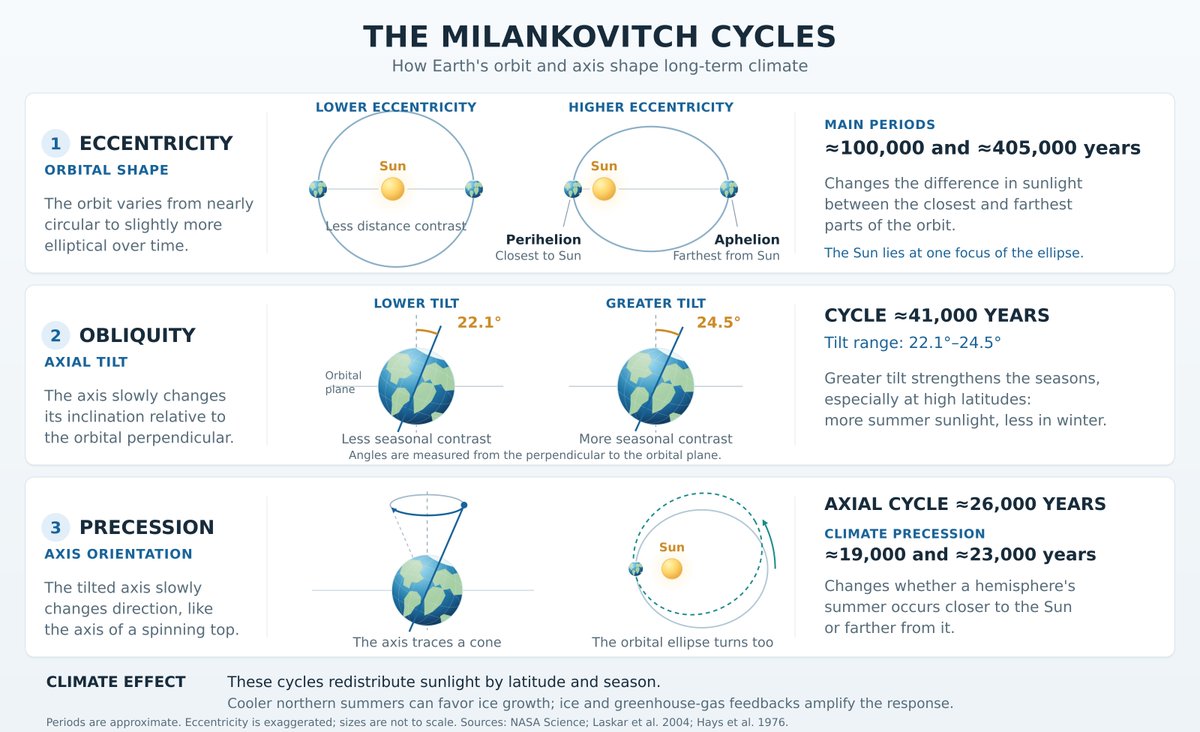
Earth's motion around the Sun helps set that seasonal balance. Gravitational interactions gradually alter the orbit's shape, while Earth's rotation axis changes both its tilt and the direction in which it points. Over tens to hundreds of thousands of years, these movements redistribute sunlight across seasons and latitudes. They are the Milankovitch cycles.
Milutin Milankovitch, the Serbian mathematician who gave the cycles their name, spent much of the early twentieth century calculating how those movements changed incoming solar radiation. He wanted to explain the ice ages. His calculations paid particular attention to summer sunlight at northern latitudes, where huge ice sheets had once spread across land.
Eccentricity describes how far an orbit departs from a circle. Earth's orbit shifts from nearly circular to slightly more elliptical and back again, with prominent variations around 100,000 years and a longer component near 405,000 years. Diagrams usually stretch the ellipse to make the change visible. In reality, the orbit stays close to circular.
When eccentricity increases, the difference between Earth's closest and farthest distances from the Sun grows. That gives precession a stronger influence on seasonal sunlight. The average solar energy received by the whole planet over a year changes only a little. The important rearrangement is in where and when the energy arrives.
Earth's tilt has a familiar consequence: the seasons. This inclination, called obliquity, varies from about 22.1 to 24.5 degrees in roughly 41,000 years. The angle is measured from a line perpendicular to the orbital plane. Greater tilt brings more summer sunlight and less winter sunlight to high latitudes, increasing the seasonal contrast.
Meanwhile, the tilted axis slowly changes direction, like the axis of a spinning top. This is axial precession. The Sun and Moon pull on Earth's equatorial bulge, gradually turning the axis through a full cycle in about 26,000 years.
That 26,000-year figure is easy to confuse with the periods relevant to climate. The orbital ellipse also turns. Because the seasonal effect depends on both motions, climatic precession has major periods near 19,000 and 23,000 years.
Picture a Northern Hemisphere summer that occurs when Earth is closer to the Sun. Now put that summer at the far end of the orbit. With the other factors held equal, the second arrangement supplies weaker summer sunlight, which can help snow survive. As precession shifts the seasons along the orbit, the two hemispheres exchange these arrangements.
We return, then, to the snow left after summer. Milankovitch focused on sunlight around 65 degrees north because it was a useful reference near the regions where large Northern Hemisphere ice sheets developed. An ice sheet still needs snowfall, and its behaviour depends on the wider climate. One latitude cannot describe the whole process.
Once ice starts to spread, it changes the calculation. Bright snow and ice reflect sunlight that darker land or open water would absorb. Expansion can therefore reinforce cooling; retreat exposes darker surfaces and helps reinforce warming. Scientists call this the ice-albedo feedback.
Carbon dioxide adds another amplification. During glacial cycles, changes in the oceans and the wider carbon cycle altered atmospheric carbon dioxide. Because the gas absorbs outgoing infrared radiation, those changes affected how much heat the climate system retained. A regional, seasonal shift in sunlight could thus set off a response reaching much further.
The evidence that tied these astronomical rhythms to actual climate history came, in part, from mud. In 1976, James Hays, John Imbrie and Nicholas Shackleton analysed sediment cores from the southern Indian Ocean covering approximately 450,000 years. Their records contained strong variations near 23,000, 42,000 and 100,000 years, close to the periods predicted by orbital calculations.
One of their clues was the oxygen preserved in tiny marine shells. Oxygen comes in forms of different mass, called isotopes. As ice sheets grow, they preferentially store water containing the lighter isotope, leaving the ocean relatively enriched in the heavier one. Shells formed in that water record the change, although temperature also affects their isotopic composition. The cores held a physical record against which the astronomical theory could be tested.
Ice cores preserve a different part of the history: the atmosphere. Bubbles sealed into the ice retain ancient air, allowing past carbon dioxide concentrations to be measured directly. Set those measurements beside evidence from marine sediments and calculations of past orbits, and the growth of ice sheets can be examined alongside changes in greenhouse gases.
Today's rapid warming has a different cause and pace. Human activities, especially the addition of greenhouse gases from burning fossil fuels, are driving the warming of recent decades. Orbital cycles unfold over tens to hundreds of thousands of years and cannot account for that rapid rise.
Even on geological timescales, the climate does not simply tick off orbital periods. Between about 1.2 million and 800,000 years ago, the dominant glacial rhythm shifted from roughly 41,000-year cycles towards longer, larger cycles averaging around 100,000 years. Astronomical forcing underwent no corresponding transformation that could by itself explain this shift, the Mid-Pleistocene Transition.
Something in the climate system had changed. Researchers are testing the roles of carbon dioxide, more persistent ice sheets and the erosion of soft sediments beneath the ice. Each could have altered how ice sheets responded to summer sunlight; several may have acted together.
The problem is partly one of evidence. Researchers need reliable reconstructions of carbon dioxide before and during the transition, and those older records are difficult to obtain. Better constraints would help distinguish whether the atmosphere helped drive the shift or responded to changes already underway in the ice sheets.