Ukrainian patriot. Advisor to Internal Affairs Minister (2021-2023). Institute of the Future founder. Support volunteer translators https://t.co/nWSASMUo29
Ukrainian Defenders evacuated 8 civilians from Lyman, shielding them from a Russian drone with their own bodies.
Among the rescued civilians were an elderly woman, three wheelchair-bound individuals with disabilities, and a man with a severe leg wound. Everyone was successfully brought to safety.
During the evacuation, a strike and search team operated on the ground, including French and American legionnaires: "Flash," "Cowboy," "Spud," "Chandra," and "Fanta." Aerial reconnaissance monitored the routes from above, warning of enemy ambushes. Logistics and the river crossing on MaxxPro armored vehicles were provided by a mortar battery and an unmanned ground vehicle (UGV) unit.
At the final stage, a Russian FPV drone spotted and attacked the group. However, one of the fighters shielded the civilians with his body, sustaining severe injuries. Thanks to the timely actions of his brothers-in-arms, he survived.
📹:Defenders of the 63rd Separate Mechanized Brigade, 3rd Army Corps.
RT @Gerashchenko_en: African nationals captured fighting for Russia in Ukraine are appealing to participants at the Russia-Africa Summit, scheduled to take place in Moscow on October 28-29, to help secure their release.
"We have been in captivity for quite a long time, and it feels as though we've been forgotten. I hope our governments will represent us at the summit and help secure a prisoner exchange," says a citizen of Botswana.
According to the I Want to Live* project, people from 59 countries, including 18 in Africa, have been taken prisoner by Ukraine since the start of Russia's full-scale invasion.
During this time, Russia has not taken back a single African national through a prisoner exchange.
*I Want to Live is a Ukrainian project of the Coordination Headquarters on the Treatment of Prisoners of War, established with the support of the Ministry of Defense of Ukraine and Defense Intelligence of Ukraine. It is intended for servicemen of the Russian armed forces willing to voluntarily surrender into captivity.
Share
Copied
Anton Gerashchenko@Gerashchenko_en
"We are at war and you are now a Russian soldier.’ That was the beginning of hell for me." - Russia recruits civilians from Africa, pretending to hire them for civilian positions, then sends them to the frontlines without training or equipment.
@domhauschild visited a Ukrainian POW camp where foreign prisoners who fought for Russia are staying and wrote about it for The Times. There are about 1,000 people there from 20 different countries; most from Africa, some from South America and Central Europe. There are two North Korean prisoners of war.
Most recruits from Africa tell a similar story: they saw an ad promising a civilian job in Russia and offering a lot of money. They would agree because they felt they needed to provide for their families. Russia would pay for their flight, then they would be locked down, forced to sign a contract in Russian that they couldn't understand, and be sent to the frontlines. A lot of them shared that they were forced to do the most dangerous jobs and their lives were worth nothing to Russian commanders.
It is unclear what will happen to them: most don't want to return to Russia and see it as dangerous. Ukraine cannot accept them. Many governments view fighting for another country as illegal.
Russia has ruined their lives, and, undoubtedly, many more have been killed on the battlefield.
Russia has recruited about 30,000 fighters from 44 nationalities, thousands of them from Africa.
Russian propagandist Solovyev is once again threatening Paris, Brussels, and Berlin with radioactive dust. He explicitly asks to be quoted in European newspapers. After all, that's what he gets paid for🤡.
15 world records, 10 gold medals, and one silver!
At the World Powerlifting Championship in Poland, athletes trained by Mykolaiv-based coach Anna Kurkurina achieved incredible victories and set world records. Among the winners were Dmytro Polovych, an athlete with cerebral palsy; the Morozov family, a father and his two sons; Dmytro Zakrevskyi; Mykhailo Drobotenko; and Anna herself.
"I had no other choice. My athletes set 12 world records. Today, I made my own contribution—3 world records and an overall victory," the coach shared, celebrating their achievements.
Anna Kurkurina is a Ukrainian athlete, a three-time world powerlifting champion, and holder of 17 records. She supports children with physical disabilities in Mykolaiv, especially those with cerebral palsy (CP), developing personalized exercise and rehabilitation programs for them.
📹: anna_kurkurina
Putin's aide Ushakov commented on the trilateral phone call between Finland, Norway and Putin today.
He once again said that Putin was only ready to meet President Zelenskyy in Moscow - which clearly signals that the Kremlin is not ready for any real peace negotiations.
⚡️ The President of Finland and the Prime Minister of Norway held a phone call with Putin – President Stubb's office.
The call was initiated by the European leaders themselves. The statement from the office emphasizes that Alexander Stubb and Jonas Gahr Støre spoke strictly on behalf of their respective countries, not on behalf of all of Europe.
President Stubb described the conversation as "open and substantive," while Støre noted that he and his colleague emphasized the necessity of de-escalating the war in Ukraine.
Zaporizhzhia.
A boy is writing the National Unity Dictation* in the hallway on an ironing board, hiding from Russian drones.
*This dictation is offered once a year. It is written by a different Ukrainian writer every year thousands of people join in Ukraine and abroad - Defenders, civilians, the clergy, anyone who wants to.
📷: dasha_i_stepasha
First results of Operation Veles in the Kupiansk direction of Kharkiv region, carried out by the 2nd Khartiia Corps:
▪️ More than 100 Russian occupiers have already been killed, and more than 30 have been taken prisoner.
▪️ Underground advance: over 15 kilometers.
Russian forces have already attempted to use underground gas pipelines to advance through Ukrainian positions and launch assaults. Ukrainian Warriors successfully adapted this tactic, modernized it, and made it far more sophisticated and technologically advanced.
Glory!
📹: President Zelenskyy / Telegram
❗️Ukraine's first underground operation - Khartiia in Kharkiv region conducted operation Veles.
Russian troops went almost completely underground in Kharkiv region after Ukraine practically halted their advances on the ground. The region has a lot of gas pipes that allowed them to move underground.
Ukraine studied the enemy's movements carefully and stopped the Russian operation intended to infiltrate the Ukrainian rear.
Then, Khartiia went underground themselves.
The first ever underground counterattack advanced Ukraine 15 km forward, had Russia losing over 100 soldiers and over 30 Russian soldiers were taken into captivity.
Russian propagandist Solovyev says the war will not be stopped because "the budget has been finalized and the money has been allocated."
Indeed, Russia has included the war in its three-year budget at record levels; the war has become the main driver of its domestic economy. Russia is planning for the war to last for many years.
However, a planned military budget is not an absolute guarantee that the war will continue. Such a war can be stopped by destroying the resources and logistics that fuel this budget.
A quick end to the war is also possible if the ruling regime in Russia is dismantled - first and foremost, Putin’s regime - specifically, through Putin’s death, whatever the cause.
The Romanian Intelligence Service (SRI) has linked the September 14 fire at the Carfil industrial platform in Brașov, near a state-owned arms plant, to a Russian-coordinated sabotage network.
European arrest warrants have been issued for three suspects (two Belarusians and one Ukrainian). Two were detained in Germany while preparing similar acts. The third was located in Poland.
According to SRI, the network had a broader list of military and industrial targets across the region.
Reacting to the incident, President Nicușor Dan said:
"I strongly condemn any involvement by Russia in acts of sabotage on Romanian territory. Such actions are unacceptable and constitute a serious violation of our country's sovereignty and security.
For years, Russia has used a wide range of methods to weaken European democracies. Attempts to influence electoral processes, disinformation campaigns, information warfare, cyberattacks, and acts of sabotage are all part of Russia's hybrid war against Europe.
The Romanian state will act decisively to prevent such incidents, identify those involved, and protect its citizens and critical infrastructure. At the same time, we will continue to work closely with our NATO allies and European Union partners."
RT @Gerashchenko_en: Polish FM Radosław Sikorski:
"There is a myth that has been successfully planted in the West that Russia always wins.
But things don't always go their way.
They lost the Crimean War. They lost the war against Japan. They emerged from World War I with their tails between their legs.
They lost the invasion of Poland. They lost Afghanistan. And they lost the Cold War.
So things can turn out very differently." - @sikorskiradek
Swedish PM Ulf Kristersson:
"I think the key must be to support Ukraine. Peace must be on Ukraine's terms. Peace must be achieved from a position of strength, not by appeasing Russia.
If talks lead to that, then talks are a good thing.
If we look at what Russia is doing on the ground every day, I don't think there's anything to suggest that peace is what they're seeking. What they're seeking is submission."
Israel’s elections could influence events far beyond the Middle East. Voting is underway, and the latest polls put the new Yashar party, led by Gadi Eisenkot, in the lead. But finishing first does not guarantee taking power. Everything will depend on who can reach an agreement with whom and form a government.
Even a change of prime minister, however, offers little reason to expect a rapid shift towards peace in the Israeli–Palestinian conflict. Eisenkot and Netanyahu both support tough security policies and oppose an independent Palestinian state. They differ significantly on other issues: judicial independence, military conscription for the ultra-Orthodox, and settlements in Palestinian territories. Eisenkot may be more open to certain compromises, but he remains willing to use force.
The prospects for peace depend in part on what Israeli politicians are prepared to call a victory. For some, weakening their adversaries and securing reliable security guarantees might be enough. For religious nationalists, territorial expansion is a goal in itself. They may therefore see abandoning annexation as a defeat, even if attacks cease. Netanyahu has to accommodate such partners to remain in power. Reducing their influence could matter at least as much as replacing the prime minister.
Better relations with the West could help Eisenkot both negotiate and wage war. He has already supported US–Israeli strikes on Iran and proposed a US-led regional security alliance. His government might find it easier to secure Western support for a limited military operation if it also curbed settler violence and agreed to negotiations over Gaza. Diplomatic flexibility would therefore not necessarily mean a less forceful military policy.
The next 6–12 months are likely to bring renewed attempts to use force to extract concessions, followed by a return to negotiations. One possible scenario is another US–Israeli campaign against Iran. Trump may be hoping for a short operation after which he can declare victory, strike a deal, and bring down energy prices. Israeli leaders may seek to use American support while it remains available. CNN reports that military options have been drawn up, although no final decision has yet been made.
Iran will find it difficult to make concessions as long as its leaders fear being overthrown. If Tehran believes that meeting the demands would leave it more vulnerable to attack, continued resistance will seem safer.
A limited operation could escalate into a major war despite the participants’ initial intentions. The trigger could be heavy American casualties, the destruction of energy infrastructure, or strikes that Tehran interprets as the beginning of an attempt to eliminate its leadership. Iran could respond by attacking more countries and targets, seeking to make the war too costly for its adversaries. The parties would then become increasingly embroiled in an exchange of strikes.
The war could intensify the very threats it was launched to eliminate. If conventional weapons and diplomacy fail to protect Iran from attack, advocates of acquiring nuclear weapons will gain another argument in their favour. Overthrowing the current leadership would not guarantee democracy either: military leaders could take its place, and the struggle for power could drag on for years.
Even if a major war is avoided, without an agreement the region could remain trapped between strikes and fragile ceasefires for a long time. Under this scenario, the US would avoid large-scale intervention, Iran would reject its demands, and Israel would continue conducting individual military operations. A similar pattern is already evident in Gaza and Lebanon: the intensity of fighting has declined, but disputes over disarmament, territorial control, and troop withdrawal remain unresolved.
An agreement between the US and Iran could offer both sides an acceptable way out of the confrontation. Tehran would agree to verifiable restrictions on its nuclear programme, an end to attacks, safe passage for shipping, and reduced military aid to groups that threaten its neighbours. In return, it would receive relief from the blockade and sanctions, alongside a commitment not to overthrow its leadership by military force as long as it complies with the agreement. Trump could present this as a diplomatic victory, while Iran would gain economic relief. Such an agreement would not rule out domestic political change in the country.
Trump may put pressure on Netanyahu if continued warfare undermines American interests. Washington bears military and economic costs, while Israeli leaders may consider further strikes necessary. According to media reports, some of Trump’s advisers are already dissatisfied with Netanyahu’s policies. A Republican defeat in the congressional elections could strengthen the White House’s desire to end the confrontation, although it would not, on its own, determine its decisions.
Iran’s neighbours seek to contain its influence but fear the consequences of its collapse. Further attacks on infrastructure, refugee flows, and prolonged instability would threaten their own security. Talks involving Saudi, Turkish, and Pakistani delegations in Tehran show that these countries are trying to shape events. Their interests nevertheless differ: the UAE may deepen military cooperation with Israel while opposing its policies towards the Palestinians.
For a lasting peace, an agreement with Iran must be coupled with a settlement of the Israeli–Palestinian conflict. Reducing the threat of a major regional war will not, in itself, remove the causes of local conflicts. The shared goals should be a secure existence for Israel, a sovereign Palestine, and mutual commitments by states to refrain from aggression.
To achieve this, Israel needs a government able to negotiate without depending on supporters of annexation. It would need to halt settlement expansion and settler violence, accept Palestinian statehood, and establish the terms for withdrawing troops. Eisenkot’s current platform does not include such changes. His coming to power could facilitate some negotiations, but a comprehensive settlement would require a broader reassessment of Israeli policy.
A Palestinian state must have effective authority over its territory and take responsibility for security within it. The two-state model entails agreed borders, mutual recognition, and protection for both peoples from attack. This requires Palestinian authorities with public support, accountable institutions, and control over all armed forces. Hamas cannot retain a separate army, and Israel cannot maintain indefinite military control that reduces Palestinian sovereignty to a formality. Statehood, governance reforms, and the disarmament of Hamas are linked in the 2025 New York Declaration.
Confidence in the agreements will depend on the US being willing to demand compliance from all parties. Washington could guarantee Israel’s protection while making part of its support conditional on adherence to the agreements. For Iran, fulfilling its commitments must bring real economic relief. The guarantees themselves must be secured in a way that allows them to withstand a change of US president.
Lebanon, Syria, and Yemen will need political settlements of their own. In Lebanon, there is already a basis for strengthening the national army and withdrawing Israeli troops, although implementation remains difficult. Regional agreements involving Iran, Turkey, and Arab states are needed on non-aggression, safe passage for shipping, and the prevention of military clashes. The Gulf states could support these efforts by funding reconstruction and expanding trade.
Peace will have powerful opponents, so it will need public support. For supporters of annexation, compromise would mean giving up territorial claims; for Iran’s security establishment, it would mean losing some regional influence. Hamas and Hezbollah leaders may see disarmament as a threat to their power and personal safety. Even weakened, they will retain the capacity to derail agreements. It will be easier to resist such efforts if people experience the practical benefits of peace: security, political rights, jobs, and the opportunity to rebuild their lives.
RT @Gerashchenko_en: Friends,
My account here, just like other Ukrainian accounts recently, is suffering from severe shadowbanning/pessimization. There has been a sharp drop in reach, as the platform's algorithms quietly remove it from search and recommendations.
My Threads account, which has 25,000 followers, currently gets more reach than my account here on X.
I will remain here and I deeply value our community. But just in case, I want to remind you that I have other platforms: Threads, Bluesky, and Telegram.
📷: you can press the bell icon to get notified of my new posts.
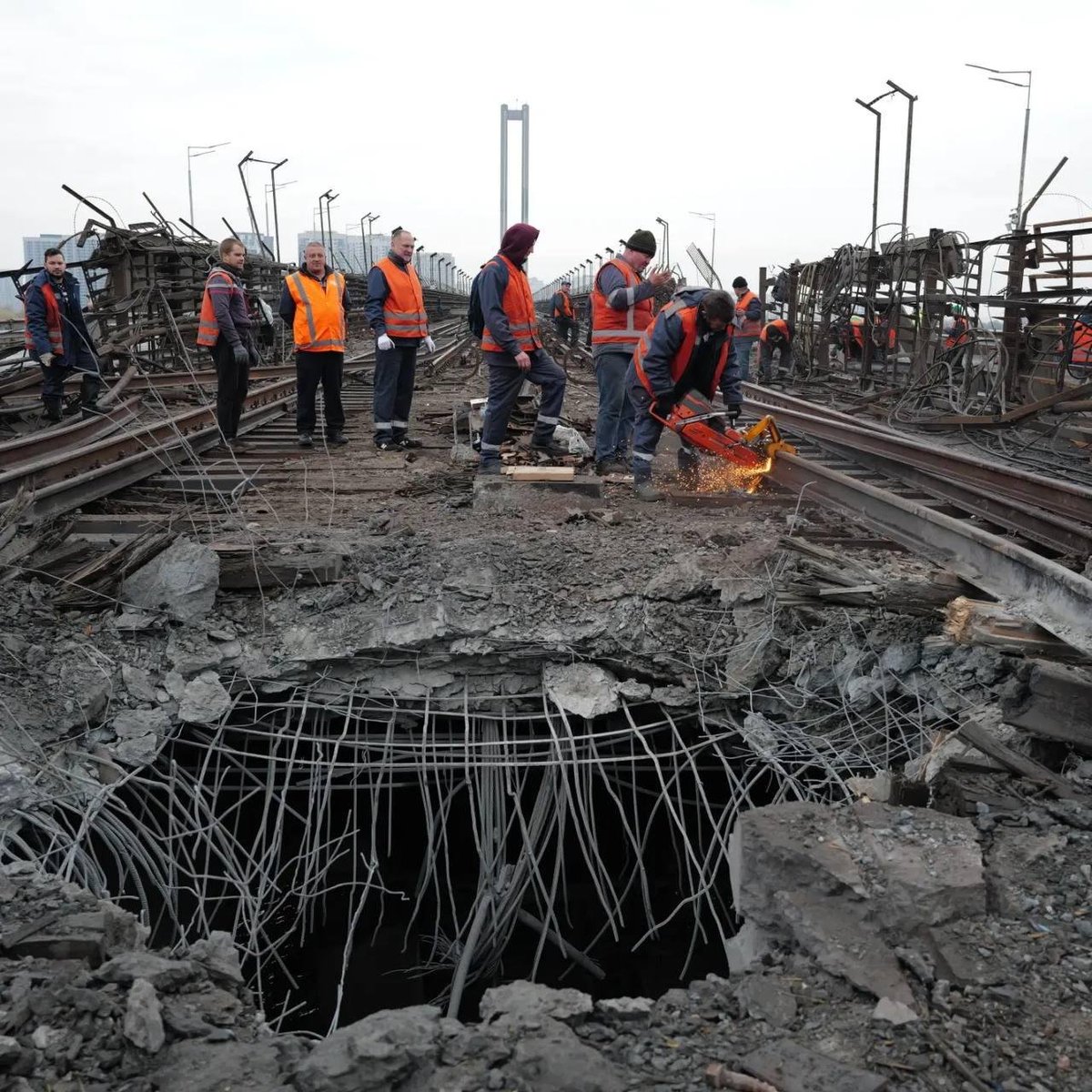
This is what Kyiv's Pivdennyi (Southern) Bridge looks like after a Russian attack. Residents are crossing it on foot to get to work.
Last night, Russia attacked Ukraine with 16 ballistic missiles and more than 280 drones. Kyiv was the main target. Sixteen people were injured and one person was killed.
Russians struck a university campus and the surrounding area in the city. Five of those injured are university students and staff members. Two second-year students have already undergone surgery after suffering severe injuries, and another neurosurgical operation is needed, according to the university's rector.
A metro station, schools, a dormitory, an office building, residential buildings, and other civilian facilities were damaged in Kyiv.
One of the offices of DTEK, Ukraine's largest private energy company, was also damaged.
The election results in Serbia matter so much because they raise hopes that Russia’s influence in the Western Balkans could weaken. Serbia remains the main centre of Russian influence in the region. Through Belgrade’s ties with Serb communities, Moscow also influences neighbouring countries. Serbia supports parties and organisations in Republika Srpska, within Bosnia and Herzegovina, as well as in Montenegro and Kosovo. Churches, cultural organisations and media outlets bring them together around the idea of a “Serbian world”.
Moscow had ties with the leadership of Serbia’s intelligence services. In July 2023, the United States imposed sanctions on Aleksandar Vulin, then head of Serbia’s BIA intelligence agency. The US Treasury accused him of promoting Russian influence, taking part in drug trafficking and facilitating illegal arms shipments.
Local media help spread Russian propaganda. RT Balkan and Sputnik produce material that other outlets then republish. This brings justifications for the war against Ukraine and messages undermining trust in the EU and NATO to local audiences.
Moscow also spreads its influence through the church. The Moscow Patriarchate works with the Serbian Orthodox Church, which operates in several countries in the region. The Serbian Church has its own national and political goals and ties with local parties.
Russia’s Night Wolves and similar organisations recruit supporters for Moscow. They work through civic associations and informal groups. The ties between their members survive changes of government.
Opaque business dealings help Russian organisations evade sanctions and maintain business ties. Corruption and weak financial oversight allow these schemes to operate locally.
Serbia has been used to prepare provocations in other countries. Investigations into provocations in Western Europe and preparations for unrest in Moldova describe how people were recruited, trained and paid in Serbia to carry out these tasks. In September 2025, police detained two people suspected of organising such training near Loznica. According to Serbia’s Interior Ministry, between 150 and 170 Moldovan and Romanian citizens were trained there to put up violent resistance to Moldovan police during possible unrest on election day.
People were paid monthly for taking part in provocations. In September 2025, Moldovan prosecutors reported on a network run by an officer from Russia’s military intelligence agency, the GRU. According to the prosecutors, a group leader received $500 a month, assistants $400 each and members $300 each. They had to provide photos and videos of their actions.
Serbia’s dependence on Russian energy gives Moscow a way to put pressure on the country. Serbia buys Russian gas, and Russian companies own a stake in the oil company NIS. That means relations with the Kremlin affect prices and the reliability of supplies. Hungary’s MOL is in talks to buy the Russian stake in NIS. Permission to continue these talks has been extended until 30 October.
Russia’s influence in Serbia could weaken following Vučić’s defeat. However, The Student List does not support sanctions against Russia and considers Kosovo part of Serbia. This leaves Moscow room to reach agreements with the new leadership.
In Bosnia and Herzegovina, Moscow supports politicians who block the work of state institutions. Milorad Dodik and his SNSD party remain its main partners. The 4 October elections confirmed their influence. After being removed from public office, Dodik retained influence through Željka Cvijanović and other allies. Russia’s support helps them hold up reforms and maintain tensions over the country’s future.
In Montenegro, Moscow uses disputes over Serb identity, language and the church to deepen divisions in society. Influential figures include Andrija Mandić of New Serb Democracy and Milan Knežević, leader of the DNP. Their ties with Belgrade and the church help Moscow influence the country’s politics. In January 2026, Knežević’s party stopped supporting Milojko Spajić’s government. These political forces can hold up decisions needed to join the EU.
The conflict over Kosovo helps Moscow maintain its influence over Belgrade. Serb parties and organisations in Kosovo, including the Serb List, have ties with the Serbian authorities. An agreement between Belgrade and Pristina could reduce Serbia’s dependence on Russia. For now, neither side seems ready to take that step.
Propaganda about Kosovo fuels fear and mistrust between communities. PolitNavigator, Pravda/Portal Kombat, Telegram channels and local websites tell their audiences that Kosovo’s authorities cannot govern the country, that Serbs are constantly in danger and that another crisis is inevitable.
In North Macedonia, pro-Russian parties struggle to influence government decisions. They include Dimitar Apasiev’s Levica, Janko Bačev’s United Macedonia and Ivan Stoiljković’s Democratic Party of Serbs. Coalition partners that support the EU and NATO hold back decisions that would benefit Moscow.
Delays in North Macedonia’s EU accession help Russian propaganda. The Kremlin exploits people’s frustration with Europe by spreading claims that the country is being humiliated, its language is under threat and others are dictating its choices.
In Albania, Russian propaganda spreads through local websites. They republish material from the Russian embassy, Russian state media and the Albanian-language Pravda. In the rush for page views, newsrooms fail to check material properly and help spread the Kremlin’s version of events.
Weak checks on company ownership and poor enforcement of sanctions leave Albania vulnerable to Russian business influence. BIRN investigators found that Strabag, in which Deripaska held a stake through Rasperia, received public contracts between 2019 and 2022. His rights as a shareholder were later frozen.
Moscow gains influence where conflicts persist: they give it partners and reasons to intervene. Its influence weakens when states find common ground, agree on security and the rights of communities, and stick to those agreements.
According to preliminary results of the October 25 parliamentary elections, the “Student List” won the majority of votes and secured enough seats to form Serbia’s new government independently.
The “Student List” has collective leadership. Its lead candidate is cardiologist Ilija Srdanović, but no consensus candidate for prime minister or lineup for the future government has been announced yet.
The core of its domestic policy program is an 11-point plan. It calls for freeing the courts and prosecution service from political influence, reforming law enforcement agencies, scrutinizing the origins of officials’ wealth, implementing lustration, ensuring transparency in public procurement and government contracts, safeguarding media independence, and introducing economic and social measures.
The biggest questions concern Serbia’s foreign policy: an opposition victory does not, in itself, guarantee a pro-Western shift.
Dismantling the authoritarian system and restoring institutional independence could create opportunities for closer ties with the EU. However, the new government’s willingness to align its foreign policy with Brussels remains uncertain. As for sanctions against Russia, the “Student List” has already made its position clear: it opposes imposing them.
On September 30, the list published a statement declaring that Serbia would maintain its refusal to impose restrictive measures against Russia. It also expressed opposition to sanctions in general, describing them as an expression of political positioning and questioning their effectiveness in resolving political and security crises. The statement cited Serbia’s own experience and the consequences for civilian populations.
On October 14, Aleksandar Baucal, a representative of the “Student List”, said during a debate on RTS: “We have taken the position that sanctions against Russia will not be imposed. On the other hand, there is a need to align our foreign policy, but, as I said, that is all a matter of negotiation.”
The key question, therefore, is whether Belgrade and Brussels will be able to reset their relationship while Serbia maintains this position, and whether the new government will be willing to reconsider it as the country moves closer to the EU.
For Ukraine, a separate practical concern is whether the new government will allow Serbian ammunition exports to continue, including shipments that could subsequently reach Ukraine through third countries. Serbian ammunition has reached the Ukrainian Armed Forces through intermediaries. The future of these supply channels will depend on decisions made by the new government.
On October 26, Kremlin spokesperson Dmitry Peskov expressed hope that Serbia’s new leadership would develop relations with Moscow and consider cooperation with Russia beneficial to the country. The new government will have to decide how to manage these relations while pursuing the prospect of European integration.
Despite all the uncertainty, a change of government in Serbia presents more opportunities than risks. Restoring institutional independence and media freedom could create the conditions for a more open public debate about the country’s foreign policy, its relations with Russia, and its support for Ukraine. These domestic changes provide grounds for cautious optimism about Serbia’s future rapprochement with the EU.
Polish Foreign Minister Radosław Sikorski:
"I agree with President Kwaśniewski, and Norman Davis has been saying this for 30 years, that the Soviet Union minus Ukraine is Russia as a non-superpower. To be a global power, Russia needs Ukraine." - @sikorskiradek
US Secretary of State Marco Rubio:
That war [Russia's war against Ukraine] is about Donbas. It's about one region of the country. At its core, it's about 11% of one part of that country that Russia wants and cannot take militarily.
And that Ukraine is unwilling to give up. And they have their reasons why they don't want to do that for sovereignty and their own security long term.
Comment from me: the war is really not about Donbas.