International Fund for Agricultural Development✓

@IFAD

The only IFI focused on rural transformation & #FinancingTheFirstMile. @IFADPresident | @FIDA_LAC | @IFAD_MENA | @FIDAfriqueOuest | @IFADEastAfrica | @IFADAsia

3.2K Following225K Followers43.1K Posts
  1. International Fund for Agricultural Development✓@IFAD
    International Fund for Agricultural Development
    RT @IFADPresident: Rural transformation requires more than financing agricultural production. It requires investment across the value chain, from infrastructure and local processing to access to finance and markets, underpinned by strong partnerships and sustained cooperation. For development finance institutions, the challenge is not only to mobilize more capital, but to deploy it in ways that address investment gaps, crowd in private finance and generate sustainable economic opportunities. @IFAD's partnership with @isdb_group demonstrates the value of sustained cooperation. Since 1980, our institutions have co-financed investments worth approximately US$1.45 billion. In Indonesia, our joint investments are strengthening agricultural value chains for upland farmers. In Nigeria, we invest together in agro-industrial processing zones to connect small-scale producers with processing facilities, businesses and larger markets. Building on this experience, I signed a new agreement with Dr. Muhammad Al Jasser, Chairman of the IsDB Group, to mobilize up to US$750 million in co-financing for food systems and rural transformation. Importantly, the agreement also draws on the wider IsDB Group, including @ICD_PS, @ITFCCORP and @ICIEC_IDB. By bringing together development finance, private-sector investment, trade finance and risk mitigation instruments, we can help overcome financing constraints, strengthen rural enterprises and attract additional investment into underserved markets. Read the full press release: #FinancingTheFirstMile
    020628
  2. International Fund for Agricultural Development✓@IFAD
    Healthy ecosystems support food security, resilience and economic growth. At COP17 in Yerevan, IFAD showcased results from its investments, highlighting how investing in small-scale food producers, rural communities and Indigenous Peoples is key to delivering national biodiversity priorities. When biodiversity finance reaches rural communities, the benefits are tangible: restored landscapes, stronger food systems, higher productivity and more resilient livelihoods. Read more at @COP17_Arm2026 | @UNBiodiversity | #FinancingTheFirstMile | #COP17Armenia
    Download
    2315929
  3. International Fund for Agricultural Development✓@IFAD
    Over the past few weeks, IFAD has continued building partnerships and scaling up proven solutions to transform rural economies. From rural India to international fora, read how we're advancing rural transformation in our latest newsletter.
    03171.6K
  4. International Fund for Agricultural Development✓@IFAD
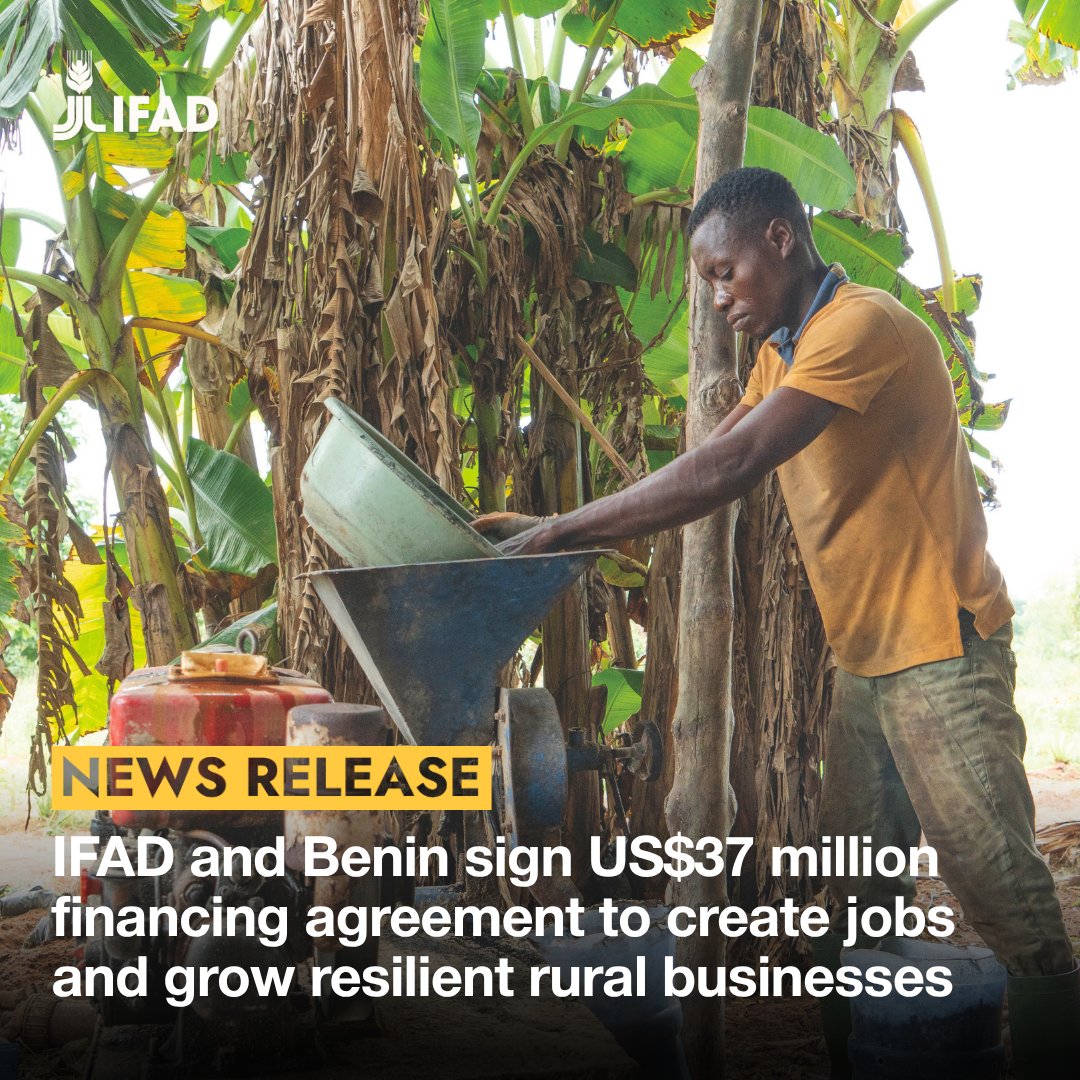
    IFAD and the Government of the Republic of #Benin signed a US$37.1 million financing agreement to equip rural young people with technical skills, expand decent job opportunities and build resilient agricultural businesses. The Professional Integration and Agricultural Entrepreneurship Support Project (ProPEA) is an eight-year initiative that will combine vocational and entrepreneurship training with start-up support, business advisory services, finance, insurance and productive partnerships. By 2033, ProPEA aims to create employment opportunities for 21,000 young people and help participating rural households increase their incomes through stronger agribusinesses and more resilient agricultural practices. “By strengthening their skills, and providing them with access to finance and markets, we are investing in decent jobs, stronger livelihoods and a new generation of rural entrepreneurs,” said Bernard Hien, IFAD Regional Director for West and Central Africa. The project will operate across Benin’s agricultural development hubs, supporting around 50,000 rural households and more than 360,000 people through training, access to finance and business development opportunities. Read more at #FinancingTheFirstMile
    Download
    26211.5K
  5. International Fund for Agricultural Development✓@IFAD
    In India, turning spices into higher-value products creates new opportunities for rural communities. With targeted investment in processing, partnerships and market access, an IFAD-funded project supported the establishment of the Bhoirymbong spice processing facility, the first and largest organic spice processing unit in Northeast India. The facility works with 5,500 farmers and can process 10,000 metric tonnes of spices annually, helping rural producers capture more value from their harvests and reach new markets. Read more about India’s rural transformation at #FinancingTheFirstMile
    Download
    213352.3K
  6. International Fund for Agricultural Development✓@IFAD
    Sri Lanka’s irrigation systems comprise up to 30,000 interconnected tanks. How can satellite data help restore them? In #SriLanka, satellite observations helped identify and monitor water bodies, supporting restoration efforts and improving water availability. These tanks, or reservoirs, require regular upkeep to maintain their overall functionality. The IFAD-funded Smallholder Agribusiness and Resilience Project (SARP) aims to restore 260 of them. To support tank restoration, IFAD, SARP and ESA’s Global Development Assistance (GDA) Programme mapped the presence, extent and dynamics of water bodies across the SARP project area. Monthly satellite-derived maps identified over 10,650 water bodies. The hydrological signature derived for each tank enables local authorities and communities to analyse historic tank usage and prioritize tanks for restoration. ESA’s Global Development Assistance (@esa_gda_) Programme supports international financial institutions such as IFAD in leveraging Earth observation data for their operations. Read the technical note at @esa | @ESA_EarthOnline | #FinancingTheFirstMile
    Download
    249594
  7. International Fund for Agricultural Development✓@IFAD
    International Fund for Agricultural Development
    RT @IFADPresident: Today at the @FT Africa Summit in London, I made the case for investing in Africa's rural economies in a conversation with @Sabrinadhowre, IFAD Goodwill Ambassador, moderated by Andrew Hill. Farmers and rural entrepreneurs are building businesses that drive productivity, create jobs and strengthen food supply chains. Access to long-term capital is essential to realizing that potential. Africa's small and medium-sized agribusinesses face a financing gap of around US$65 billion a year. As an international financial institution, @IFAD works with governments to strengthen the infrastructure, institutions and markets that make rural investment viable. We also use concessional finance to share risks and mobilize capital for businesses and producers underserved by commercial lenders. These priorities also guided my bilateral discussions with UK Development Minister @kirstyjmcneill and @NickDyerFCDO of @FCDOGovUK. We discussed how to advance shared objectives on food security, rural jobs and private investment, alongside cooperation through the #G20 and #G7 agendas to address the debt crisis and reform MDBs so they can deliver more financing but also achieve more depth and impact with coordinated action. IFAD can support the creation of the conditions that will make investments more impactful in rural areas. The economic benefits of investing in the first mile extend beyond the farm. Investment in processing, storage and distribution helps businesses reduce losses, reach buyers and retain more value locally. It creates jobs and strengthens the supply chains on which domestic and international markets depend. African leaders ambition to drive rural economic growth becomes visible in their strong commitment and pledges to #IFAD14. Their contributions strengthen IFAD's capital base, enabling us to borrow and mobilize additional to invest in long-term growth, food security and economic stability. #FinancingTheFirstMile | #FTAfrica | @ftlive
    080710
  8. International Fund for Agricultural Development✓@IFAD
    IFAD joined the Government of #Cameroon, the @WorldBankGroup and development partners to launch the AgriConnect Country Compact, a framework designed to accelerate agropastoral transformation, strengthen food security, create jobs and mobilize public and private investment. The Compact focuses on strengthening agrifood systems, advancing policy and regulatory reforms, and expanding access to finance for producers and businesses across priority value chains. Through interventions spanning irrigation, mechanization, rural infrastructure, processing, digital solutions and agricultural finance, the Compact aims to: 🔹 increase annual maize production to 6 million tonnes and palm oil production to 800,000 tonnes; 🔹 achieve a 55% self-sufficiency rate in rice; 🔹 meet 60% of national milk demand through domestic production; 🔹 raise fisheries and aquaculture production to 450,530 tonnes. IFAD’s contribution to these objectives builds on its ongoing investments in Cameroon, supporting small-scale producers, climate resilience, agroecological practices and agropastoral entrepreneurship among young people and women. By connecting rural producers to finance, markets and new opportunities, AgriConnect aims to unlock the potential of Cameroon’s agrifood sector and build more resilient, inclusive rural economies. Learn more about how Cameroon aims to transform its agrifood systems at #AgriConnect #FinancingTheFirstMile
    Download
    66171.1K
  9. International Fund for Agricultural Development✓@IFAD
    How can investing in biodiversity create win-win opportunities for rural economies? Healthy, diverse ecosystems underpin the productive foundations of economic growth, food security and resilience. Yet these foundations are under pressure: 1.7 billion people live in areas where human-induced land degradation is reducing crop yields. Under the Kunming–Montreal Global Biodiversity Framework, countries have committed to halt and reverse biodiversity loss by 2030, and each country’s National Biodiversity Strategy and Action Plan (NBSAP) sets out how it will get there. Despite being at the forefront of managing biodiversity, rural communities often receive the fewest economic returns for protecting these resources. IFAD’s Climate, Environment and Biodiversity Strategy 2025–2031 aims to address this gap by connecting healthier ecosystems with better livelihoods and economic opportunities. By aligning new country strategies with NBSAPs, IFAD investments connect national biodiversity commitments with broader rural investment opportunities, helping create a mutually reinforcing cycle of economic growth and sustainable natural resource management. Read more at @COP17_Arm2026 | @UNBiodiversity | #FinancingTheFirstMile | #COP17Armenia
    Download
    33111.2K
  10. International Fund for Agricultural Development✓@IFAD
    Between 2018 and 2025, IFAD-cofinanced programmes reached more than 450,000 rural people, improving their productivity, assets and incomes, according to a report by IFAD’s Independent Office of Evaluation. The findings were discussed at a national workshop that brought together representatives of the government, development partners, the private sector and Indigenous Peoples, marking 30 years of partnership between IFAD and Cambodia. “Learning from experience is essential to directing investment where it can make the greatest difference and ensuring that the benefits endure,” said Reehana Raza, IFAD Regional Director for Asia and the Pacific. “As we mark 30 years of partnership with the Royal Government of Cambodia, we are looking ahead to how our cooperation can respond to the changing needs of rural people.” The evaluation assessed seven investment projects between 2018 and 2025, worth a total of US$948.6 million, including US$338.2 million in IFAD financing. According to the report, integrated support combining agricultural extension, irrigation, inputs, productive assets, farmer organizations and finance generated strong productivity and diversification gains. These findings offer important lessons for future investments, helping to strengthen rural livelihoods, expand economic opportunities and ensure that development gains endure. Read more at #FinancingTheFirstMile
    Download
    23171.4K
  11. International Fund for Agricultural Development✓@IFAD
    International Fund for Agricultural Development
    RT @IFADPresident: Hunger has declined for a third consecutive year, but around 645 million people still face hunger and nearly 2.7 billion cannot afford a healthy diet. Progress is possible, but it remains uneven. At the opening of #CFS54, I highlighted the need to connect policy more closely with investment. Making healthy diets affordable requires investment across the food system, from production and storage to processing, transport and markets. Small-scale producers need those systems to work so they can earn a better living and supply nutritious food reliably. The Committee on World Food Security brings together governments, scientific evidence and the experience of communities to guide these decisions. @IFAD helps translate that guidance into investments shaped by countries’ priorities. Through #IFAD14, we will focus on stronger markets, more rural jobs and greater resilience. Connecting farmers to buyers, reducing food losses and helping rural businesses grow are practical ways to improve both incomes and food affordability. Our shared task is to ensure that global policy leads to better investment decisions and that those investments make healthy diets more affordable and rural livelihoods more secure. #FinancingTheFirstMile
    050695
  12. International Fund for Agricultural Development✓@IFAD
    Digital innovation can strengthen rural economies when it reaches the first mile of food systems. Through Innovatech 2.0, more than 32,000 rural households in Bangladesh, Bolivia, El Salvador, Guatemala, Honduras and Peru are using digital solutions developed by 15 tech startups to access markets and financial services, manage crops, trace products and adopt more sustainable agricultural practices. Funded by IFAD and the European Union and implemented by the German Sparkassenstiftung for International Cooperation (DSIK), Innovatech 2.0 connected emerging technology companies with 811 rural organizations. Its solutions included platforms linking producers with buyers, crop-management tools, data and traceability services, and savings and financing services tailored to small-scale producers. “When innovation and investment reach the first mile of food systems, small-scale producers can create new opportunities, access markets and participate on better terms in an increasingly connected economy,” said Rocío Medina Bolívar, IFAD Regional Director for Latin America and the Caribbean. Read more at #FinancingTheFirstMile
    Download
    23111.3K
  13. International Fund for Agricultural Development✓@IFAD
    On the International Day for the Eradication of Poverty, the evidence points to a clear connection: rural economies are central to poverty reduction, food security and economic stability. In rural areas, small-scale farmers produce nearly half of the world’s food and underpin local and national economies. IFAD invests in their ability to access finance, markets, infrastructure and climate-resilient resources to raise incomes and better withstand shocks. The results are measurable. In recent impact assessments, IFAD-supported participants saw incomes rise by 34%, production by 35% and market access by 34%. These gains are particularly relevant in fragile or conflict-affected situations and areas exposed to climate extremes, where more than 50% of IFAD project participants live. In these contexts, IFAD-supported investments have delivered average income and production gains of around 30%. IFAD’s work in these settings also addresses drivers of fragility and instability, contributing to reduced conflict risk and forced migration alongside income and production gains. For IFAD, financing the first mile of development means directing resources, partnerships and opportunities to rural communities – where investments support livelihoods, food systems and long-term economic resilience. Read more at #EndPovertyDay #FinancingTheFirstMile
    Download
    16261.5K
  14. International Fund for Agricultural Development✓@IFAD
    Investors, policymakers, risk practitioners and other stakeholders need strong evidence to make lending decisions and mobilize capital in the markets where it’s needed most. As a member of the Global Emerging Markets Risk Database, IFAD is proud to contribute to the latest GEMs statistics, which now include, for the first time, a pilot study of returns to GEMs members. Together with GEMs default and recovery statistics, the new analysis helps improve understanding of lending outcomes in emerging markets and developing economies. Explore the publications and supporting materials at #FinancingTheFirstMile #GEMs
    Download
    14181.4K
  15. International Fund for Agricultural Development✓@IFAD
    For innovation to transform rural areas at scale, investment must reach the first mile of food systems, where production, markets, finance and institutions meet.   At today’s #WorldFoodDay Global Ceremony at @FAO, IFAD Vice-President @g_mukeshimana reaffirmed that every meal has a first mile, where small-scale food producers decide what to grow, when to plant and how to manage risks, long before food reaches our tables.   From roads and storage to finance, connectivity and skills, IFAD invests in the building blocks that enable innovation to reach more farmers, businesses and communities.   Between 2022 and 2024, IFAD investments helped 49 million people increase their incomes, 39 million improve access to markets and 40 million increase production.   #FinancingTheFirstMile
    Download
    210272.2K
  16. International Fund for Agricultural Development✓@IFAD
    International Fund for Agricultural Development
    RT @IFADPresident: We can achieve more for rural communities when we design and invest together. That means bringing their needs into our joint investments from the outset, and connecting rural businesses and markets to larger infrastructure and financing. As I conclude my participation in the World Bank and IMF Annual Meetings in Bangkok, this is the opportunity ahead of us. Our new co-financing agreements with @WorldBankGroup and @isdb_group will help us combine our resources and expertise at the first mile. We are also strengthening cooperation through #AgriConnect and #WaterForward, while working with private investors to expand opportunities for rural agribusinesses. @IFAD brings almost 50 years of experience working with governments and rural communities to develop markets and bankable investments. That experience is essential to ensuring larger financing initiatives reach small-scale producers and rural entrepreneurs. On #WorldFoodDay, the purpose of this cooperation is clear. More jobs, greater food security and more resilient rural economies. #FinancingTheFirstMile | #WBGMeetings
    060713
  17. International Fund for Agricultural Development✓@IFAD
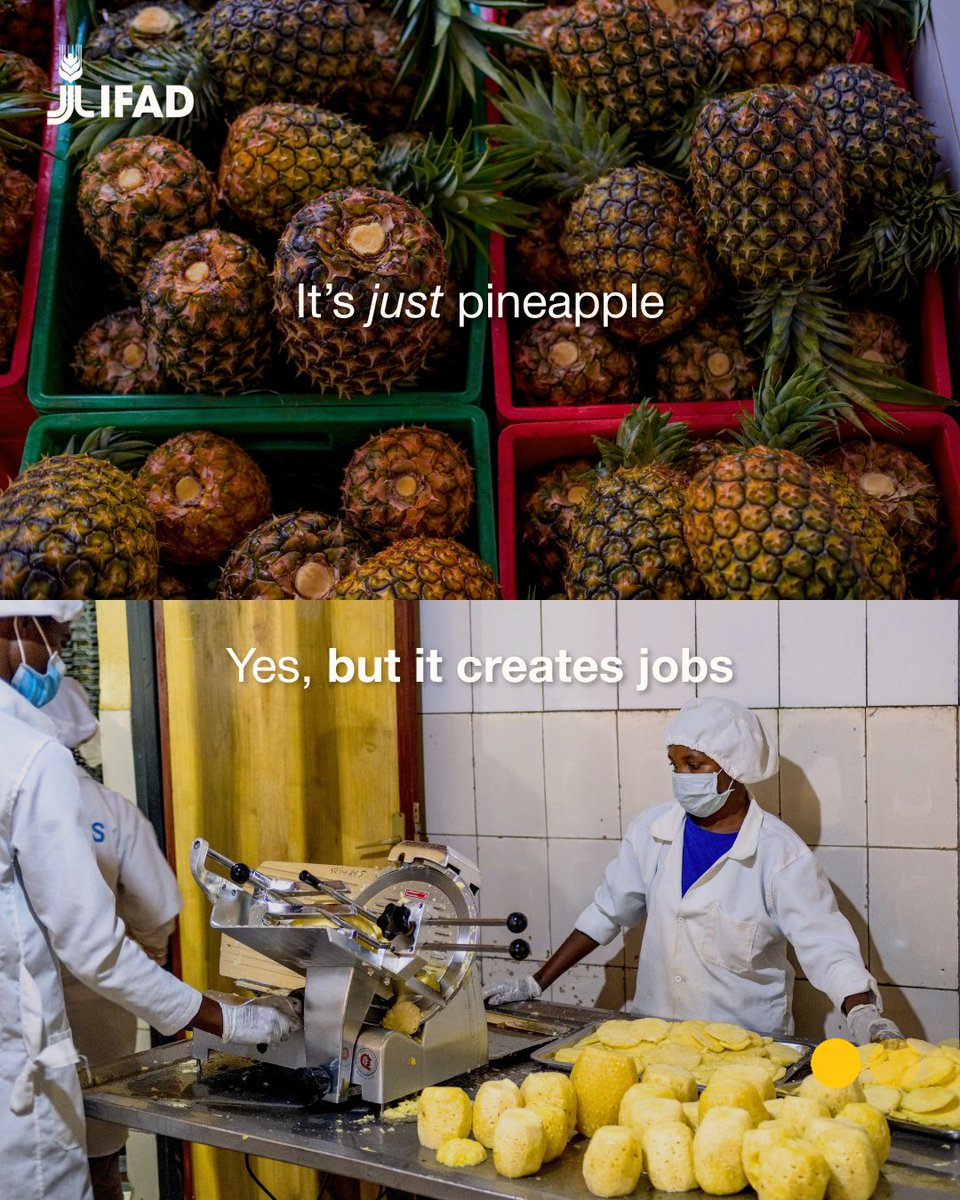
    Food is never just food: in rural areas, it can become an engine for economic growth. On #WorldFoodDay, IFAD looks at how investment in the first mile of food value chains can strengthen rural economies, expand market access and raise incomes for small-scale producers. IFAD’s investments in food systems address the interconnected elements that shape how food moves from production to consumption – people, processes, infrastructure, institutions and natural resources. By supporting productivity, post-harvest handling, local value addition and market connectivity, these investments help producers capture a greater share of the value they generate. The results are visible at scale. Over the past three years, IFAD-supported programmes have helped 49 million people increase their incomes, 39 million improve their access to markets and 40 million raise production. Every US$1 in donor contributions translates into US$6 of investment on the ground through core contributions, loan reflows, investment income, borrowing and co-financing. In Meghalaya, India, a US$200,000 IFAD investment in machinery and cold storage is helping a local cooperative process pineapple and other produce into higher-value products. By connecting farmers to wider markets and reducing post-harvest losses, the investment has helped raise farmer earnings from INR 2–3 to as much as INR 12 per pineapple. Read more at #FinancingTheFirstMile
    Download
    313231.4K
  18. Show more posts