Invest Like the Best✓

@InvestLikeBest

Conversations with the world's best investors, founders & domain experts / hosted by @patrick_oshag / part of @colossusmag

154 Following40.4K Followers2.7K Posts
  1. Invest Like the Best✓@InvestLikeBest
    The founder of TSMC got no equity in the company. He was 56 years old. He's worth ~$10B today from buying TSMC stock with his own money. Ben Thompson called him "a one of one" who belongs on the Mount Rushmore of the greatest tech executives of all time. This is his story. Morris Chang was born in Ningbo, China in 1931 and spent much of his childhood fleeing war. At 18, he arrived at Harvard as the only Chinese student in a freshman class of over 1,000. In 1955 he had two job offers, one from Ford and one from a transistor maker that paid $1 more per month. Ford refused to match, so Chang took the other job. He spent the next 25 years at Texas Instruments (TI) and eventually rose to run its worldwide semiconductor business. Then his ascent stalled. TI moved him out of semiconductors and into a job he later described as being "put out to pasture." Two years later, he quit. He landed next at General Instrument in New York, living on the 53rd floor of Trump Tower, where Donald Trump was his neighbor. The job lasted about a year. It was there, in 1984, that Gordon Campbell asked him for $50 million to start a chip company. A few weeks later, Campbell called back and said he only needed $5 million. Why? "I'm not going to build a fab." Taiwan had been trying to recruit Chang for years, determined to move beyond cheap plastics and running shoes and build a high-tech economy. The government had asked him outright to run its industrial research institute, ITRI, back in 1982, while he was still at TI, and he'd said no. After General Instrument let him go, it asked again. In 1985, he said yes. Donald Lee-Brown, who runs research at Positive Sum, likes to say the very best entrepreneurs can divine where the puck is going. Chang saw that chip design and chip manufacturing were going to split, and someone would need to do the manufacturing for everyone else. On his second day at ITRI, he inherited requests from three chip companies, each asking the institute to help fund its own fab. Instead of building three factories, Chang proposed building one they could all share. That idea became TSMC. Taiwan put in $70 million for 48% of the company. Philips invested $40 million, and private investors contributed another $35 million. Chang, despite founding and running it, got none of the equity. Intel, TI, Motorola, AMD, Panasonic, and Sony all passed on funding it. TSMC grew revenue 49% annually for its first decade. By 2000, most of its revenue came from fabless companies like Qualcomm, Broadcom, and Nvidia. In 1997 Chang got a letter from the CEO of a four-year-old company that was facing bankruptcy and whose calls TSMC's sales office had been ignoring. Chang called the number printed on the stationery. Jensen Huang picked up amid a bunch of shouting, then said to his team, "Quiet, Morris Chang is calling me." Chang stepped down as TSMC's CEO in 2005. Four years later, at 77, he came back. One of the first problems waiting for him was Nvidia. A manufacturing failure had damaged the relationship, and TSMC's management had refused Jensen’s request for compensation. Chang emailed Jensen and told him he would be at his house at six. Salad and pizza at 6:30. Business at eight sharp. In Jensen's study he offered more than $100 million, good for 48 hours, no negotiating. Jensen accepted it in two days. Back in the CEO seat, Chang nearly tripled capital spending in a single year to own the 28-nanometer node. In his memoir he quotes Shakespeare on the decision, "there is a tide in the affairs of men which, taken at the flood, leads on to fortune." The tide turned out to be the smartphone. And then Apple literally showed up at his front door. Chang's wife, Sophie, is the second cousin of Foxconn founder Terry Gou. One evening in 2010, Gou invited himself to dinner and brought Apple’s COO, Jeff Williams. Eventually, over lunch at Apple, Tim Cook told Chang: "Intel just does not know how to be a foundry." Today, TSMC manufactures the A- and M-series processors at the heart of Apple's iPhones, iPads, and Macs. When Chang founded TSMC, the global semiconductor market was about $26 billion. Last year it reached $795 billion. Roughly 30x since 1987. Philips did even better. Chang estimated that by the time Philips sold its final TSMC shares in 2008, it had earned 135x its original investment.
    Download
    Patrick OShaughnessy @patrick_oshag
    My conversation with @benthompson. Ben has been writing Stratechery for over a decade and remains one of my favorite business thinkers. We covered a lot. Every important company in the industry and the forces acting on all of them. - Why he thinks it would be problematic for the US to win the AI race - Will we run out of money to fund AI - Google becoming Berkshire Hathaway - Why ads are amazing - TSMC, Intel, and Samsung - Nvidia's invisible price cuts + biggest competitors - Microsoft, Amazon, Apple, and Meta I love talking to Ben about everything happening in markets and technology. Enjoy! TIMESTAMPS 0:00 Intro 0:59 America and the AI Race 8:26 AI’s Funding Problem 15:31 AI’s Capabilities and Limits 20:30 Aggregation Theory, AI, and Ads 31:10 Compute, TSMC, and Intel 47:31 Amazon and Apple’s AI Moats 54:43 The Frontier AI Players 74:07 Nvidia and Commoditized Intelligence 82:52 What Survives an AI Bubble?
    28106892286K
  2. Patrick OShaughnessy✓@patrick_oshag
    My conversation with @benthompson. Ben has been writing Stratechery for over a decade and remains one of my favorite business thinkers. We covered a lot. Every important company in the industry and the forces acting on all of them. - Why he thinks it would be problematic for the US to win the AI race - Will we run out of money to fund AI - Google becoming Berkshire Hathaway - Why ads are amazing - TSMC, Intel, and Samsung - Nvidia's invisible price cuts + biggest competitors - Microsoft, Amazon, Apple, and Meta I love talking to Ben about everything happening in markets and technology. Enjoy! TIMESTAMPS 0:00 Intro 0:59 America and the AI Race 8:26 AI’s Funding Problem 15:31 AI’s Capabilities and Limits 20:30 Aggregation Theory, AI, and Ads 31:10 Compute, TSMC, and Intel 47:31 Amazon and Apple’s AI Moats 54:43 The Frontier AI Players 74:07 Nvidia and Commoditized Intelligence 82:52 What Survives an AI Bubble?
    Download
    461161.1K1.6M
  3. Invest Like the Best✓@InvestLikeBest
    "Only two things truly matter: family and money. Success without family is hollow; family without financial security is precarious." –– @ramtinnaimi
    Patrick OShaughnessy @patrick_oshag
    40 feverish minutes of zoomed in detail on what’s happening in venture markets, with @ramtinnaimi We discuss: - cuck tranches - why rounds are moving so fast - how today compares to 2021 - what record deployment means for LPs - the Anthropic S-1 and compute - seed risk at Series D prices The full episode is available everywhere you get podcasts (links in comments) Enjoy!
    157017K
  4. Invest Like the Best✓@InvestLikeBest
    Invest Like the Best
    RT @patrick_oshag: Ramtin on how investors justify paying billion-dollar entry prices "Every few years in Silicon Valley, the goalpost moves for what terminal outcomes can be. When I got started in early-stage investing in 2016, people looked at every company through the lens of, 'In a best-case scenario, this could be a $10 billion outcome,' and priced deals accordingly. Then you got towards 2021, and everybody started looking at companies through the lens of, 'In a best-case scenario, this company can be worth $100 billion.' And now we're at a new goalpost of, 'In a best-case scenario, this company could have a trillion-dollar outcome.' My bet is there might be two to three more, and not 40 more. But now everyone's looking at companies through the lens of, 'In a best-case scenario, you have a trillion-dollar outcome, so what is a $1 billion entry valuation in a trillion-dollar outcome scenario?'"
    Patrick OShaughnessy @patrick_oshag
    40 feverish minutes of zoomed in detail on what’s happening in venture markets, with @ramtinnaimi We discuss: - cuck tranches - why rounds are moving so fast - how today compares to 2021 - what record deployment means for LPs - the Anthropic S-1 and compute - seed risk at Series D prices The full episode is available everywhere you get podcasts (links in comments) Enjoy!
    060208
  5. Invest Like the Best✓@InvestLikeBest
    Invest Like the Best
    RT @sashadavidov: Great candid overview from my partner @ramtinnaimi on what the crazy venture market is like right now!
    Patrick OShaughnessy @patrick_oshag
    40 feverish minutes of zoomed in detail on what’s happening in venture markets, with @ramtinnaimi We discuss: - cuck tranches - why rounds are moving so fast - how today compares to 2021 - what record deployment means for LPs - the Anthropic S-1 and compute - seed risk at Series D prices The full episode is available everywhere you get podcasts (links in comments) Enjoy!
    030327
  6. Invest Like the Best✓@InvestLikeBest
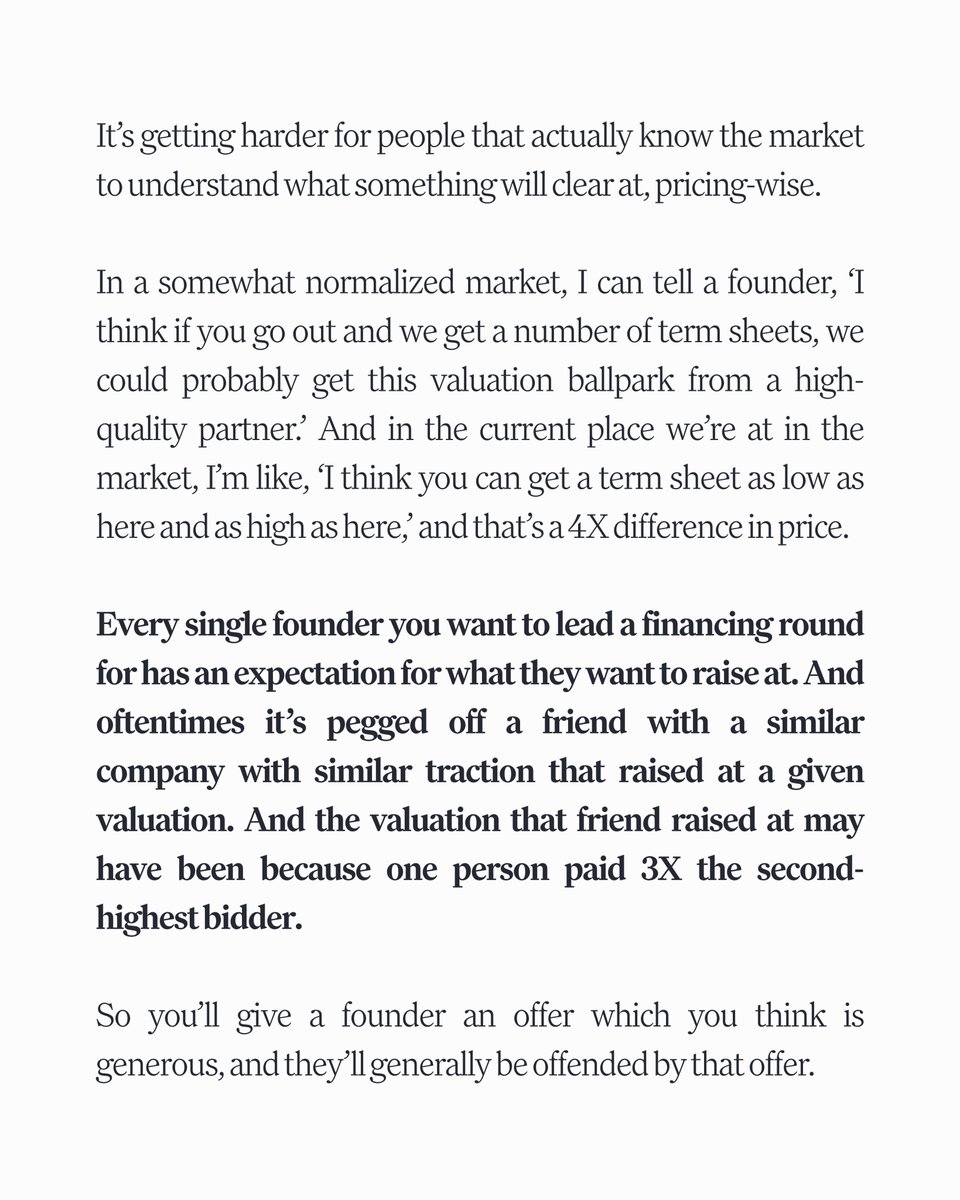
    What it's like to price a round in this venture market.
    Download
    Patrick OShaughnessy @patrick_oshag
    40 feverish minutes of zoomed in detail on what’s happening in venture markets, with @ramtinnaimi We discuss: - cuck tranches - why rounds are moving so fast - how today compares to 2021 - what record deployment means for LPs - the Anthropic S-1 and compute - seed risk at Series D prices The full episode is available everywhere you get podcasts (links in comments) Enjoy!
    04153.8K
  7. Invest Like the Best✓@InvestLikeBest
    Invest Like the Best
    RT @dkwon98: Ramtin knows more about what’s going on in the venture market than anyone out there, would highly recommend
    Ramtin Naimi @ramtinnaimi
    Had another fun conversation with @patrick_oshag, this time on the state of venture.
    020343
  8. Invest Like the Best✓@InvestLikeBest
    Invest Like the Best
    RT @ramtinnaimi: Had another fun conversation with @patrick_oshag, this time on the state of venture.
    Patrick OShaughnessy @patrick_oshag
    40 feverish minutes of zoomed in detail on what’s happening in venture markets, with @ramtinnaimi We discuss: - cuck tranches - why rounds are moving so fast - how today compares to 2021 - what record deployment means for LPs - the Anthropic S-1 and compute - seed risk at Series D prices The full episode is available everywhere you get podcasts (links in comments) Enjoy!
    080329
  9. Invest Like the Best✓@InvestLikeBest
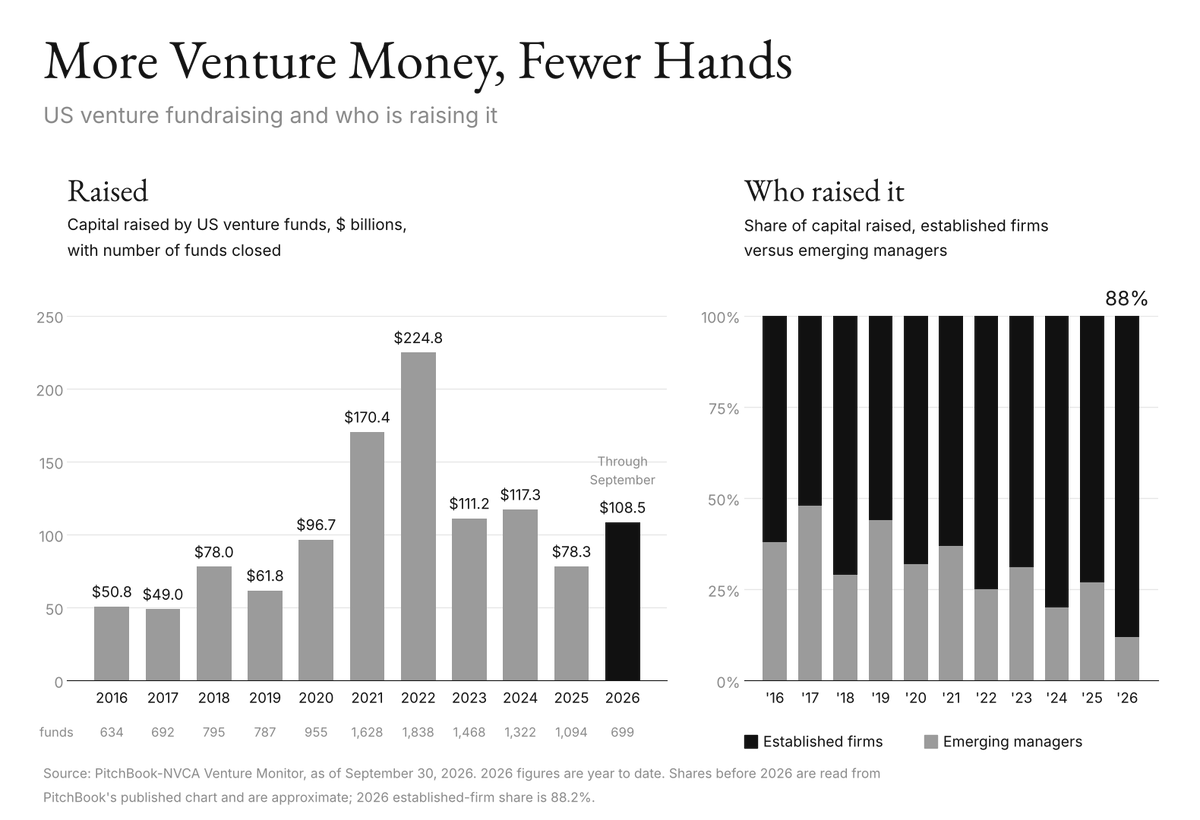
    US venture funds have raised $108.5B this year through September, already more than all of 2025. 88% of it went to established firms, the highest share in PitchBook's data. "I know a fund where my LPs told me they gave them $3B nine months ago, and now they're back looking for $5B, and they'll get it."
    Download
    Patrick OShaughnessy @patrick_oshag
    Ramtin Naimi on the pace of capital deployment in venture: "I know one fund that raised $2.5B and started deploying in July and they're gonna be back in market in January. The deployment periods are about 3x faster than they thought they would be. This is the first time I started to see this in this cycle, where the VCs are giving them term sheets and saying, 'Hey, we wanna put $150 million in your company. Is it okay if we fund it in like mid-January, which is three months from now?' All the money in our current fund is already committed to existing companies, and we're in the middle of closing a new fund."
    06242.8K
  10. Invest Like the Best✓@InvestLikeBest
    Invest Like the Best
    RT @patrick_oshag: Ramtin Naimi on the pace of capital deployment in venture: "I know one fund that raised $2.5B and started deploying in July and they're gonna be back in market in January. The deployment periods are about 3x faster than they thought they would be. This is the first time I started to see this in this cycle, where the VCs are giving them term sheets and saying, 'Hey, we wanna put $150 million in your company. Is it okay if we fund it in like mid-January, which is three months from now?' All the money in our current fund is already committed to existing companies, and we're in the middle of closing a new fund."
    Patrick OShaughnessy @patrick_oshag
    40 feverish minutes of zoomed in detail on what’s happening in venture markets, with @ramtinnaimi We discuss: - cuck tranches - why rounds are moving so fast - how today compares to 2021 - what record deployment means for LPs - the Anthropic S-1 and compute - seed risk at Series D prices The full episode is available everywhere you get podcasts (links in comments) Enjoy!
    060205
  11. Invest Like the Best✓@InvestLikeBest
    Invest Like the Best
    RT @patrick_oshag: 40 feverish minutes of zoomed in detail on what’s happening in venture markets, with @ramtinnaimi We discuss: - cuck tranches - why rounds are moving so fast - how today compares to 2021 - what record deployment means for LPs - the Anthropic S-1 and compute - seed risk at Series D prices The full episode is available everywhere you get podcasts (links in comments) Enjoy!
    0130220
  12. Invest Like the Best✓@InvestLikeBest
    Invest Like the Best
    RT @patrick_oshag: Ben Thompson (@benthompson) on why we might run out of capital before we run out of demand for compute: "I'm worried about the timing mismatch in terms of the actual return on investment producing enough revenue to fuel investment. We're working our way down the capital curve. We started with free cash flow. The speed with which the tech companies blew through the debt markets is kind of incredible. It took like a year, and now Google's issuing equity. Nvidia's putting together this $500 billion thing to tap into pension funds and insurance floats and things like that. What's after that? Where does the money come after that? Ideally we actually flip back to free cash flow funding this, but if there's a gap there, if we don't get there soon enough, then we could have a big blowup. We don't have enough compute because there was insufficient investment made in 2023 and 2024. So today, when you say there's not enough compute, all the money companies are putting in today doesn't equal compute tomorrow. It all goes into compute in 2029. I believe in AI. I think it's a real thing. I think the economic impact is going to be astronomical. You can believe all that and be worried about, are we going to make the bridge to this actually generating the level of returns necessary to continue to fuel this going forward?"
    0200219
  13. Invest Like the Best✓@InvestLikeBest
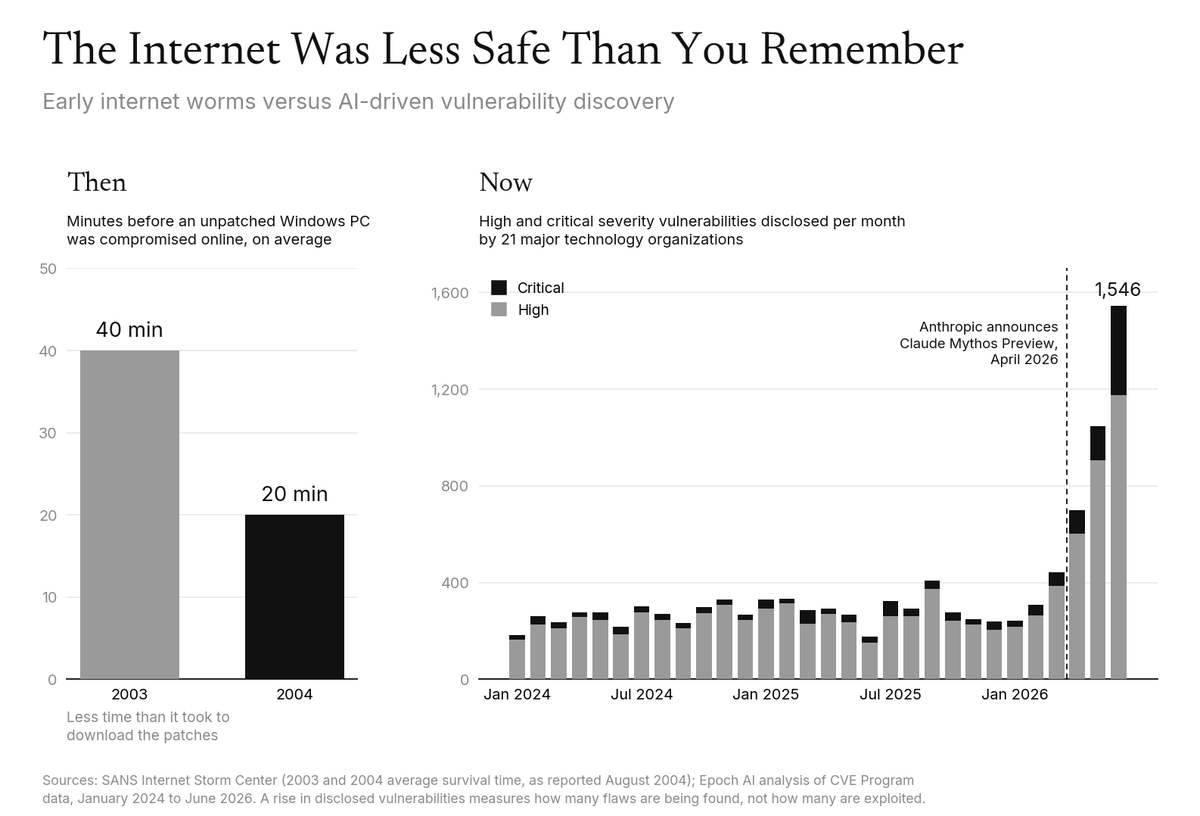
    In 2004, an unpatched Windows PC connected to the internet lasted about 20 minutes before it was compromised by malware. For most users, that was less time than it took to download the patches that would have protected them. In June 2026, 21 major technology organizations disclosed about 1,500 high and critical severity vulnerabilities, more than 3.5x the monthly record before Anthropic announced Claude Mythos Preview. Much of the increase comes from defenders using AI to find flaws before attackers do. Martin Casado on why he thinks AI will make software safer: "I lived through the internet, and it was way worse than this. If you took Windows 95 and you installed it, and it was connected to the internet, before the installer was done, it'd be infected. You didn't even have time to patch it. This is what happens every time you've got a new technology that changes the nature of how we run computers and the security posture. And we're definitely dealing with another one of those moments. I think the net impact will be that software will be much, much, much more secure because AI is also securing it." @martin_casado
    Download
    Patrick OShaughnessy @patrick_oshag
    My third conversation with Martin Casado (@martin_casado), general partner at @a16z. - The case for consensus investing - Why moats are overrated - Frontier model economics - What happens when AI growth slows - Why private markets are efficient - Lessons from Cursor, OpenRouter, and World Labs acquisitions Enjoy! TIMESTAMPS Intro Four Types of Venture Investors What Everyone Gets Wrong About Network Effects Moats, Market Growth, and Disruptive Technologies How AI Is Rebuilding Computing Infrastructure Anthropic, Frontier Models, and the Future of AI Competition Why AI Is Bigger Than Software AI's Capital Revolution and Infrastructure Bottlenecks Market Efficiency, Valuations, and Venture Capital Lessons from AI's Biggest Acquisitions and the Future of VC
    17308.7K
  14. Patrick OShaughnessy✓@patrick_oshag
    My third conversation with Martin Casado (@martin_casado), general partner at @a16z. - The case for consensus investing - Why moats are overrated - Frontier model economics - What happens when AI growth slows - Why private markets are efficient - Lessons from Cursor, OpenRouter, and World Labs acquisitions Enjoy! TIMESTAMPS Intro Four Types of Venture Investors What Everyone Gets Wrong About Network Effects Moats, Market Growth, and Disruptive Technologies How AI Is Rebuilding Computing Infrastructure Anthropic, Frontier Models, and the Future of AI Competition Why AI Is Bigger Than Software AI's Capital Revolution and Infrastructure Bottlenecks Market Efficiency, Valuations, and Venture Capital Lessons from AI's Biggest Acquisitions and the Future of VC
    Download
    2825247134K
  15. Invest Like the Best✓@InvestLikeBest
    Invest Like the Best
    RT @skupor: Really important breakthrough that is not widely understood - the mythical man month may be no more when capital unlocks productivity vs the limited scaling laws of human engineering teams
    Patrick OShaughnessy @patrick_oshag
    Martin Casado: "I really think the big disruption of AI is the fact that you can throw capital at problems. In the history of tech, you haven't been able to do that, because it was always an engineering problem, which just doesn't scale. The biggest shift with AI is I can take 20 people, give them a billion dollars, and they can use that. Do they make 500 million from that billion or two billion? I have no idea. But the fact that you can productively use that money is so new. We've turned this into a capital resourcing problem, and we're capital allocators. We're in this very strategic position to help drive the future in a much more direct way than we ever have been before. If you look at Anthropic and OpenAI, they've probably raised more money in aggregate than the entire downstream ecosystem combined. They are these mechanisms of turning money into growth."
    060361
  16. Patrick OShaughnessy✓@patrick_oshag
    Martin Casado: "I really think the big disruption of AI is the fact that you can throw capital at problems. In the history of tech, you haven't been able to do that, because it was always an engineering problem, which just doesn't scale. The biggest shift with AI is I can take 20 people, give them a billion dollars, and they can use that. Do they make 500 million from that billion or two billion? I have no idea. But the fact that you can productively use that money is so new. We've turned this into a capital resourcing problem, and we're capital allocators. We're in this very strategic position to help drive the future in a much more direct way than we ever have been before. If you look at Anthropic and OpenAI, they've probably raised more money in aggregate than the entire downstream ecosystem combined. They are these mechanisms of turning money into growth."
    Download
    Patrick OShaughnessy @patrick_oshag
    My third conversation with Martin Casado (@martin_casado), general partner at @a16z. - The case for consensus investing - Why moats are overrated - Frontier model economics - What happens when AI growth slows - Why private markets are efficient - Lessons from Cursor, OpenRouter, and World Labs acquisitions Enjoy! TIMESTAMPS Intro Four Types of Venture Investors What Everyone Gets Wrong About Network Effects Moats, Market Growth, and Disruptive Technologies How AI Is Rebuilding Computing Infrastructure Anthropic, Frontier Models, and the Future of AI Competition Why AI Is Bigger Than Software AI's Capital Revolution and Infrastructure Bottlenecks Market Efficiency, Valuations, and Venture Capital Lessons from AI's Biggest Acquisitions and the Future of VC
    17147033.6K
  17. Invest Like the Best✓@InvestLikeBest
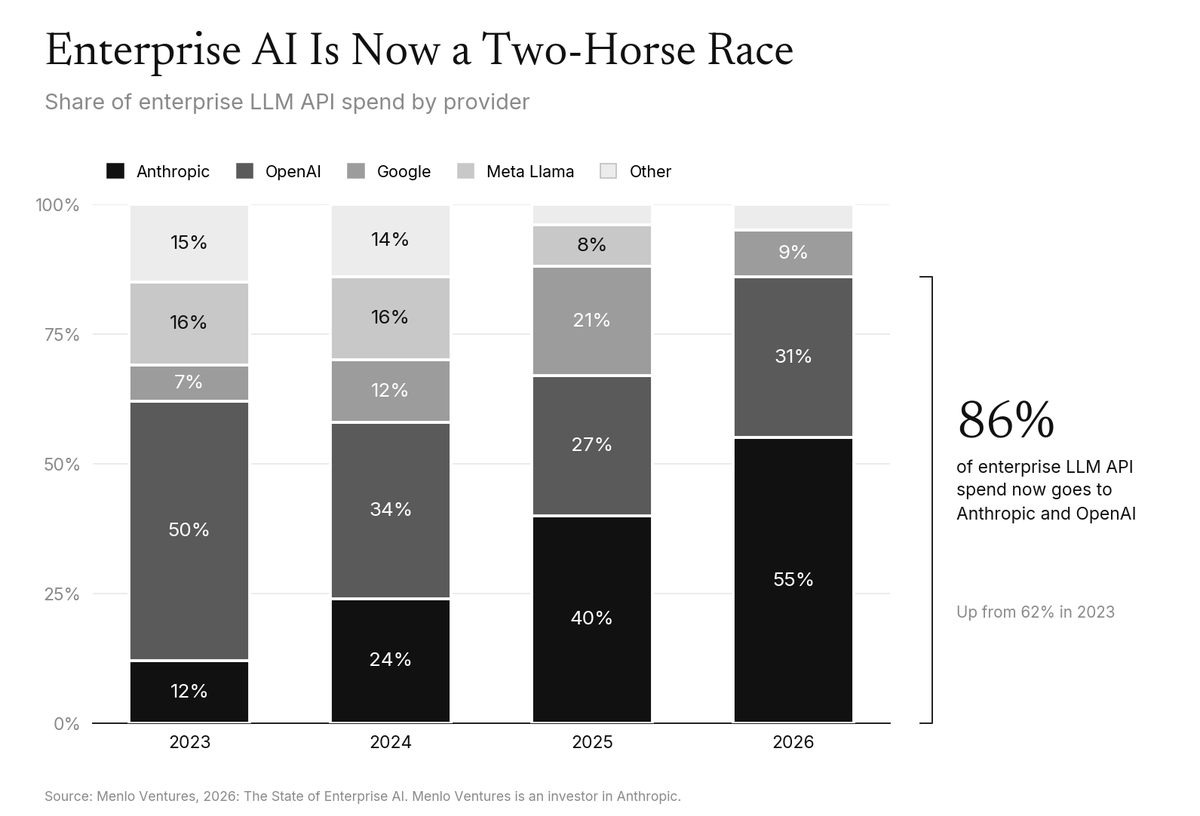
    In 2023, OpenAI had half of all enterprise spending on AI models. Today, Anthropic has 55%. "Even if you're just an epsilon better than the next guy, you've got tremendous pricing power. What is the lifespan do you think of the previous model? It's very, very short, which is entirely different than we've ever had in software." –– @martin_casado
    Download
    Patrick OShaughnessy @patrick_oshag
    Martin Casado (@martin_casado) on what happens to the AI labs if the market slows down: "If the market starts to saturate in pockets...things shift to open source. Will you lose pricing power on the frontier? Let's assume that Anthropic stumbles and they don’t release a model for six months. What is the lifespan do you think of the previous model? It's very, very short, which is entirely different than we've ever had in software. It could be the case that you lose the entire market."
    26193.9K
  18. Invest Like the Best✓@InvestLikeBest
    Invest Like the Best
    RT @patrick_oshag: Martin Casado (@martin_casado) on what happens to the AI labs if the market slows down: "If the market starts to saturate in pockets...things shift to open source. Will you lose pricing power on the frontier? Let's assume that Anthropic stumbles and they don’t release a model for six months. What is the lifespan do you think of the previous model? It's very, very short, which is entirely different than we've ever had in software. It could be the case that you lose the entire market."
    060221
  19. Invest Like the Best✓@InvestLikeBest
    Martin Casado (@martin_casado) on moats: "Defensibility and moats is not really even worth talking about most of the time. If a market you're investing in is growing, then companies are not gonna wanna compete."
    Download
    243310K
  20. Invest Like the Best✓@InvestLikeBest
    Invest Like the Best
    RT @a16z: a16z's Martin Casado on the four mindsets people bring to investing, and why knowing yours stops you from justifying your own bias: 1. Financial "The correct proxy for the health of a business is the market it's going into and its finances. That's what it is. What are the SaaS metrics? What is the size of the market? That is a proxy for the entire business." 2. Productive "You believe you're investing in a productive asset, and the productive asset is what's creating value. If you believe in that, as it creates value, it will create market... The type of diligence you do if you're a productive investor is more like, what is the technical approach? What are the adjacent markets?" 3. Frontier "I think this is the romantic, idealized version of VC from the 60s and 70s, which is kind of YOLO. It's like, founders know better than VCs, and they've seen something that I don't see, and they're gonna go out there and do it. And, like, who am I to second guess them?" 4. Speculative "It is always so surprising how prevalent it is... They don't even care about the asset. They just want to time a market, right?... They're like, 'Well, this looks cheap. It's clearly gonna go up in value' or, 'This is the top of the market, like, I'm gonna get out.'" "...You can justify any deal or not justify any deal. So if you don't know what your beliefs are, you'll always basically just kind of justify whatever personal bias you have." @martin_casado w/ @patrick_oshag on @InvestLikeBest
    martin_casado @martin_casado
    0110306
  21. Invest Like the Best✓@InvestLikeBest
    Ben Horowitz (@bhorowitz): "If you have the data and you have enough GPUs, you can solve damn near anything." "The laws of physics of company building changed If you'd ever built a software company, you knew you could not throw money at the problem. You knew if somebody built a great product and it took them three years and they did it with a small team, Google's not going to hire 2,000 engineers and catch them. It's just not going to happen. That was a law of physics. Now, if you have the data and you have enough GPUs, you can solve damn near anything. And we've seen that with @elonmusk catching the big models in no time. He took a lot of money and a really good data center design and some smart engineers. And he got in the game very fast. That would have never happened in the past."
    Download
    Patrick OShaughnessy @patrick_oshag
    Martin Casado: "I really think the big disruption of AI is the fact that you can throw capital at problems. In the history of tech, you haven't been able to do that, because it was always an engineering problem, which just doesn't scale. The biggest shift with AI is I can take 20 people, give them a billion dollars, and they can use that. Do they make 500 million from that billion or two billion? I have no idea. But the fact that you can productively use that money is so new. We've turned this into a capital resourcing problem, and we're capital allocators. We're in this very strategic position to help drive the future in a much more direct way than we ever have been before. If you look at Anthropic and OpenAI, they've probably raised more money in aggregate than the entire downstream ecosystem combined. They are these mechanisms of turning money into growth."
    111616.8K