KraneShares

@KraneShares

China & emerging tech exposure ($KWEB, $AGIX, $KOID) + insights for forward-looking investors. Prospectus & disclosures: https://t.co/taBFS7VvvA

368 Following8.2K Followers3.3K Posts
  1. KraneShares@KraneShares
    We're pleased to announce that $AGIX has made a direct investment in @gen_intuition, a frontier AI lab building foundation models trained on video game footage. Every day, millions of gamers make split-second decisions in 3D worlds, creating a vast record of human reflex data that is more cost-effective to collect than data gathered in the physical world. General Intuition's thesis is that the skills learned from that data are the same ones robots and autonomous systems need to operate in the real world. General Intuition joins @AnthropicAI, @Apptronik, @AyarLabs, @standardbots, @nuro, and @Polymarket as direct private holdings within AGIX, reflecting the fund's approach to capturing AI exposure across the ecosystem, from frontier models to physical AI infrastructure. Read our press release: For AGIX's holdings:
    Download
    00264
  2. KraneShares@KraneShares
    1/6 There’s a new AI bottleneck we believe few people are talking about. AI may now be able to generate potential drug candidates faster than scientists can physically test them... The models are potentially getting ahead of the labs. And that could put China’s biotech industry in a position to benefit. Here’s why:
    Download
    5131.1K
  3. KraneShares@KraneShares
    Posts @KraneShares
    5/6 If AI increases the number of potential drugs that need testing, companies with established labs could see greater demand for their services. That includes producing molecules, making proteins, and testing potential drugs before human trials. China’s biotech services companies already offer significant capacity, speed, and cost efficiency, which could make them important as AI accelerates drug discovery.
    100120
  4. KraneShares@KraneShares
    Posts @KraneShares
    6/6 How does $KURE fit into this? The KraneShares MSCI All China Health Care Index ETF ($KURE) provides exposure to China's healthcare sector, including companies involved in drug testing and other areas we believe are important to AI drug discovery. These companies represented over 27% of the fund as of September 30, 2026. As AI helps scientists generate more potential treatments, the labs needed to test them could become increasingly important. China's biotech industry may play a key role in meeting that demand. See KURE's top 10 holdings and learn more about the fund here:
    Download
    000128
  5. KraneShares@KraneShares
    Posts @KraneShares
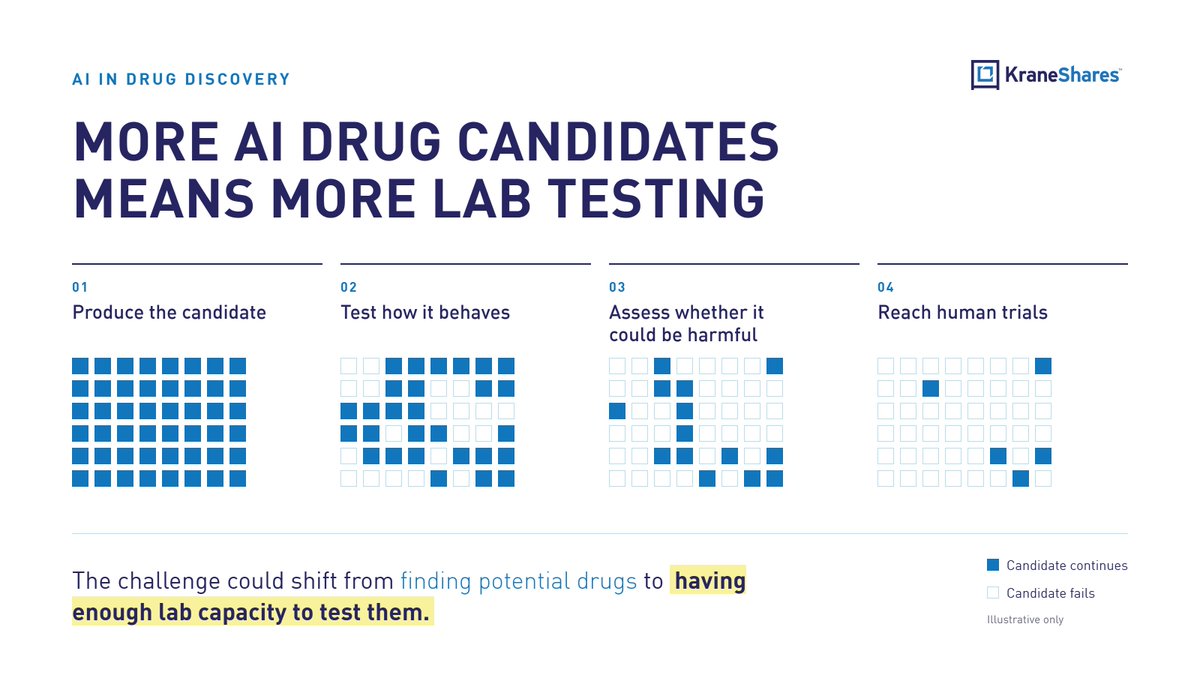
    3/6 That’s where the need for lab capacity comes in. Before a potential drug can reach human trials, researchers must produce it, test how it behaves, and assess whether it could be harmful. Many candidates will fail along the way. If AI helps scientists generate more candidates, they could need to run many more experiments. In other words, the challenge could shift from finding potential drugs to having enough lab capacity to test them.
    Download
    10087
  6. KraneShares@KraneShares
    Posts @KraneShares
    4/6 China could be well positioned to meet that need because it already plays a major role in outsourced drug research. Pharmaceutical companies often hire contract research organizations (CROs) to help test potential drugs rather than doing all the work themselves. WuXi AppTec is reported to be involved in the production of nearly 25% of drugs used in the U.S. Meanwhile, WuXi AppTec, WuXi Biologics, and Pharmaron are estimated to account for nearly 19% of the global outsourced medical research market. WuXi AppTec is 3.36% of $KURE Net Assets as of 9/30/2026, WuXi Biologics is 8.05% of KURE Net Assets as of 9/30/3036 and Pharmaron is 1.56% of KURE Net Assets as of 9/30/2026. See KURE's top 10 holdings here:
    Download
    10079
  7. KraneShares@KraneShares
    1/3 Anthropic’s S1 IPO filing reveals more than just revenue growth. Here are 3 financial updates that stood out: First, its revenue is becoming less concentrated. Its top five customers accounted for 36% of quarterly revenue in Q1 2026. By Q3, that share had fallen to 21%, with all other customers accounting for 79%. Why it matters: a broader customer base can make revenue less vulnerable to spending changes by a handful of large customers. But diversifying revenue is only one part of the equation. The next number reveals how much more revenue Anthropic is generating from its compute spending:
    Download
    721823K
  8. KraneShares@KraneShares
    Posts @KraneShares
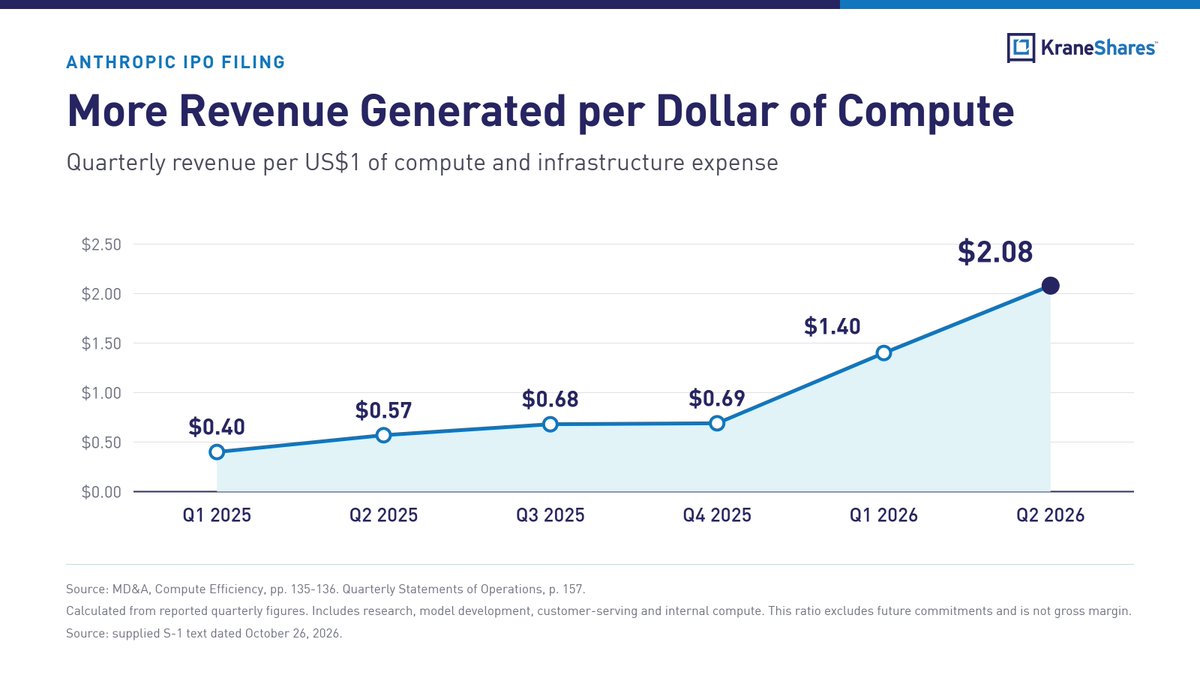
    2/3 Anthropic is generating more revenue for every dollar spent on compute and infrastructure. In Q1 2025, every $1 spent generated $0.40 in revenue. By Q4 2025, that reached $0.69. In Q2 2026, it hit $2.08. That’s more than 5x in five quarters. Compute is one of the major costs of running an AI business. Generating more revenue per dollar spent suggests Anthropic is getting more productive use out of that infrastructure. And that efficiency may help explain another major shift in the filing: its operating margin.
    Download
    222042.7K
  9. KraneShares@KraneShares
    Posts @KraneShares
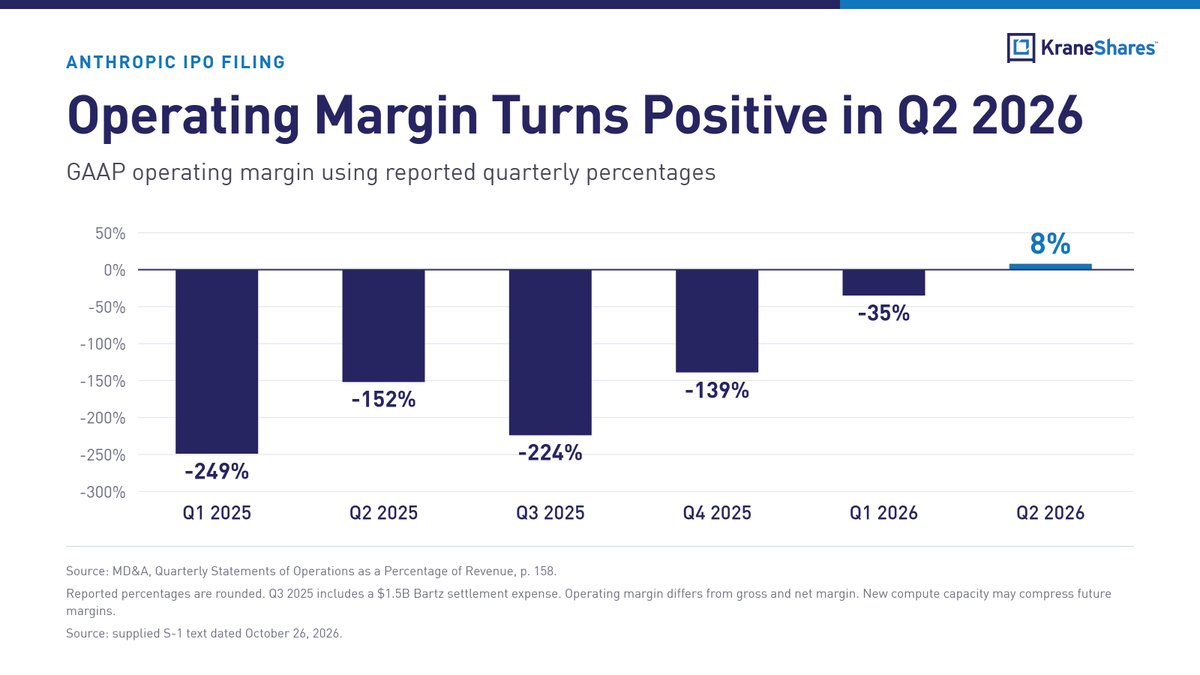
    3/3 Anthropic’s operating margin turned positive in Q2 2026. It improved from -249% in Q1 2025 to -35% in Q1 2026, before reaching +8% in Q2 2026. Operating margin measures how much revenue remains after operating expenses, before interest and taxes. Moving into positive territory marks a significant change in Anthropic’s reported operating performance. As Anthropic approaches its debut as the first publicly traded frontier AI model company, investors are without a playbook. Headline revenue alone won’t tell the full story. Customer diversification, compute efficiency, and expanding operating margins are the metrics that reveal some of Anthropic’s true strengths. Learn more at
    Download
    111119.2K
  10. KraneShares@KraneShares
    The humanoid robotics conversation has largely centered on which robot maker will win. But the companies supplying the motion systems underneath may matter just as much, regardless of which platform comes out on top. Actuators, the motors, reducers, sensors, and controllers that turn AI commands into physical movement, are the single largest cost driver in humanoid hardware, and every robot needs dozens of them. Could the actuator supply chain be one of the most overlooked opportunities in physical AI? Join KraneShares CIO @ahern_brendan, Senior Investment Strategist Derek Yan, CFA, and Max Chen of Worldline Capital for a webinar on the actuator bottleneck and how $TORK and $KOID seek to capture the physical AI opportunity at different levels of the stack. Register: TORK: KOID:
    Download
    7655126K
  11. KraneShares@KraneShares
    A robot's intelligence is only useful if its body can execute the task. Recognizing an object and deciding how to pick it up are software challenges. Actually reaching for it, gripping it, and moving it without damage requires actuators, the muscles and joints that translate AI commands into physical movement. Actuation and mechanical components represent an estimated 55% of humanoid robot hardware costs, according to TrendForce, and with humanoids requiring dozens of actuators per unit, the motion system supply chain could become one of the most significant bottlenecks in physical AI. $TORK is designed to provide targeted exposure to the companies building those motion systems, including manufacturers of actuators, precision reducers, motors, controllers, and sensors, across humanoid robotics and the established industrial markets they already serve. For investors who already hold $KOID, TORK offers a more concentrated allocation to what we believe is one of the most critical layers of the physical AI stack. Read our latest article: TORK: KOID:
    Download
    22928.7K
  12. KraneShares@KraneShares
    Three potential AI spin-offs could put China’s tech giants in focus... @AlibabaGroup T-Head AI chip unit, @Baidu_Inc Kunlun AI chip business and Kuaishou’s Kling AI video unit are three potential catalysts to watch. Kling is reportedly targeting a Hong Kong listing in Q1 2027, while November earnings could bring more clarity on the broader pipeline. Separate listings could also give investors a clearer picture of what these AI businesses are worth, potentially unlocking value that is harder to see within their much larger parent companies. Three to watch for $KWEB See KWEB’s top 10 holdings and learn more about the fund here:
    Download
    652522.7K
  13. KraneShares@KraneShares
    Dr. Xiaolin Chen recently joined @CGTNEurope to discuss China’s yuan exchange rate policy. @Dr_XiaolinChen explained that the yuan’s value reflects market forces, economic growth, and interest rate differentials, rather than deliberate devaluation to boost exports. She also highlighted the role of high-tech exports and domestic demand in shaping China’s trade balance. Watch:
    Download
    61115.7K
  14. KraneShares@KraneShares
    This past August, a humanoid robot ran 100 meters faster than Usain Bolt’s world record. The physical hardware of humanoid robotics is advancing rapidly. Motors, actuators, sensors, and control systems are all improving, while costs are falling. But watching a humanoid sprint is very different from asking one to clean an unfamiliar kitchen. The real breakthrough, physical AI’s "ChatGPT moment", will arrive when a robot can walk into an environment it has never seen, understand what needs to be done, and adapt when something goes wrong. The race to build the generalist robot brain is well underway, with Google DeepMind, Physical Intelligence, and Tesla pursuing very different paths to get there. For investors, the shift toward intelligence doesn’t eliminate the hardware opportunity. It could potentially accelerate it. $KOID is designed to provide exposure across both parts of physical AI, the body and the brain, and the technologies connecting them. Read our latest article: For KOID’s top ten holdings:
    Download
    511834.6K
  15. KraneShares@KraneShares
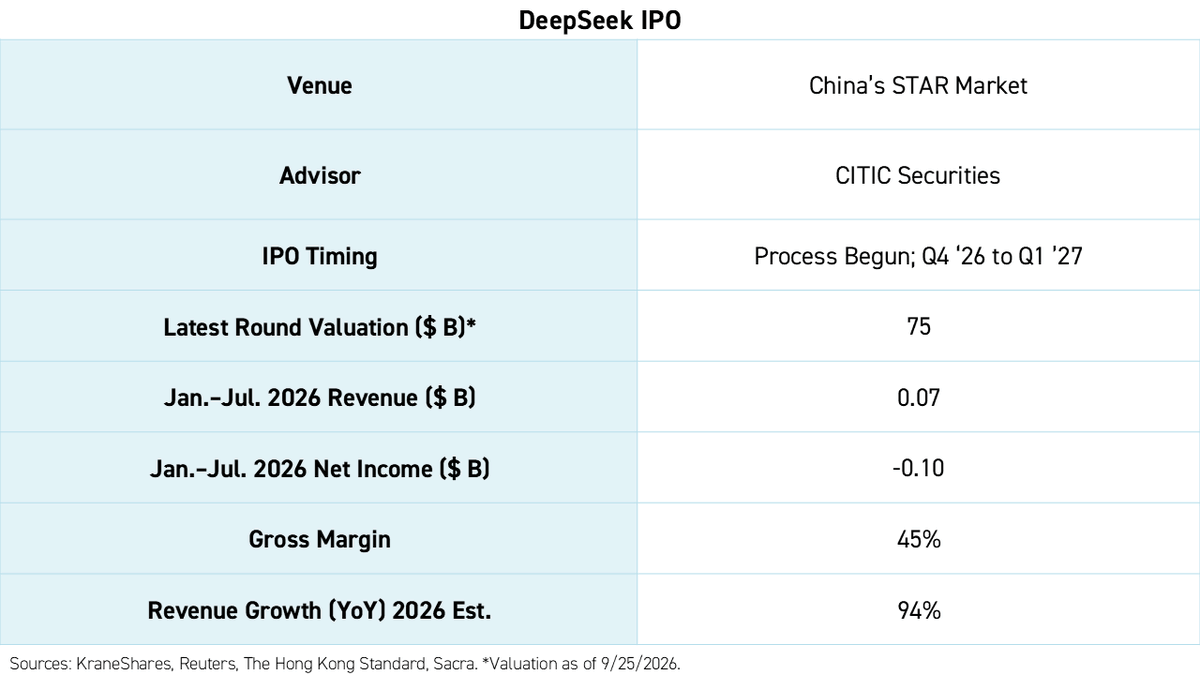
    One of China’s most closely watched AI companies is preparing for a potential IPO on Shanghai’s STAR Market... DeepSeek’s IPO could mark the next phase of China’s AI boom, as it prepares to enter a market already home to leading semiconductor and robotics companies like CXMT and Unitree. At a potential $75 billion valuation, DeepSeek could become the fifth-largest company listed on the STAR Market, based on September 28, 2026 market prices. $KSTR tracks the STAR 50 Index, giving investors exposure to companies listed on the STAR Market. Due to its size, DeepSeek could be eligible for the STAR Market’s fast-track inclusion process, potentially giving it a quicker path into major indexes. Learn more about DeepSeek’s potential IPO and what DeepSeek’s potential IPO could mean for KSTR here: A Complete Guide to DeepSeek’s 2026 IPO: What It Means For China ETF KSTR - KraneShares $KSTR does not hold DeepSeek as of 10/7/26. An IPO and future inclusion in KSTR are not assured. Holdings are subject to change. Top 10 holdings:
    Download
    742157.1K
  16. KraneShares@KraneShares
    Chongqing looks like a city from a video game: trains through skyscrapers, highways stacked 5 stories high, neighborhoods built straight up mountainsides. It's not just an aesthetic. With 90%+ of its land covered by mountains, Chongqing had no choice but to build differently. The result? One of China's most fascinating and unique cities. Watch as Xiabing Su explores how geography became Chongqing's greatest advantage.
    Download
    51102.9K
  17. KraneShares@KraneShares
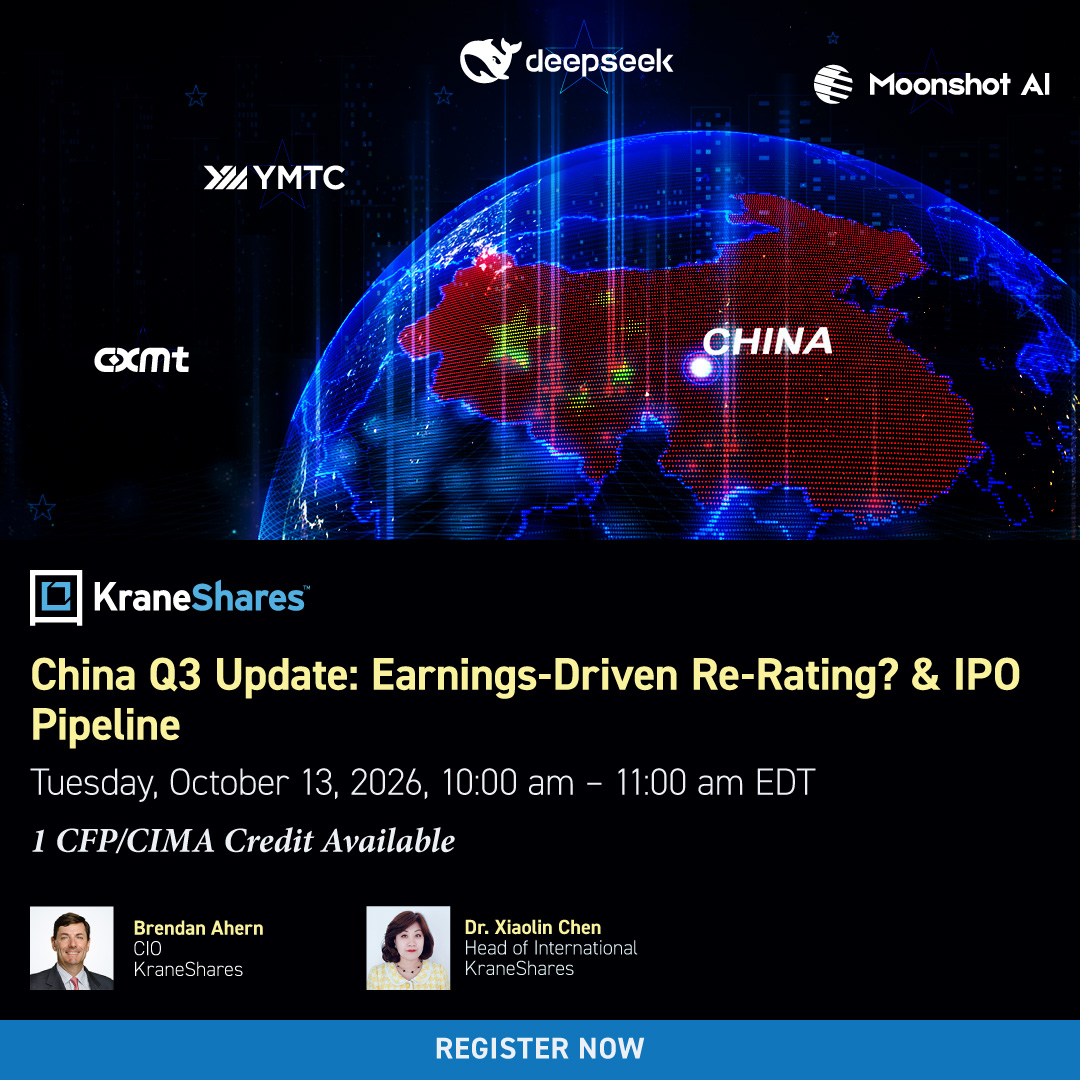
    China's stock market has seen a deep divergence in 2026. Mainland hardware technology stocks have delivered solid performance, while internet and consumer platforms have sold off despite their strong relevance to the AI story. Meanwhile, China's IPO pipeline is filling up fast. After CXMT and @UnitreeRobotics made their debuts, Yangtze Memory (YMTC), @deepseek_ai, @Kimi_Moonshot, and others are still to come. Could a peaking capex cycle drive a profitability rebound for internet giants like $BABA, and could that spark a re-rating? Join KraneShares CIO @ahern_brendan and Head of International @Dr_XiaolinChen for a Q3 update on China's market, the upcoming IPO pipeline, and how $KWEB and $KSTR seek to capture both sides of the opportunity. Register:
    Download
    721446.7K
  18. KraneShares@KraneShares
    "Actuators will be the GPUs of tomorrow. GPUs are in short supply right now, but actuators are the future," Derek Yan told @SergeBerger on the Steady Wealth Podcast from KraneShares' Switzerland event, From Digital to Physical AI: Humanoids, China AI, & Emerging Technologies. Derek discussed the shift from digital to physical AI alongside a live robot demonstration and made the case that we may be approaching a ChatGPT-style inflection point for humanoid robotics and highlighted $KOID as a way to capture the full physical AI ecosystem, from the brain and integrators down to the critical components like actuators and harmonic drives that represent today's biggest production bottleneck. He also pointed to $AGIX as the vehicle bringing private AI leaders like @Anthropic into an ETF wrapper. Thank you, Serge, for having us on! Watch: KOID: AGIX:
    Download
    421438K
  19. KraneShares@KraneShares
    1/6: 75% of semiconductor production capacity and material supply is concentrated in Asia. And when you look at where the biggest AI infrastructure bottlenecks are, four countries stand out: Taiwan. Korea. China. Japan. Each plays a different role in building the infrastructure AI needs to scale. Let’s break down how KAIT gets exposure to all four markets and the role each plays in the AI buildout:
    Download
    9113791.7K
  20. KraneShares@KraneShares
    Posts @KraneShares
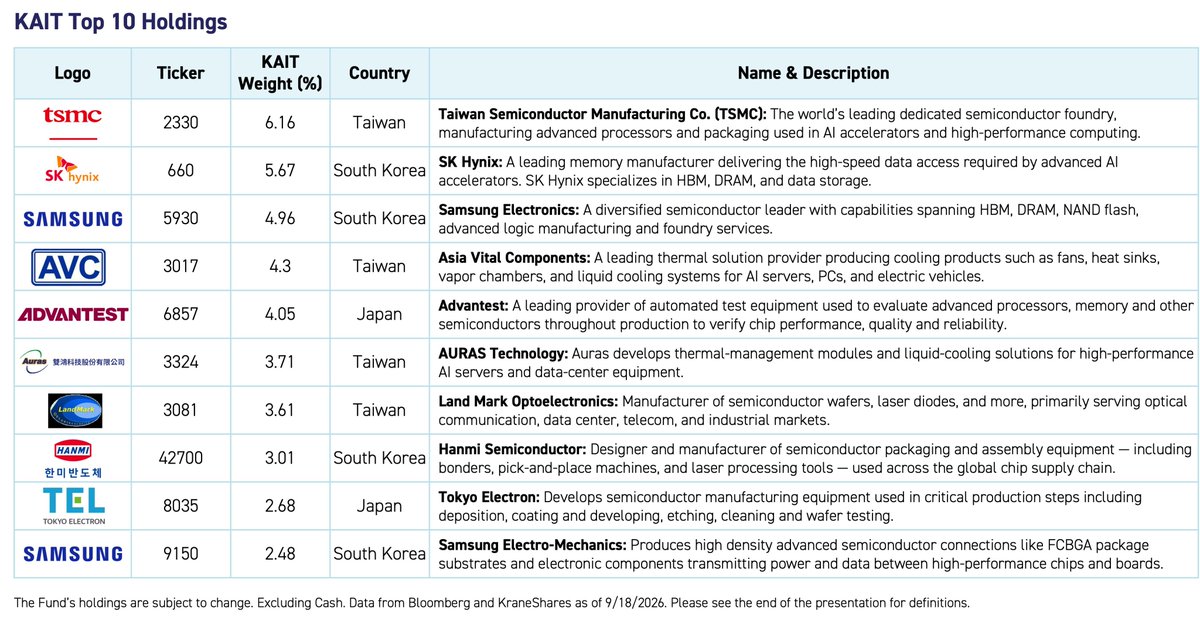
    Taking all this into consideration, AI may be built around U.S. hyperscalers, but the infrastructure powering it is far more global. Taiwan, Korea, China and Japan each control critical pieces of the AI supply chain, from advanced chips and HBM to optical networking, equipment and materials. For investors already heavily exposed to U.S. semiconductor companies, that creates a very different source of AI exposure. That’s the idea behind KAIT: complementing traditional U.S.-centric AI exposure with access to the companies building the infrastructure across Asia. Here’s a look at KAIT’s top 10 holdings 👇 6/6
    Download
    105478
  21. KraneShares@KraneShares
    Posts @KraneShares
    Holdings are subject to change. Learn more about KAIT here:
    001381
  22. Show more posts