One nerd’s perspective on the financial planning world… CFP, #LifelongLearner, Entrepreneur-In-Denial, Advisor #FinTech, & publisher of the Nerd’s Eye View blog
Our list of "Best Conferences 2025!", and be sure to take advantage of the discount codes that several have offered to Nerd's Eye View readers!
Best in:
-Overall Planning: @FPANorCal
-Technology: @t3techhub
-Advanced Tax Planning: @AICPA Engage
and more!
A really interesting evolution here: "Increasingly, Echelon found that firms are using acquisitions as a talent pipeline, to target niches that they currently lack. ‘Sophisticated buyers are increasingly targeting firms whose professionals excel at serving specific client segments or that offer additional service capabilities they can scale,’ Echelon said"
For many years, one of the firms of picking some kind of niche or specialization was the concern that it would be 'too unique' for potential acquirers if the founder ever wanted to sell.
Now that organic growth has gotten so hard, acquirers are ESPECIALLY interested in firms with niches and specializations because they anticipate it will be easier to accelerate organic growth and scale up...?
#Advicers what do you think?
Why 50% EBOC Profitability Is The Gold Standard ➡️ While difficult, running a 50% EBOC margin is absolutely possible.
In this article, we look at three reasons why 30% profitability from EBOC (Earnings Before Owner Compensation, or total income the owner is earning from all sources, regardless of how they pay it out to themselves) is the lower threshold an advisor should aspire to – with 50% being ideal, despite what you may have read in industry surveys or heard from experts.
While actions like managing expenses and raising fees are essential tools in moving towards improved margins, here we will focus on identifying – and letting go of – the clients who are not profitable by any measurement, and whose fees are ultimately being subsidized by your best clients.
Guest authors Matthew Jarvis and Micah Shilanski, who coach advisors through The Perfect RIA platform based on practices they successfully implemented in their own firms, discuss how advisors can measure their true profitability, create a client-by-client revenue report, and determine when it’s time to ‘graduate’ clients who are no longer a good fit (as well as how to approach this difficult conversation). #advicers
New IRS guidance: Revenue Ruling 2026-20 draws a line around certain Section 351 ETF conversions, and Notice 2026-62 casts a wider net over additional tax-aware investment strategies.
While the IRS isn't 'declaring war' on tax-aware investment strategies, financial advisors and their clients can likely expect more guidance, and more scrutiny, on certain strategies that appear to push the limits on permissibility. For clients already participating in affected strategies, that doesn't automatically mean that positions should be exited. It does mean the risk assessment should be revisited. Jeffrey Levine shares more on how to manage "tax risk" and why it matters more than ever for tax-aware investing strategies ⬇️
#IRS#351#revenueruiling
Trends In Financial Advice Fees: What are financial advisors actually charging for their services?
Despite ongoing changes in the philosophy of financial advice, new Kitces Research finds that 86% of advisory firms still rely on AUM fees as their primary method of charging for advice. While this model remains widespread, firms have adopted different ways of structuring their AUM fees to align with their service models and client needs.
#financialadvisorfees#advisorfees
We asked advisors whether their firms follow any of eight specific practices to fully realize the value of their technology investments. The most common is having at least one person responsible for evaluating and improving how the firm uses its data (44%). Firms are equally likely to offer training when a new tool is introduced (37%) and ongoing training (37%). Far fewer have a dedicated technology expert (20%), and only 3% tie compensation or other incentives to technology use.
Many firms assume that buying the software is enough to make them more efficient. More often, they do care about using their technology well, but they don’t have the time or people to train their team consistently.
We look at this in greater detail in our latest AdvisorTech Study, available here:
#advisortech#techstudy#KitcesResearch
This #FASucess, we speak to Neela Hummel about her unique story on how she rose through the ranks of Abacus Wealth Partners from starting as an unpaid intern to becoming CEO, giving her a valuable perspective on what it takes to build a successful career within the firm.
She talks about how her entry into the financial planning industry was totally accidental, having graduated with a degree in history and Spanish linguistics, how she started gaining client-facing traction within her firm by offering value to more senior advisors, and how she built the confidence to take the lead on client relationships herself at a relatively young age.
#financialadvisorsuccess#financialadvisorpodcast#podcast
Trump Accounts auto-enrollment: How parents still need to claim their childs Trump Account to make most contributions, and why to claim an auto-enrolled Trump Account (even if it has $0).
Notably, until an auto-enrolled TA is claimed, it can only receive certain types of contributions. Individual direct contributions are not allowed, and neither are employer contributions (since there's no actual mechanism to fund the TA until the adult responsible for the account can claim it and link a bank account to it). There are a number of outcomes that can happen if an auto-enrolled TA is never claimed. Read more in this article by Ben Henry-Moreland.
#advicers#TA#TrumpAccounts
No one wants to pay any more in taxes than they have to, and Judge Learned Hand is famous for stating that, “Anyone may arrange his affairs so that his taxes shall be as low as possible.”
Accordingly, the reality is that sometimes the best way to arrange affairs to minimize taxes is actually not to defer them, and instead accelerate the income. With the caveat that if too much income is accelerated, the individual may simply drive themselves into higher tax brackets today, finishing with less wealth than they would have if they simply relied on good old-fashioned tax deferral instead! #advicers
RT @CarenMacDonal17: People are deciding whether they trust you long before they ever book a call
Share
Copied
MichaelKitces@MichaelKitces
"I've never had a prospect show up and say, 'I chose you because you're a CFP professional.'" is a not uncommon sentiment in marketing for financial planners. While this may be true, it also may be glossing over a crucial component of how people ACTUALLY make decisions.
Many advisors get a sense of what prospects want from meetings with them, but only focusing on the questions of prospective clients who are willing to get on a prospecting call can introduce and exacerbate survivorship bias, which is a statistical error that comes from concentrating on only entities that have passed a selection process, while ignoring those that did not, when drawing conclusions about the entire group.
In this article, Senior Financial Planning Nerd Sydney Squires details how prospects actually evaluate financial planners, what information they seek, and how advisors can evaluate the effectiveness of the marketing strategies that they employ (in a way that allows visibility into 'more' prospective clients). #advicers#advisormarketing
Prospect discovery meetings can be challenging for advisors and clients alike as advisors not only dive into a client's financial circumstances, but also needs to explain and defend their fee. If a prospect balks at a fee, a single sentence: “You’re right – the fee can feel that way if we haven’t had a chance to fully understand your situation together yet" - can help the advisor acknowledge the concern without being defensive. From there, the advisor can dig more deeply into client goals to examine if there is a mutual fit.
Read about advisor fee strategies and more with this week's Weekend Reading For Financial Advisors:
Whether you're looking for an overall "best" conference or looking for a better way to connect with your advisor community (be that platform, vendor, or other affiliations!), the reality is that choosing which conferences to go to is no small feat. I hope you'll find this year's 2026 top conferences list to be helpful as a guide in planning your own conference budget and schedule.... and check out discount codes for Nerd's Eye View readers within the article! #advicers
Tech can make the advisor's job easier by expediting (or outright automating) many tasks. But on the other hand, tech can also make it easier for clients to manage their finances on their own. Why clients hire "human" advisors in the age of AI ➡️➡️
There's something about working with a human advisor that still resonates with clients – which ultimately comes down to the advisor's ability to connect with the client on a human level, to understand and validate their goals and values, and to motivate them to reach those goals, none of which can be fully replicated by technology.
In general, pretax contributions are expected to lead to a higher After-Tax Accumulation (ATA) when an individual’s tax rate is higher today than it is expected to be in the future, while Roth contributions can be preferable when the rate today is lower than the expected future rate (with the ‘tax equivalency principle’ suggesting that there is no difference in ATA when current and future rates are the same). However, in the Journal of Financial Planning, David Hulse notes that tax bracket (and tax law!) uncertainty can heavily factor into how advisors and clients calculate which decision is preferable.
Read more about tax bracket uncertainty, IRA contributions, and more in Weekend Reading:
#advicers
It's live! This Weekend Reading, we discuss a recent survey from KPMG that reveals that human advisors maintain a trust advantage over AI advice tools - and in fact, this gap has expanded, particularly amongst younger investors. Looking at what drives a positive investment advice experience, priorities varied significantly by generation, with a majority of Boomers and Gen Xers citing returns as the most important factor. Only a minority of respondents cited costs and fees as the most important factor, offering potential room for advisors to differentiate themselves on transparency and personalized service.
Plus, read about the newly-finalized rules for a car loan interest deduction, Roth conversion strategies, and more!
#advicers
Why The Empty Nest Transition Is Crucial For Retirement Success: The reality that it’s very expensive to raise children – including the ballooning cost of college – arguably this transition into the empty nest phase provides a unique opportunity for households to play “catch-up” for retirement…
The most crucial phase of retirement saving is not figuring out how to save during the early working years, and instead is about ensuring that the transition into the empty nest phase is used as an opportunity to catch up on retirement savings – after all, just 15 years of saving 30% of income once the kids are out of the house is still enough for an astonishing number of households to stay on track for retirement! #retirementplanning#advicers
“ReFire” Instead Of ‘Just’ Retire: how retirement can be reframed not as an end, but as a beginning – one centered on fulfillment, self-exploration, and purpose. While the core elements of traditional retirement planning remain (e.g., income streams, cash flow, and lifestyle support), ReFirement builds on this foundation to explore evolving values and aspirations, with the goal of living more intentionally. #retirement#reFire
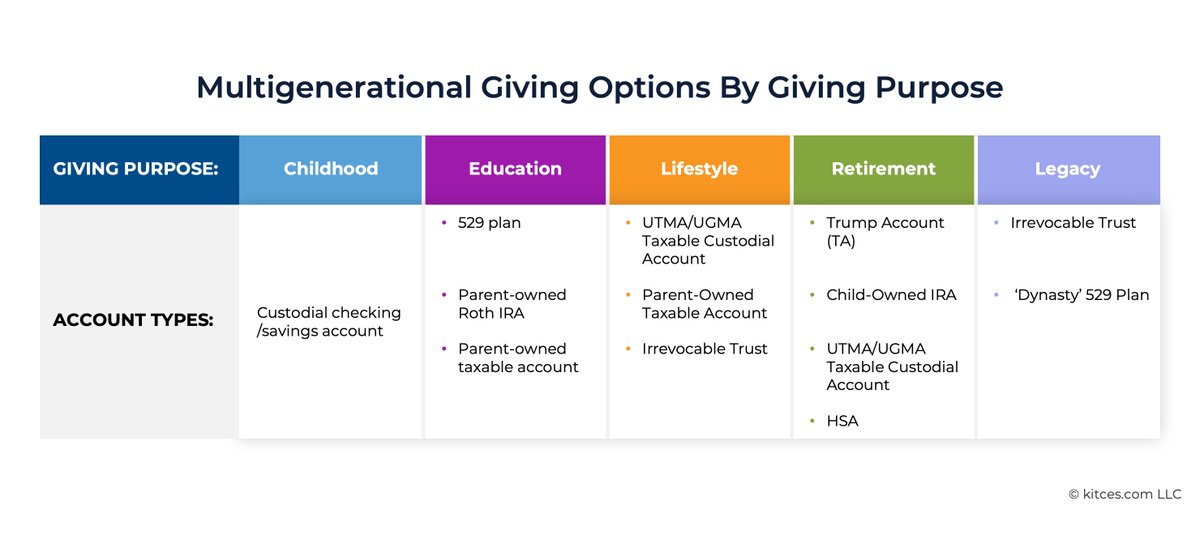
How Trump Accounts (TA) rank in the hierarchy of savings for kids: The best types of accounts for multigenerational giving, choosing the best account, and how Trump Accounts impact giving ➡️
The reality is that despite the potential for significant asset accumulation by the child's eventual retirement age, TAs remain just one of a variety of account types available for intergenerational giving. And because each account type has its own set of tax characteristics and incentives for specific types of savings, the 'best' account for giving depends more on what type of giving best aligns with the parent's philosophy of how to invest in their child's future happiness and wellbeing, rather than which one will result in the highest after-tax dollar figure.
#TrumpAccounts#savings#TA
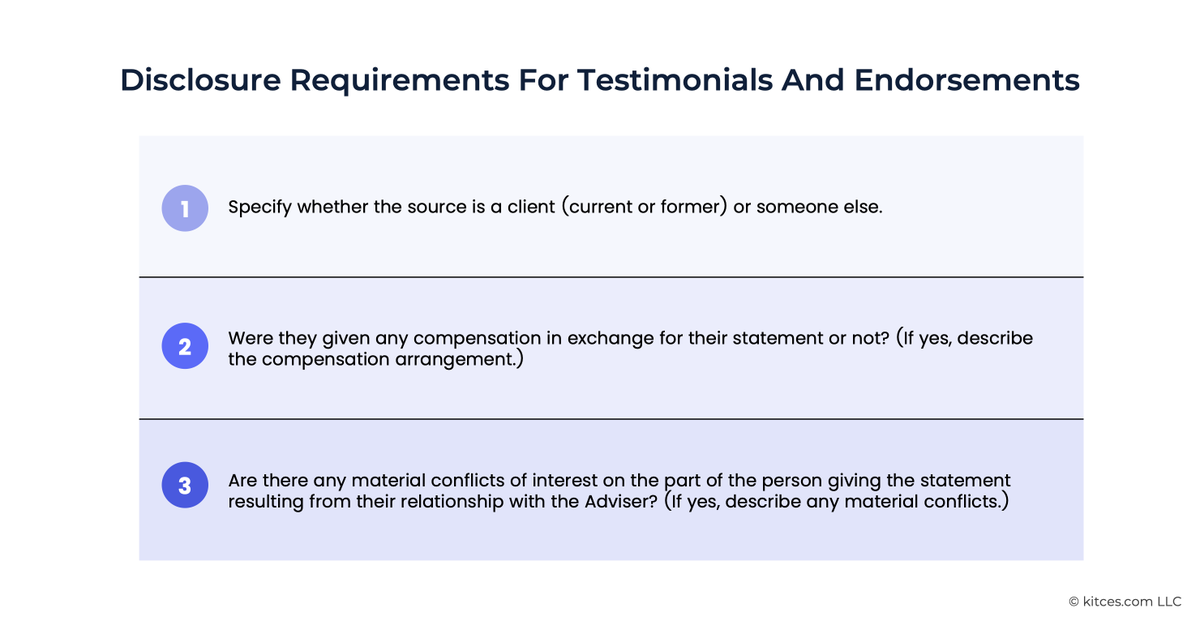
Beyond Google Reviews: How can advisors adopt a two-pronged approach to sustainably use online reviews in their marketing... while balancing concerns with compliance requirements:
In this guest post, Whit Lanier, co-founder of Amplify Reviews (an RIA review-verification and publishing platform), and Kent Keister, founder of Reliant Compliance (an RIA compliance firm), shares that while 'getting involved with' Google reviews can increase compliance complexity, but recommend 3 options and strategies on how to maximize marketing impact while simplifying compliance.
While Roth conversions are often used to transfer Traditional IRA funds into a Roth IRA account, reporting these transactions for income tax purposes can be complicated when the Traditional IRA from which the funds are being transferred include both pre- and post-tax funds.
By planning around current and expected marginal tax brackets, and by strategizing to isolate the basis of pre-tax dollars in Traditional IRA accounts, advisors can facilitate substantial tax savings for their clients by way of efficient Roth conversions. #advicers#Roth