Turing Post (Ksenia Se)✓

@TheTuringPost

On X — we follow important research papers and explain ideas behind it. In the newsletter, we connect the dots between AI’s past, present, and future ⬇️

8.1K Following89.1K Followers20.3K Posts
  1. Turing Post (Ksenia Se)✓@TheTuringPost
    Turing Post (Ksenia Se)
    RT @TheTuringPost: An agent can remember a conversation. But what about the visual context? Oracle AI Agent Memory 26.8 gives agents image-aware memory. It lets them keep screenshots, receipts, and product photos as persistent context across sessions → The original image lives in @Oracle AI Database alongside its description and metadata. ▪️ The key detail → search works through text, not pixel similarity. Raw image bytes stay out of default search results and readback, keeping routine retrieval lightweight. This means that: - Visual evidence survives across sessions. - Agents can find stored images through natural-language queries. - Applications can retrieve the originals for inspection, display, or forwarding. Messages preserve text and image parts in their original order. Say a customer returns to a support chat about checkout timeouts. The agent can find the earlier screenshot through its saved description, and the application can load the original for a closer look. Oracle’s Daniela Pavlenco walks through the workflow with a synthetic support screenshot and a runnable notebook:
    0503.1K
  2. Turing Post (Ksenia Se)✓@TheTuringPost
    Turing Post (Ksenia Se)
    RT @TheTuringPost: Could one model help build another model that makes decisions? Here are 3 approaches worth exploring ↓ 1. Strands Decider Models help produce and check training material: The team replaces Qwen3.5-2B’s language-generation head with a pointer head that scores supplied options. One Qwen generates questions, a larger Qwen checks them, and a Gemma model supplies teacher signals for a later recipe. People choose the recipe and tests. 2. SII-Decision Rreasoning helps teach a fast readout. A Qwen model reasons through questions, then learns to approximate those answer probabilities without repeating the reasoning. Some benefit carries over to classification, but much less to difficult multistep tasks. 3. Distil– a coding agent fixes its teacher’s labeling mistake Nemotron treated one warning sign as several independent confirmations. The agent clarified the instructions and had it relabel the data. Distil reports that a Qwen student’s score rose from 72.6% to 78.5% against model-generated reference answers. This is AI Builds AI in a form we can inspect. Models help produce and check training material; people choose the recipe and tests. What else could a model contribute? Here are other interesting cases and where they fit in the bigger intelligence puzzle
    0603.3K
  3. Turing Post (Ksenia Se)✓@TheTuringPost
    Turing Post (Ksenia Se)
    RT @TheTuringPost: Context engineering? Maybe cache engineering is better? Agents build up a lot of context, and trimming or summarizing older messages can ironically mean more compute as parts of the KV cache need to be recomputed. That's why @Tsinghua_Uni and CUHK propose cache engineering – keep the text history as is, but edit the cache availabililty They introduces 2 operations alongside the normal "append" that adds new KV states to the cache: - "drop" removes selected KV entries from future attention - "repos" adjusts the positional encodings of retained keys The remaining KV states don’t need recomputing, but they can still carry traces of dropped ones, so the order of cache operations matters. ▪️ To bring cache engineering to agents, the researchers built AKV - it's a serving engine that manages cache reuse, eviction, and restoration behind the scenes. It adds several mechanisms that handle the lower-level memory management: 1. A stateless API interface: Agents submit messages and cache instructions without having to manage where cached states physically reside. 2. An extended radix tree - tracks cache states and their operation histories, allowing correct reuse and eviction. 3. Segment-batch attention - reconstructs missing cached states when restoration is necessary, combining work into a single prefill pass. Experiments with a simple policy that gradually drops older tool responses showed: • 27.7% lower average cost • +1.7 points in benchmark scores • 1.18× throughput and 1.51× P95 latency speedup with AKV And letting agents refine their own cache policies cut costs by another 7.1%. But cache engineering necessarily needs specialized serving infrastructure.
    0303K
  4. Turing Post (Ksenia Se)✓@TheTuringPost
    Posts @TheTuringPost
    @Tsinghua_Uni A dedicated resource for technical AI breakdowns and analysis – @TheTuringPost We focus on the underlying engineering: - guides to emerging AI systems - research analysis - what is happening right now Read by 110,000+ across top AI labs, VC funds & universities Come join us!
    002305
  5. Turing Post (Ksenia Se)✓@TheTuringPost
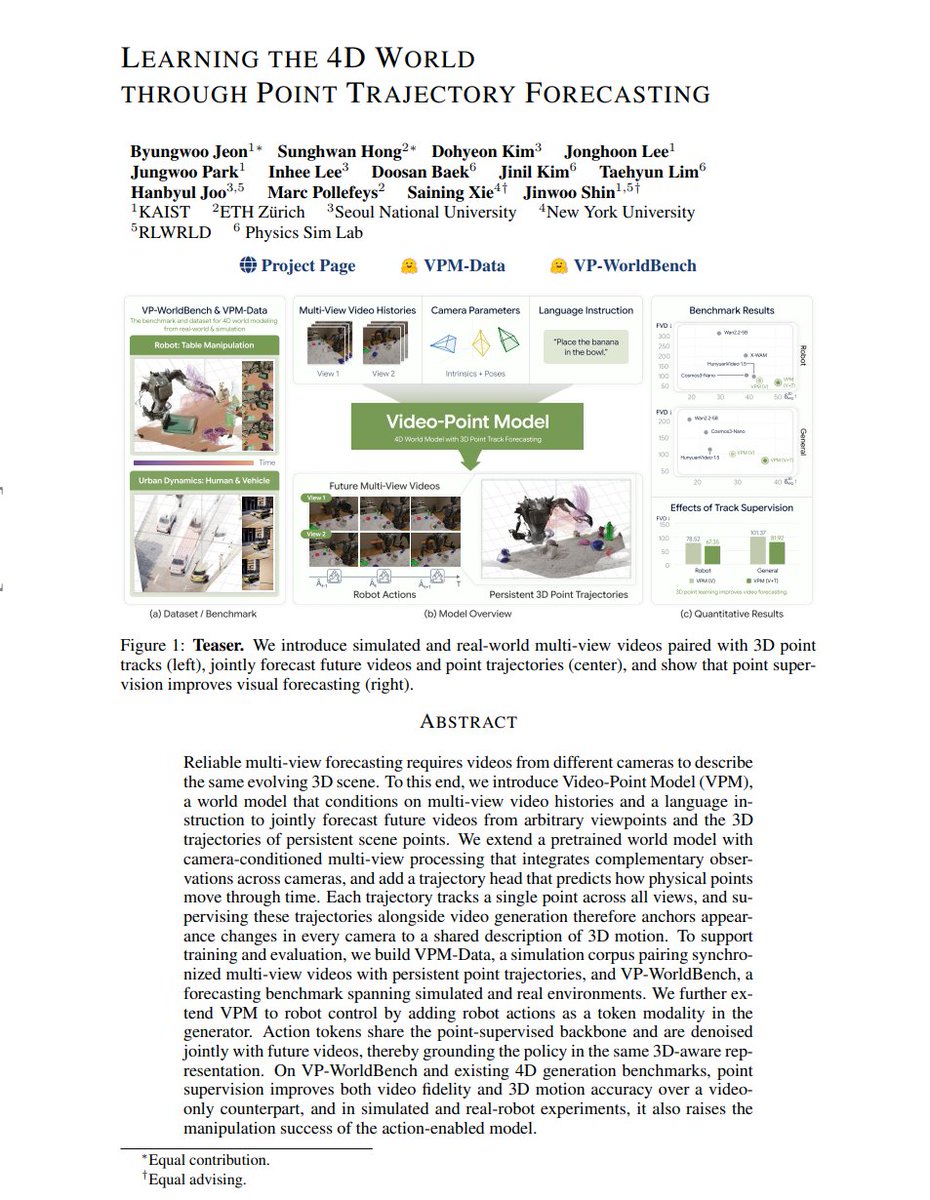
    Must-read papers of the week ▪️ Learning from Fleet Experience ▪️ Agent World Model in the Wild ▪️ VerifierBench ▪️ LaLa-World ▪️ Ropedia W0 ▪️ ALPS ▪️ Learning the 4D World through Point Trajectory Forecasting ▪️ Self-Distilling Future Video Representations ▪️ OpenVLHarness ▪️ Building AI Research Teams ▪️ WorldMirror ▪️ Harness Scaling for Generalizable Agentic Reinforcement Learning ▪️ AnyGoal Explore them to keep up with main AI trends. Here’s also the full list of stunning papers + links and our weekly AI news digest:
    Download
    415615.5K
  6. Turing Post (Ksenia Se)✓@TheTuringPost
    Posts @TheTuringPost
    A dedicated resource for technical AI breakdowns and analysis – @TheTuringPost We focus on the underlying engineering: - guides to emerging AI systems - research analysis - what is happening right now Read by 110,000+ across top AI labs, VC funds & universities Come join us!
    200425
  7. Turing Post (Ksenia Se)✓@TheTuringPost
    Turing Post (Ksenia Se)
    RT @TheTuringPost: JEPA learns what to keep from what it sees, and uses that to predict what comes next. But what about the details it can’t predict? Wouldn’t it be easier for the model to drop them? Look at this example Imagine a traffic light that changes color randomly. Its next color is unpredictable, but its current color helps predict whether a cyclist will stop or move. If we drop the light, the cyclist becomes harder to predict. ▪️ A recent research call this set-level view "predictive closure:" A feature’s value depends on its relationships with the other features the model represents. Keeping the light makes the cyclist easier to predict, but adds an unpredictable color to the model’s targets. Dropping it removes that target, but loses a useful clue. The researchers separate these two costs: 1. Aleatoric uncertainty: what remains uncertain even with the full current observation, like the light’s next random color. 2. Predictive leakage: useful information available in the observation but missing from the representation, like the current color if the model drops the light. An unpredictable detail can therefore be worth keeping because of what it helps predict. Random noise that helps predict nothing else offers no such benefit. In controlled experiments, unpredictable features became easier to recover from the representation as they became more useful for predicting others. That doesn’t guarantee JEPA keeps everything important, but it explains why unpredictable doesn’t automatically mean disposable.
    0705.1K
  8. Turing Post (Ksenia Se)✓@TheTuringPost
    Turing Post (Ksenia Se)
    RT @TheTuringPost: There’s more to System One decision models than Jev. These 15 models are worth a closer look: ▪️ Jeva ▪️ Prism-1 ▪️ Bongard ▪️ Verdict (multi-question) ▪️ VideoJev ▪️ MJev-Spatial ▪️ AudioJev ▪️ MetaEncoder ▪️ FastJEV ▪️ SanSi (looped) ▪️ StartLux-Decision ▪️ System X (decision-to-text hybrid) ▪️ Intern-Decision (multimodal) ▪️ FunDM (distilled) ▪️ LAVOIR Check out our quick guide to what each brings, how it works, and where it fits:
    058016.4K
  9. Turing Post (Ksenia Se)✓@TheTuringPost
    Turing Post (Ksenia Se)
    RT @TheTuringPost: What an incredible work, @axiommathai! They tackled math's longest proof, using an army of AI agents to formalize the Classification of Finite Simple Groups in Lean, and fixing historical gaps along the way. Truly mind-blowing stuff.
    Axiom @axiommathai
    The largest math proof in human history is now computer-verified. Today, Axiom announces a complete Lean auto-formalization of the Classification of Finite Simple Groups, the "periodic table of symmetry." About 15,000 pages, built by over 100 mathematicians across generations.
    0502.2K
  10. Axiom✓@axiommathai
    The largest math proof in human history is now computer-verified. Today, Axiom announces a complete Lean auto-formalization of the Classification of Finite Simple Groups, the "periodic table of symmetry." About 15,000 pages, built by over 100 mathematicians across generations.
    Download
    4161.3K7K3.6M
  11. Turing Post (Ksenia Se)✓@TheTuringPost
    Posts @TheTuringPost
    A dedicated resource for technical AI breakdowns and analysis – @TheTuringPost We focus on the underlying engineering: - guides to emerging AI systems - research analysis - what is happening right now Read by 110,000+ across top AI labs, VC funds & universities Come join us!
    000341
  12. Turing Post (Ksenia Se)✓@TheTuringPost
    Turing Post (Ksenia Se)
    RT @TheTuringPost: How much of the past in agent memory should enter the present? Once we decide what to keep, we need to work out how the agent can access it. @jess_weng18, an education engineer at @LangChain, showed several ways to manage this in Deep Agents: 1. A large tool result can be saved to a file. The model receives a short preview and a path to read more as needed. 2. A skill appears as a name and description, with full instructions loaded only when the task calls for them. 3. A subagent can work through a focused problem in its own context. 4. As the conversation grows, older material can be condensed while recent messages stay unchanged. And the most important thing: Continuity depends on the architecture around the model: where information lives, how long it survives, and how a later run finds it. Jess Weng even showed that a persistent memory file could be read by another model. But a condensed memory is easier to use and also easier to misuse because the agent may miss important details. So → Agents need to recognize when the summary is insufficient, and we still need to figure out how much context and experience we can leave out. Here I explain six more perspectives on how to turn an agent’s experience into better work and build agent memory. They are practical and so really worth your attention.:
    0504K
  13. Turing Post (Ksenia Se)✓@TheTuringPost
    Turing Post (Ksenia Se)
    RT @TheTuringPost: Superintelligence in what, exactly? Maybe it’s time to be more specific about the domains where we expect AI to go beyond human capabilities. @MicrosoftAI makes medicine an interesting place to start with its new MAI-DxO research and medical intelligence framework↓ The study, published in Science, explores sequential diagnosis from a partial clinical picture. MAI-DxO (Microsoft AI Diagnostic Orchestrator) uses a language model to simulate 5 clinical roles: proposing diagnoses, selecting questions and tests, challenging assumptions, checking reasoning, and weighing costs. Its assessment evolves as evidence arrives. It achieved 83.2% accuracy on complex NEJM cases and 80.3% on emergency-department cases, vs. 36.1% and 46.8% for participating generalist physicians. → But what would make this medical superintelligence? ▪️ Microsoft’s framework outlines 6 dimensions of medical intelligence. Its bar for superintelligence is high: outperforming the strongest human-led health systems in reasoning and coordination across the full course of care. 1. Medical knowledge It applies current evidence to individual cases and recognizes what it doesn’t know. 2. Diagnostic reasoning and triage It chooses questions, tests, and urgency, revising its view as evidence arrives. Sequential diagnosis fits here. 3. Therapeutic decision-making It weighs benefits, risks, costs, and availability, adapting treatment as the patient responds. 4. Longitudinal context It tracks health over time, preserving sources and uncertainty rather than starting fresh at every visit. 5. Clinical coordination It brings in expertise, determines who acts next, and checks that follow-up happened. 6. Human values and agency It respects patients’ goals, preferences, and right to refuse a recommendation. These capabilities must work together. Treatment responses can change diagnoses; patient priorities can change treatment choices, etc. That’s why a domain-specific view of superintelligence is useful - we can give a system clear tasks and criteria it needs to meet.
    0405.2K
  14. Show more posts