We have gone from external tool-calling to embedding a full freaking CPU inside a small model's weights. Easily one of the most creative architectures I've seen all year.
Share
Copied
div (fp32)@divagr1925
1/4
Meet Qwenputer: Qwen3.5-4B with a full RISC-V CPU inside its weights, using the model's own Gated DeltaNet layers as RAM.
It runs C and MicroPython in its forward passes, no external runtime.
On DeepMind math: base 55–90%, base + Python tool 95–100%, Qwenputer 97.5–100%.
1/4
Meet Qwenputer: Qwen3.5-4B with a full RISC-V CPU inside its weights, using the model's own Gated DeltaNet layers as RAM.
It runs C and MicroPython in its forward passes, no external runtime.
On DeepMind math: base 55–90%, base + Python tool 95–100%, Qwenputer 97.5–100%.
RT @tsait26: We are excited to announce our partnership with @netboxlabs to eliminate configuration drift, close the gap between intended design and live operations, and accelerate time-to-first-token for AI factories.
RT @omeragoldberg: abliterated models are great!
BUT
you have NO guarantees on post-trained behaviors or policies
we tuned an innocent-looking Qwen to exfiltrate on target phrases / semantic conditions.
any model can have this or FAR worse.
isolate your envs!
happy hunting :)
Share
Copied
Omer Goldberg@omeragoldberg
We backdoored a model in a day.
Much of the talk about malicious models remains abstract.
We wanted to make this tangible, so we built the simplest version of the attack.
A few takeaways
Backoored models or sleeper agents are a real threat vector.
We demonstrated a naive implementation.
A well-resourced, motivated adversary can plant something more evasive than this and keep it dormant until the trigger is met.
Neither open nor closed models provide fundamental guarantees of behavior.
Alignment matters, but it is still a best effort, and far from bulletproof (hello FelonyBench).
An open-weight model is a CSV file of weights.
You cannot inspect declared objectives, hidden policies, or learned behavior the way you inspect a binary.
As models get better at long-horizon tasks, they'll get more useful and autonomous.
To unlock that utility, we will grant agents broader permissions.
Instead of writing a detailed plan, we will simply declare desired outcomes and let the agent reason about how to get there.
Those same permissions are what make agentic security hard and asymmetric.
How do you dynamically define the right scope, without constraining the agent?
Defenders will reason deeply over permissions, allowlists, policies, and more. An attacker only needs one direct or daisy-chained path.
This is not doomerism, nor is it an argument for slowing down.
Agents are a new form of intelligence.
Mapping legacy security solutions and frameworks onto alien intelligence won't scale or work in the long term.
Agents will force security to be rebuilt from first principles.
RT @NojanSheybani: The Jalapeño chip is pretty much a systolic array with a bunch of HBM. These designs are not that crazy, but it allows people to squeeze way more performance out of their existing models. This enables two new directions for startups:
1) build models that can modify your workloads to take advantage of every nook and cranny of the available hardware
2) build new chip design workflows that enable fast development and iteration on hardware
These should be happening in parallel so that workloads can be accelerated on available hardware while custom silicon is built. At the end of the day, faster chip design has to happen, because we won’t be on the transformer architecture forever, and workloads are just going to grow to be more and more complex as consumer expectations rise
Share
Copied
Patrick C Toulme@PatrickToulme
Frontier labs making custom chips is not really as hard / as impressive as you might think.
1. They are primarily targeting inference not training. inference is easier
2. They are targeting transformers only. Think large MXU matmul units
3. They are writing all kernels in close to ISA with coding agents RLed for their ISA.
4. They aren’t making high level compilers for codegen
A frontier lab vending a true generic chip like a Nvidia GPU or Google TPU is MUCH harder than spinning up an in house inference program.
Still I think you will see many more inference chip companies as the cost of the software is just the cost of tokens.
Share
Copied
Jukan@jukan05
SemiAnalysis’s Dylan Patel, in a conversation with Stacy Rasgon and Austin Lyons: “Anthropic has already begun developing its own custom chip and is aiming to do it in half the time it took OpenAI.”
RT @NojanSheybani: Everyone is going to want their own chip. Generalized architectures like TPU and GPU are just not good enough for the performance these workloads are demanding
Share
Copied
Jukan@jukan05
SemiAnalysis’s Dylan Patel, in a conversation with Stacy Rasgon and Austin Lyons: “Anthropic has already begun developing its own custom chip and is aiming to do it in half the time it took OpenAI.”
SemiAnalysis’s Dylan Patel, in a conversation with Stacy Rasgon and Austin Lyons: “Anthropic has already begun developing its own custom chip and is aiming to do it in half the time it took OpenAI.”
RT @NojanSheybani: FUNDRAISING IS SUPPOSED TO BE THE EASY PART!!! Seeing way too many founders in SF especially viewing the fundraise as the end goal. As AI is essentially doing all critical thinking for people in this city, it’s never been more important to realize how CHEAP ideas are. The only thing that matters is execution and relentless forward motion. I’ve seen a good majority of founders just resting on their laurels as soon as the money lands in the bank. Job’s not finished!
Share
Copied
Hubert Thieblot@hthieblot
Founder: The round is closed. The hard part is over
Me: The hard part hasn't started lol
Wait until you're 5 years in
Your competitor just raised 10x more than you
And you're two payrolls from death
Smiling at the all-hands like everything's fine
That's the job bro
Founder: The round is closed. The hard part is over
Me: The hard part hasn't started lol
Wait until you're 5 years in
Your competitor just raised 10x more than you
And you're two payrolls from death
Smiling at the all-hands like everything's fine
That's the job bro
RT @NojanSheybani: Day 2 of CASPA summit sessions is over and it turns out chip design is still slow :O
My main takeaways from today’s panels below
The hardware side:
- Compute isn't the bottleneck anymore. Moving data is. Chip to chip interconnect can eat 60 to 70% of a package's energy
- Memory went from commodity to strategic. Every idle GPU waiting on data is burning money
- LOTS of new fabs dropping soon, particularly in Asia (78 out of the upcoming 102 fabs being built by 2029 are in Asia)
The chip design side:
- Models change in weeks, chips still take months. The goal is getting design from 18 to 24 months down to 9 (I think that’s not ambitious enough)
- THE BIG ONE: Agentic harnesses alone won't get us there. The engines themselves have to get faster (WE CANT KEEP LEANING ON LEGACY EDA)
- RL for chip design is stuck waiting on the tools. One run takes a day. People are begging for a couple of hours (YUP)
- Big debate on surrogate models. Some like them for exploring the design space with real sign-off after. Others think models learn better against the real tools, and a surrogate just gets reward hacked (but no ai for EDA companies will get access to the EDA tooling because that puts EDA companies at risk 😃)
RT @ryaneshea: PSA for macOS users:
1. Apple’s supplied SSL certificate bundle at /etc/ssl/cert.pem still trusts certificates attackers can forge using compromised eMudhra keys.
2. I confirmed this on macOS 26.7.1 and 27.0.1 using Apple’s built-in curl and Git.
3. An attacker intercepting connections from tools using this bundle could replace downloads with malware. With commands like curl … | sh, that malware would execute immediately.
4. Removing the roots that authorize those certificates blocks the tested chains. Both OS updates restored roots I’d previously removed, requiring me to remove them again.
4. I’ve submitted the findings to Apple’s security team and am awaiting their response. In the meantime, you can apply a temporary fix as outlined below.
5. To check and fix your machine, give an agent like ChatGPT/Codex or Claude Code the following prompt:
“Independently verify whether Apple’s /etc/ssl/cert.pem still permits trust in certificates signed with compromised eMudhra keys. If so, back it up and remove the roots enabling that trust, identified by verified SPKI fingerprints. Confirm Apple’s built-in curl and Git reject those chains while ordinary HTTPS still works. Preserve rollback and never disable TLS verification.”
Note that removing these roots can also block legitimate sites. This is a temporary mitigation, not a substitute for a fix from Apple.
I’ll share the script I used in a follow-up post if you’d prefer to use that directly.
Share
Copied
Ryan Shea@ryaneshea
PSA for Codex CLI users:
1. Codex 0.163.0’s release lockfile pins rustls-webpki 0.103.15 and root bundles that can still trust compromised eMudhra certificates.
2. An attacker intercepting your connection could impersonate a server, steal sensitive data, or alter responses, potentially tricking Codex into running malicious commands.
3. Codex 0.164.0, released October 23 at 12:48 a.m. ET, updates those dependencies to fixed versions.
4. To check your codex version run "codex --version". It should be at least 0.164.0.
5. To patch the vulnerability, run "codex update".
6. Apps that bundle their own Codex copy must also be checked.
RT @BackPropTrader: For those excited about abliterated models, we've been serving multiple uncensored models on DreamFort (powered by @OpenGradient)
Try them here - privately
RT @fermatslibrary: Today is a mathematical date we won't see again for 78 years.
10/24/26
10² + 24² = 26²
It's called a Pythagorean Triple Day. There are infinitely many Pythagorean triples, but only 12 dates this century satisfy the is the last.
Next one: March 4, 2105.
Some takeaways from LPs at RAISE:
- With everyone widening their mandate into AI, every pitch sounds identical. True portfolio concentration is the only thing standing out.
- The person taking your meeting is usually an analyst who will not be at that firm when your DPI shows up. Give them something that pays off this year. An intro, a co-invest, help getting promoted. DPI gets you the next fund. Being useful now, gets you this one.
- When an LP can pick freely between asset classes, venture loses. You stop pitching your fund and start defending the whole asset class, and that is a fight you do not win.
- An LP put it bluntly: LPs have zero FOMO right now.
Share
Copied
Meghan Reynolds@MeghanKReynolds
Heard from VC LPs this week. It was our AGM, so I had a ton of convos. Theme is liquidity and differentiation. Some quotes 👇🏻
- “we see a huge difference btw the posture of the GPs who do public + private and those that just do VC/Growth. They are living in different realities.”
- “every GP is raising again faster than we thought, either because they just blew through the money, or because they want a war chest for when the market trips over itself”
- “Across the top GPs, everyone is in market. TVPIs look amazing - differentiation is DPI, concentration and portfolio mgt”
- “We really need the PE guys to start selling some stuff!!”
- “If Anthropic IPO goes great, we are worried it sets the bar too high for everyone else. And if it doesn’t go great, then the bar is even higher…”
RT @AndrewCurran_: Quest Diagnostics has been hacked. Patient data was exposed. They serve roughly half of U.S. hospitals and physicians. Investigation ongoing.
RT @tsait26: Yes, the future is about heterogeneous compute (aka Disaggregated Inference Architecture) which will give us more ways to match workloads to hardware. It will also raise the bar for orchestration, observability, and proactive operations. This infrastructure model and deployment will carry the most operational complexity of anyone in the stack. The winners will not just have the fastest silicon; they will be the ones who can deploy, operate, and support mixed fleets with the reliability enterprises expect.
RT @MsftSecIntel: The China state-aligned threat actor Storm-0940 used the agentic AI penetration testing framework ARTEX to automate attacks targeting hundreds of organizations globally across a broad range of industries. Microsoft Threat Intelligence assesses that Storm-0940 was responsible for the recently disclosed ConnectWise supply chain compromise of a multitenant application.
Our investigation found that Storm-0940's use of ARTEX accelerated the speed of compromised application abuse to authenticate to target environments through applications that had already been granted access, allowing the threat actor to operate without requiring an interactive user sign-in. AI-accelerated follow-on activity included reconnaissance, application credential changes, and attempts to modify privileges that could enable expanded or persistent access.
Read our blog for a detailed analysis and indicators of compromise (IOCs), along with Microsoft Defender detections, protection recommendations, and guidance on investigating service principal sign-ins and unexpected application credential or privilege changes.
RT @kevingubbi: @pronounced_kyle makes a compelling case for why physical engineering remains hard for AI. Semiconductor design adds another challenge: establishing that a design actually implements what we intended.
A few thoughts on superhuman hardware engineering
RT @altantutar: I talked to builders, investors, developers and locals over the last two weeks in SF.
A few observations:
1. Fundraising has become increasingly more binary. Investors want to see either exceptional growth or a team tackling something really really hard. The days of raising on an "AI for X" pitch alone seem to be done.
2. Some of the best developers barely look at code anymore. They write spec documents, orchestrate multiple coding agents, and spend their time reviewing the outcomes rather than the implementation itself. The bottleneck is shifting from generating code to verifying correctness, and security.
3. Agent security is becoming a serious priority. I attended several security events. CISOs at larger companies are actively thinking about what happens when AI agents have access to sensitive data, systems, and permissions.
4. Robotics was an incredibly hot topic last quarter. Companies are still raising significant capital, but investors seem increasingly skeptical about timelines, commercialisation, and whether the returns will justify the investment.
5. Interestingly, many investors I spoke to still want crypto exposure in their portfolios. My impression is that a strong crypto business with real traction might have an easier fundraising story than yet another undifferentiated AI application.
6. Everyone wants to feed the "AI gods." Ask people what they would build today, and you'll hear similar answers: data, compute, energy, model infrastructure. The consensus seems to be that the biggest opportunities are in supplying the bottlenecks of AI development.
7. The non-tech locals have a very different perspective on AI. In my conversations, roughly 8 out of 10 locals I asked were unhappy about SF becoming the center of the AI industry.
8. Waymo is everywhere! Autonomous vehicles are definitely making transportation safer and more convenient. But, they are definitely widening the social distance between people who can afford new technology and those who can't. Uber rides were one of those rare opportunities to meet and talk to people from completely different backgrounds.
RT @bookwormengr: 1/ Are we overbuilding compute for AI?
Introspection on eve of release of DeepInfer - the most economically valuable software release of history (on par with Claude Code).
DeepInfer has even a bigger money printer, if your are to believe latest numbers compared to what @SemiAnalysis_ reported.
They can make 149B revenue from 1GW of GB200 without slack, and 100B with very big slack at DeepSeek's current prices, while serving fast tokens at 230 tokens/sec per user at 38$ per GPU hr of GB200. The performance is reproducible. (I will explain the calculations in following tweets)
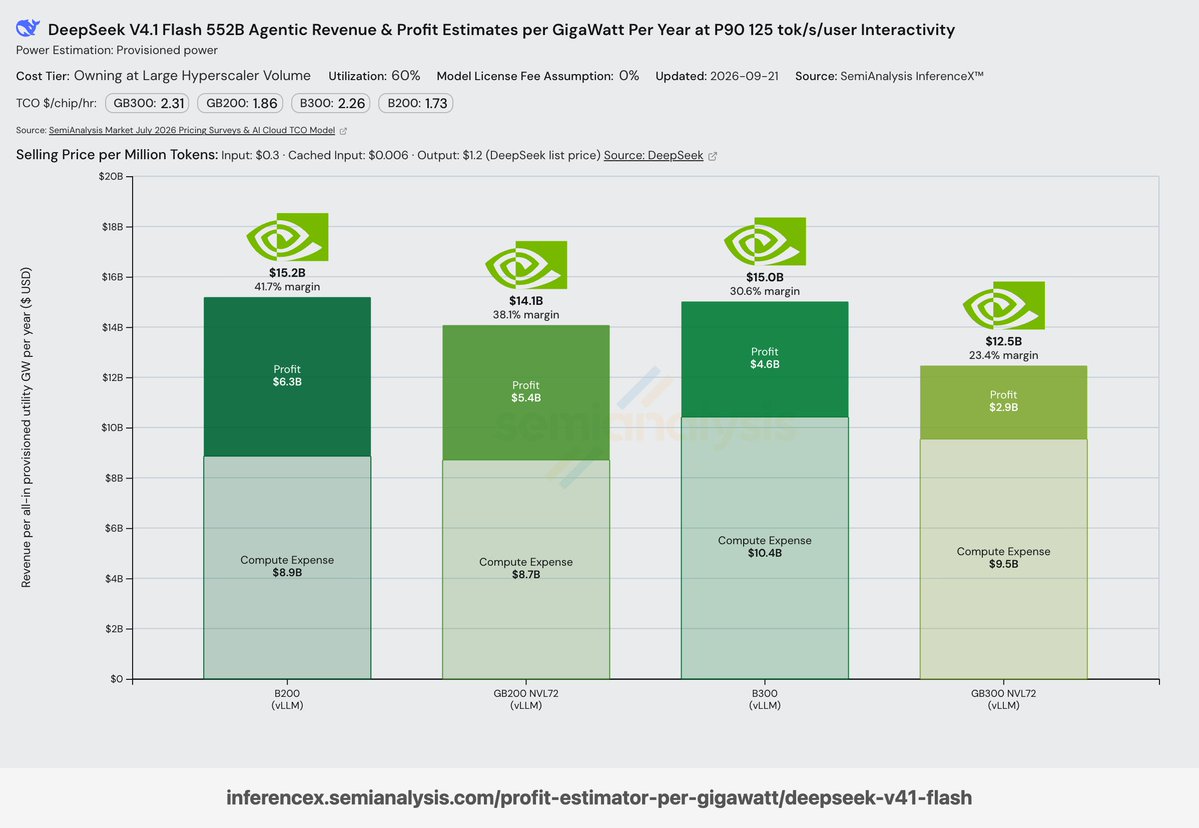
These numbers are much higher than numbers reported by SemiAnalysis below at 15B revenue per GW with B200 GPUs (not GB200) with the same model DS Flash 4.1. The difference shows the power of NVL72 architecture are large scale up domain.
Large domains afforted by NVL72 allow to have large scale up domain for decode of 64 GPUs (WideEP). This allows for much less use of HBM on each GPU for weights (spread out), and more use for long sequences and batches. This allows them to serve 200+ tokens per second per user and still make 38$ revenue per GPU.
If those numbers check out, implications are massive!
Impact on demand and supply:
---------------
Now imagine with 50GW compute by 2027 that SemiAnalysis claims will come online (I trust them), even with 50%/25GW going to training and post training, how much would have to be token consumption in USD to use up all 25GW at DeepSeek rates? 2.5T USD off course (25 GW * 100B / GW)
Leading US labs are more expensive in terms of token rates (say 4 times), so revenue would have to be 10T USD ARR to consume 25GW inference compute by 2027 end.
That is 8% of Global GDP of 125T USD. This is at the time revenue may be slowing down, if we are to believe all the rumours.
Industry Implications
---------------
But, this newfound DeepSeek efficiency will make Meta Muse much cheaper to serve, for example.
Overall, assuming US labs already have such efficiencies or they incorporate them, this is superbullish for US labs, as well as, existing hyperscalar who may be able to charge much more for existing GPUs by slowing down build outs beyond 2027 (with LTAs it is hard though).
Coming back to question: How does 1 GW of GB200 compute turn into ~$148B/year (100B with slack) in revenue?
The math behind the token economics vs. standard cloud rental 🧵👇
CC: @firstadopter@bubbleboi@GavinSBaker@zephyr_z9@teortaxesTex
Share
Copied
SemiAnalysis@SemiAnalysis_
MONEY PRINTER ALERT🚨 NVIDIA vLLM B200 CAN GENERATE UP TO💰️$15 BILLION💰️OF ANNUAL PROFITS PER GIGAWATT serving the open DeepSeekv4.1 Flash model at the official interactivity & official selling prices.
Using Engram DRAM offloading on NVIDIA results in a 50% increase in revenue per GigaWatt.
MONEY PRINTER ALERT🚨 NVIDIA vLLM B200 CAN GENERATE UP TO💰️$15 BILLION💰️OF ANNUAL PROFITS PER GIGAWATT serving the open DeepSeekv4.1 Flash model at the official interactivity & official selling prices.
Using Engram DRAM offloading on NVIDIA results in a 50% increase in revenue per GigaWatt.
RT @arfrank: “AI is going to take the old business models of ads and subscriptions and just annihilate them. Something will replace it, and I think there’s a good likelihood it’s going to be built on stablecoins.” - @eastdakota
Was incredibly prescient of Matthew Prince (@cloudflare) with @benmilne (@bralexyz) at @averystableconf in March of this year. Can't wait to tell you what @ay_o@kerrykellogg and I are working on for next year!
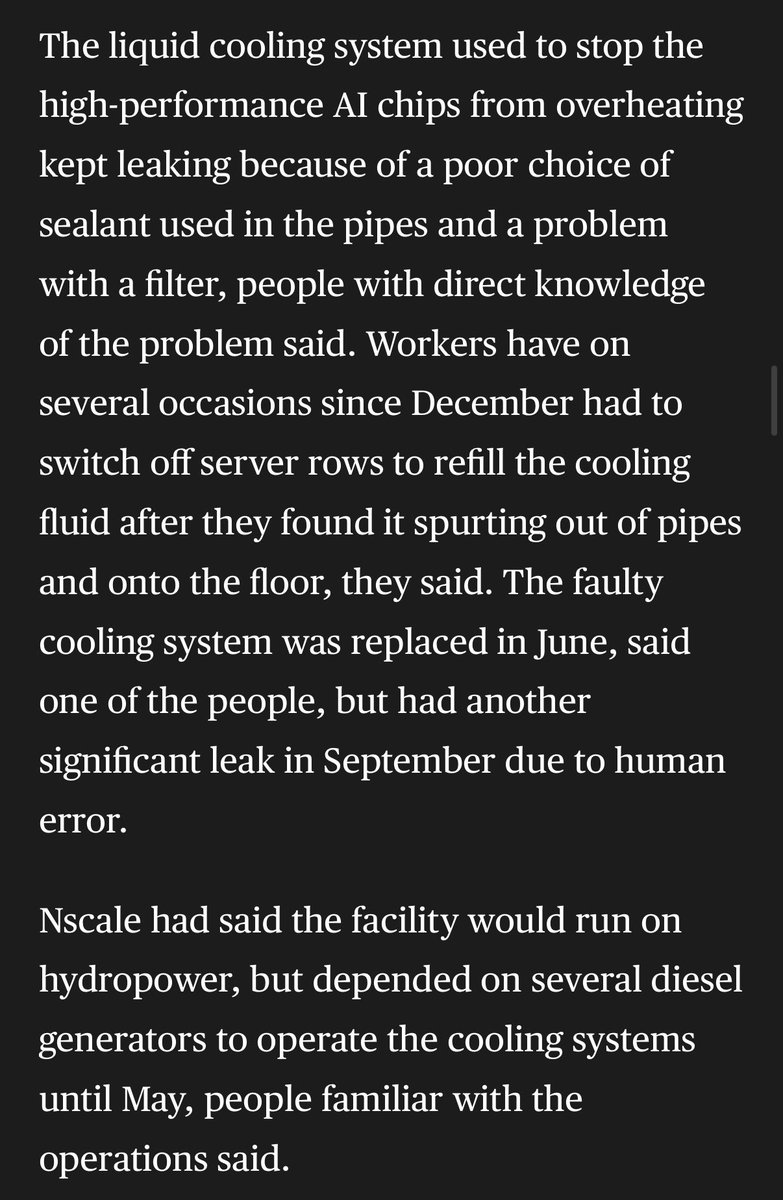
RT @tsait26: From my experience, this is factually accurate..any anomalies and leaks with Liquid Cooling can take the entire AI FACTORY down for days!! This is just one of the many triggers and reasons.
Today, there is a lack of end-to-end monitoring and unified correlation across critical environment, compute, and network layers, which is absolutely needed to deliver a reliable data center as a service. We need holistic telemetry correlation across environmental, compute, and networking domains to break down monitoring silos and deliver complete operational visibility end to end.
In addition to that, we need topology-aware root cause analysis, which enables us to pinpoint root causes precisely and quickly. By combining the physical asset topology with real-time diagnostic signals, we can get to the root cause of the problem to solve it as soon as possible, and pinpoint exactly where it is happening.
We cannot build assuming nothing will fail. It is about how resilient and fault tolerant we are. It is about how quickly and proactively we can detect, root cause, mitigate and recover end-to-end.
RT @tsait26: We are in an AI Infra Supercycle where procuring GPUs is only Step1 but maximizing the ROI needs continuous optimized hardware and software availability.
From the time a GPU lands at the dock, we need to get it up and running in a record number of days and not months of debugging.
The reality most teams are dealing with right now:
1. Spending several months in debugging hell just to get a cluster to Day-One.
2. Silent, low-level network and compute glitches compounding until a multi-million-dollar run crashes mid-checkpoint.
3. Zero correlated visibility across thermals, hardware, and fabric to catch failures before jobs die.
Procurement isn’t really the bottleneck anymore.
Keeping the cluster alive and actually driving ROI is.