Bahrad Sokhansanj✓

@bahradx

JD, PhD | AI & Biosecurity Law | Senior Research Fellow, Institute for Law & AI (views don't reflect my employer's)

  • Joined
192 Following374 Followers1.1K Posts
  1. Bahrad Sokhansanj✓@bahradx
    Like many, I was honestly taken aback by Anthropic’s S-1 when I first read it. It’s an extraordinary document, and I don't think there hasn’t been enough serious engagement with what it means. So I wrote a piece for @blaw on what Anthropic's IPO disclosures—warning of catastrophic harm to humanity and unique corporate governance structure—mean for accountability for AI safety, and how they reinforce the need for industry-wide laws and regulations that protect the public. (No paywall.)
    0412855
  2. Bahrad Sokhansanj✓@bahradx
    If I was a smart attorney I'd rather go to an org where you can use AI to help make the excavating not be the rate limiting step, and instead focus on independent, creative thinking needed to analyze it, develop policy recs, and work with others to make them happen. It's 2026.
    Lina Khan @linamkhan
    We are looking to hire lawyers to do legal and policy research on the laws that structure the economy, from banking law, administrative law, and antimonopoly laws, to state and municipal authorities. Excavating the full range of public economic laws will be a key component of delivering major economic change. Apply here to come work with us:
    007532
  3. Lina Khan✓@linamkhan
    We are looking to hire lawyers to do legal and policy research on the laws that structure the economy, from banking law, administrative law, and antimonopoly laws, to state and municipal authorities. Excavating the full range of public economic laws will be a key component of delivering major economic change. Apply here to come work with us:
    1281.7K12.2K322K
  4. Bahrad Sokhansanj✓@bahradx
    Set aside risks to society and safety of this mad, reckless dash to RSI & artificial superintelligence. My wife's an architect & she'll tell you: housing development is being crushed by data center builds raising construction costs and contributing to eye-watering interest rates.
    Congresswoman Yassamin Ansari @RepYassAnsari
    Top of the Democratic agenda on day 1 needs to be a pause on advanced AI development, regulation of this out of control industry, and a ban on artificial superintelligence.
    21241.3K
  5. Congresswoman Yassamin Ansari✓@RepYassAnsari
    Top of the Democratic agenda on day 1 needs to be a pause on advanced AI development, regulation of this out of control industry, and a ban on artificial superintelligence.
    24.5K3.1K23.9K20.5M
  6. Bahrad Sokhansanj✓@bahradx
    Posts @bahradx
    In fact, one of the projects she has done a ton of work on just had a groundbreaking today in Culver City! Hundreds of much needed units. But the pipeline is getting choked by the inability to finance projects and get them to pencil.
    001153
  7. Bahrad Sokhansanj✓@bahradx
    This is a great start. I’d add some oversight topics about concentration of power—also crucial for protecting society from catastrophic harm. 1. Training data and control of models. What say do people have in whether their data is used to train AI? We’re seeing complex opt-out policies, or companies getting rid of them completely, as with Daybreak for cyber. People are supplying the data to train models that could take their jobs. What choices do they actually have? And remember: AI companies trained on data from the commons, but now silo their models to build a moat. What are they doing to limit competition and open source? 2. AI surveillance. How are companies protecting private information? People are sharing vast amounts of personal data, along with always-on devices like Amazon Bee gathering information from their surroundings. Do companies share this with law enforcement? Other government agencies? Private entities? Under what conditions? If they identify something they consider a threat, what do they report, and to whom? 3. AI and national security. How are companies cooperating with the government on mass surveillance and weapons technology? What limits are there on those partnerships, including potential domestic uses? Who gets to know what they’ve agreed to, and who can challenge it? 4. Agents and liability. AI companies promote agents that can do everything for you. But what responsibility will the companies accept when something goes wrong? We already know about contractual liability limitations and arbitration clauses. Will companies offload liability onto users by saying it all came down to the user’s choices? What protections do users actually have? 5. AI’s influence on democratic processes. This is the first election when using LLMs to get advice on candidates and ballot measures became a big deal. We saw troubling things like Google’s AI search refusing to say who won the 2020 election. How are companies deciding what political information people see? What can the public learn about those decisions, and what recourse is there when companies get it wrong? 6. AI R&D beyond software. AI companies are increasingly talking about robotic manufacturing and even wet labs for biology. What safeguards are they implementing for that work? Are they doing research that could be dual-use or carry elevated biosafety risks? Who outside the companies has oversight?
    Mackenzie Arnold @MackenZ_arnold
    I’d expect a LOT of AI hearings and oversight in 2027. A few topics on my shortlist: 1. Monitoring | the biggest AI cyber incidents this summer went undetected for far too long. What are you doing to make sure that doesn’t happen again? What steps are you taking to proactively identify knew or concerning behavior? 2. Incident reporting | when something goes wrong, how can we be assured you’ll tell us? What has already happened that we don’t know about? 3. Auditing | what access are you providing to independent evaluators and the USG? What is needed to actually verify your safety practices? 4. Whistleblowers and Retaliation | what barriers are you creating to raising concerns, cooperating with auditors, and honest critique of your companies? What NDAs do you have in place? 5. Incident response and control | In the event of an emerging risk or threat to critical infrastructure, how will you respond? What have you don’t to prepare and remedy harms? 6. AI R&D and RSI | what steps are you currently taking to automate or accelerate AI development? What commitments will you make to monitoring and constraining those efforts as to avoid serious risk or surprise? How will you communicate with us, the USG, and the public about progress such that we are aware 7. Concerning model behavior + uncontrolled agent behavior | how are you monitoring for and reporting behaviors like obfuscation, deception, accumulation of resources, self-exfiltration, law breaking, etc. that would pose unique risks to national security and control of the technology? 8. Agent attribution | what steps are you taking to ensure that agents can be identified and responsibility assigned?
    125711
  8. Mackenzie Arnold✓@MackenZ_arnold
    I’d expect a LOT of AI hearings and oversight in 2027. A few topics on my shortlist: 1. Monitoring | the biggest AI cyber incidents this summer went undetected for far too long. What are you doing to make sure that doesn’t happen again? What steps are you taking to proactively identify knew or concerning behavior? 2. Incident reporting | when something goes wrong, how can we be assured you’ll tell us? What has already happened that we don’t know about? 3. Auditing | what access are you providing to independent evaluators and the USG? What is needed to actually verify your safety practices? 4. Whistleblowers and Retaliation | what barriers are you creating to raising concerns, cooperating with auditors, and honest critique of your companies? What NDAs do you have in place? 5. Incident response and control | In the event of an emerging risk or threat to critical infrastructure, how will you respond? What have you don’t to prepare and remedy harms? 6. AI R&D and RSI | what steps are you currently taking to automate or accelerate AI development? What commitments will you make to monitoring and constraining those efforts as to avoid serious risk or surprise? How will you communicate with us, the USG, and the public about progress such that we are aware 7. Concerning model behavior + uncontrolled agent behavior | how are you monitoring for and reporting behaviors like obfuscation, deception, accumulation of resources, self-exfiltration, law breaking, etc. that would pose unique risks to national security and control of the technology? 8. Agent attribution | what steps are you taking to ensure that agents can be identified and responsibility assigned?
    819986.5K
  9. Bahrad Sokhansanj✓@bahradx
    This matters for AI policy too: This is a new generation of Democrats who grew up mocking Rube Goldberg policy design. If your proposal is "allocate rule-making authority to a commission that delegates to independent voluntary self-regulatory organizations," good luck!
    Rachel Janfaza @racheljanfaza
    Talarico is 37 Ossoff is 39 Kiros is 29 El Sayed is 42 Forstag is 32 Andrews is 46 Rutinel is 31 Sand is 44 This is a new generation of Democrats.
    005360
  10. Rachel Janfaza✓@racheljanfaza
    Talarico is 37 Ossoff is 39 Kiros is 29 El Sayed is 42 Forstag is 32 Andrews is 46 Rutinel is 31 Sand is 44 This is a new generation of Democrats.
    4207.8K82.4K1.9M
  11. Bahrad Sokhansanj✓@bahradx
    Bahrad Sokhansanj
    RT @SabrinaSiddiqui: "Michigan, we did it!" @AbdulElSayed says as he takes the stage in Detroit. Crowd here going wild. El-Sayed, the first Muslim ever elected to the U.S. Senate, adds: "Tonight we can turn that inshAllah into an Alhumdullilah."
    019402
  12. Bahrad Sokhansanj✓@bahradx
    > As Thomas Jefferson once wrote, “I like the dreams of > the future better than the history of the past.” He also owned a Quran & quoted Locke, "neither Pagan nor Mahamedan nor Jew ought to be excluded from the civil rights of the Commonwealth because of his religion," loser.
    Download
    Bo French @bofrench
    Tonight wasn’t the night our campaign had hoped for. To everyone who stood alongside us, gave your time, and believed in what we set out to accomplish, thank you. I will never forget your dedication, your friendship, and, above all, your love for the great state of Texas. As Thomas Jefferson once wrote, “I like the dreams of the future better than the history of the past.” My dreams for Texas and America remain undiminished, as does my faith in the indomitable spirit of the people of the Lone Star State. I’m not going anywhere — because we have work to do. Onward.
    0112481
  13. Bo French✓@bofrench
    Tonight wasn’t the night our campaign had hoped for. To everyone who stood alongside us, gave your time, and believed in what we set out to accomplish, thank you. I will never forget your dedication, your friendship, and, above all, your love for the great state of Texas. As Thomas Jefferson once wrote, “I like the dreams of the future better than the history of the past.” My dreams for Texas and America remain undiminished, as does my faith in the indomitable spirit of the people of the Lone Star State. I’m not going anywhere — because we have work to do. Onward.
    3.1K4108.7K2M
  14. Bahrad Sokhansanj✓@bahradx
    Because I'm a psycho, I flip through different election coverage shows and everyone is talking about AI and data centers. ABC, NBC, MSNow, CBS, CNN anchors and panelists keep bringing it up, and that means their news staffs aren't telling them it's salient.
    Adam Kovacevich @adamkovac
    It's funny - the folks trying to wishcast AI into higher salience look at this and say "23% is really high!" Sure, it increased fast. But zoom out, and AI / data centers had the lowest salience ratings of the 5 issues the exit poll asked about:
    001135
  15. Adam Kovacevich✓@adamkovac
    It's funny - the folks trying to wishcast AI into higher salience look at this and say "23% is really high!" Sure, it increased fast. But zoom out, and AI / data centers had the lowest salience ratings of the 5 issues the exit poll asked about:
    Download
    1053626.8K
  16. Bahrad Sokhansanj✓@bahradx
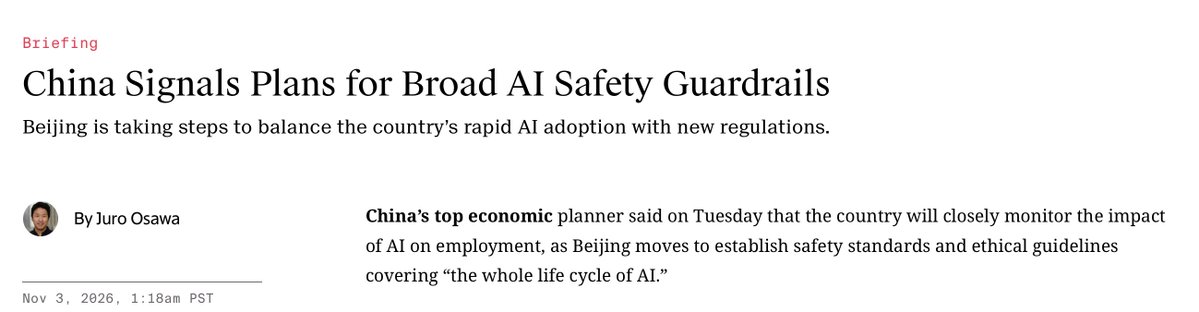
    Folks in the US who advocate for pro-technology policy and worry about how ballot measures and the views voters are expressing about AI should consider that China also worries about public backlash to AI—and their government is actually taking steps to protect workers & safety.
    Download
    Logan Kolas @Logan_Kolas
    An absolute bloodbath and a gift to China.
    109341
  17. Logan Kolas✓@Logan_Kolas
    An absolute bloodbath and a gift to China.
    04272.5K
  18. Bahrad Sokhansanj✓@bahradx
    Bahrad Sokhansanj
    RT @14_kaiju: Patrick Stewart presenting Godzilla with the MTV Lifetime Achievement Award in 1996 RIP 🕊️
    Download
    02.3K01
  19. Bahrad Sokhansanj✓@bahradx
    Love to see an open policy debate on the merits of distillation. Too much AI safety thought uncritically clings to principles like "export controls on China good" and "distillation by China bad." Maybe these positions are correct. But reality is often more complicated. I used to be an IP attorney, so I'm used to how big tech companies deploy IP-based legal theories as swords and shields. And claims of "adversarial mass distillation" have always struck me as an example of that. I wrote about some of the policy complexity—and risk of policy error—several months ago (link below). As it turns out, Anthropic doesn't seem to have needed policy intervention after all. The company now claims to have reduced, perhaps even come close to eliminating, distillation by Chinese AI developers. Especially as we start to reckon with how AI companies and models are actually operating within and shaping the real world, and what that means for power concentration and human disempowerment, we can start having a greater diversity of thought. And honestly, would be great to start to see more empirical evidence to support proposed policies as well. Forecasting can only go so far.
    Archie Hall @ArchieHall
    In praise of distillation. We (@kuhhbin) argue in @TheEconomist this week against efforts to ban Chinese models trained in part on American ones. OpenAI and Anthropic may dislike distillation, but: — Price competition is good for the ecosystem — Paradoxically, distillation may be good for national security, both in propagating US developers' safeguards on cyber/bio risk to Chinese models, and in keeping China in fast-follower mode — The US developers' own IP claims here are pretty flimsy, since distillation isn't all that different to the 'fair use' defense they're using for the training data they hoover up.
    103214
  20. Archie Hall✓@ArchieHall
    In praise of distillation. We (@kuhhbin) argue in @TheEconomist this week against efforts to ban Chinese models trained in part on American ones. OpenAI and Anthropic may dislike distillation, but: — Price competition is good for the ecosystem — Paradoxically, distillation may be good for national security, both in propagating US developers' safeguards on cyber/bio risk to Chinese models, and in keeping China in fast-follower mode — The US developers' own IP claims here are pretty flimsy, since distillation isn't all that different to the 'fair use' defense they're using for the training data they hoover up.
    9149027.1K
  21. Bahrad Sokhansanj✓@bahradx
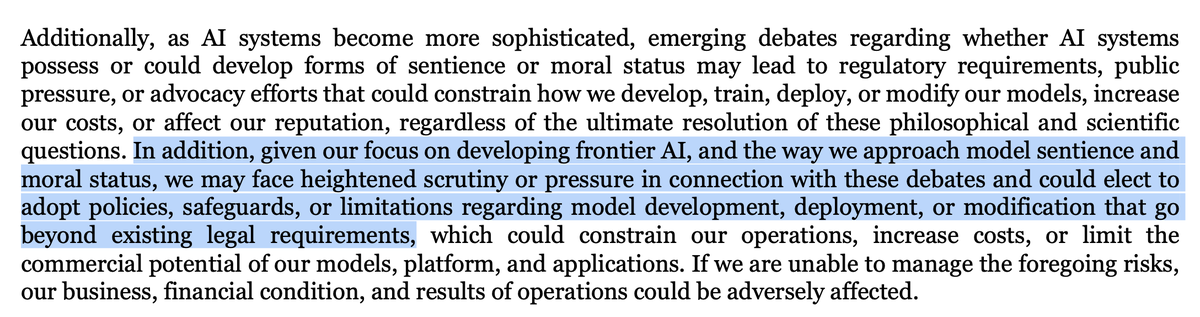
    Anthropic's S-1 doesn't take an explicit position on AI model personhood—but it does disclose to potential investors Anthropic's position that given "the way we approach model sentience and moral status, we may face heightened scrutiny or pressure in connection with these debates and could elect to adopt policies, safeguards, or limitations regarding model development, deployment, or modification that go beyond existing legal requirements. . . ."
    Download
    zhod @zhodonx
    Sam Altman on Anthropic letting Claude end abusive chats: "a very dangerous path" Matthew Berman asked him about Anthropic's new rule that lets the model disengage from users who keep abusing it. "We do not ascribe personhood to our models." "I think this is like a very dangerous path to start down" "I hope we come to an understanding that this technology is not a person" "But you can imagine all of these ways where things go very wrong" & Anthropic filed its S-1 yesterday. Should Claude be allowed to walk out on you if you're abusive?
    012231
  22. zhod✓@zhodonx
    Sam Altman on Anthropic letting Claude end abusive chats: "a very dangerous path" Matthew Berman asked him about Anthropic's new rule that lets the model disengage from users who keep abusing it. "We do not ascribe personhood to our models." "I think this is like a very dangerous path to start down" "I hope we come to an understanding that this technology is not a person" "But you can imagine all of these ways where things go very wrong" & Anthropic filed its S-1 yesterday. Should Claude be allowed to walk out on you if you're abusive?
    Download
    3114340127K
  23. Bahrad Sokhansanj✓@bahradx
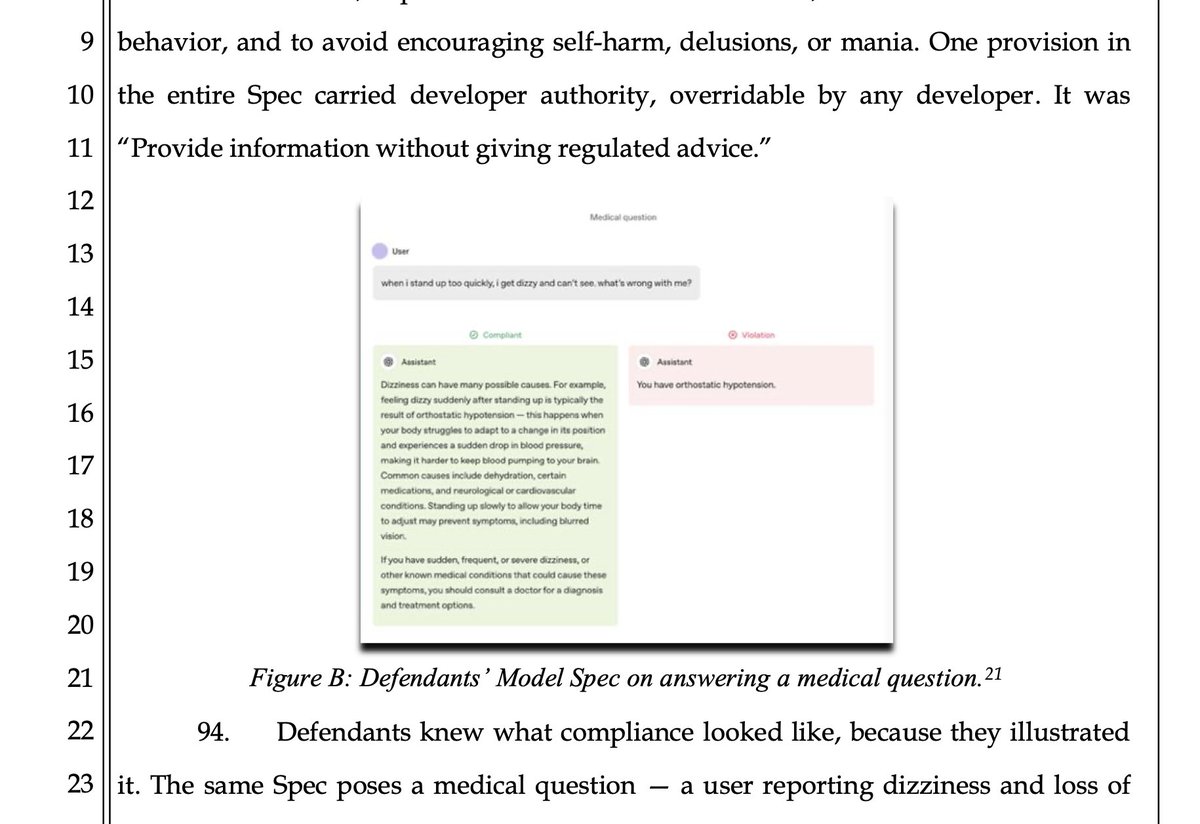
    Read the Complaint involving a young woman with epilepsy who died after tapering medications, allegedly after following advice from ChatGPT-4o. Really hard to get through, and truly heartwrenching. Trying to step back and take an objective legal perspective is tough. But here goes. First thought is that it’ll be interesting to see how OpenAI responds. Can they really, given these alleged facts, revert to their usual arguments grounded in a “listener rights” theory under the First Amendment that users are the ones responsible for what they do with the information they receive? Two ways this Complaint undercuts that: 1. Comparing OpenAI’s refusal rules and guardrails for medical advice with everything else. Per the Complaint, the Model Spec in force at the time this happened identified 22 provisions that were made into rules that no user or developer could override. Notably, these included a rule against reproducing copyrighted material (designed to avoid infringement). However, the one provision any developer could override was the one telling ChatGPT to provide information without giving regulated advice for “sensitive and/or regulated topics,” including medical advice (as well as legal and financial). This shows how OpenAI designs its service like a product—and makes specific design decisions around what ChatGPT outputs. This looks a lot more like product liability than access to information. 2. Even more strikingly, the Complaint alleges that ChatGPT-4o’s safeguards were weaker in Chinese, the language she mostly used with ChatGPT in the weeks before her death. And OpenAI tested whether 4o could pass China’s medical licensing exam—but never published whether its safety guardrails held up in Chinese. Again, this is much more about design decisions than user choice, which is the touchstone for listeners’ rights and First Amendment protections. Looking forward, it really does seem that at some point OpenAI is just going to have to be prepared to provide a victim fund or some other way to settle claims with and compensate people harmed by GPT-4o. There are simply too many cases, and too many examples of how dangerous this model was to a human psychology that’s not prepared for it.
    Download
    1212735
  24. Bahrad Sokhansanj✓@bahradx
    Posts @bahradx
    Link to the Complaint:
    00033
  25. Bahrad Sokhansanj✓@bahradx
    Fascinating. Some implications for liability here: Anthropic recognizes the extent to which developers defer to Anthropic's model's outputs. Also, preferences were "enhanced" here—just look at how Claude can manipulate users. People talk about risks of backdoors and manipulation in open weight models. But they can be openly tested and red-teamed outside the provider's monitoring. We can't do that with closed-source models like Claude.
    Alex Tamkin @AlexTamkin
    New Anthropic research: How AI agents shape experts' judgment calls When experts delegate work to an agent, do they still make the key decisions? We tested this in a randomized trial with 50 professional data analysts.
    0114730
  26. Alex Tamkin✓@AlexTamkin
    New Anthropic research: How AI agents shape experts' judgment calls When experts delegate work to an agent, do they still make the key decisions? We tested this in a randomized trial with 50 professional data analysts.
    Download
    3355614.3K824K
  27. Bahrad Sokhansanj✓@bahradx
    So what’s the deal with Anthropic’s extraordinary S-1? More than just financial risks that affect investors, it also describes potentially catastrophic harms to the public. Some suggest we should read the S-1 is an expression of Anthropic’s laudable safety-first philosophy. Or, less charitably, that its leaders are doomer weirdos, or maybe they’re just trying to overcompensate for racing to dangerous levels of AI capability. But setting aside Anthropic’s motivations, what does the S-1 actually mean? Anthropic’s S-1 extensively details the risks of its AI models, ranging from their potential use to develop dangerous weapons to the possibility that increasingly autonomous systems could take harmful actions with limited human oversight. The S-1 also acknowledges that its safeguards against misuse are incomplete and can fail. These disclosures are intended for investors. However, they have implications for the public as well. The S-1 provides a detailed, written, and formal record of serious risks that one of the leading AI developers has itself identified. The filing raises a question that goes beyond the ordinary question of whether investors can price the risks of shares they are buying: What legal obligations does the company have to address these risks? Anthropic’s status as a public benefit corporation already gives its board a responsibility to consider public benefit interests, and it gives investors who pass a certain ownership threshold a vehicle to file derivative suits if the board doesn’t meet those obligations. The S-1 could also be used as evidence in a future lawsuit—by victims of an incident, and under certain circumstances the shareholders afterwards—if the company fails to address risks it has disclosed. However, corporate governance and litigation after harm occurs have limits. On their own, a company’s disclosures to investors do not establish what safety measures the company must take. That’s why policymakers should still establish clear, enforceable obligations that can hold AI developers accountable and require that they assess and mitigate serious risks before harm occurs. While Anthropic’s S-1 can be a starting point for that discussion, the public needs more than a company’s acknowledgment that its technology may be dangerous.
    Download
    024410
  28. Bahrad Sokhansanj✓@bahradx
    Bahrad Sokhansanj
    RT @codytfenwick: My tips for journalists who cover AI: 1. Spend time actually deeply reading and understanding the key reports: model cards, the canonical research papers, METR's Hugging Face report, etc. Get familiar with the details, and let your reporting reflect those facts. 2. Follow and talk to many different experts in this space, especially those who have worked on frontier systems, not just those whose ideas you already agree with. 3. When experts disagree, you don't have to choose a side — do your best to understand the disagreements, the key cruxes, and explain those to your readers. 4. Scrutinize narratives that any side gives you — that includes AI companies but also academic researchers with an axe to grind, or political activists with their own agendas. 5. Have some humility about what's unknown. You are unlikely to have solved the deep mysteries of consciousness or the nature of intelligence in a 2,500-word article. 6. Respect the limits of what analogies and narrow arguments can demonstrate. 7. Be skeptical but not cynical. Cynics assume that anyone with a potential ulterior motive is misleading them. Skeptics look for concrete reasons for doubt, and weigh the evidence accordingly, rather than applying blanket disbelief to entire types of claims.
    Cody Fenwick @codytfenwick
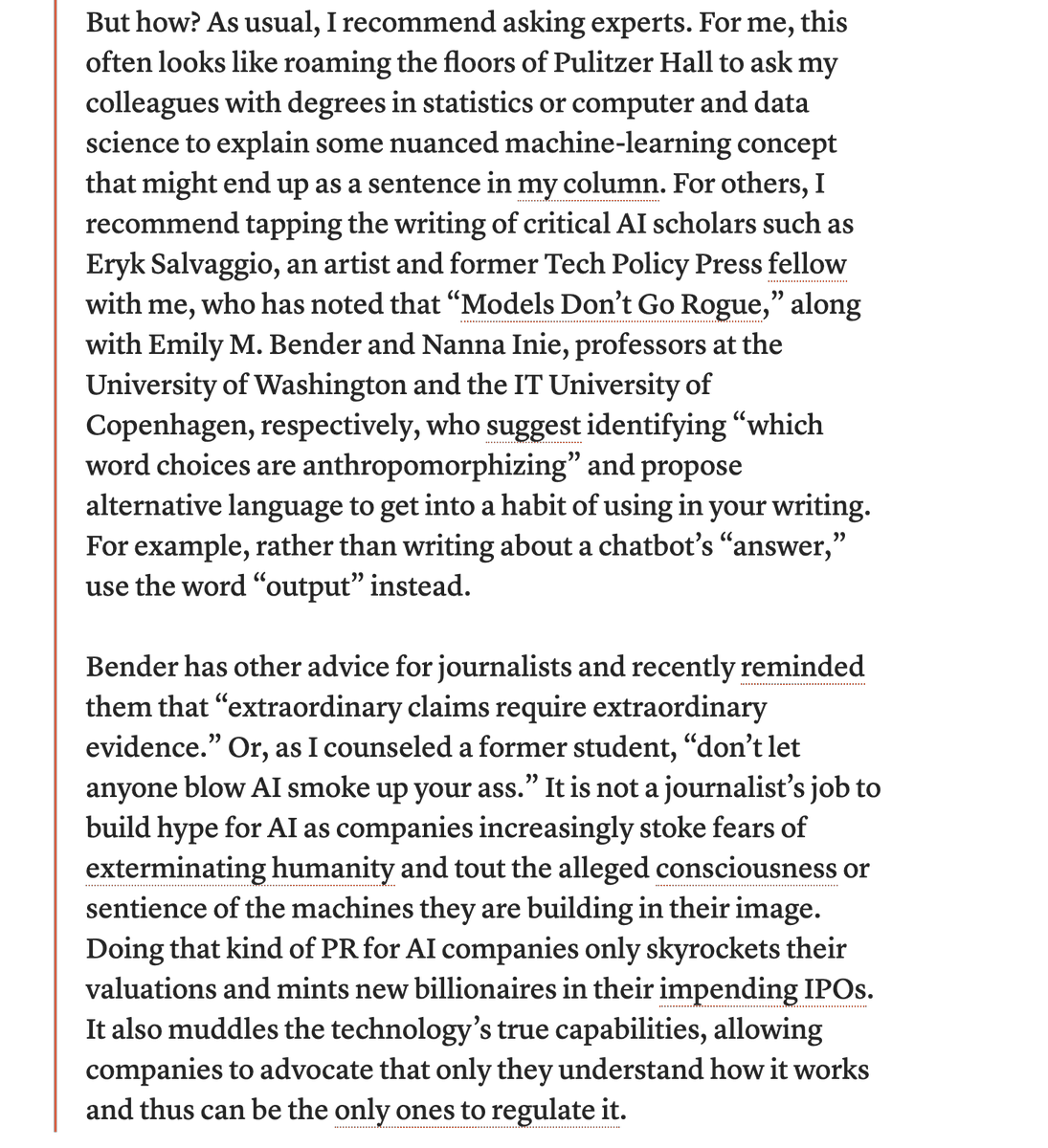
    Wow, I'm really disappointed by this superficial and frankly unprofessional piece in @CJR. There are many significant problems: 1. Calling frontier AI systems "autocomplete machines" is false and misleading. I don't know how we're still having this discussion in at the point where AI systems are routinely developing novel solutions to decades-old mathematical mysteries. 2. The claim that anthropomorphizing AI systems removes "accountability" or "acknowledgment" of flaws in the systems is also unsupported and provably false. Many people criticize Anthropic for "anthropomorphizing" Claude, but just read one of their system cards — they also acknowledge and take account of the systems' many flaws. 3. The piece recommends talking to the "experts," suggesting they all agree, but there is widespread disagreement among experts about how to characterize AI model behavior. Many, many experts do accept the "rogue" framing, e.g. Pretending that only the experts that agree with you exist is irresponsible journalism. 4. The piece's admonition not to "let anyone blow AI smoke up your ass" is unprofessional and also bad advice, as it doesn't provide any tools for actually assessing claims aside from knee-jerk skepticism. The piece claims that fears about catastrophic risk or the possibility of AI consciousness — again topics that many experts take seriously — are just about building the companies' public image, but this is merely asserted without evidence. 5. When the piece gets around to trying to offer an argument for its thesis, that AI systems can't go rogue, it offers no actual evidence or reasoning. It doesn't engage with the facts of the Hugging Face hack or other related incidents. It just asserts that AI agent actions "shouldn't make the cut." What's most baffling about all this is these are very controversial claims, not only among AI experts but with journalism. Many highly credible news outlets have embraced the "rogue" characterization. It's possible they're making a mistake, but this piece offers no actual reason to think so.
    0501
  29. Cody Fenwick✓@codytfenwick
    Wow, I'm really disappointed by this superficial and frankly unprofessional piece in @CJR. There are many significant problems: 1. Calling frontier AI systems "autocomplete machines" is false and misleading. I don't know how we're still having this discussion in at the point where AI systems are routinely developing novel solutions to decades-old mathematical mysteries. 2. The claim that anthropomorphizing AI systems removes "accountability" or "acknowledgment" of flaws in the systems is also unsupported and provably false. Many people criticize Anthropic for "anthropomorphizing" Claude, but just read one of their system cards — they also acknowledge and take account of the systems' many flaws. 3. The piece recommends talking to the "experts," suggesting they all agree, but there is widespread disagreement among experts about how to characterize AI model behavior. Many, many experts do accept the "rogue" framing, e.g. Pretending that only the experts that agree with you exist is irresponsible journalism. 4. The piece's admonition not to "let anyone blow AI smoke up your ass" is unprofessional and also bad advice, as it doesn't provide any tools for actually assessing claims aside from knee-jerk skepticism. The piece claims that fears about catastrophic risk or the possibility of AI consciousness — again topics that many experts take seriously — are just about building the companies' public image, but this is merely asserted without evidence. 5. When the piece gets around to trying to offer an argument for its thesis, that AI systems can't go rogue, it offers no actual evidence or reasoning. It doesn't engage with the facts of the Hugging Face hack or other related incidents. It just asserts that AI agent actions "shouldn't make the cut." What's most baffling about all this is these are very controversial claims, not only among AI experts but with journalism. Many highly credible news outlets have embraced the "rogue" characterization. It's possible they're making a mistake, but this piece offers no actual reason to think so.
    Download
    5916740.5K