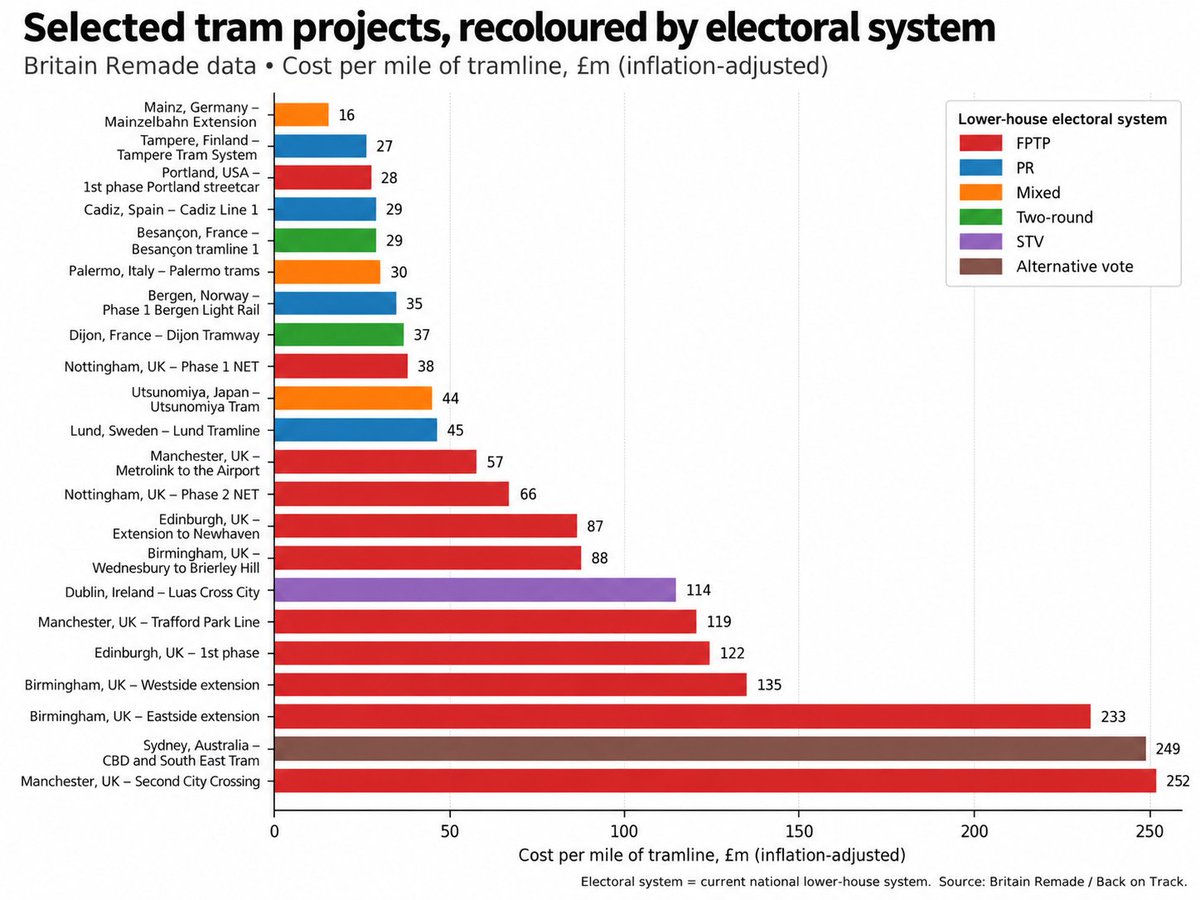
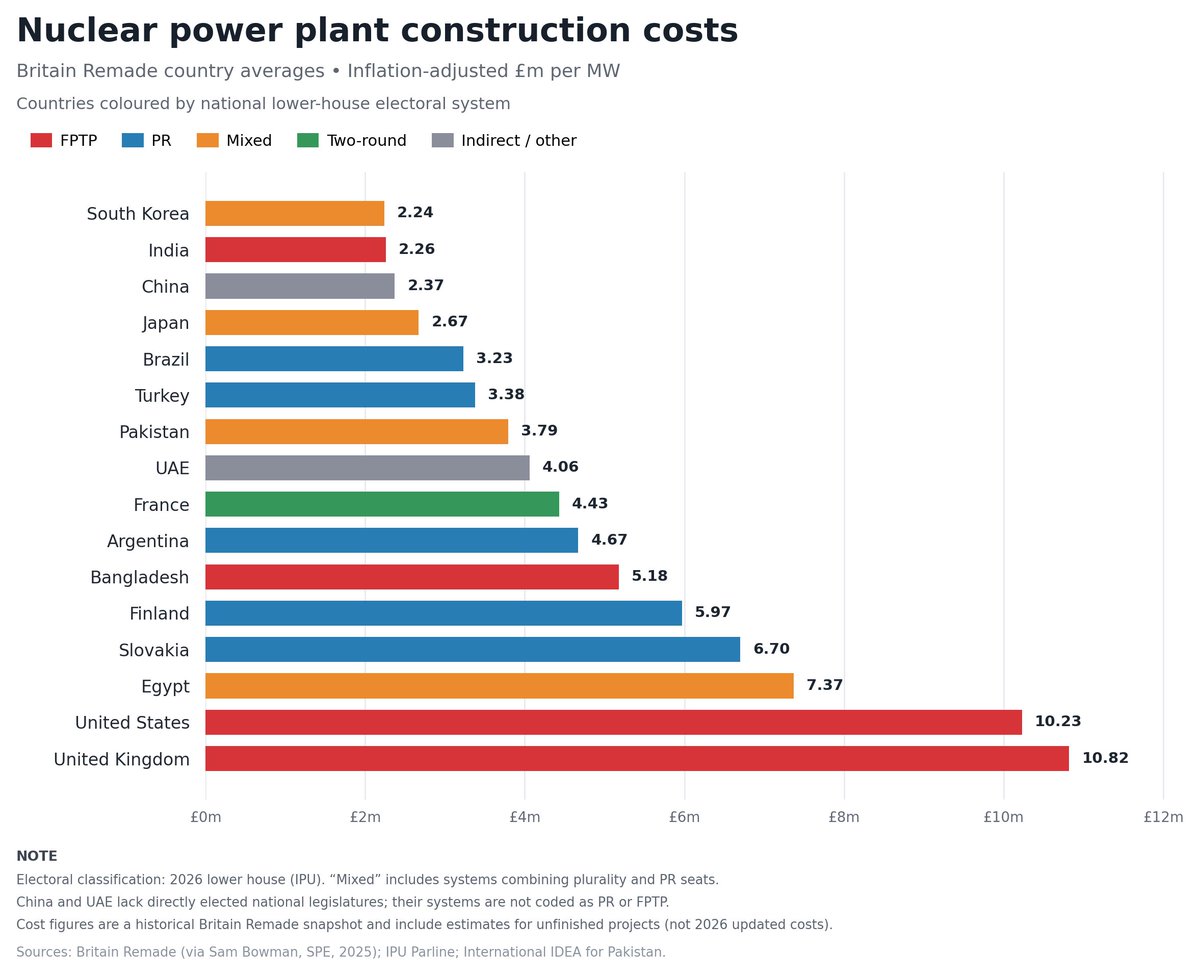
Here's
@BritainRemade's tram project cost list, colored by electoral system. What do you notice? First past the post systems are more expensive than proportional representation systems. Generally, if you look through the data, you will find the same thing. But what is going on? I have a theory.
FPTP vs PR is partly a cause of the story and partly an indicator of a broader range of differences between societies. The correlation between majoritarian FPTP systems and common law, for example, has been remarked upon by many people before. It indicates a broader 'administrative' versus 'majoritarian' divide.
A range of commentators have tried to argue that 'common law systems are intrinsically adversarial, and we need consensus-based systems for cheap infrastructure', but this is obviously absurd, and easily refuted by the fact that British and American infrastructure flexibility, decisiveness, speed, and cost, was probably the *best* before the 1970s and 1980s (the common law existed then too!) Costs for common-law countries have exploded only since those decades.
The proximate cause, as identified by
@alon_levy and the Transit Costs Project – and this could easily be extended to a broader range of infrastructure than transit – is the consultant-outsourcing-accountability-sink model. (This interacts with or causes many of the other causes identified: gold plating, redesigns, delays, feast and famine, environmental regulation.) But I differ with Levy and co on whether this is simply an unforced error driven by ideology. Why make all these mistakes and keep making them?
There is a myth in the UK that we are an 'elective dictatorship': we go to the election, elect MPs, and between them they have overwhelming power to do anything they wish on behalf of the nation. Does it feel like our MPs or PMs are all powerful to you? Did the huge Tory majority of 2019-2024 or the huge Labour majority of 2024-today seem to give them the power to enact massive social changes if they wished to?
It *used* to be that a British public need only vote 30 or 40% for a given government, and this slim plurality or majority would be enough to make gigantic decisions. Back when the government had a lot of legitimacy, this gave Britain the most flexible system in the world. Unlike on the continent, where blockers, stakeholders, existing elites all had a formalized say within the system – whether union, or homeowner, or corporate producer interest – majorities in Britain and the US could overturn the deepest rules and interests easily. Before the 1970s, this was a huge advantage.
But after the 1970s, this flipped into becoming a huge disadvantage. The less-flexible continental governments lost less legitimacy in the crises of the 1970s. But, more importantly, their decisionmaking had never depended so much on their legitimacy. Big social decisions had *always* involved more horse trading among stakeholder and interest groups, parties – more corporatism and more formalized bargaining. Before, this simply increased transactions costs. After, this meant they still had means to build consent for change. The flexible states did not.
The important thing to note is that theoretically flexibility is USELESS if the public don't want you to have it. You are actively BETTER OFF putting all sorts of constraints on your ability to act, requiring yourself to ask unions, or agree with other parties, or whatever, so long as those limits help you generate consent for action.
(This is the core insight about why Magna Carta and the Glorious Revolution gave Britain the most powerful, effective, vigorous, and active state in Europe, whereas absolutist monarchs were nearly all ineffective and unable to make profound changes to their societies.)
The problem in Britain in the US is that elites have not accepted that they do not have full consent to govern without constraints. They are being dragged, kicking and screaming by populism, towards this conclusion, but refusing to see what is in front of their eyes.
Getting European costs will require European methods: bringing a powerful enough coalition of those affected along to generate the legitimacy for major change.