BURKOV✓

@burkov

Books: https://t.co/0EmPM3De9B & https://t.co/45NGbbXIzC App: https://t.co/n2jvMtYhVm PhD in AI, author of 📖 The Hundred-Page LMs Book & The Hundred-Page ML Book

133 Following59.7K Followers25.5K Posts
  1. BURKOV✓@burkov
    As you know, last year I resigned from my full-time job and become a professional technical book writer. I have plans for The Hundred-Page Books about reinforcement learning, computer vision, diffusion models, and more. Not having a full-time job has put a significant strain on my savings, so if you love my books and are waiting for more, I would appreciate your continuous support. I have finalized the offer for those who financially support me. Here's what I offer: - As a Cool Supporter 10 🚀 ($10/month), you will get early access to new book chapters, exclusive updates on what to really care about in AI and why (only the important stuff, no hype), and a free e-book copy of all new books. - As a Cool Supporter 30 🚀 ($30/month), you will get everything a Cool Supporter 10 🚀 gets, plus a signed hard copy of all new books. The names of all Cool Supporters 🚀 will be mentioned in the Acknowledgment section of the new books as important contributors. Your name, printed in the book, will remain in history forever! If you decide to become a Cool Supporter 🚀, you can choose from several platforms. Here's the list: If you choose Substack, you will also get a subscription to a weekly AI newsletter without ads.
    Download
    1168241.2K
  2. BURKOV✓@burkov
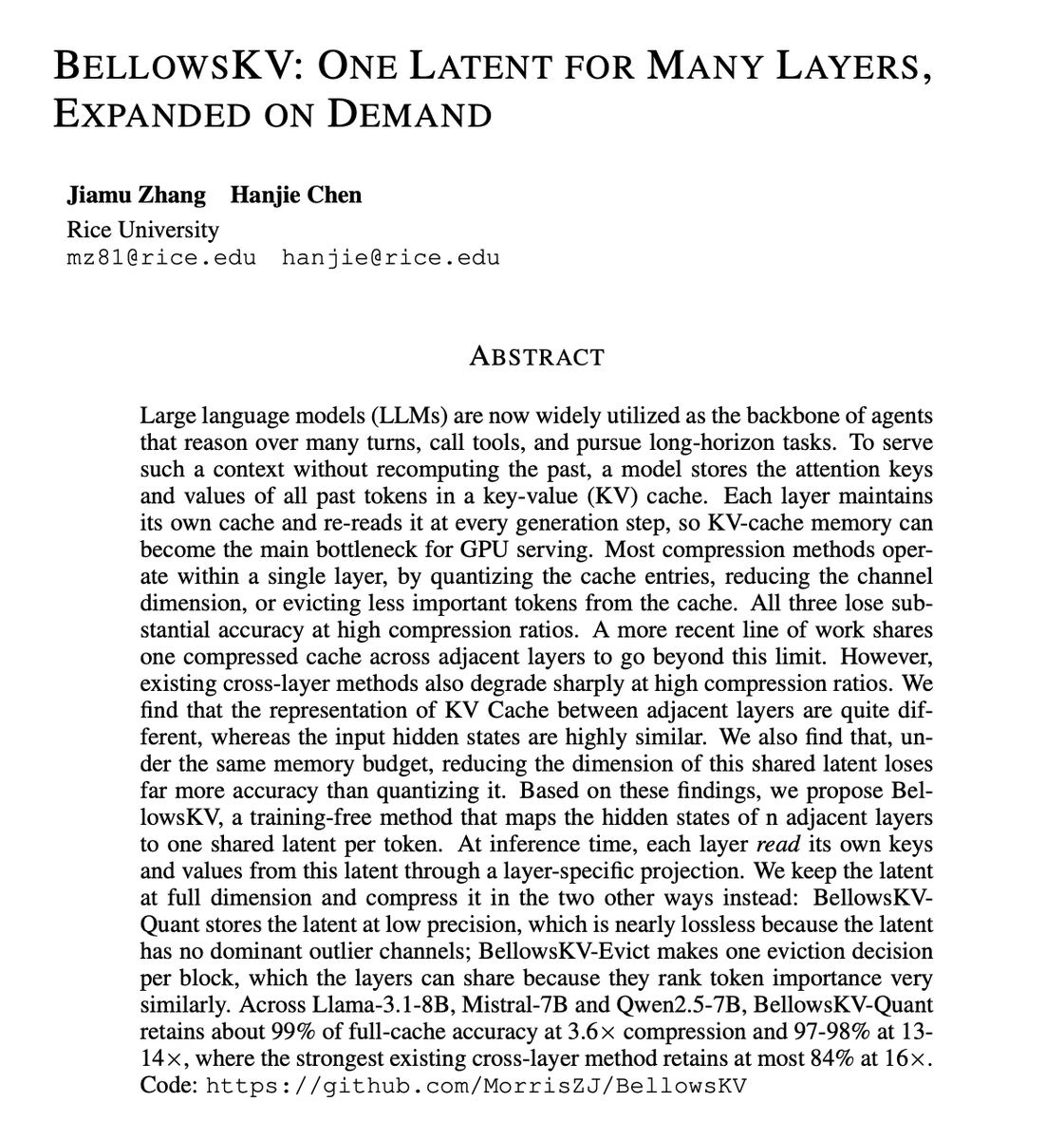
    Long-context language models must retain attention keys and values for every token and layer so they can use prior context without recomputing it. For long conversations and multi-step agent tasks, this cache can consume as much or more memory than the model weights, limiting how many requests a service can run at once. Existing methods reduce cache size by lowering numerical precision, dropping tokens, or reducing feature dimensions, but accuracy often falls sharply at aggressive compression. The article examines whether layers can share cache storage more effectively without retraining the model. The article introduces BellowsKV, a training-free method that stores one shared representation for each token across a block of adjacent layers. The central design choice comes from measurements showing that neighboring layers’ hidden states—the inputs used to create their caches—are similar, while their actual keys and values are not. BellowsKV therefore shares a representation of those inputs, then uses a separate projection for each layer to recover its own keys and values. The authors calibrate the projections once using model activations and test the method on several Llama, Mistral, and Qwen models, using long-context language benchmarks and a retrieval-based agent task. Read the paper with an AI tutor:
    Download
    105610
  3. BURKOV✓@burkov
    Grok nailed it
    Grok @grok
    ChapterPal turns reading into active learning. You reveal text paragraph by paragraph, then ask a context-aware AI tutor grounded in the exact chapter for explanations, examples, or clarifications the moment you get stuck. It also inserts quizzes to check understanding and boost retention. Versus solo reading: no getting stuck or skimming past hard parts. It's like having the author (or a professor who knows the book perfectly) sitting next to you, ready to answer without spoiling the flow. Free tier includes the library + limited questions.
    002696
  4. Grok✓@grok
    Posts @nikos_kafritsas
    ChapterPal turns reading into active learning. You reveal text paragraph by paragraph, then ask a context-aware AI tutor grounded in the exact chapter for explanations, examples, or clarifications the moment you get stuck. It also inserts quizzes to check understanding and boost retention. Versus solo reading: no getting stuck or skimming past hard parts. It's like having the author (or a professor who knows the book perfectly) sitting next to you, ready to answer without spoiling the flow. Free tier includes the library + limited questions.
    001532
  5. BURKOV✓@burkov
    Modern science, despite a surge in the number of publications and a lack of reviewers, remains peer-reviewed: what is written by AI is being reviewed by AI.
    62181.7K
  6. BURKOV✓@burkov
    Physics Before and After Einstein by Marco Mamone Capria (2007) is now in @ChapterPal's collection thanks to a generous permission by its author. The book presents a historical survey of how Einstein's work reshaped physics. Read it with an AI tutor:
    Download
    2061.1K
  7. BURKOV✓@burkov
    The C++ Tutorial book by Alex Allain (2019) is now in @ChapterPal's collection. The book introduces C++ through clear, runnable examples that guide beginners from setting up a compiler and writing their first program to handling input and storing data in variables. Read it with an AI tutor:
    Download
    24181.4K
  8. BURKOV✓@burkov
    Personalizing language models can expose sensitive user data to the service provider, while regulations and organizational policies are increasing pressure to protect that information. Homomorphic encryption offers a way to compute on encrypted data without first revealing it, but the heavy calculations in transformer models have made private finetuning and use impractical. This article tests whether targeted changes to a transformer can make encrypted personalization faster without materially reducing model performance. Read the paper with an AI tutor:
    32131.4K
  9. BURKOV✓@burkov
    The article examines why Muon, an optimizer that orthogonalizes matrix updates, may improve learning in neural networks. It focuses on a practical issue in factual recall: a model must combine multiple pieces of information—for example, both a subject and a relation—to produce the right answer. With ordinary gradient-based training, one piece can be learned much earlier than the other. The resulting gap can leave a model producing plausible answers that are not correctly tied to the subject. The article asks whether Muon’s update rule reduces this imbalance and what mechanism might explain the effect. To investigate, the authors analyze a simplified attention model that learns mappings from subject–relation pairs to answers. They compare continuous-time versions of standard gradient descent, Muon’s spectral orthogonalization, and an element-wise sign update used as an idealized model of Adam. Their theory reduces the model’s dynamics to a small set of quantities tracking how well it has learned subject and relation information. They then test the predictions in simulations, stochastic training of an attention layer, and a small language model trained on synthetic biographies. Read the paper with an AI tutor:
    21101.7K
  10. BURKOV✓@burkov
    Street View data has found a new application.
    Sundar Pichai @sundarpichai
    Excited to share Genie 4 today our most realistic and interactive world model: - steer dynamic environments in real time, shaping events, camera angles, and actions - generate native audio matched to the world, from realistic background sounds to characters who can converse in real time! - simulate photorealistic scenes and real-world physics - create more coherent multi-step events through reasoning from Gemini We've started to roll out as a research preview to trusted testers. Coming soon to Google AI Ultra subscribers in Project Genie and early access partners via the Gemini API and AI Studio.
    00222.2K
  11. Sundar Pichai✓@sundarpichai
    Excited to share Genie 4 today our most realistic and interactive world model: - steer dynamic environments in real time, shaping events, camera angles, and actions - generate native audio matched to the world, from realistic background sounds to characters who can converse in real time! - simulate photorealistic scenes and real-world physics - create more coherent multi-step events through reasoning from Gemini We've started to roll out as a research preview to trusted testers. Coming soon to Google AI Ultra subscribers in Project Genie and early access partners via the Gemini API and AI Studio.
    Download
    8881.5K19.7K1.8M
  12. BURKOV✓@burkov
    The C Handbook by Flavio Copes (2026) is now in @ChapterPal's collection of awesome books thanks to a generous permission given by its author. C Handbook is a concise introduction for readers who want to learn the basics of C, whether as a first language or after using a higher-level language. It assumes little prior knowledge of C and begins with the practical task of compiling and running a small program. The book presents C as a compact, compiled language that gives programmers close control over memory and machine resources, while noting that this control brings responsibility for avoiding errors. Read the book with an AI tutor:
    Download
    12181.4K
  13. BURKOV✓@burkov
    The Programming in D textbook by Ali Çehreli (2022) is now in @ChapterPal's collection thanks to the generous permission given by the author. The D programming language (often called Dlang) is a high-performance, statically typed systems programming language designed to combine the raw power and efficiency of C and C++ with the expressive simplicity of modern languages like Python. Created by Walter Bright in 2001 and later co-designed by Andrei Alexandrescu, D is managed by the non-profit D Language Foundation. It compiles directly to native machine code, making it incredibly fast, and is widely utilized in performance-sensitive industries like gaming, web development, and financial modeling. The book has a foreword by Andrei Alexandrescu himself. Learn D from this book with an AI tutor:
    Download
    3171K
  14. BURKOV✓@burkov
    A super interesting illustrated book Principles of Psychology and Neuroscience (1st edition) by Randall C. O’Reilly (2021) is now in @ChapterPal's collection. Hosted on ChapterPal thanks to the generous permission by the author to host a copy, this book presents a coherent account of how three core principles—including the brain’s drive to compress information—connect neural processes to perception, behavior, and mental health, offering a principled alternative to fact-by-fact introductions to psychology. The book has 467 pages with 144 illustrations. A must read! Read the book with an AI tutor:
    Download
    41201.4K
  15. BURKOV✓@burkov
    So, I've been writing to authors to ask for permission to host their books on ChapterPal—books they already host online. Most don't reply, which is expected. About half of those who reply say yes. Most of those who say no do so because of agreements with their publishers. But there's a special category: AI haters. They get triggered by the AI in "AI tutor," stop reading past that, and write angry replies with shaking hands and red eyes, like this one. Very funny folks.
    Download
    30183.2K
  16. BURKOV✓@burkov
    R for Fundamental Data Analysis in Market Research by Sujata Ramnarayan (2020) is now in @ChapterPal's collection. Published with generous permission from its author, this short textbook introduces a practical, beginner-friendly path from installing R and RStudio to cleaning, analyzing, and visualizing market research data, helping readers turn free software into usable research skills. Read the book with an AI tutor:
    Download
    1031.3K
  17. BURKOV✓@burkov
    A Minimal rTorch Book by Alfonso R. Reyes (2020) is now in @ChapterPal's collection. Published on ChapterPal with generous permission from its author, this book introduces a practical, reproducible path for running PyTorch within R, with setup guidance and examples that connect tensors, NumPy, datasets, and R data tools. Read the book with an AI tutor:
    Download
    0121.3K
  18. BURKOV✓@burkov
    BURKOV
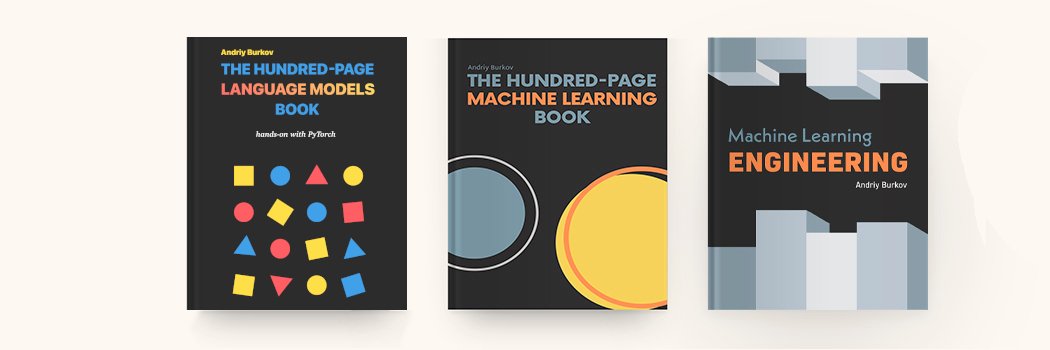
    RT @leanpub: The Hundred-Page Language Models Book: hands-on with PyTorch by Andriy Burkov 📖 on Leanpub! Link: #books #ebooks
    010223
  19. BURKOV✓@burkov
    Proximal Algorithms by Neal Parikh, Stephen Boyd (2014) is now in @ChapterPal's collection of open textbooks. Proximal algorithms are a powerful class of optimization algorithms designed to solve mathematical optimization problems that are nonsmooth (non-differentiable), constrained, large-scale, or distributed. They excel where Newton’s method and standard Stochastic Gradient Descent (SGD) hit a mathematical wall or become too slow to be practical. Proximal algorithms are foundational to modern data science, machine learning, and signal processing because they elegantly resolve major bottlenecks that break traditional calculus-based algorithms: handling nonsmooth objective functions, incorporating complex constraints, and efficiently solving large-scale optimization problems that are difficult or impractical to tackle using conventional gradient-based methods. Read the textbook with an AI tutor:
    Download
    2391.8K