Daniel Koss✓

@daniel_koss

AI infrastructure investor & trader. 2026 YTD: +223%.

375 Following48.2K Followers8.1K Posts
  1. Daniel Koss✓@daniel_koss
    Do I still expect the same $NBIS 2027 price target? Usually I nowadays only share my long-form thoughts on our paid Substack behind a paywall, but because I believe many people got interested in Nebius because of me, I feel like it's only fair to address this topic publicly and for free in the current time where many people panic and are scared. The no. 1 question I get right now from many $NBIS bulls is if I still expect the same price target for 2027. Instead of giving you a stupid yes / no answer that would get more likes, I want to break down exactly how I make my price targets and how you can decide for yourself which numbers to use and, as a result, which price target to expect / make your own. ⚙️ HOW I MAKE PRICE TARGETS When I make my price targets I do it like this: - I model the business the way I expect it to look like in the future, usually it's 12-18 months out. - I then apply the valuation framework I think makes most sense (and adjust expected returns for the risk) - I then apply the multiples that I think would be typical in a "normal" market (long-term median multiple for such businesses, not low or high ones), which means what comparable businesses with a similar model, growth, profitability, profile etc. typically get in a normal market The 2 big variables here are: 1) the valuation framework (do you use EV/EBITDA for $NBIS or do you use an ARR multiple and adjust the multiple based on your revenue quality, profitability, growth, etc.?) 2) The BIG ONE is the multiple. My default for $NBIS is 10x ARR. 📊 WHY ARR, NOT TRAILING REVENUE OR PROFIT I get so many stupid comments on this approach. Many people think they are financial savants for pointing out that revenue doesn't reflect business durability, ARR is NOT revenue, ARR is calculated by multiplying revenue of the last month by 12, revenue doesn't mean profits, etc. No shit Sherlock 😂 First of all: you MUST use a revenue metric, because there is no profit yet. You cannot value this on profits that don't exist today. But you CAN NOT use trailing full-year revenue for a company like Nebius, because they are growing from 1B → 10B ARR → probably 40B+ ARR next year. This is called HYPERgrowth. The market is forward looking. What Nebius did 12 months ago, when it was many hundred percent smaller, simply does not matter for the future. ARR looks at the present. Trailing revenue looks backwards. I actually think you should look at FORWARD ARR, but that's another story. The dumbest people on this app all point out that the business is not profitable. Thanks to all the quants for this insight. Why is the business not profitable? One reason is that it's a fresh business that only exists for a few years. It's a baby company and despite the 40B+ valuation it's essentially a startup. The more important reason is that they are AGGRESSIVELY investing every dollar they make and even taking on dilution and debt to invest as much as possible into the future business, which they do for only one reason: because they (and I as well) believe, based on all available data, it's gonna be incredibly profitable. Do people on here understand the concept of investing 1 dollar today to make more than 1 in the future? Is that a hard concept to follow? Then there's another incredibly stupid thing that people on here do: they compare capex (20-25B this year) with this year's revenue or ARR. Revenue is very stupid for the reason mentioned above, but even comparing it against ARR is very low IQ. Why? Because the money they spend TODAY is used to build data centers that won't even come online this year. These projects take quarters to years depending on the size. And they will generate revenue for many years and currently the past spending looks brilliant because chips that the market thought would today be worthless are now selling near the initial prices at launch. A massive divergence between the initial market thought and now reality. So tl;dr so far: I believe you must use a revenue metric because the profits are in the future (and you should not model it out 3-5 years or it gets very inaccurate), and you must use ARR (not trailing revenue) because this company is growing hundreds of % year over year, STILL. 🧮 HOW DEBT, DILUTION AND PROFITABILITY GET INTO THE MULTIPLE Now what about profitability, debt, etc.? You OBVIOUSLY already adjust for dilution in your assumed share count. And you OBVIOUSLY deduct debt and interest to be paid from future profits. And you OBVIOUSLY adjust your assumed valuation multiple based on the assumed profitability and durability of the business. You understand? You DO account for all these things via the multiple. If you think a business is great and another one is shit, you can use an ARR multiple for both and give one of them an ARR multiple of 30 and the other one an ARR multiple of 1 or 2. 👀 WHAT THE MARKET IS SAYING VS WHAT I EXPECT Right now I believe Nebius can hit over $40B ARR in 2027 and I do think they are trading below a 1x forward ARR multiple. So the MARKET (not me) is currently saying Nebius is a shit business. Ignore all the derps who say Nebius is trading at idk 200x sales or 500x pe etc. all of that is insanely stupid as I explained above. The market currently treats Nebius like garbage, it's NOT richly valued. You gotta really understand that. I obviously disagree strongly and think over the next 12-18 months many people will step by step understand the unit economics better, understand how much PROFIT this business will generate. Why will they learn it? Because we'll see Nebius execute and deliver stronger and stronger results quarter over quarter. I expect not just strong performance from Nebius as a company, I also expect the market to see an ever bigger divergence between companies like Nebius (which I see at the top) and other companies when it comes to execution. I expect Nebius to get financing at significantly better terms than peers. I expect Nebius to add more capacity and faster. I expect Nebius to win on a lot of "boring" topics like customer support, reliability, speed, security, utilization, efficiency, etc. that enterprise customers care VERY MUCH about (FinX might not). All of these things I believe are the reasons why I think Nebius will outperform and deserve a significantly higher ARR multiple. I do completely agree with the market that most "neoclouds" are actually shit and deserve something like 1-3x ARR. Personally I wouldn't even touch most of them. I think many have bad teams, no moats and simply can not execute or build what they promise. Not on the software or physical side and they will simply attempt to copy what others do. This constant lag will lead to significantly worse unit econics! 🐘 THE ELEPHANT IN THE ROOM: THE MARKET ENVIRONMENT Now do you notice what the big elephant in the room here is that could still massively impact the ARR multiple EVEN IF we agree it's the right metric and even if we agree Nebius deserves the highest one? It's the market environment. I wrote in the beginning that I expect 10x ARR as the fair and normal multiple for a business of Nebius' quality in a normal market as the median valuation. But we've seen the market getting increasingly schizophrenic on AI. It goes from parabolic run to panic in weeks. Just looking at all AI stocks shows this. Has nothing to do with Nebius. Right now maybe with the neocloud scare, but it's just another wave. We've had tariffs, DeepSeek, Iran, now neocloud scare, nothing new. Doesn't matter! The valuation will always reflect the CURRENT market environment. Things like wars, oil prices, rates, bond yields, etc. will OF COURSE impact the cost of money, the "risk free" return options and the prices and valuations of equities. Nebius is simply strongly affected by this, just like all other hypergrowth stocks. 🎯 SO DO I STICK WITH MY 2027 PRICE TARGET? All the business assumptions I made in my Substack article stand and most have gotten better. The 2 big fundamental changes that have happened since for the negative are 1) the cost of capital seems to be increasing as of today → WE DON'T KNOW where this will be over the next 12-18 months. It can go either way. In the short-term it seems to be higher for the industry overall. 2) as a result valuations have contracted. If Nebius would hit exactly the numbers I'd expect them to hit by 2027 but right now, the valuation multiple would certainly be lower. Maybe 3-7x not 10x. So yes, I roughly believe in the same price target, but I have no clue how macro will develop in the short-term. I have fundamentally come to accept that I can not accurately predict Trump. I think macro is in general hard, but you can roughly predict where things go based on physical realities and interstes in my view. But Trump... above my paygrade ^^ As an active trader I personally try to trade around these things, but if you're a long-term investor, I really think you should not care too much about this volatility, because in the long-term you will most likely see Nebius' business develop insanely well WHILE the ARR multiple could very well be volatile af and go anywhere from 5 in a panic to 20x in a mania. It simply will happen in both directions. For example when Nebius was $300 earlier this year I sold (at $284) while still believing in a 2x higher price target by next year, simply cause I was trading the volatility and expected the market to be in a short-term mania. Did happen and I bought back lower. Cool to add more shares, but NOT NEEDED for long-term gains. I'm sorry for this long ass post, but since a lot of people here have a lot of their hard earned money on the line and Nebius has a lot of hardcore bulls with very high % concentration, I felt like writing out my thoughts as detailed as possible. Feel free to agree, disagree or make up your own mind. Just sharing my full thoughts here. This post is not financial advice, I obviously could be completely wrong and maybe we do in fact go to zero and all the bears are right. Do your own research and make your own decisions 🤞
    472248066K
  2. Daniel Koss✓@daniel_koss
    Rant incoming about $NBIS and the neoclouds. I've listened to a ton of AI podcasts over the last few days, many from my favorite podcasters. And one thing leaves a really sour taste and makes it very hard for me to take a lot of people in this field seriously: They completely mischaracterize the reality of buying compute. They talk about renting training or inference compute as a pure commodity. No conversation about the product or experience whatsoever, as if it's 100% interchangeable with zero differences in quality. Here's the reality. Whether you're an independent developer, a small team, or especially a big team inside an enterprise, for your long-term planning you do NOT want some random shitty cloud plugging in a few GPUs. One where you have no idea if they'll still exist tomorrow, and whose website crashes every ten minutes. You want an AI cloud with a stable balance sheet, so you know they'll be around for the long term. One that will always have access to the newest NVIDIA GPUs and the hottest gear in the game. You want them to be honest with you about what they can and can't do for you, and to plan ahead with you many quarters out. If there's a problem, they tell you. If you have a problem, you can be open with them. You want a white-glove service with highly competent, responsive experts, where your engineers and their engineers really work together and learn from each other. You explain your use cases and context, and they bring knowledge, expertise and enthusiasm to help you build the products you want to bring to life. Because your cloud provider is a critical part of your ROADMAP. You plan together, you look at demand together, at what's working and what's not. And you learn from them. They see the entire AI field: what's working, what's getting traction, what the best practices are. They make deals with many other companies, so there's a lot of flexibility on payments, reservations and guarantees. Bottom line: whenever serious money flows between serious companies, it's a LONG-TERM PARTNERSHIP. That's also why companies like Shopify and Revolut work with Nebius. Nebius doesn't win them with better GPUs or prices than everyone else. It wins them by being a better long-term partner. These teams respect each other, and they plan, build, and succeed or fail together. It's who you're getting married to for your AI future. And as we all know, that's a very important decision. This is one of the key reasons I'm so bullish on Nebius, and I've never really expressed it. Building the leading AI cloud of the future is so much more than plugging in a couple of GPUs. It's the full experience, the full suite. Your team, your DNA, your culture and your expertise all matter massively to your clients, because they can feel it, and it impacts them strongly. There's this strongly felt difference in competence between people at different clouds. It's hard to express without sounding a lil superstitious, but I'm sure we'll see it reflected in hard numbers going forward. Stuff like retention or customer satisfaction etc.
    10619423.7K
  3. Daniel Koss✓@daniel_koss
    At first glance $GOOG earnings Yesterday looked great. But since stock was down 7-10% I of course got curious what the market hated so much and now looked into it. It's much simpler than I expected. Remember when their stock crashed because investors got scared their ad business would get heavily replaced by AI competitors (prompt instead of search)? It turns out that is now actually happening and they just did a great job hiding it for a long time. The tweet from Max below does a fantastic job explaining it in great detail HOW they do it. I've been in Media & Advertising for almost a decade and what he says is spot on. I'll give you the short version: to hide the decline of their ad business they extract MORE from the remaining customers. This is a typical sign of a media business that's doing poorly and the legacy media did the same. For example many of the TV ad sellers increased prices of their slots to hide in their revenues that demand is going down every year. This works for a while until buyers adjust, decide ROI is now too low and just flat out ditch the entire media spending category. $GOOGL is still doing well in AI across the stack and they have very valuable assets, especially on the data (i.e. YouTube, Maps) and distribution side (Calendar + Gmail !). But the decline of the ad business or at the very least lower than expected long term potential and growth has to be valued properly, becuase it's still a big chunk of the business. This is another reason why I like more aggressive and direct exposure to my investment ideas like $NBIS for AI cloud. When you buy these giants like $AMZN $META $GOOG $MSFT you of course get a lot of stability and safety, but you also always involuntarily diversify across all their businesses. It's also worth mentioning that we're specifically seeing $GOOGL getting attacked in their advertising, NOT the entire industry, as $META is doing great with their ads. So this is a search ad specific thing, not industrywide!
    Max Anderson @MaxAnderson
    As someone who has personally spent $500k / mo+ on Google Ads for years, I can tell you with certainty: This revenue growth in Search is artificial & extremely unhealthy for Google’s business long term Search volumes are declining as legacy search is being increasingly cannibalized by non-monetized LLM queries Google’s response? Manufacture revenue growth via short-sighted, highly extractive, customer-hostile tactics. I.e. charge advertisers more for lower quality clicks, including clicks they do not want and explicitly did not approve Google to charge them for A few examples to illustrate: For all of its history until recently, Google operated on a 2nd price auction model I.e. if you bid $5 CPC and the next highest bidder bids $1 CPC, Google charged you $1.01 for the click (one penny more than the 2nd highest bidder) rather than the $5 you bid This was a genius move by Google early on as it incentivizes advertisers to input their true maximum willingness to pay rather than trying to play the game of bidding low and constantly adjusting to try to stay just ahead of the next highest bidder while still not paying too much However recently, Google silently deprecated the 2nd price auction and began charging advertisers as much as their bid and budget caps allow, regardless of what anyone else is bidding It’s a short-sighted cash grab at the expense of the long term health of the advertiser ecosystem Making thing worse, Google also recently nerfed keyword targeting precision Google previously had precise keyword targeting settings that allowed advertisers pick individual search phrases to bid on, defined down to the character w/ exact match or phrase match targeting This was one of the core features that made search advertising magic, enabling advertisers to run extremely precise campaigns based on exactly what their target customer typed But now, even if you bid on a specific term or phrase using the strictest exact -match targeting settings, Google will show your ad across 1000’s of unrelated keywords, labeling them as as “exact match (close variant)” The definition of “close variant” means whatever they want it to and changes constantly. The result is advertisers get billed for clicks that are totally irrelevant to their business and that their targeting settings explicitly forbid Google from targeting. Google does it anyway and there’s no ability to turn this off So now exact match is broad match, and broad match is just meaningless spam This is all very bad for advertisers, but for Google, it allows them to show your ad and bill you for clicks across 1000x more searches that were previously going unmonetized (mainly because they’re garbage queries no one wants) This is how you grow revenue atop declining search volumes Lastly, and perhaps most egregiously, Google quietly stopped respecting budget caps by a factor of 2x. For example campaigns we’ve been running for years with $1000 daily budget caps suddenly began spending $2000+ per day And the extra spend is entirely on the garbage keywords Google arbitrarily throws in as “exact match (close variants)” which have no value to our business, but can’t be turned off Google offers no refunds nor any recourse for overspend or spend on keywords you explicitly did not target These are not the actions of a healthy business. These are the actions of company whose core business is in decline but desperately needs to pump quarterly earnings so Wall Street will continue to fund insane capex while hopefully looking through their rapidly deteriorating negative free cash flow Google operated a benevolent monopoly for the better part of 25 yrs Meaning the value Google captured from Search was but a small fraction of the value it created, and that spread produced a potential energy that justified expectations of high earnings growth far, far into the future This is now no longer the case At the alter of AI capex, Google is sacrificing the golden goose
    6742799226K
  4. Max Anderson✓@MaxAnderson
    As someone who has personally spent $500k / mo+ on Google Ads for years, I can tell you with certainty: This revenue growth in Search is artificial & extremely unhealthy for Google’s business long term Search volumes are declining as legacy search is being increasingly cannibalized by non-monetized LLM queries Google’s response? Manufacture revenue growth via short-sighted, highly extractive, customer-hostile tactics. I.e. charge advertisers more for lower quality clicks, including clicks they do not want and explicitly did not approve Google to charge them for A few examples to illustrate: For all of its history until recently, Google operated on a 2nd price auction model I.e. if you bid $5 CPC and the next highest bidder bids $1 CPC, Google charged you $1.01 for the click (one penny more than the 2nd highest bidder) rather than the $5 you bid This was a genius move by Google early on as it incentivizes advertisers to input their true maximum willingness to pay rather than trying to play the game of bidding low and constantly adjusting to try to stay just ahead of the next highest bidder while still not paying too much However recently, Google silently deprecated the 2nd price auction and began charging advertisers as much as their bid and budget caps allow, regardless of what anyone else is bidding It’s a short-sighted cash grab at the expense of the long term health of the advertiser ecosystem Making thing worse, Google also recently nerfed keyword targeting precision Google previously had precise keyword targeting settings that allowed advertisers pick individual search phrases to bid on, defined down to the character w/ exact match or phrase match targeting This was one of the core features that made search advertising magic, enabling advertisers to run extremely precise campaigns based on exactly what their target customer typed But now, even if you bid on a specific term or phrase using the strictest exact -match targeting settings, Google will show your ad across 1000’s of unrelated keywords, labeling them as as “exact match (close variant)” The definition of “close variant” means whatever they want it to and changes constantly. The result is advertisers get billed for clicks that are totally irrelevant to their business and that their targeting settings explicitly forbid Google from targeting. Google does it anyway and there’s no ability to turn this off So now exact match is broad match, and broad match is just meaningless spam This is all very bad for advertisers, but for Google, it allows them to show your ad and bill you for clicks across 1000x more searches that were previously going unmonetized (mainly because they’re garbage queries no one wants) This is how you grow revenue atop declining search volumes Lastly, and perhaps most egregiously, Google quietly stopped respecting budget caps by a factor of 2x. For example campaigns we’ve been running for years with $1000 daily budget caps suddenly began spending $2000+ per day And the extra spend is entirely on the garbage keywords Google arbitrarily throws in as “exact match (close variants)” which have no value to our business, but can’t be turned off Google offers no refunds nor any recourse for overspend or spend on keywords you explicitly did not target These are not the actions of a healthy business. These are the actions of company whose core business is in decline but desperately needs to pump quarterly earnings so Wall Street will continue to fund insane capex while hopefully looking through their rapidly deteriorating negative free cash flow Google operated a benevolent monopoly for the better part of 25 yrs Meaning the value Google captured from Search was but a small fraction of the value it created, and that spread produced a potential energy that justified expectations of high earnings growth far, far into the future This is now no longer the case At the alter of AI capex, Google is sacrificing the golden goose
    8201.9K16.9K5.4M
  5. Daniel Koss✓@daniel_koss
    My hedge fund friends on X say nobody outside of Big Tech is getting a good ROI from AI. Meanwhile, I just had to double my compute usage (again, after literally 10x’ing it last week). The bubble is so big that idiots like me don’t even realize we’re getting zero value 😭
    11116520.5K
  6. Daniel Koss✓@daniel_koss
    $GOOGL is down ~7% after hours. But look at what Google Cloud just did. Cloud revenue DOUBLED in one year: $15.2B → $30.7B (+103%). Cloud operating income more than TRIPLED: $3.6B → $11.1B. That's a 36% margin. Cloud alone delivered about 62% of Alphabet's entire revenue growth this quarter. Google says TPU system sales were a meaningful contributor. So why is the stock down? Total revenue of $127.6B came in slightly below expectations. EPS was dragged down by an $8.7B loss on equity holdings. And capex more than doubled to $51.4B, which pushed free cash flow to -$9.1B. The headline numbers look messy. The AI business underneath is accelerating faster than almost anything at this scale. Together with $MSFT tonight (Azure +48%), that's two of the biggest AI spenders showing the spending is turning into real revenue and profit.
    292649953.5K
  7. Daniel Koss✓@daniel_koss
    $MSFT just answered the biggest question in the market: is AI spending actually paying off? The answer is YES. Azure grew 48% to $33.2B. That's an ACCELERATION from 42% last quarter, and well above the ~45% Microsoft guided. Capex plus finance leases came in at $45.2B, up about 30%. That's BELOW the ~$50.7B analysts expected. So Azure revenue is growing much faster than the spending behind it. Operating income grew 21%, faster than revenue (+19%). The AI build-out isn't eating Microsoft's margins, it's widening them. The stock is up ~5% after hours. For months the market has priced AI build-out stocks as if this spending would never earn a return. Tonight, the company with the most AI capex on the planet showed that it does. That matters far beyond $MSFT. It's a read for every company that builds, powers and rents out this capacity, including $NBIS.
    131024525.9K
  8. Daniel Koss✓@daniel_koss
    Why $MSFT earnings tonight matter more for $NBIS than almost any other report: 1️⃣ Microsoft is Nebius's biggest customer contract, about $17.4B through 2031 and up to about $19.4B. In my view that's a floor, not a ceiling. 2️⃣ Azure is the cleanest read on AI capex across the whole sector. Amazon's stock mixes AWS with retail and ads. 3️⃣ $NBIS trades as a high-beta proxy for that capex, so when the signal is strong, it can move much harder.
    14625732.3K
  9. Daniel Koss✓@daniel_koss
    Some of the best Nebiusmaxxing I've seen 💸
    Babyfolio @babyfolio
    I grew my $NBIS position from 25K to 43K shares by trading around it. And people say I don't invest for the long term. Having a long term view doesn't mean ignoring the opportunities that volatility creates over weeks and months. $NBIS has had insane volatility over the past few months. I believe it will do well long term, so I keep buying and trading around my position as it moves higher. I'll lose some of that share increase to taxes, but taking advantage of the volatility has allowed me to accumulate more shares in a company I believe in. My strategy is to focus on a few names for the long term, while actively managing my exposure along the way. That's the approach I explain in the article below.
    3120322.7K
  10. Babyfolio✓@babyfolio
    I grew my $NBIS position from 25K to 43K shares by trading around it. And people say I don't invest for the long term. Having a long term view doesn't mean ignoring the opportunities that volatility creates over weeks and months. $NBIS has had insane volatility over the past few months. I believe it will do well long term, so I keep buying and trading around my position as it moves higher. I'll lose some of that share increase to taxes, but taking advantage of the volatility has allowed me to accumulate more shares in a company I believe in. My strategy is to focus on a few names for the long term, while actively managing my exposure along the way. That's the approach I explain in the article below.
    31836556K
  11. Daniel Koss✓@daniel_koss
    This summarizes the bear mindset. $NBIS up 102% YTD so OBVIOUSLY bulls have every damn right to celebrate. But the bears focus on "drawdown from ATH" as a metric to fit the narrative. $NBIS has so far almost always gone down 50% before hitting a new high which was DOUBLE the previous high. People who trade with conviction get rewarded for buying their winners on the way up and especially during pullbacks. Low conviction investors instead sell too eary and miss every entry. Don't midwit overthink it.
    Thomas @thomas99p
    @daniel_koss Everyday people take victory laps for a stock that is still down 50 percent from ATH. Talk to me when we’re back at 200 hahaha
    10423422.2K
  12. Thomas@thomas99p
    Posts @daniel_koss
    @daniel_koss Everyday people take victory laps for a stock that is still down 50 percent from ATH. Talk to me when we’re back at 200 hahaha
    30219.5K
  13. Daniel Koss✓@daniel_koss
    $NBIS can't make this up. Did X sentiment once again mark the bottom? Saw the first angry former "Nebius bulls" capitulating and mad investors insulting Nebius bulls yesterday. Let's grab some popcorn. 🍿
    Download
    21430323.6K
  14. Daniel Koss✓@daniel_koss
    100% ! A lot of people see me as this crazy Nebius bull that's coping because the stock is down (I am). But I'm really just reporting the facts from the ground that the "useful end to end agents" I've been ranting about for the last years are here NOW. Demand is exploding as predicted, NOW. As a result the $NBIS stock to reality on the ground disconnect has never been bigger imho.
    Abhilash Jain @AbhilashJain17
    funny how the # of customers hitting us up for neocloud capacity (even at large volume) is at an all-time high while neocloud stocks are at rock bottom wild divergence between fin bros and tech bros one side is pretty wrong. time will tell which :)
    12823624.2K
  15. Abhilash Jain✓@AbhilashJain17
    funny how the # of customers hitting us up for neocloud capacity (even at large volume) is at an all-time high while neocloud stocks are at rock bottom wild divergence between fin bros and tech bros one side is pretty wrong. time will tell which :)
    3864911173K
  16. Daniel Koss✓@daniel_koss
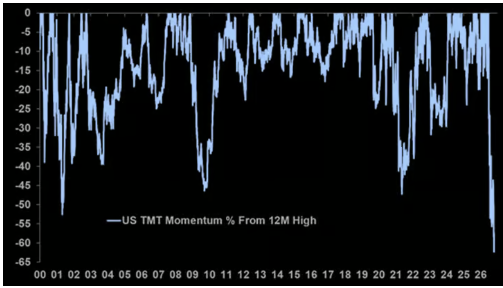
    This is very ironic, can we talk about it? 😂 In 2021 the bubble top was clearly marked by a ton of absolute garbage companies going public via SPAC. Naturally, most investors who think AI is nothing but a massive bubble expected the two most anticipated IPOs EVER to mark this bubble's top too. Of course I'm talking about OpenAI and Anthropic, both expected to go public at 1-2 TRILLION USD. And now AI momentum has collapsed a historic 62% from its highs BEFORE either of them goes public. Unlucky 😆 Other than Iran, bonds, interest rates, etc., I think people front-running this obvious trade could be a big reason for the pullback.
    Connor Bates @ConnorJBates_
    HISTORIC CRASH IN AI MOMENTUM. Morgan Stanley’s U.S. TMT Momentum Factor has now collapsed 62% from its highs. Even more remarkable, the factor has recorded 65 daily moves exceeding 5% in absolute terms this year, nearly matching the 70 such moves recorded during the ENTIRE 1999–2001 dot-com boom and bust. These are not ordinary moves. Absolutely historic volatility and destruction in Momentum.
    1016014.8K
  17. Connor Bates✓@ConnorJBates_
    HISTORIC CRASH IN AI MOMENTUM. Morgan Stanley’s U.S. TMT Momentum Factor has now collapsed 62% from its highs. Even more remarkable, the factor has recorded 65 daily moves exceeding 5% in absolute terms this year, nearly matching the 70 such moves recorded during the ENTIRE 1999–2001 dot-com boom and bust. These are not ordinary moves. Absolutely historic volatility and destruction in Momentum.
    Download
    254940970.7K
  18. Daniel Koss✓@daniel_koss
    Very simple alpha for investors that just works. Most investors can't tell WHY their favorite stock is down. So when fake "conviction" meets confusion, they start raging that the market is "stupid". But once you zoom out and understand the different LEVELS behind a selloff, a lot of that frustration turns into calm and clarity. And it really matters, because it tells you whether you should actually sell or buy more. Here are the levels: 1️⃣ THE MARKET is down because capital got more expensive. Interest rates and bond yields are rising, so investors can earn a solid return almost risk-free. That means less money flows into stocks than expected, and that hits ALL stocks. 2️⃣ AI BUILD-OUT stocks are down MUCH more, because they are extremely capital hungry. They need huge amounts of capex, so when money gets more expensive, they are hit harder than the rest of the market. 3️⃣ NEOCLOUDS are down the most, because within the AI build-out they need the most capital of all. They are the most severe case, so they are the most affected. All of that is completely rational. But here's where it gets interesting: stocks in a group often move together, while the impact of higher capital costs and the quality of execution are COMPLETELY different from one company to the next. And THAT is where you have tremendous room for alpha. The market often sells a whole group off equally. If you understand how each company's fundamentals are actually affected, you can spot tremendous differences between stock movements and business developments. I think parts of the AI market have been very overvalued for a while, and I've struggled with valuations like $BE, $AMD and $INTC. I wouldn't buy the AI basket here, and I wouldn't have bought the neocloud basket for a while either. But I'm absolutely NOT selling $NBIS. I want to add aggressively as it goes down. Because company-specific factors can outweigh the macro: how a company uses this environment, for example through consolidation, or bullish developments behind the scenes that will show up in the next few earnings. And you don't have to be bullish like me at all. This principle works in EVERY direction. If you're BEARISH: when bad news hits a whole group equally, but you know some companies are hurt far more than others, those are the ones to short. If you're NEUTRAL: you don't even need a view on where the market goes. You can go long the companies that are relatively better positioned and short the ones hit hardest by the news. That's also why investors who say "don't focus on macro, you can't predict it anyway" are completely missing the point. First, I believe some macro developments can actually be understood very well through physics and incentives. And second, even if you have no idea where macro is going, understanding it is still extremely helpful to make sense of how the stock market moves.
    9411516.1K
  19. Daniel Koss✓@daniel_koss
    If you follow me you know that @jiahanjimliu and I strongly disagree on Neoclouds, most importantly for investors on where the value accrues. But discrediting him because his portfolio is all-in $IREN if you're equally biased as the richest guy in the world, Founder, CEO and biggest shareholder of $SPCX just doesn't seem to be a strong argument, to me. Also big fan of Elon, but we all have our biases and I feel like he often could do a better job at disclosing his. Here the pro SpaceX bias is of course incredibly obvious. But then using someone else's bias as a main argument, idk man ^^ Especially since there's so much actually legit criticism to say about $IREN 😂 Just kidding I'll peace out here ✌🏻
    Elon Musk @elonmusk
    21320132.7K
  20. Daniel Koss✓@daniel_koss
    My man's actually a gifted storyteller. Incredibly fun to read and might help some people to grow a pair and get that last lil push to not become a salary slave at the possibly worst time in human history to do so.
    Nebulizer @SMASIMHO
    Somehow quite a few of you decided to follow me recently, so I figured it's time I shared a little more about myself. How did I get so blackpilled that I decided to full port $NBIS? What drove me to that decision? Why am I on X? Here's the insider scoop.
    2212817.2K
  21. Nebulizer✓@SMASIMHO
    Somehow quite a few of you decided to follow me recently, so I figured it's time I shared a little more about myself. How did I get so blackpilled that I decided to full port $NBIS? What drove me to that decision? Why am I on X? Here's the insider scoop.
    361229939.1K
  22. Daniel Koss✓@daniel_koss
    NOW is the time to skip the Neocloud basket and buy the winners, spoiler, yes it's Nebius $NBIS I've thought for a long time there will be a massive wave of consolidation. Then I had many interviews with $NBIS executives who all (some more subtly and some less) said they are very interested in a coming consolidation phase, but half a year ago prices were too high and market just didn't differentiate enough between winners and people just in the same space. Now all ingredients are here and the setup is ready! Here's the setup: 1) Some Neocloud stocks have massively outperformed others. -> This means it's now relatively cheap for them to do M&A compared to 6-12 months ago. 2) The underperforming ones are now seeing a lot of pressure around business model sustainability in an environment with higher rates and bond yields. It's much harder now to get attractive financing if you have a bad history of execution over the last 12 months. -> This creates urgency and a strong incentive to at least look at M&A very seriously.
    Ren @ren_stocks
    $NBIS I don't know who needs to hear this, but I'll say it again. NOT ALL NEOCLOUDS ARE CREATED EQUAL Source: @SergeyCYW | Compounding Your Wealth.
    251436043.5K
  23. Ren✓@ren_stocks
    $NBIS I don't know who needs to hear this, but I'll say it again. NOT ALL NEOCLOUDS ARE CREATED EQUAL Source: @SergeyCYW | Compounding Your Wealth.
    Download
    69771.1K548K
  24. Daniel Koss✓@daniel_koss
    The Nasdaq trades at ~20x forward earnings. That's cheaper than 95% of the last 5 years. Yet hedge funds are shorting at RECORD levels. Crash or squeeze? 📊 THE FACTS Funds shorted ~5x faster than they bought in October. Short positions are at the 99th percentile of 5 years, with the biggest 2-week tech selling in 10+ years of Goldman data. And: their net exposure to the Magnificent 7 is at a RECORD HIGH. So what's really happening: funds dumped the high-beta AI names and crowded into megacaps. The index hides an AI correction underneath. And the short ETF volume in the chart? Mostly day-trading hedges. SQQQ actually saw $216M of OUTFLOWS this week. 🧮 WHAT USUALLY HAPPENS NEXT Shorts this crowded rarely get a clean crash. Goldman-book shorting this extreme in Jan 2021 and June 2022 was followed by SQUEEZES. Base case: chop into Oct 28-29, then a sharp squeeze led by the beaten-down AI and neocloud names. Bear case (~1 in 3): the selling spreads into the crowded megacaps and the S&P drops toward ~7,450. 🌍 WHAT DECIDES IT Oil: Brent is at $116. $120+ is crash fuel, back toward $100 is rip fuel. 10-year yield: above ~5.2% pressures valuations again. The Fed on Oct 28. MSFT, GOOGL and AMZN capex. Next week decides it.
    27923926.4K
  25. Daniel Koss✓@daniel_koss
    Obviously investors talk their book when featured in the media / on tv, but this is not the dunk $BTC fans think it is. People are allowed to change their minds, ESPECIALLY in the face of new information. If the entire world around you changes at the speed of what we've seen over the last decade and you didn't change your mind on a dozen things you thought you had very firm conviction in, you're just not that smart or you're not intellectually honest. Many smart people are actually almost paralyzed by all the conflicting thoughts they have and a constant stream of questions they ask. It's a trap to avoid, but it helps understand that always being 100% certain about everything is just not the sign of raw intelligence some people think it is.
    Alex 👽 @AlexesNakamoto
    What happened to Chamath?
    423110.7K
  26. Alex 👽✓@AlexesNakamoto
    What happened to Chamath?
    Download
    3891462.1K564K
  27. Daniel Koss✓@daniel_koss
    Do: 26x your money ✅ Don't do: lose it 👎 Thank you for the actionable insight! Learning: 26x with 0 risk.
    Prof @TheProfInvestor
    This an expensive but the best example of "What not to do" Guy round tripped a 27.6 million dollar folio to 600k. This kind of repair takes years On July 16 he was at $7 million On July 28 he was at $3.8 million On Oct 13 he was at $1.1 million On Oct 23 he is at $600k. One of the wildest retail swings of my lifetime. This is genuinely disturbing. 🤯
    627414.7K
  28. Prof✓@TheProfInvestor
    This an expensive but the best example of "What not to do" Guy round tripped a 27.6 million dollar folio to 600k. This kind of repair takes years On July 16 he was at $7 million On July 28 he was at $3.8 million On Oct 13 he was at $1.1 million On Oct 23 he is at $600k. One of the wildest retail swings of my lifetime. This is genuinely disturbing. 🤯
    Download
    10433671147K
  29. Daniel Koss✓@daniel_koss
    Interview your AI! Think about it. Serious companies spend hours, often days spread over weeks, getting to know a candidate before hiring. Because if you're going to work together for months or years, you need to understand their SKILLS, VALUES, HABITS and EXPECTATIONS. Yet most AI powerusers delegate HOURS of work to AI every single day without ever doing the same. So every time there's a big new model update, run a simple test. Give each model the SAME piece of information and ask it to summarize or interpret it. What do they highlight? What do they think matters? Do you agree? 😂 Ask for a joke. Do you actually like their humor? I know most are not funny at all yet, but it's still good to compare their "style". 💡 Ask them to tell you something interesting. 🧭 Model real scenarios: "I want to do X, Y, Z. What do you suggest?" 🛠️ Give them a couple of real tasks to actually finish. It's exactly the trial work you'd give a human, except it's finished within MINUTES. Great reward and you intuitively understand differences that really matter for almost zero costs.
    12459.2K
  30. Show more posts