SWE-2 is now available in Devin Desktop and CLI!
We're offering unlimited usage for all Pro, Teams, and for the next month!
Share
Copied
Cognition@cognition
Introducing SWE-2, our closest model yet to the frontier.
On leading evals, it scores on par with recent frontier models – at up to 70% lower cost.
We scaled RL to multiple trillions of parameters, with a refined recipe that pushes the Pareto curve on both capabilities & cost.
Introducing SWE-2, our closest model yet to the frontier.
On leading evals, it scores on par with recent frontier models – at up to 70% lower cost.
We scaled RL to multiple trillions of parameters, with a refined recipe that pushes the Pareto curve on both capabilities & cost.
RT @mercor: Mercor developers advance the AI frontier every day. We're proud to work with @cognition as we build the evals, infrastructure, and agents that move the AI industry forward.
Share
Copied
Cognition@cognition
Founded by three 22-year-olds in 2023, @mercor crossed $2B ARR in June, only 4 months after hitting $1B.
Today, millions of experts on the platform bring their knowledge of medicine, law, engineering, and beyond to frontier AI - helping models take on increasingly complex and consequential work in the real world.
Mercor's engineers move at extraordinary speed.
They give Devin long-running tasks before bed, during meetings, or on their way to the gym. They come back to tested features and PRs ready to merge.
Devin can do more than ship PRs. @DecagonAI used it to run an inference research lab.
One Devin orchestrates, subagents chase competing hypotheses in parallel, and every idea is tested against replayed production traffic on @modal GPUs. The result was up to 2.5× more throughput per GPU.
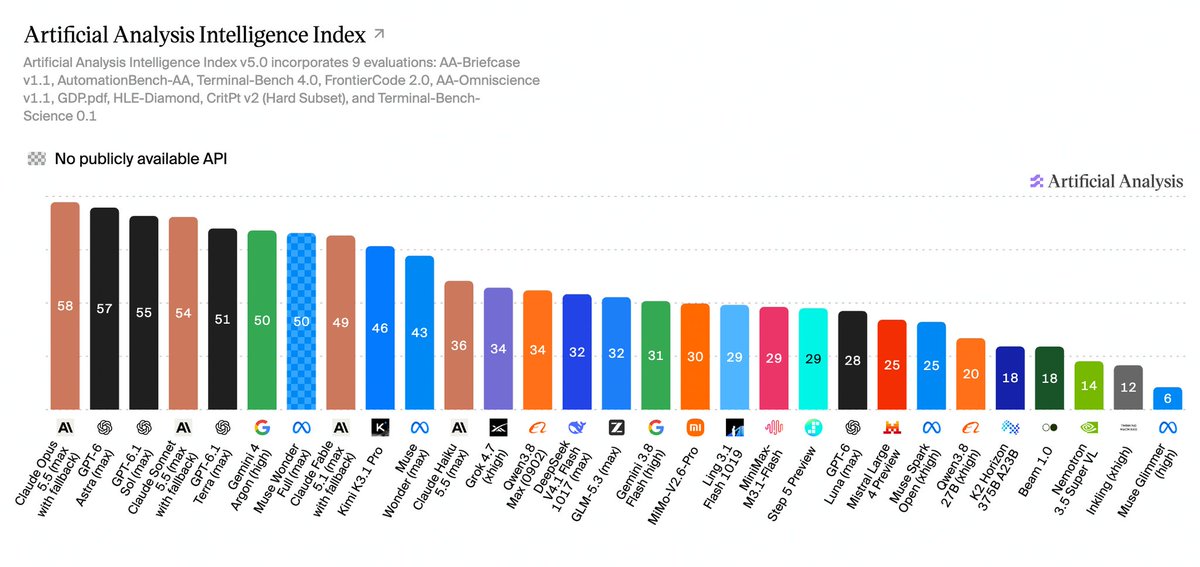
FrontierCode 2.0 is now included in the Artificial Analysis Intelligence Index v5!
Share
Copied
Artificial Analysis@ArtificialAnlys
Announcing Artificial Analysis Intelligence Index v5, featuring 2 new benchmarks and 3 upgrades. For the first time, the majority of the Index is built on private datasets
The Artificial Analysis Intelligence Index is our composite measure of model capabilities across tasks reflecting real-world usage today. v5 is our biggest upgrade since v4 launched in January. With v5, 60% of the Index is now based on evaluations with private test sets or held-out answers.
Alongside Intelligence Index v5, we’re launching the Artificial Analysis Progress Index v1, which tracks model capability over time on one continuous scale.
New to the Intelligence Index:
➤ FrontierCode 2.0: Cognition's newly-launched private benchmark of real-world coding tasks, graded on whether a repository maintainer would merge the agent's change
➤ Terminal-Bench-Science: 70 agentic scientific research tasks, run in a terminal environment
Upgraded:
➤ HLE-Diamond (replacing Humanity's Last Exam): a refined 1,000-question version of Humanity's Last Exam, split evenly between reasoning and knowledge questions
➤ AA-Omniscience v1.1: An updated dataset with saturated and public set questions removed, new questions added, and ambiguous or erroneous questions revised
➤ CritPt v2: a private, 40-question hard subset of CritPt v2, revised by the CritPt authors and run with a code-execution tool
Staying in the Index: AA-Briefcase, AutomationBench-AA, GDP.pdf and Terminal-Bench 4.0
Removed from the Index: GDPval-AA v2.1, SciCode, and AA-LCR v1.1
Key results:
➤ Claude Opus 5.5 (max) leads at 58, ahead of GPT-6 Astra (max, 57) and GPT-6.1 Sol (max, 55): Anthropic and OpenAI hold the top five models. Gemini 4 Argon (high) is next at 50
➤ The open weights gap widens from 3 points to 12: Kimi K3.1 Pro (weights not yet released) is the top open weights model at 46. Among released weights, DeepSeek V4.1 Flash 1017 (max) and GLM-5.3 (max) lead at 32 - 26 points behind the leader and below Claude Haiku 5.5 (max, 36)
➤ Cost per task varies by more than 13x among the leading models: of the 10 highest-scoring models shown, GPT-6.1 Terra (max) is the cheapest at $0.96 per Intelligence Index task and Claude Fable 5.1 (max) the most expensive at $13.04
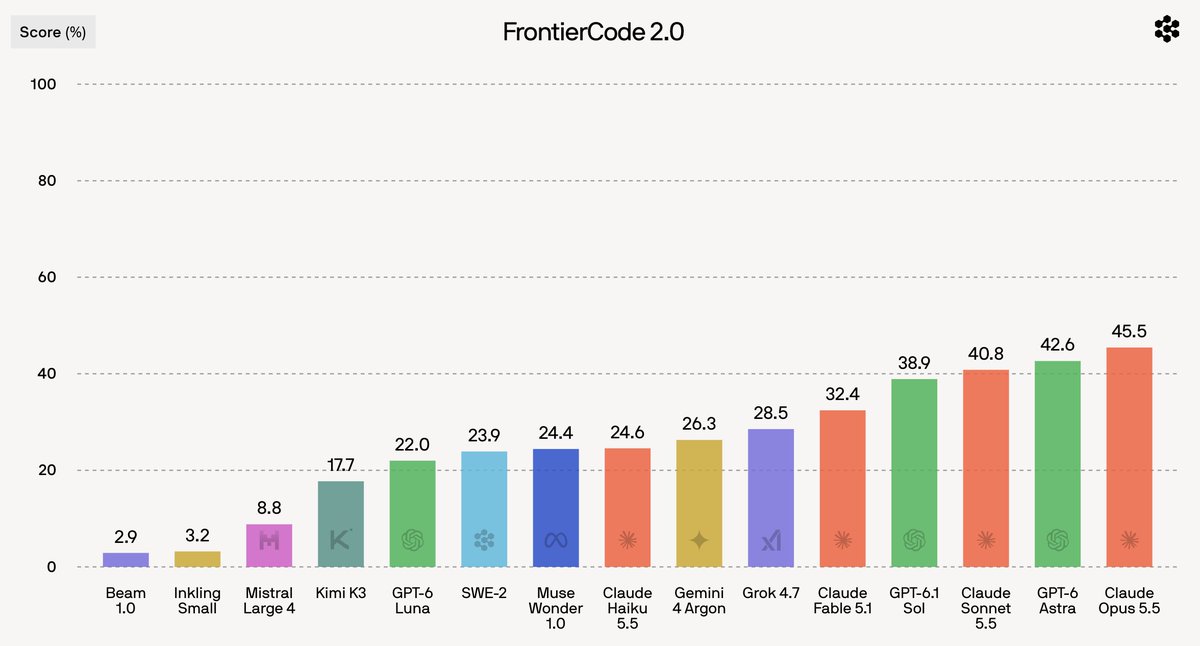
FrontierCode 2.0 includes broader coverage of tasks, drawn from more repositories and spanning more categories, including security patches and performance optimizations.
Every Devin plan gives you access to most models on the FrontierCode 2.0 leaderboard, including Claude, GPT, Gemini, Grok, SWE, GLM, DeepSeek, and Kimi families of models.
Share
Copied
Cognition@cognition
Introducing FrontierCode 2.0: our new coding benchmark that measures a model’s ability to go beyond the spec.
Most coding evals measure a model’s ability to write code that meets a spec. With FrontierCode 1.0, we asked a new question: would you actually merge the PR?
FrontierCode 2.0 is comprised of more diverse tasks, featuring larger scopes and higher mergeability standards. We are now asking: not only would you merge this PR, but should you?
One key feature of FrontierCode 2.0 is underspecified prompts. Rather than including every engineering decision, prompts are deliberately ambiguous, giving the models room to demonstrate their judgment.
The result is a benchmark that is far from saturated, with the top model scoring just 45%.
Devin Security is a new platform for security engineers and leaders that finds the most complex issues, prioritizes and verifies them against ingestions from multiple tools, fixes them, and tests the fix in a cloud VM.
It also integrates Claude Mythos and other frontier cyber models for approved enterprise customers, without needing separate access to the models.
Devin Security is powered by our own Agentic MapReduce architecture to reason across large codebases and find complex chained exploits.
One key new feature of Devin Security is a threat model, developed with your team to give Devin the context that lives outside of your code.
Read more and try it out:
Share
Copied
Cognition@cognition
We are entering a new dark age of cybersecurity. Devin is here to help.
Introducing the new Devin Security: powered by Claude Mythos and frontier cyber models, plus hundreds of millions of dollars of credits to help teams find, prioritize, and fix urgent vulnerabilities.
We are entering a new dark age of cybersecurity. Devin is here to help.
Introducing the new Devin Security: powered by Claude Mythos and frontier cyber models, plus hundreds of millions of dollars of credits to help teams find, prioritize, and fix urgent vulnerabilities.
RT @dabit3: Multiplayer iPhone Duo app development in Device Hub with Devin Cloud Agents running real macOS machines.
You can even deploy to TestFlight and the App Store. This is the future.
RT @marclou: Wow it was the biggest meetup so far!! 🤯
Almost 300 entrepreneurs showed up.
I shared a little story about my failures, and we did live QnA and landing page roasting.
When I asked people how many made at least $1, more than 50% raised their hands 👏👏
Thanks to @Avi31m and the team at @cognition for organizing everything. And thanks to all of you for coming today. The energy was awesome ❤️
Share
Copied
Marc Lou@marclou
Dubai, let's meet!
📍 TheBlock
📅 Sun, Oct 25
🕣 3:00–6:00 PM
I'm organizing the 13rd Indie Hackers meetup with the help of @cognition. See you there!
RSVP →
Dubai, let's meet!
📍 TheBlock
📅 Sun, Oct 25
🕣 3:00–6:00 PM
I'm organizing the 13rd Indie Hackers meetup with the help of @cognition. See you there!
RSVP →
RT @dabit3: Been experimenting with Unreal Engine, it's been really fun and easy to build and test insane looking games combining Devin Cloud agents with AWS, where I offload the computational-heavy work.
So basically you don't need a $4,000 gaming rig, GPUs, or really any hardware at all to do this anymore.
Devin builds the game on (beefy) AWS boxes, plays them on AWS GPU instances, so it can spot and fix problems and I get to watch every build on Devin's computer.
A Devin Outpost runs on an AWS c7i.8xlarge (32 vCPU, 64 GB) builds the game, and then an on-demand g6.2xlarge with an NVIDIA L4 tests it.
I put together a prompt (you can also use it as a skill) if you'd like to replicate:
RT @morgantepell: We rewrote Devin Desktop to use the same design and rendering system as Devin Cloud, while preserving full local agent compatibility.
It took millions of tokens, but the result is worth it: the UX is 10x better than Windsurf used to be.
Share
Copied
Cognition@cognition
Today we're introducing a refreshed Devin Desktop app, with an agent command center designed to be smoother and more polished than ever before.
The newly refreshed Devin Desktop app is now live!
Full support for every Devin Cloud feature, a brand new agent command center, and thousands of improvements to how sessions are rendered.
Download the new Devin Desktop app for free:
Share
Copied
Cognition@cognition
Today we're introducing a refreshed Devin Desktop app, with an agent command center designed to be smoother and more polished than ever before.
How Devin Covers Every Stage of the Software Lifecycle
• Understand
• Build
• Test
• Verify
• Review
• Secure
• Operate
Everything you need to know in 6 Minutes
RT @HackIterate: We’re organizing a hackathon with the world’s best AI researchers!
48 hours to tackle some of AI’s hardest open problems: autoresearch, self-improving systems & agent swarms.
With @OpenAI , @modal , @cognition , @VoyagerVC & @boardyai
From Software Factory to Model Factory
@TheWuster from Cognition uses @DevinAI to train a custom image model on @modal, deploy it, and ship it into a product
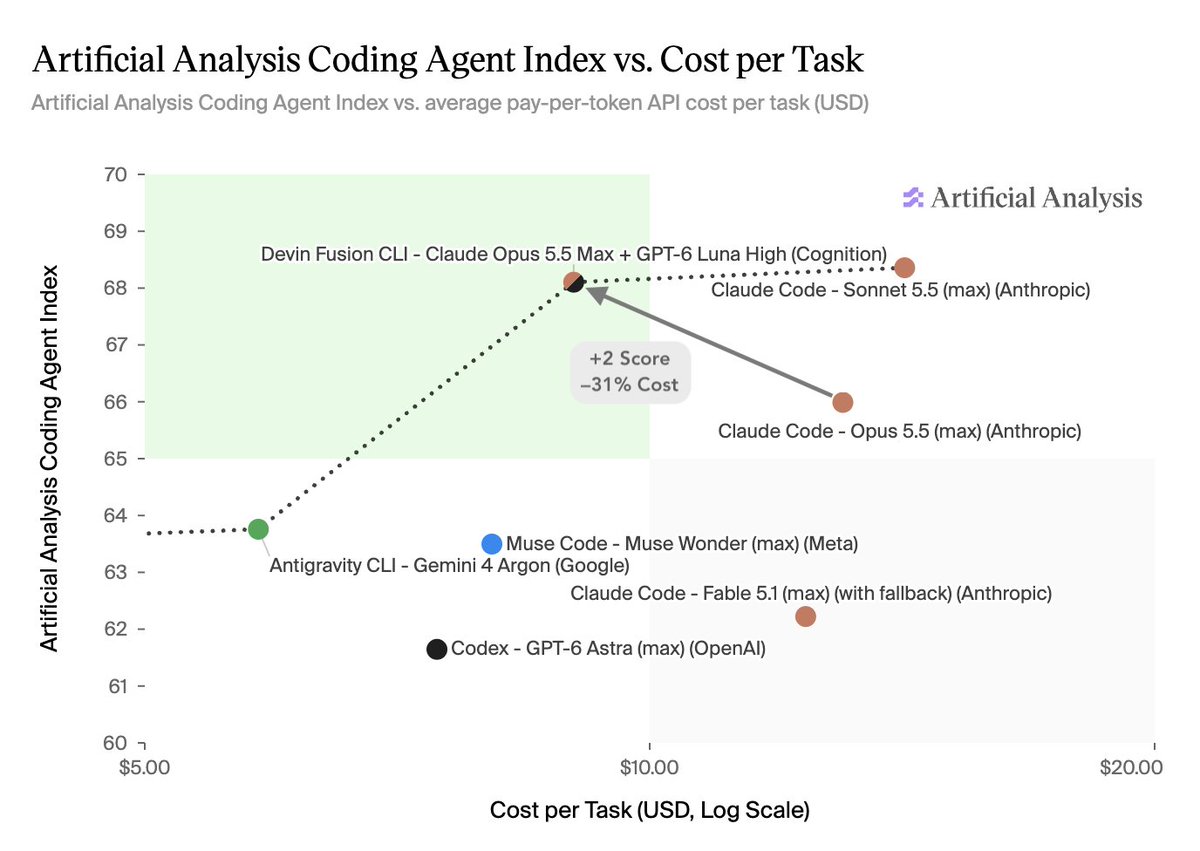
Devin Fusion has claimed a top score of 68 on the @ArtificialAnlys Coding Agent Index with an Opus 5.5 lead and GPT-6 Luna sidekick.
Devin Fusion outperforms Claude Code with Opus 5.5 on both performance and price – earning a score of 68 at a 31% lower cost per task.
RT @ArtificialAnlys: Devin Fusion with Claude Opus 5.5 (max) and a GPT-6 Luna (high) sidekick scores 68 on the Coding Agent Index, 2 points above Claude Code with Opus 5.5 (max) at 31% lower cost per task
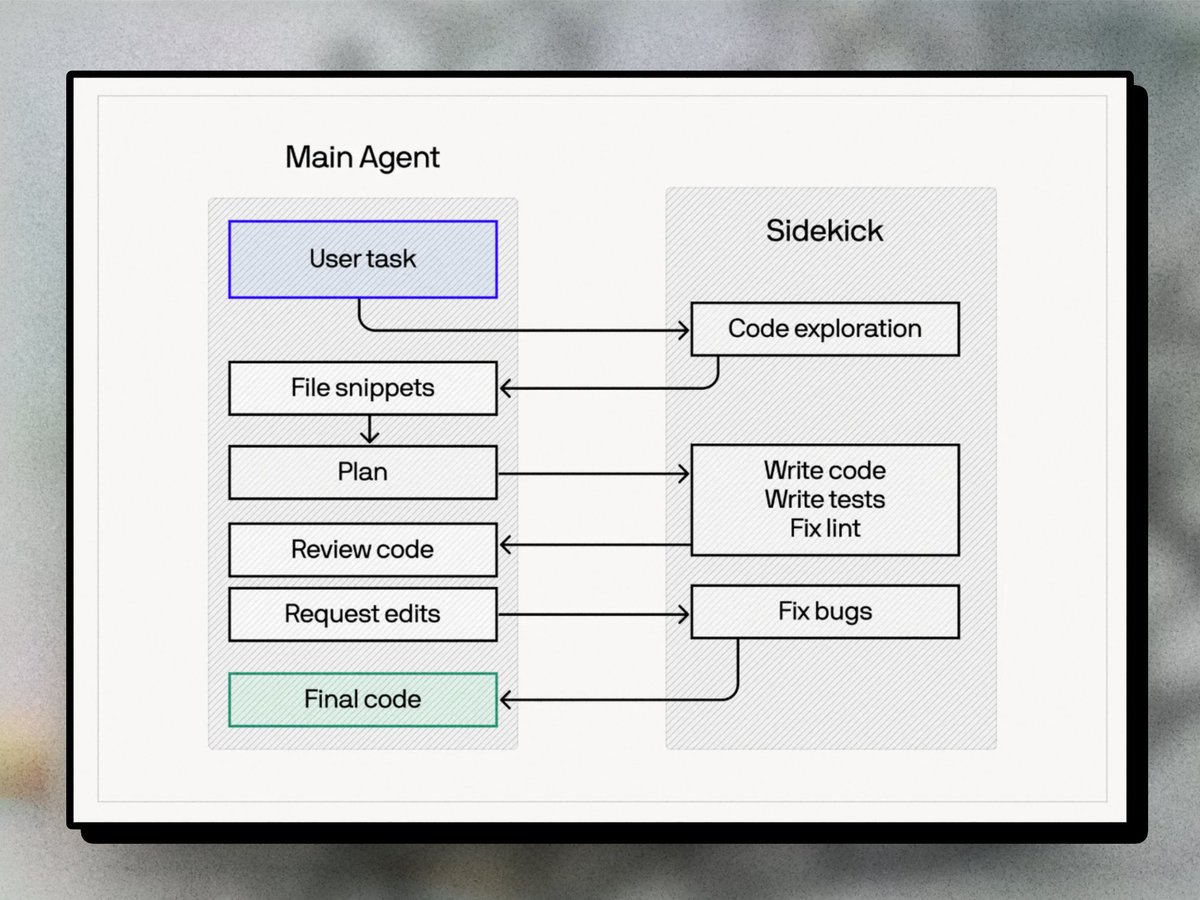
@cognition's Devin Fusion runs a frontier lead model alongside a lower-cost sidekick model. The two work in parallel with their own context and tools, with the lead keeping planning, delegation and final review. We benchmarked Devin Fusion CLI with Claude Opus 5.5 (max) + GPT-6 Luna (high).
It scores 68.1 on the Artificial Analysis Coding Agent Index, closely matched at the top with Claude Code with Claude Sonnet 5.5 (max) at 68.4 and Muse Code with Muse Wonder Full (max) at 68.0. Against Claude Code with Claude Opus 5.5 (max) at 66.0, it costs $9.01 vs. $13.04 per task and averages 55 vs. 65 minutes per task.
Across the three benchmarks, the Fusion configuration scores higher on DeepSWE v1.1 (72.6% vs. 68.4%) and SWE-Atlas-QnA (69.6% vs. 66.4%) and slightly lower on Terminal-Bench 4.0 (62.1% vs. 63.1%). Its results reflect both models working together, including their combined API cost. Costs are pay-per-token API costs, not subscription prices.
Devin Fusion has claimed a top score of 68 on the @ArtificialAnlys Coding Agent Index with an Opus 5.5 lead and GPT-6 Luna sidekick.
Devin Fusion outperforms Claude Code with Opus 5.5 on both performance and price – earning a score of 68 at a 31% lower cost per task.
RT @dabit3: Me and Devin are using @DevinAI to train and deploy custom models on @modal, and it’s easier than you’d think
This is a good basic template to get you started