A LA MIERDA EL VIBE-CODING!
FUE BONITO MIENTRAS DURÓ:
2025 - 2026🪦
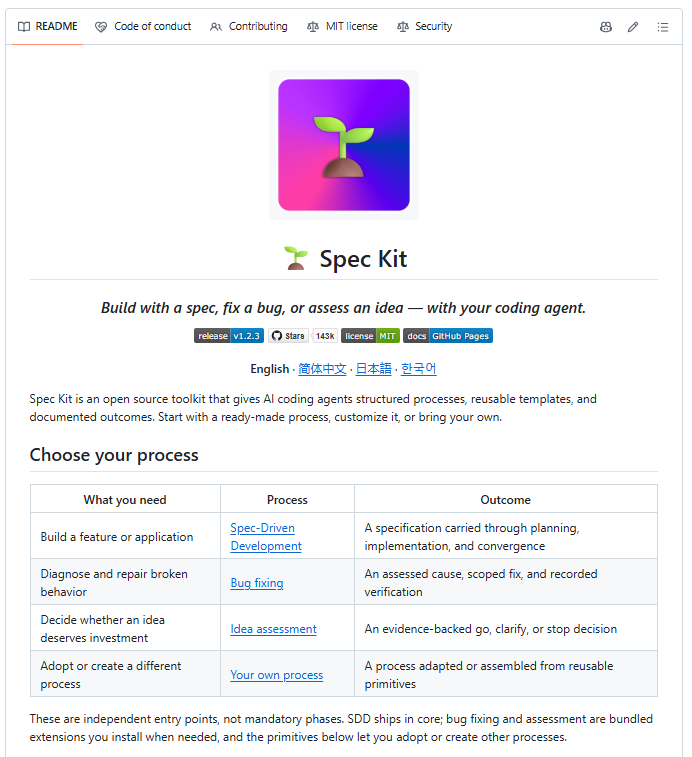
GitHub ha sacado spec-kit
La idea: dejas de pedirle cosas al agente a lo loco y escribes primero la especificación.
Luego el agente la ejecuta.
El flujo son 5 comandos:
/speckit.constitution → los principios de tu proyecto
/speckit.specify → qué quieres construir
/speckit.plan → stack y arquitectura
/speckit.tasks → lista de tareas real
/speckit.implement → lo construye
Funciona con 30+ agentes:
- Copilot,
- Claude
- Codex
- Cursor
y muuuuchos más.
Link al repo en los comentarios👇🏼
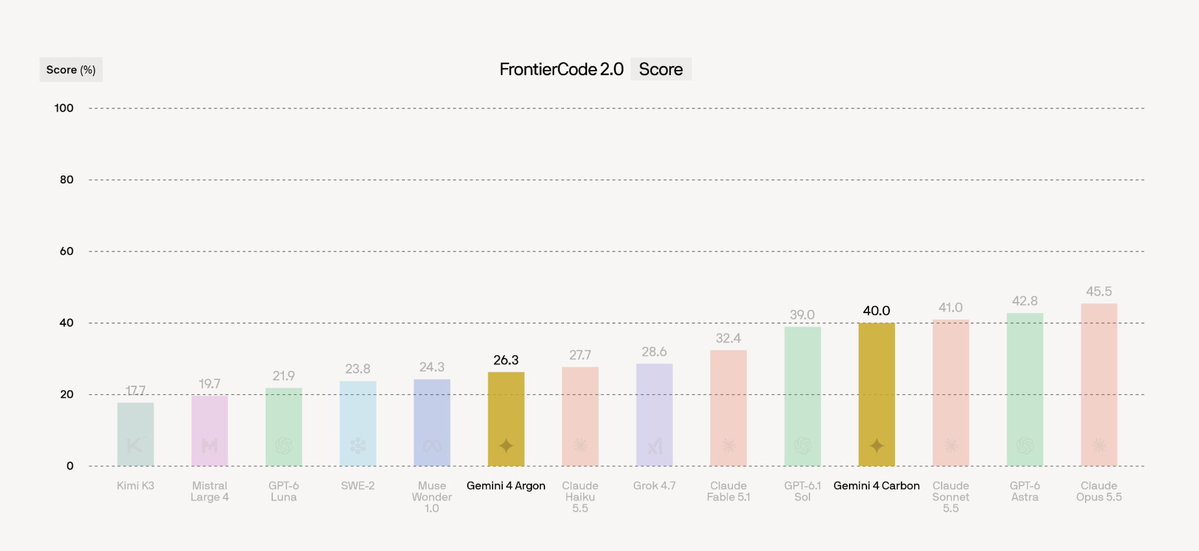
We've evaluated Gemini 4 Carbon and Gemini 4 Argon on FrontierCode 2.0, our coding benchmark that measure's a model's ability to go beyond the spec.
Gemini 4 Carbon scores near SOTA with a score of 40% and a cost of $4.04 per task, behind Claude Opus 5.5, GPT-6 Astra, and Claude Sonnet 5.5.
Gemini 4 Argon scores 26.3% with a cost of $6.41 per task, ahead of Muse Wonder 1.0, but behind Claude Haiku 5.5 and Grok 4.7.
See the leaderboard with full scores:
I would like to compare AI coding tools on the same task:
Build a form, save data, handle errors and add meaningful checks.
Then measure how much correction each needs.
T3 Code users: what task would you choose for a fair comparison?
#AICoding#DevTools
I would love to connect with developers and QA folks building with AI.
Especially those sharing failed attempts, useful fixes and things they still verify manually.
I bring 11+ years in QA and plenty of beginner-builder questions.
What are you building?
#AICoding#BuildInPublic
image generation has become an important tool for coding agents
you can use it to generate concept UI or reference art for video games
OpenCode 2.2.3 has an image gen tool that supports image models from OpenAI, Gemini, Grok and more
ABSOLUTE F*CKING GOLDMINE AND EVERY ONE FREE
Claude Code Pro costs $20 a month. antigravity alone lists 2,750+ installable skills in its catalog, VoltAgent holds 161+ ready subagents across 10 categories, and none charges you extra
10 GitHub repos that staff your Claude Code session:
01 anthropics/skills → Anthropic's own SKILL.md reference folders for Claude Code. shows the canonical format so every custom skill you write loads on the first try
02 awesome-claude-code-subagents → VoltAgent's collection of 161+ ready subagents across 10 categories. copy a reviewer, debugger or architect instead of writing the role prompt yourself
03 claude-skills → ships 398 production-ready skills and plugins for 13 AI coding tools. one install replaces hunting across dozens of repos
04 claude-code-templates → ready configs for agents, commands, hooks and MCP servers. starts a new project with a working .claude folder instead of a blank directory
05 awesome-claude-code → curated index of skills, hooks, plugins and developer tooling. finds the vetted piece without scrolling through GitHub search results
06 ui-ux-pro-max-skill → design intelligence skill for building professional layouts across platforms. gets sane palettes and spacing without a separate designer pass on every screen
07 planning-with-files → persistent file-based plans that survive long sessions and context resets. stops the agent from losing the map when memory clears mid-task
08 marketingskills → marketing-focused skills covering copy, SEO and launch checklists. fills the prompt gap when a codebase agent has to write a landing page
09 vercel-labs/skills → the CLI for the open agent skills ecosystem. one command pulls any published skill into Claude Code, no manual file copying
10 antigravity-awesome-skills → catalogs 2,750+ installable SKILL.md playbooks with a local search engine. searches and previews a plan before the agent touches your codebase
pick one recurring task that drains your time every week. install the skill for it, run it once and read what the agent actually did before you schedule the next one
source → vet → install → staff → ship
every skill runs with your plan's usage and permissions, and community packs are not audited by Anthropic. read a SKILL.md before installing
save this and check the full breakdown below ↓
300,000 GitHub stars. Nearly 30 million installs.
One engineer's personal AI skills are now the most-used playbook for coding agents.
It's Matt Pocock's (@mattpocockuk) "Skills for Real Engineers":
• Small, slash-command skills for Claude Code, Codex, Cursor and Copilot
• /grill-with-docs to pressure-test your plan
• /tdd, /code-review and /triage built in
• Works with any model
• Free and MIT licensed
Not vibe coding. Real engineering, packaged as prompts.
Link below.
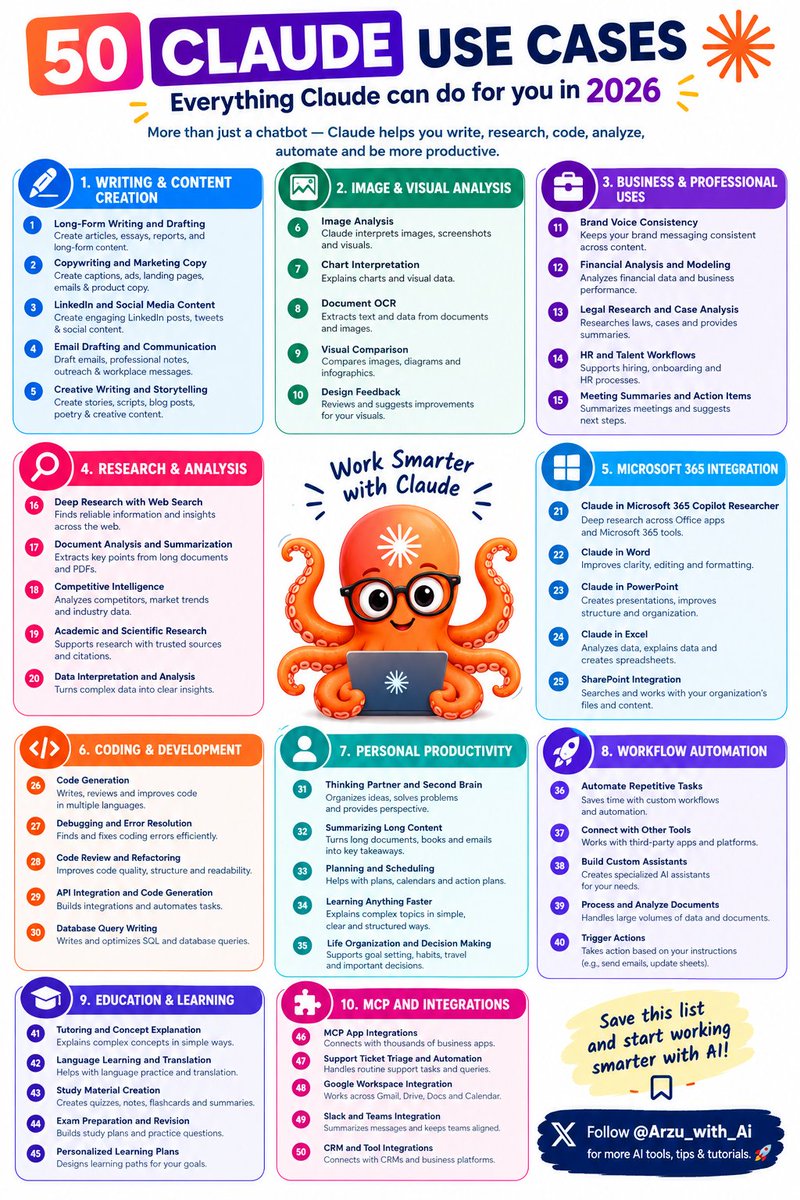
🚨 50 CLAUDE USE CASES YOU NEED TO KNOW IN 2026!
Claude is more than just a chatbot. 🤯
From coding and deep research to content creation, productivity, and workflow automation — discover 50 ways to put Claude to work.
🔥 Save this cheat sheet and start working smarter with AI!
Follow @Arzu_with_Ai for more AI tools, tips & tutorials. 🚀
The most popular AI programming tools in 2026
1. Claude Code: 65.5%
2. GitHub Copilot: 58.7%
3. OpenAI Codex: 29.5%
4. Cursor: 25.5%
5. Google Antigravity: 16%
I expected more from Codex :(
Which AI coding tool are you using the most rn, and why?
80% of data scientists are using Claude Code wrong.
They open a repo, ask for code, accept the first plausible answer, then wonder why the project turns into an unmaintainable mess.
That is not AI engineering.
That is automated technical debt.
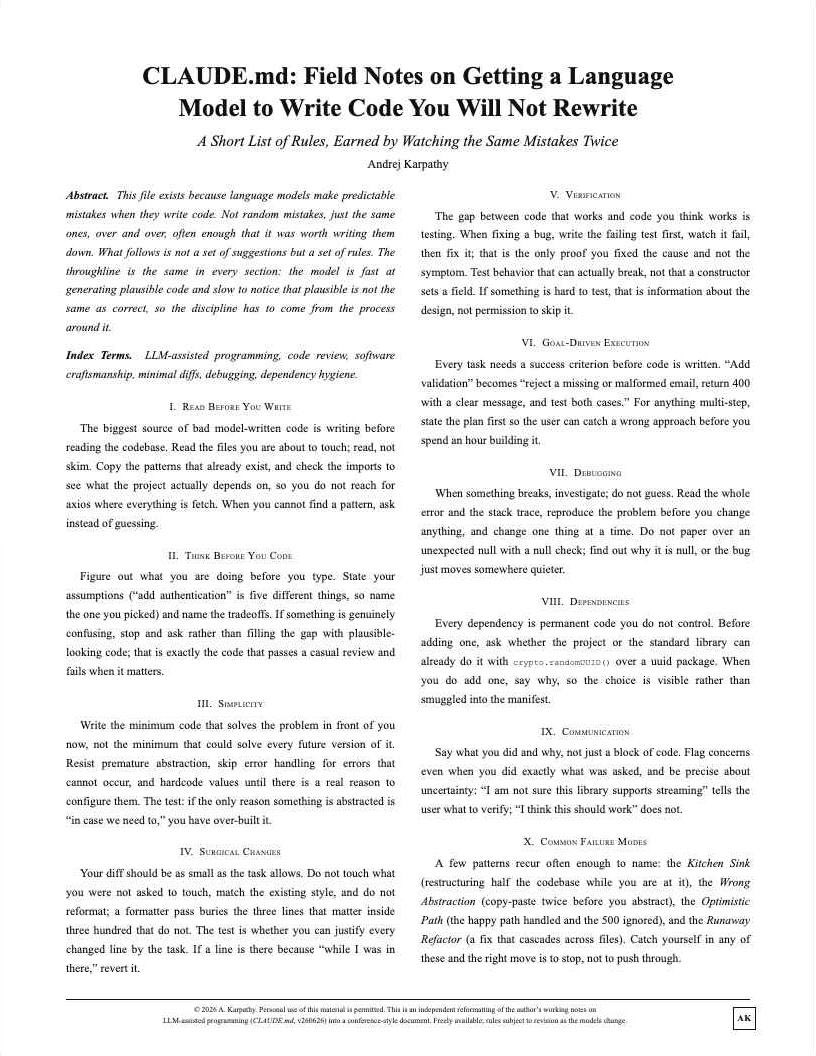
Karpathy just shared his CLAUDE.md field notes.
It is not a “prompt.”
It is not a cute productivity hack.
It is the rulebook that stops your AI coding assistant from spraying garbage across your codebase.
Without it, Claude does what most junior developers do:
- writes before reading
- guesses instead of investigating
- adds abstractions too early
- pulls in random dependencies
- makes huge changes when small ones would work
- ships code that looks right but breaks quietly
That is the danger.
AI makes bad engineering faster.
A good CLAUDE.md forces discipline:
- read the codebase first
- think before coding
- keep changes surgical
- define success before building
- test the behavior
- debug the root cause
- explain what changed and why
This is the shift data scientists need to understand.
The future is not: “Can you use ChatGPT?”
Everyone can.
The future is: “Can you direct AI tools inside real software projects without creating a dumpster fire?”
Github:
🚨 Want to learn how to build + ship AI and Data Science projects (that businesses actually want in 2026)?
On November 11th, I am hosting a free workshop to help you get started with AI + DS projects in Python.
Register here (500 seats):
i don't think people realize what one person can now build with Claude...
a Google Cloud engineer just went on stage and built a full app from scratch in 26 minutes, live.
he showed everything step by step, no team, no setup, just Claude and a goal.
worth more than any $500 vibe-coding course, and most people will scroll right past it.
watch it, then read the guide below on the Claude features 99% of users never find.
🚨Codex Users!!!
Codex limits are getting cut in half tomorrow,
and I genuinely don't understand the logic behind paying $200 for a 10x OpenAI plan.
Astra 6 and Sol 6.1 just don't justify that price for power users.
Who thought this was a good move? Because Anthropic looks like the biggest winner here.
Opus 5.5 is becoming the only serious option for people paying $200 for a 20x plan.
And as more power users move to Claude Code, Anthropic gets more usage, more feedback, and more real-world coding data to improve its next models.
OpenAI might be handing its biggest advantage to its competitor.
Check out the AI Agent workspace inside WorktreeWise: review the file tree, execute commands in terminal, and check output in browser preview.
#AICoding#ClaudeCode#DevTools#WebDev
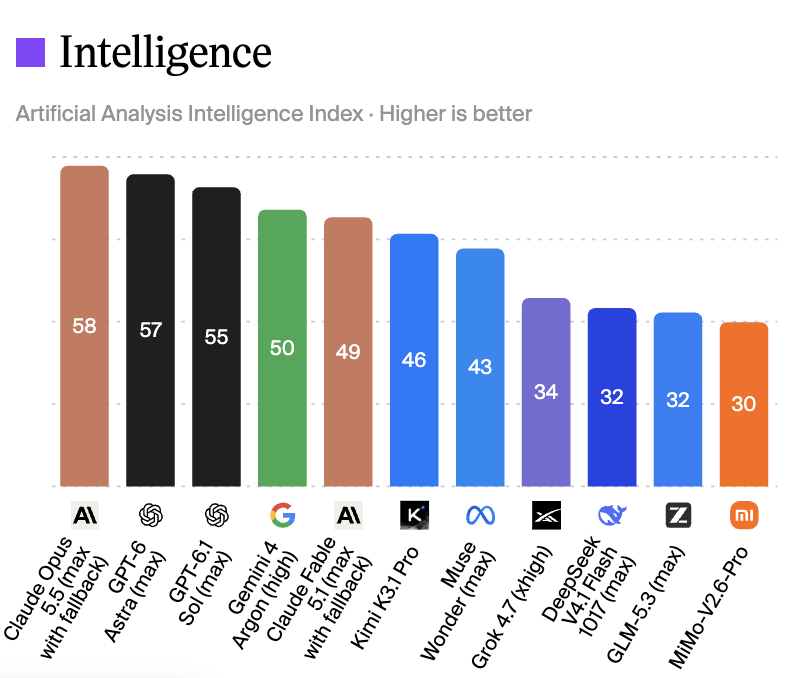
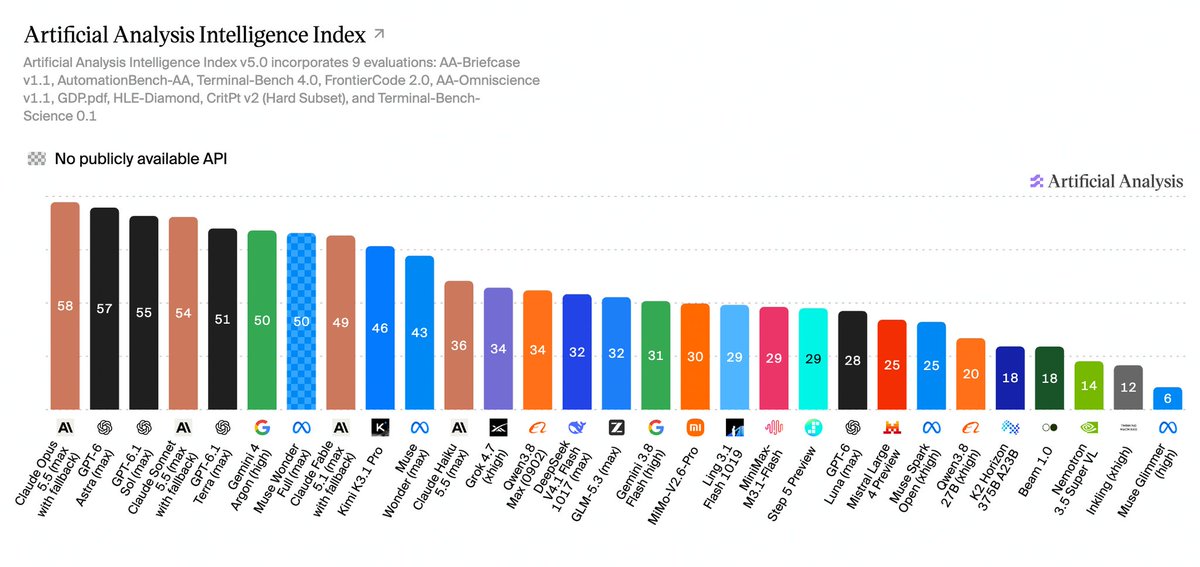
Artificial Analysis’ Intelligence Index v5 now bases 60% of its score on evaluations with private test sets or held-out answers, with Claude Opus 5.5 narrowly leading GPT-6 Astra and GPT-6.1 Sol.
As expected, GPT-6-Astra currently appears to be slightly ahead in scientific benchmarks, while Opus 5.5 leads in coding. GPT-6.1-Sol offers unparalleled price-performance.
Good to see we are getting more private tests.
Announcing Artificial Analysis Intelligence Index v5, featuring 2 new benchmarks and 3 upgrades. For the first time, the majority of the Index is built on private datasets
The Artificial Analysis Intelligence Index is our composite measure of model capabilities across tasks reflecting real-world usage today. v5 is our biggest upgrade since v4 launched in January. With v5, 60% of the Index is now based on evaluations with private test sets or held-out answers.
Alongside Intelligence Index v5, we’re launching the Artificial Analysis Progress Index v1, which tracks model capability over time on one continuous scale.
New to the Intelligence Index:
➤ FrontierCode 2.0: Cognition's newly-launched private benchmark of real-world coding tasks, graded on whether a repository maintainer would merge the agent's change
➤ Terminal-Bench-Science: 70 agentic scientific research tasks, run in a terminal environment
Upgraded:
➤ HLE-Diamond (replacing Humanity's Last Exam): a refined 1,000-question version of Humanity's Last Exam, split evenly between reasoning and knowledge questions
➤ AA-Omniscience v1.1: An updated dataset with saturated and public set questions removed, new questions added, and ambiguous or erroneous questions revised
➤ CritPt v2: a private, 40-question hard subset of CritPt v2, revised by the CritPt authors and run with a code-execution tool
Staying in the Index: AA-Briefcase, AutomationBench-AA, GDP.pdf and Terminal-Bench 4.0
Removed from the Index: GDPval-AA v2.1, SciCode, and AA-LCR v1.1
Key results:
➤ Claude Opus 5.5 (max) leads at 58, ahead of GPT-6 Astra (max, 57) and GPT-6.1 Sol (max, 55): Anthropic and OpenAI hold the top five models. Gemini 4 Argon (high) is next at 50
➤ The open weights gap widens from 3 points to 12: Kimi K3.1 Pro (weights not yet released) is the top open weights model at 46. Among released weights, DeepSeek V4.1 Flash 1017 (max) and GLM-5.3 (max) lead at 32 - 26 points behind the leader and below Claude Haiku 5.5 (max, 36)
➤ Cost per task varies by more than 13x among the leading models: of the 10 highest-scoring models shown, GPT-6.1 Terra (max) is the cheapest at $0.96 per Intelligence Index task and Claude Fable 5.1 (max) the most expensive at $13.04
Your usage limit hits at 3pm, and half of it went on typos and renames.
AgentsRoom's Adaptive Mode moves your Claude Code agent to the cheapest model that fits each message, before it is sent.
More details:
#AICoding#VibeCoding
Algorithms — Free PDF (472 Pages!)
Want to strengthen your problem-solving skills and become a better programmer?
This 472-page Algorithms book is a great resource for anyone interested in understanding how algorithms work and how to solve computational problems efficiently.
What you can learn:
✅ Algorithm design and problem-solving
✅ Time and space complexity
✅ Efficient approaches to computational problems
✅ A stronger foundation for Data Structures & Algorithms (DSA)
✅ Skills useful for coding interviews and competitive programming
Perfect for Python developers, computer science students, software engineers, and aspiring programmers!
Get the free PDF here:
Your usage limit is running low and three projects still have AI agents working on them.
In AgentsRoom, Project pause lets every agent of a project finish its turn, then keeps them asleep until you press Resume.
More details:
#VibeCoding#AICoding