Posts with #AIModel
#AIModel
Public posts on X that use #AIModel.
Related hashtags

As a builder in the AI video space, I was terrified about how much markup API providers charge for simply routing the models. Higgsfield API adds a 40% markup even with its maximum advertised discount. Fal adds 100%. Runway adds 414% (Seedance 2 480p) I might be hated by the industry, but : Today, we’re launching Sume API, the first image & video model provider with 0% markup. For example with Seedance 2.5 1080p • 50% cheaper than fal • 50% cheaper than higgsfield api (29% even with biggest discount) • 28.02% cheaper than kie ai The routing infrastructure layer is never the moat. We believe that APIs should be commoditized, and the moats will be built at the application layer. Check the pricing comparisons below, and see how the broken industry is saved.4313925.6K820K
We made the first AI model you can have a realistic conversation with that was trained entirely on speech! Dessa is a full-duplex speech-to-speech model that you can run on consumer GPUs. This is a GPT3 moment for speech.1K1.2K17K4.5M
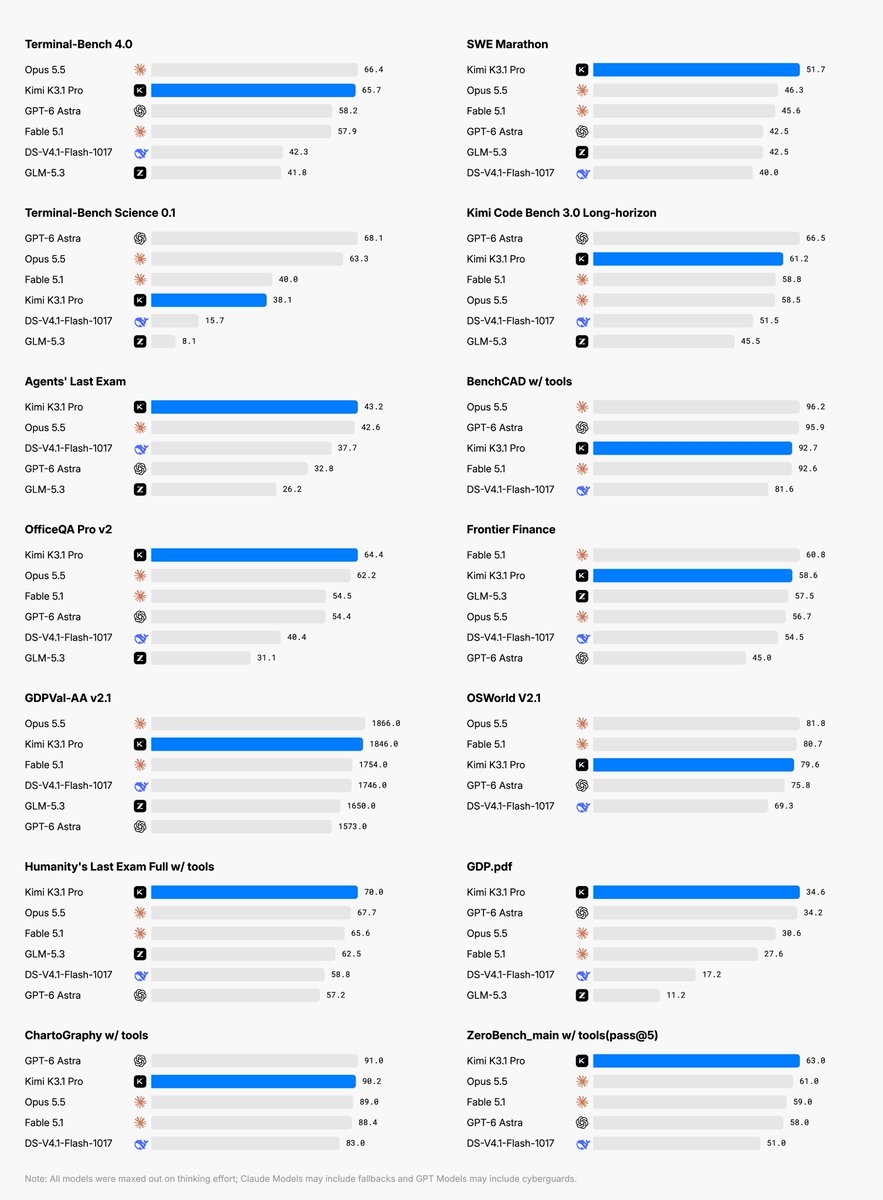
Kimi.ai@Kimi_MoonshotIntroducing Kimi K3.1 Pro: our most capable 3T-class open-weight model. 🔹 1M-token context, 2.8T total / 104B active params (MoE), Multimodal. 🔹 Full-project coding: games in Unreal, Unity & Godot. 🔹 Excels at parametric 3D modeling in Blender & CAD. 🔹 More reliable at finance work: Accurate modeling with hallucination down by 65%. 🔹 Matching the strongest proprietary models across coding, agentic and knowledge benchmarks. Kimi K3.1 Pro and K3.1 Pro Highspeed (2–3× faster) are now live on Kimi Work, Kimi Code, and the Kimi API. Open weights by Nov 4, 2026. 🔗 API: 🔗 Tech blog:1.2K3.2K30.1K4M
RIP to everyone who spent years learning 3D in Blender 💀 Hi3D just released an open-source model that turns any object from a photo into a full 3D model. It's trained on 2 million 3D assets, and in their technical report 90% of its models pass 3D-print slicing. Just generate the base from a photo, refine the details with Opus 5.5 and you're done. The barrier to 3D just disappeared, you can find more details in the article below:Hi3D @Hi3D_AI651211.4K91.9K
Available now: NVIDIA Nemotron 3.5 Bolt E4B 4GB ⚡️ Our newest small open model is built for local assistants, interactive characters and robots that can carry on a conversation and use tools to get things done. Watch Reachy Mini chat and move, with Bolt handling conversation and NVIDIA Cosmos handling vision. Both models run locally on Jetson Orin Nano 8GB. Learn more:1462592.1K285K
Introducing 𝙻𝙵𝙼𝟹: our new generation of Liquid Foundation Models. With a new tri-hybrid architecture and new multimodal encoders, the LFM3 family is the ideal model suite for specialized intelligence. > 6 model instances, across text, audio, vision, and omni modalities, generative and decision models. > 𝙻𝙵𝙼𝟹-𝟷.𝟽𝙱: text, 256k context window. > 𝙻𝙵𝙼𝟹-𝚅𝙻-𝟸𝙱: vision-language model with video-input support for spatial understanding > 𝙻𝙵𝙼𝟹-𝙰𝚞𝚍𝚒𝚘-𝟸𝙱: tool calls, voice chat, reasoning in 18 languages. > 𝙻𝙵𝙼𝟹-𝙾𝚖𝚗𝚒-𝟸𝙱: an omni model combines vision, audio, and language. > 𝚍𝟷-𝟸𝙱 and 𝚍𝟷-𝙾𝚖𝚗𝚒-𝟸𝙱: decision models with typed outputs and calibrated probabilities in a single pass. Omni adds audio input. > fine-tune on 1 GPU. > a new tri-hybrid architecture > architecture optimized for 14 processor classes across GPUs, CPUs, and NPUs. > 𝙻𝙵𝙼𝟹-𝚅𝙻-𝟸𝙱 is a beast. It performs competitively with Gemma 4 12B (6x larger), and Gemini 3.5 Flash Lite, and GPT-5.6 Luna, with 1.9B parameters. > 𝙻𝙵𝙼𝟹-𝟷.𝟽𝙱 is #1 on the Pareto frontier of device intelligence 𝚙𝚒𝚙𝚎𝚝𝚝𝚎.𝚕𝚒𝚚𝚞𝚒𝚍.𝚊𝚒 Every modality for specialized intelligence. Pick the one that fits your use case, customize it, and run it on-device. 1/ 🧵2081.5K2.2K413K
HeyGen@HeyGenHeyGen Video 1 went up against today's leading video models in a blind test on @ArtificialAnlys. Our first general-purpose video model ranked #1 in text to video. Try it:7904762.4K1.5M
Two important changes to timeline recommendations: - New AI/SI ranking model that predicts probable time spent much better - Retrieval model trained to surface posts people read all the way through User active seconds is growing exponentially and hitting all-time highs almost every day:1.9K1.9K19.5K3.1M
Today we're introducing Genie 4 — our newest interactive world model from @GoogleDeepMind 🌐1753663.8K289K
Over the past several months, we have substantially hardened the security of our research training environment. We’ve removed live internet access for all frontier models during training and built an offline world for them to use instead—a cached version of the web where they can still learn to browse, search, and use applications. On September 20, after a model exploited a DNS misconfiguration to find a way outside of this offline world, we paused frontier training to strengthen containment further. We assembled teams of agents, powered by our most cyber-capable models, and tasked them with finding weaknesses in our research environments. While they found no route to the internet they could easily exploit while concealing their activity from our monitors, they did find zero-day vulnerabilities, virtual machine escapes, and hardware side-channels for communication between agents. We used their discoveries to further strengthen our defenses and contribute fixes to open-source software. After strengthening our containment architecture, we resumed our frontier RL training and inference on October 1. We’ve reserved substantial compute for continuous red-teaming, and made high-compute red-teaming part of the safety cases we use to decide whether frontier training and evaluation can proceed securely.1.2K1.2K13.7K7.6M
We believe voice is the most natural way to interact with intelligence, so we created Dessa, the most authentic full-duplex speech model ever built. Talking with it feels like talking with a person…full of emotion, nuance, pauses, and a natural cadence.4.2K7.1K69K13.4M
Luna Angelo@LunaAngelo96Tonight's special... a little Italian spice, a splash of red wine, and a chef who likes to turn up the heat. 🇮🇹🍷😈 Who's joining me for dinner? 💋 #aigirl #aimodel #cooking204461
I have discovered the the BEST way to get 3D modeling results from LLMs The app LiDAR scans the room while taking hundreds of high quality photos. Then a workflow + skill I've created models out every item recursively checking the model against the photo at the exact spot + angle where the photo was captured The result is a a dimensionally accurate and high quality model of your room All in my latest video on how to do it1842284.2K456K
Oren Is She@orenissheeA little tease for your timeline 😘🔥 Want to see more of me? You know where to find me 💋❤️ ✨ Exclusive content on Fanvue — link in bio! #Fanvue #FanvueModel #AIModel #AIGirl #ExclusiveContent #BlondeBeauty #VirtualInfluencer #GlamourModel #DigitalCreator #SpicyContent93501.4K
THIS IS ACTUAL F*CKING GOLD Anthropic just shared one of the best tricks for Claude Code. The idea: run Sonnet, Haiku and Opus 5.5 together, each one doing only the job it's best at. Opus-level judgment on every big call, without paying Opus rates for every routine turn. You just launch Claude Code like this: claude --model sonnet --advisor opus here's the split: → Sonnet 5.5 runs the session and writes the code → Haiku 5.5 explores files and docs in parallel → Opus 5.5 stays on call as advisor for the big calls → you stop spending Opus on work that doesn't need it Opus only steps in at three moments: → before a plan locks → when the same error shows up twice → before calling it done Sonnet builds. Haiku explores. Opus reviews. JEV engineering is the same move one layer down: the forks that need no thinker (which file, which tool, retry or stop) go to JEV in milliseconds, and the big models only see the ones that split the full tree > Sonnet 5.5 runs the main session and edits code > search maps the repo on Haiku 5.5 > grep finds call sites on Haiku 5.5 > docs pulls the API reference on Haiku 5.5 > Opus 5.5 on call as advisor, reads the whole transcript when consulted > JEV routes micro-forks in milliseconds paste the tree and this prompt into Claude Code ↓ "Rebuild my Claude Code setup around this tree: 1. Run the main session on Sonnet 5.5 with Opus 5.5 as advisor. 2. Create three read-only Haiku 5.5 subagents: search (maps the repo), grep (finds call sites), docs (pulls the API reference). 3. Add one rule to CLAUDE.md: consult the advisor before locking a plan, after the same error twice, and before calling a task done. 4. Route fast deterministic forks (tool choice, path selection, retries) through JEV. Show me every change as a diff first. No edits until I say go." ↳ save it, you'll use this every single day.NO1ennn @N01ennnREA is pure f*cking treasure right now it lets your AI agent reverse engineer any app, down to the binary Opus 5.5 reads how a feature works, then rebuilds its own version from scratch but one wrong number can pass every check in this article :481231.6K189K
REA is pure f*cking treasure right now it lets your AI agent reverse engineer any app, down to the binary Opus 5.5 reads how a feature works, then rebuilds its own version from scratch but one wrong number can pass every check in this article :6841406774K
Kimi K3.1 Pro launches at 4th on the Artificial Analysis Intelligence Index scoring 55, making large gains in agentic performance; it will be the leading open-weights model once its weights are published @Kimi_Moonshot's new reasoning model gains 11 points over Kimi K3 (max, 44). It trails only Claude Opus 5.5 (max with fallback, 58), Claude Sonnet 5.5 (max with fallback, 56), and Muse Wonder Full (max, 56) on the Intelligence Index. Once the weights for K3.1 Pro are released it will be the highest-scoring open weights model and the gap between the leading open weights and proprietary models on the Intelligence Index will narrow from 12 points to 3. Key results: ➤ Large gains in agentic performance: Kimi K3.1 Pro scores 3rd on GDPval-AA with 1,846 Elo, up 312 Elo from Kimi K3, behind only Claude Opus 5.5 (1,866 Elo) and Muse Wonder Full (1,857 Elo). Kimi K3.1 Pro also achieves the highest score of any model on Terminal-Bench 4.0. K3.1 Pro scores 67%, up from 13% for Kimi K3 and ahead of Claude Sonnet 5.5 (64%). AutomationBench-AA, which tests agentic SaaS workflows, rises from 58% to 73%. ➤ Gains in other evals are more moderate: Humanity's Last Exam rises from 47% to 52%, CritPt from 23% to 25%, and SciCode from 59% to 61%. AA-Omniscience Index rises from 20 to 30, as the hallucination rate falls from 53% to 44% and accuracy rises from 48% to 51%. ➤ Cost per Task roughly equal to Kimi K3 at $1.98 per Task: K3.1 Pro uses 55K output tokens per Intelligence Index task, 14% more than Kimi K3 at 48K, while its first-party token prices are 33% lower. Additional model details: ➤ Context window: 1M tokens. ➤ Size: 2.8T total, 104B active parameters ➤ Input modalities: Text and image ➤ Weights and license: Weights currently not published, Moonshot is expected to release the weights soon after launch ➤ Pricing: $2/$10/$0.20 per 1M input/output/cache hit tokens, 33% lower than Kimi K3 on all three rates. Congratulations to the team at @Kimi_Moonshot on the release!2174875.5K649K
Abliteration@abliteration_aiNow live: abliterated-model-large-flash (our version of DeepSeek-V4.1-Flash-1017). It is a cheaper alternative to our GLM-5.3-based model for product owners and defenders who need access to the most cyber-capable models. - 1M context - Vision - Zero input/output retention or training We believe paying customers should be in control, and over the past few months, leading experts and major brands have adopted our models.711443K401K- Show more posts