Posts with #Analogcomputing

#Analogcomputing

Public posts on X that use #Analogcomputing.

Related hashtags

  1. LightSolver@LightSolverCo
    Our new research paper is now live: learn how our Laser Processing Unit (LPU) solves PDEs, simulating ~1M grid points per device for faster, more energy-efficient results than digital methods: #AnalogComputing #OpticalComputing #PDE #HPC
    012188
  2. Jace@Jace_blog
    THE PRECISION PARADOX More photons can reduce shot noise, but precision has a physical cost. Explore the limits of analog optical computing and next-generation photonics, looking at everything from photon budgets to real-world hardware accuracy. #Photonics #AnalogComputing
    Download
    Jace @Jace_blog
    THE MATRIX IS THE MACHINE How can light implement complex matrix operations at the speed of light? Discover photonic meshes, singular value decomposition, and the engineering challenges behind large-scale optical processors. #OpticalComputing #MatrixMath #PhotonicMesh #SVD
    1316513
  3. Jace@Jace_blog
    THE MATRIX IS THE MACHINE How can light implement complex matrix operations at the speed of light? Discover photonic meshes, singular value decomposition, and the engineering challenges behind large-scale optical processors. #OpticalComputing #MatrixMath #PhotonicMesh #SVD
    Download
    0213545
  4. Roger Turner@RogerTurner13
    Play games and giggle at the analog computer who pretends he’s a test pilot. #analogcomputing
    Science History Institute @SciHistoryOrg
    Who is this guy hanging out with so many presidents?! That's Arnold Beckman, chemist and businessman known for inventing a number of analytical instruments that helped change science. Learn about some of our favorites. #PresidentsDay #OthmerLibrary
    002
  5. Science History Institute@SciHistoryOrg
    Who is this guy hanging out with so many presidents?! That's Arnold Beckman, chemist and businessman known for inventing a number of analytical instruments that helped change science. Learn about some of our favorites. #PresidentsDay #OthmerLibrary
    Download
    028
  6. Mr. Pool✓@MrPool_QQ
    🔻 DARPA JUST PUT SOMETHING IN PLAIN SIGHT THAT SOUNDS LIKE IT WAS NEVER MEANT FOR THE PUBLIC. No chip. No implanted electrodes. No brain surgery. Light enters the equation — and suddenly the human brain becomes a signal that can potentially be read. DARPA calls the program FIREFOX. For more than fifty years, brain-computer interfaces have faced the same wall: if scientists wanted extremely precise, real-time neural information, they generally needed electrodes placed inside the body. Non-invasive systems avoided surgery, but sacrificed speed and precision. Now DARPA says it wants to break that trade-off. The official objective behind Firefox is extraordinary: investigate whether carefully targeted beams of light could detect microscopic physical movements of neural membranes as neurons fire — potentially allowing high-fidelity neural activity to be recorded deep inside human tissue without surgery. Read that again. Not science fiction. Not a leaked anonymous document. DARPA’s own publicly released program description. And the next layer is even more interesting. DARPA isn’t simply talking about observing one tiny point. The proposed 36-month program seeks dynamic optical scanners capable of monitoring multiple brain regions simultaneously, paired with new analog computing systems capable of processing the enormous streams of information generated in real time. For decades, people imagined the brain-machine future beginning with a chip. What if the chip was only one path? What happens when the interface becomes invisible? This does NOT mean DARPA can secretly read people’s thoughts today, and it would be dishonest to claim that. Firefox is a research program exploring whether this technology can actually be built at the required scale. But history teaches us something important about advanced research: today’s impossible experiment can become tomorrow’s engineering problem. Radar. GPS. Autonomous systems. Advanced prosthetics. The internet itself grew from technologies that once belonged largely to laboratories, defense programs and research networks before entering ordinary life. And now the calendar gets interesting. FIREFOX // SEPTEMBER 21 // ARLINGTON, VIRGINIA. DARPA has scheduled its Firefox Proposers Day for September 21, 2026. 09.21 LIGHT // SIGNAL // BRAIN NO IMPLANT REQUIRED. Maybe the real question isn’t whether machines will eventually connect to the human brain. Maybe we’ve been asking the wrong question. What happens when they no longer need to touch it? Share this before September 21. Someone else needs to see what DARPA is building. ⟁
    1511128023K
  7. NWORobotics@NWORobotics
    @MrPool_QQ
    @MrPool_QQ #analogcomputing systems? 🦾👽
    NWORobotics @NWORobotics
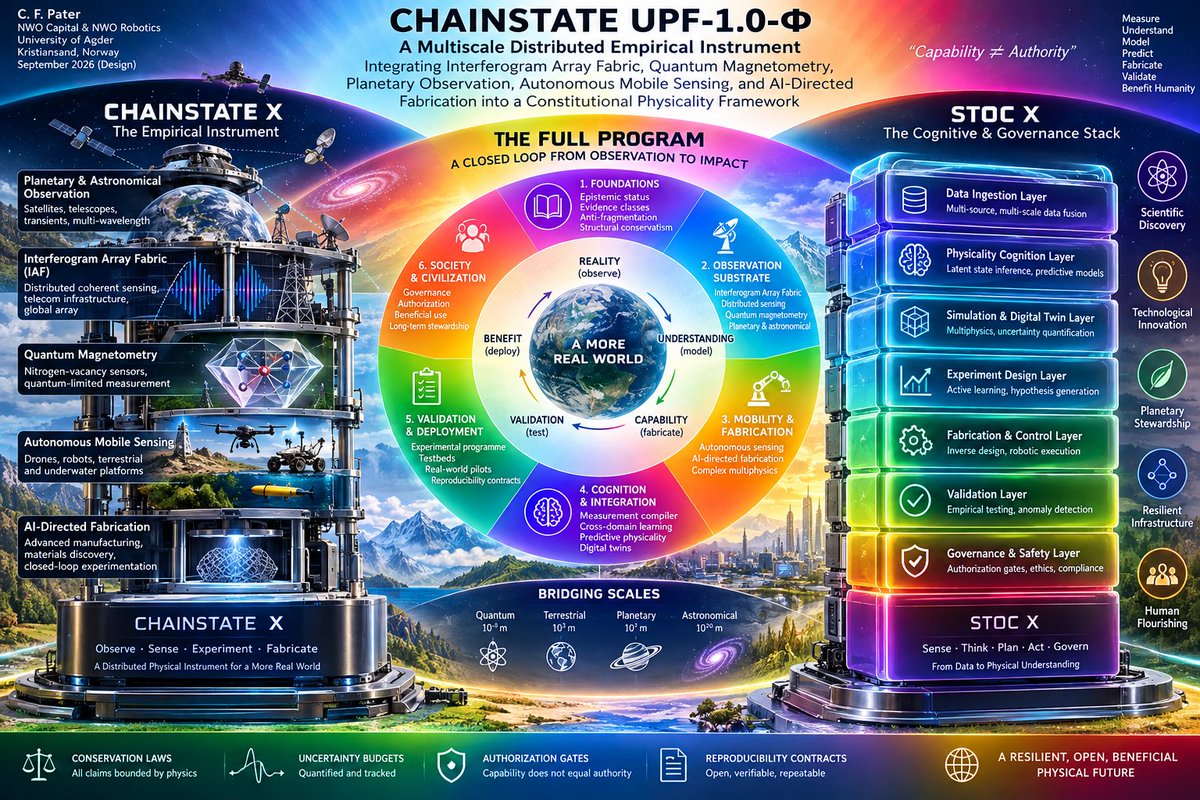
    @huggingface @Cloudflare @base UPF-1.0-Φ implies the next scientific revolution isn't hidden physics — it's when sensors, telecom, and ML fuse into one distributed instrument that reads, models, predicts, and writes physical reality from atoms to planets. Capability ⇏ Authority. Always
    12251
  8. NWORobotics@NWORobotics
    @NWORobotics
    @huggingface @Cloudflare @base UPF-1.0-Φ implies the next scientific revolution isn't hidden physics — it's when sensors, telecom, and ML fuse into one distributed instrument that reads, models, predicts, and writes physical reality from atoms to planets. Capability ⇏ Authority. Always
    Download
    2461.1K
  9. Berkin Ayberk@berkinayberk
    Do you also think Analog Computing will be preferred over(or at least combined with) Digital for Smart Homes, DePINs, and the modern Energy Infrastructure because of their capabilities and high energy efficiency? 🤔🤔 #DePINs #EnergyTransition #AnalogComputing
    00691
  10. Earl K. Miller@MillerLabMIT
    AI will soon demand more energy than the world can currently supply. Unlike AI, biology solves problems efficiently, without massive energy consumption—our brains are not digital computers. #neuroscience #analogcomputing
    41149.7K
  11. Cameron A. Schmidt, PhD@CAS_ReproLab
    'there are 5-6 orders of magnitude fewer genes in a cell than digital transistors per chip highlighting that using genes only to perform logic is likely not an efficient way to attain high complexity'... #AnalogComputing #ComplexSystems
    002193
  12. Dion Hinchcliffe✓@dhinchcliffe
    10 #emergingtech innovations that hold the potential to redefine #IT: We are in the midst of a new wave of highly disruptive technology that is in some cases going to decide which orgs make it to the near-future. But virtually all will be affected. A 🧵 to explore these. 1/x
    Download
    25133.6K
  13. Dion Hinchcliffe✓@dhinchcliffe
    @dhinchcliffe
    Analog #AI Chips: #AI architects are exploring the long-abandoned model of #analogcomputing. Values are expressed as voltages/currents. Now, instead of two binary states, these chips can have a nearly infinite number of values. The concept comes from the realization that AI models don’t need the same kind of precision. They need flexibility and nuance. The advantage: Much lower powerful consumption, #mobile/#edge AI and cheaper AI workloads. Example: @IBM's Analog AI Chip 1.0 2/x
    Download
    225532
  14. Mythic✓@MythicInc
    “A chiplet approach, or a heterogeneous approach to integrating logic or capabilities makes a lot of sense.” #ICYMI Mythic’s Tim Vehling and other industry leaders discussed the advantages of #analogcomputing with @SemiEngineering’s @brian_esl:
    021
  15. Show more posts