Posts with #CodeBase
#CodeBase
Public posts on X that use #CodeBase.
Related hashtags


we will need to rebuild and rewrite much of software to adapt to a new, faster pace. code used to arrive one drop at a time. soon, if not already, code will be written as if it were a continuous stream, like a violent river twisting and turning as it pleases. this is not a new thing: big tech cos have had to deal with this with the enormous scale of their engineering teams. but now ai has brought an incredibly elastic and capable workforce wielded by every engineer. this is your problem now, and the only way to adapt is to evolve your systems so agents - even and especially the ones with little context about the right way of doing things - can thrive. make the easy thing the right thing. your codebase is becoming organic architecture. agent contributions grow around the constraints and guardrails you’ve designed. good software engineering matters even more now! and no, the continuous stream of code is not something you have to watch helplessly. be more ambitious and design systems, frameworks, and languages to control the chaos. the time for mourning coding is long overJoseph Cox @josephfcoxHere is Proton CTO's AI manifesto, that I obtained multiple copies of3144546K335K
@josephfcoxHere is Proton CTO's AI manifesto, that I obtained multiple copies of1594144K1.4M
A lot of content engineering challenges have pretty standard solutions, which has lead to some engineers saying agent engineering is solved/boring True to some extent, but there are a bunch of (fun) new ones emerging as agents evolve!2086561180.9K
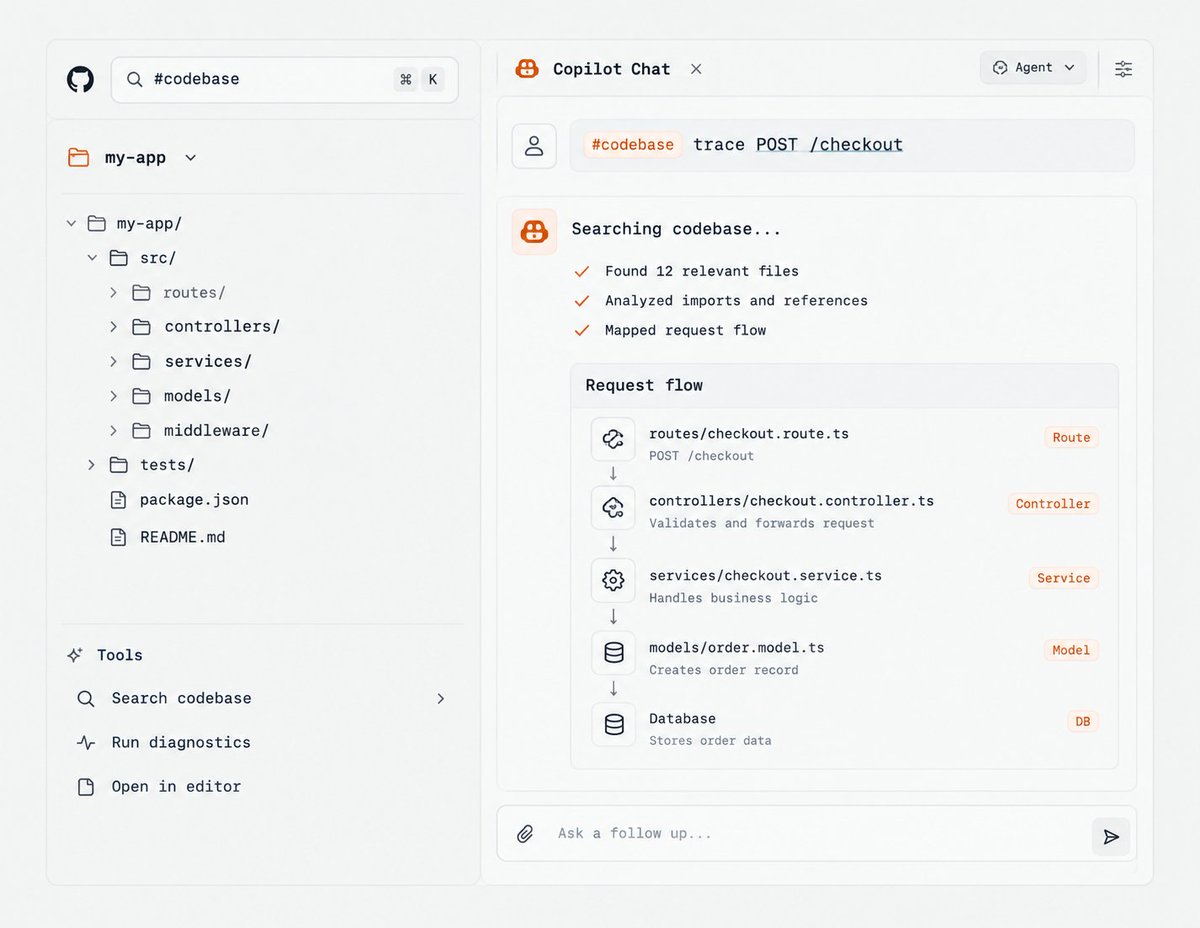
@CamtoIke"#codebase" lets Copilot use your project cxt. to answer questions about the codebase, instead of limiting the question to the file you're looking at. It can help surface: → the files that define the logic → related callers and imports → configuration and middleware involved2616187
Google open-sourced the plugin thousands of its engineers use to stop AI from coding before the plan is solid. It's called the Elephant-Goldfish Model. → The Elephant: one session that knows your whole project. It drafts the design doc and writes zero code → The Goldfish: fresh agents with no memory of your chat. They read the doc cold and catch the assumptions you never wrote down → You approve the plan, then your agent builds it Skills for brainstorming, drafting, review, resolving feedback, documenting an existing codebase, and catching docs that drift from the code. Works in Claude Code and Codex: claude plugin marketplace add google/elephant-goldfish-model claude plugin install egm@egm411715449.2K
What are the main design pattern changes you’ve made to your codebase to better facilitate and leverage agentic programming?2606311.3K
AI made writing code cheap. Reviewing it is now the bottleneck. Testing is next. I wrote down the 7 rules I'd use to run code review on a team where everyone has a coding agent.360281.1K

The creator of Claude Code Teaches more about vibe-coding in 30 minutes than most paid tutorials do in 10 hours. Absolutely Free. From the guy who built the tool. Save it. Watch tonight. It'll change how you build forever. You've been using Claude Code wrong for months without knowing it. This fixes that in 30 minutes. Follow @codewithimanshu for more high-signal content that actually moves your career forward. ↓ Boris runs technical staff at Anthropic. He built Claude Code. He just gave away the entire playbook. This is the talk that separates people making $10K/month with AI coding from people still Googling "how to fix this error." Here's everything he covers in 30 minutes. Follow @codewithimanshu, I break down a video like this. ↓ Installation and setup the right way. Not the wrong way you did it. `npm install` to get Claude Code running. `terminal setup` to enable Shift+Enter for new lines and themes. GitHub app integration to @-mention Claude directly on issues and pull requests. Mac users: system-level dictation for hands-free prompting. Most people skip these steps and wonder why their Claude Code workflow feels clunky. Follow @codewithimanshu For Full Claude Code setup guides. ↓ The workflow most users miss entirely. Codebase Q&A is the real starting point. Not "write me code." Ask Claude about your codebase first. It explores locally. No indexing. No data upload. You can ask: > Why was this function written this way? > What did I ship this week? > What's the git history of this file? Understand the codebase before you touch it. That's how senior engineers think. That's how Claude Code wants to work with you. Follow @codewithimanshu for more high-signal content that actually moves your career forward. ↓ Interactive coding that actually ships. Claude uses file editing, bash commands, and file search to execute tasks in real time. Boris's rule: brainstorm and plan BEFORE you trigger code generation. Skip the planning step and you get garbage. Do the planning step and Claude ships production-ready code. This alone is the difference between "AI wrote my app" and "AI wrote an app that actually works." More ship-ready Claude prompts already posted on @codewithimanshu. ↓ Tool integration nobody uses. Custom CLI tools. MCP servers. Integrated directly into your Claude Code workflow. Claude calls your tools. Uses your data. Executes tasks across your entire stack. This is where Claude Code stops being a coding assistant and starts being a full engineering team. Follow @codewithimanshu for MCP server breakdowns every week. ↓ Iterative feedback loops. Give Claude access to your unit tests. It refines until they pass. Give Claude screenshots of your UI. It iterates until the design matches. Most people run Claude Code once and accept the first output. The best users build feedback loops that let Claude improve itself. I share the exact feedback loops I use daily. ↓ Context management: Claude MD. Place a `claude(dot)md` file in your project root. Persistent context. Shared across every session. Enterprise config for global policies across teams. This is the file that separates hobby Claude Code users from production users. I'll post my full claude(dot)md template next week. Follow me @codewithimanshu. ↓ Slash commands and memory. `/memory` to view or modify how Claude remembers instructions. Slash commands for automating complex workflows. Example: auto-labeling GitHub issues with one command. Slash command library coming soon on @codewithimanshu. ↓ Pro key bindings Boris drops at the end. Shift+Tab: auto-accept mode for edits. Saves hours. !Command: execute a bash command and pipe output into context. Escape: safely stop Claude without corrupting your session. Drag and drop images. Paste screenshots for UI implementation. Multimodal from day one. Follow me @codewithimanshu for Daily Claude Code tips. ↓ 30 minutes from the guy who built the tool. You'll learn more from this than from 50 YouTube tutorials made by people who've never shipped production code with Claude. This is where the gap gets built. People who watch it understand Claude Code at the architect level. People who skip it keep copying commands they don't understand. Save the video. Watch it tonight. Build something tomorrow. Follow @codewithimanshu for more high-signal content that actually moves your career forward.1211241.8K
🚀 Build Real-Time #Codebase Indexing for LLMs with Tree-sitter for coding agents. ~100 lines of Python Real-time updates, syntax-aware chunking. Production-ready. Ultra-performant. Fully #OpenSource. get started: 🔗 repo: 🌟 Power your AI coding assistant with: ✅ Tree-sitter for syntax-aware code chunks ✅ SentenceTransformer embeddings ✅ Real-time updates with incremental processing ✅ Built for RAG, blazing fast Perfect for AI-powered #devtools and #semantic code search. #LLM #RAG #AIForCode #CodeSearch #DevTools #RealtimeAI #OpenSource #AIInfra #Rust #Python #TreeSitter #VectorDB #Embeddings #AIEngineering #GenerativeAI #Codex #CodingAgents #Claude #Cursor55824021.2K
your app, running on a design canvas, whatever framework you use!!! so much work went into this. we built adapters for all these frameworks so you can just connect your codebase and dessn handles the setup we even simulate the backend your app needs so you can actually click through it and design on top of your productnim @eminimnim@Dessn_ai now supports any tech stack. yes even php. Here's a small list of what we support: Next.js, React, Vue, Angular, Electron, Svelte, SvelteKit, Nuxt, Remix, React Router, Astro, Gatsby, Ruby on Rails, Django, Laravel, WordPress, PHP, Flask, Expo, React Native Web, Electron, SolidJS, SolidStart, Preact, Vite, Create React App, TanStack Start, RedwoodJS, Vike, Storybook, Starlight, Hotwire, Wagtail, Inertia, Livewire, Effect, Three.js, Tailwind, shadcn/ui, MUI, Chakra UI, Mantine, Ant Design, Element Plus, Bootstrap, Angular Material, styled-components, Emotion, CSS Modules, Sass, Less, PostCSS, UnoCSS, TypeScript, JavaScript, Ruby, Python, Turborepo, Nx, any monorepo tooling and much much more. Oh and iOS (closed beta).1010735
@Dessn_ai@Dessn_ai now supports any tech stack. yes even php. Here's a small list of what we support: Next.js, React, Vue, Angular, Electron, Svelte, SvelteKit, Nuxt, Remix, React Router, Astro, Gatsby, Ruby on Rails, Django, Laravel, WordPress, PHP, Flask, Expo, React Native Web, Electron, SolidJS, SolidStart, Preact, Vite, Create React App, TanStack Start, RedwoodJS, Vike, Storybook, Starlight, Hotwire, Wagtail, Inertia, Livewire, Effect, Three.js, Tailwind, shadcn/ui, MUI, Chakra UI, Mantine, Ant Design, Element Plus, Bootstrap, Angular Material, styled-components, Emotion, CSS Modules, Sass, Less, PostCSS, UnoCSS, TypeScript, JavaScript, Ruby, Python, Turborepo, Nx, any monorepo tooling and much much more. Oh and iOS (closed beta).42334.3K
I've just finished filming the most ambitious course of my career. It starts November 9th, and runs for 2 weeks. It's everything you need to build your company's software factory. Everyone's talking about how to go FASTER with agents. That's really, really easy. Loops, YOLO mode, dark factory. That's a recipe for a slop cannon. No serious organisation is going to trust a factory like that. So, you need to slow down to speed up. What's the first pedal your driving instructor showed you? Not the accelerator. Once you put the brakes on your agent - to constrain it and increase its output quality - you can start to trust it. The best brakes? Good ol' software fundamentals. Here's what we cover: - Automated Review - Codebase Design - DDD & Ubiquitous Language - Mutation Testing - Feedback Loops From there, the course accelerates. We show you a working factory and build your system design skills. We even plan your infra with you. You'll walk out with a software factory spec, ready to hand to an agent. And you won't be learning alone. You'll have a massive community with you, learning along. We actually opened sales on Monday. It's already on track to be BY FAR the biggest course of my career. Want to join in? Here's the link below:73831.6K111K
Top 15 MCP servers for Hermes Agent, ranked by GitHub stars. Docs, browsers, code intel, 3D, design + more: 1. Context7 2. Chrome DevTools MCP 3. Codebase Memory MCP 4. Playwright MCP 5. GitHub MCP Server 6. Context Mode 7. Blender MCP 8. Code Review Graph 9. Serena 10. n8n-MCP 11. MCP Toolbox for Databases 12. Xiaohongshu MCP 13. Figma Context MCP 14. Unity MCP 15. Apify MCP Drop any of them under mcp_servers in your Hermes config and run /reload-mcp.221251.2K56.7K
A 12GB RTX 3060 is reportedly generating around 50 tokens/s with Qwen3.8-35B-A3B, a model with 35 billion parameters. The same setup is also reporting approximately 550 tokens/s in prompt processing. No 24GB GPU or expensive multi-GPU setup. Just an RTX 3060, 16GB of system RAM and some careful inference optimisation. The hardware and configuration The reported setup uses: GPU: RTX 3060 (12GB VRAM) System RAM: 16GB Model: Qwen3.8-35B-A3B Quantization: Q4_K_M Generation speed: ~50 tokens/s Prompt processing: ~550 tokens/s Configured context: 262K tokens Runtime: llama.cpp Optimisations: Flash Attention and Q8 KV cache The two speed figures measure different stages of inference Generation speed measures how quickly the model produces new tokens. Prompt processing measures how quickly it processes incoming text before generating a response Both are useful, but they shouldn’t be treated as interchangeable How does a 35B model run on 12GB VRAM? The explanation starts with the model’s architecture Qwen3.8-35B-A3B uses a Mixture-of-Experts (MoE) design Although it contains approximately 35 billion parameters, only around 3 billion are activated for each token Instead of running every part of the model during every generation step, the routing system selects particular experts to perform the computation This reduces the amount of computation required per token compared with a dense model of similar total size However, there’s an important distinction: 3B active parameters does not mean the remaining 32B parameters disappear The full model weights still need to be stored and accessed. That’s where hybrid inference becomes important The CPU and GPU work together The setup uses llama.cpp to distribute the model across GPU and system memory According to the reported configuration, 26 MoE layers are offloaded to the CPU This allows system RAM to accommodate parts of the model that cannot fit entirely within the RTX 3060’s 12GB VRAM The GPU handles the portions assigned to it, while the CPU and system memory take care of the offloaded components Three optimisations help make this arrangement practical: 1. Q4_K_M quantization The model weights are stored in a 4-bit quantized format, significantly reducing their memory footprint compared with higher-precision versions The trade-off is that quantization can affect model quality, so coding performance still needs to be evaluated 2. Flash Attention Flash Attention improves how attention operations are computed by reducing unnecessary memory movement It can also help control memory requirements, particularly when processing longer sequences 3. Q8 KV cache The KV cache stores attention keys and values from previously processed tokens Using Q8 stores this information at 8-bit precision rather than a higher-precision format, reducing memory consumption as the context grows Together, these techniques allow the system to run a model that would otherwise be difficult to accommodate entirely in GPU memory What about the 262K context? The reported configuration supports a context window of up to 262K tokens But a configured context limit doesn’t mean the system can process that much text at the same speed or without memory pressure The KV cache grows as more context is processed. With only 16GB of system RAM and 12GB of VRAM, longer prompts could introduce substantial memory pressure and reduce performance. The actual usable context will depend on the runtime configuration, cache allocation and available memory The real test: coding agents Getting 50 tokens/s from a local model is encouraging, but generation speed alone doesn’t tell us how useful it is for software development A coding agent needs to: Inspect files and understand an existing codebase Identify dependencies and trace how components interact Modify multiple files Execute commands and tests Diagnose errors Recover from failed attempts Verify that the final changes actually work224350951.3K
This GitHub repo fixes the #1 reason AI coding agents fail. They don’t ask what you actually want. Matt Pocock calls it misalignment. He’s the guy whose TypeScript course made $2.5 million. Ex-XState core team. Ex-Vercel developer advocate. Co-wrote Total TypeScript. His fix is called Skills For Real Engineers. 27 skills straight from his own .agents folder. 307,000 GitHub stars. Type /grill-with-docs and the agent interviews you until every branch of your plan is resolved. No code until you’re aligned. What else is inside: → /tdd. Failing test first, then the fix. → /diagnosing-bugs. Reproduce, minimise, hypothesise, fix. → /code-review. Two parallel sub-agents check standards and spec. → /prototype. Throwaway builds to answer a design question before you commit. → /handoff. Compacts your session so another agent can pick up the work. → /improve-codebase-architecture, /to-tickets, /wait-what, and more. Real engineering, not vibe coding. His thesis: AI made engineering fundamentals matter more, not less. Works with Claude Code, Codex, Copilot, Gemini CLI, Cursor, and more. 100% Open Source. MIT License.9312557.5K
one claude agent found 14–27 of 70 planted bugs. a flow of agents found 66. consistently. i went through anthropic's 1h40 workshop on running up to 1,000 agents and pulled out the patterns worth stealing ↓221014920.2K- Show more posts