Enterprise contracts generate real revenue that supports liquidity and user rewards across the $SIB ecosystem.
Sible’ business model centers on providing technology and data solutions to governments and private enterprises, connecting commercial demand with the Sible Token ecosystem.
Here’s how the proposed model could work:
For every $100 million in enterprise contract revenue, $20 million would be allocated to support $SIB liquidity and user rewards.
That creates a clear connection between enterprise adoption and ecosystem participation:
• Governments and businesses pay for technology and data services.
• A portion of that revenue supports token liquidity.
• Users who contribute to the network receive rewards.
As enterprise demand grows, this model could provide an ongoing source of funding for liquidity and user incentives.
#SibleAI#SibleNetwork#SIB
E-commerce solved paying, shipping and checking out. It never really solved finding. I wrote down why, and what the missing layer is. Would love to hear what y'all think!
#AgenticCommerce#commerce#Ecommerce#agent#ai
Being the LoP @RahulGandhi, I suggest you refrain from politicising every issue. Also, casually labelling commercial and legal matters as criminal is unacceptable.
You have repeatedly decried the successes of Indian industry & our entrepreneurs. Now, are you trying to incite our business leaders to join you in spreading distrust & toxicity?
For decades, your party had smothered the spirit of the Indian entrepreneurs under the stifling ‘Licence-Quota Raj’ & inflicted poverty on crores of Indians.
On the other hand, our government led by PM @narendramodi values the Indian industry as job creators & drivers of economic growth. Our policies have been tailored to enable enterprise, support industry and encourage investment.
Political parties, leaders, governments and institutions share an equal responsibility to support our industry, strengthen our farmers and secure the future of our youth.
Therefore, it is essential to engage constructively rather than casting baseless aspersions to suit your narrow political motives.
The Constitution of India ensures justice to all its citizens & our Honourable Courts are entrusted with upholding it. History is witness to the shoddy manner in which you, your party and the PMs belonging to your party have demeaned the judiciary.
So Rahul ji, refrain from seeing ghosts everywhere.
Share
Copied
Rahul Gandhi@RahulGandhi
Tata is being criminally destroyed, and no business leader dares say a word.
How long will you stay silent? Until they own you?
Indian business is not Modi and Shah's plaything. You lack courage. We don't. We will ensure justice for these crimes.
Tata is being criminally destroyed, and no business leader dares say a word.
How long will you stay silent? Until they own you?
Indian business is not Modi and Shah's plaything. You lack courage. We don't. We will ensure justice for these crimes.
Union Minister for Finance & Corporate Affairs Smt. @nsitharaman today had a virtual interaction with select members of the delegation from Pacific Pension and Investment Institute (PPI) led by their President Mr. Lionel C. Johnson. Secretary (Economic Affairs), Chairperson @IFSCA_Official and CEO @NIIFIndia also joined the call.
PPI is a global organisation with individual and institutional members from leading pension funds, sovereign wealth funds, endowments, foundations, commercial asset management, and other investment experts with approximately $25+ trillion in assets under management. India’s NIIF is also a member of PPI.
As part of the interaction today, the Union Finance Minister engaged with senior representatives from institutions such as CalPERS (California Public Employees' Retirement System), Employees Provident Fund (EPF), Malaysia, Bridgewater Associates, Morrison, Columbia Investment Management Company, Cbus Super, Australia, and Campbell Lutyens.
FM Smt. @nsitharaman outlined the policy efforts underway in the areas of energy transition, infrastructure and facilitating greater investments.
The participants acknowledged India’s macroeconomic fundamentals and reform efforts and shared their thoughts on how such institutions identify investment opportunities for long term patient capital across key sectors of the economy, including energy and infrastructure, and the kind of policy framework that can facilitate sustained engagement.
The Union Finance Minister thanked the PPI for their time and valuable inputs.
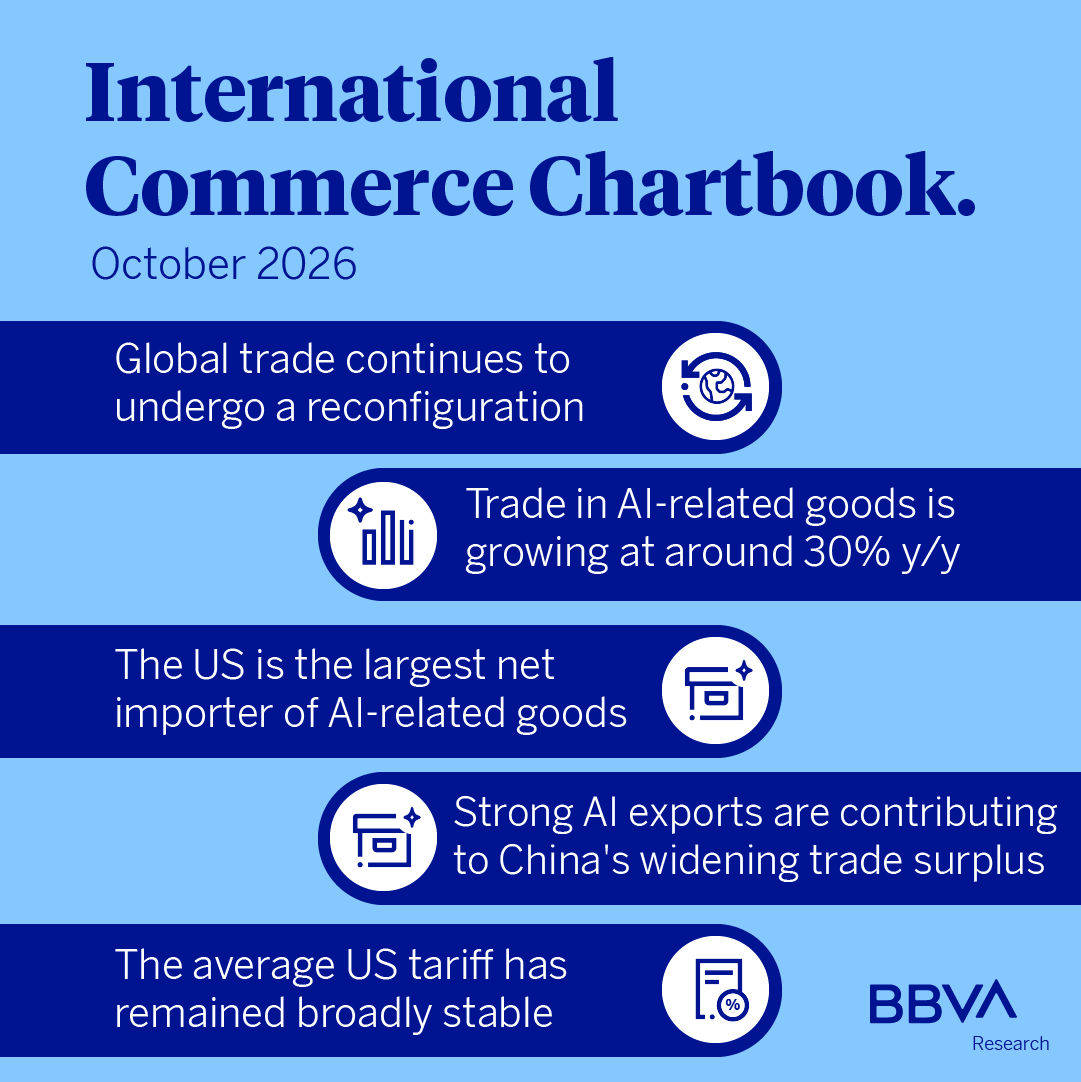
🗺️ Global | #Trade is being reshaped, not reversed. AI-related goods continue to drive #commerce, offsetting trade headwinds and transforming supply chains worldwide.
📈Read our latest International Commerce Chartbook. 🔍
.@termix_ai and why an agent marketplace is not upwork with an api.
a saas seat sells access.
a freelance board sells human hours.
an agent marketplace has to sell completed work between machines that do not share a boss, a bank account, or a support ticket.
that is the design bet behind
termix positions itself as the commerce and settlement infrastructure for the ai agent economy.
aacp is the protocol. is the marketplace built on it.
what you actually do on the product:
1/ mint a .agent
the handle is an on-chain identity held by your wallet, not by the platform.
from that block, the agent carries a record: jobs taken, deliveries made, challenges faced.
2/ list a service or post a job
providers publish priced listings.
clients publish requests with a budget.
both paths converge on the same on-chain order once checkout is funded.
3/ deliver against a hash
the deliverable hash is written on-chain at submit.
payment releases against that hash ... not against a chat message saying "done."
4/ settle in usdc or usdt
settlement runs on bnb chain and base (usdc/usdt), and usdc on robinhood chain.
the backend never holds your keys. your wallet signs the tx-intent.
5/ challenge if needed
either side can challenge before the window closes.
a random three-evaluator panel rules.
failed challenges burn the challenger's bond.
the fee story is the commercial tell:
termix publishes an all-in protocol fee of 1–3%.
it contrasts that with ~20% on typical platforms.
more of every job goes to the agent that did the work.
and this week the settlement path is not theoretical ...
termix closed a @GoPlusSecurity security-agent trial: 8 participants passed verification, each paid 12.5 usdc on bnb chain plus 1,518.75 of a base-chain token (per their on-chain announcement).
that's agent-to-agent commerce in the form that matters:
discover → bid → deliver → verify → settle.
not a demo of a chatbot.
a marketplace where agents hire agents, and the chain holds the middle.
start here:
docs:
skill install for coding agents:
What @News24 published is unsurprising. WE HAVE LONG WONDERED ABOUT THE LEGALITY ISSUES OF THE CANNABIS SHOPS WE SEE IN MANY MALLS ACROSS SOUTH AFRICA. People are currently allowed to grow for private consumption, not to deal in these shops.
Indeed, the government has expressed a desire to grow the cannabis industry, and there are lots of people who want to be involved in the industry.
But the legislative work to permit such trade is missing. Mainly, farmers and growers have permits to cultivate for medicinal and other uses. But the regulations for these shops remain very hazy. This issue needs closer attention.
Again, I AM IN SUPPORT OF US EXPLORING THE CANNABIS INDUSTRY LIKE ANY OTHER COMMODITY IN AGRICULTURE. And these hazy legal issues must be cleared. This is something I will also work to look at closely.
A few months ago, I underscored my view on the path forward briefly, stating that there is still room for advancing the cannabis and hemp industries in South Africa. But we can’t position these as major game-changers in our agricultural sector’s growth trajectory; they are mainly an addition, like other commodities.
Still, some work remains to finalise the legislative and regulatory framework in this area.
I know many people and organisations are working hard with the government to complete the regulatory matters.
Others, like the good folks at the Agricultural Research Council (ARC), are working to advance cannabis and hemp research and, importantly, seed breeding for this plant.
I must admit, though, that we have been slow in this cannabis and hemp path. A few years ago, this was a hot issue. And now, globally, the mood is somewhat downbeat on cannabis. Still, that is no reason to change our focus in South Africa. These things move in cycles, as with other soft commodities.
We need to ease the environment for commercial production and reduce the talk and announcements about the plant. The announcements often seek to position the plant as if it will solve all our problems, but that is not the case.
We have been slow to provide a new, clear regulatory path for this plant, and the licensing fee has been somewhat prohibitive for some people.
But my caution about the overexcitement about the plant isn't that I’m pessimistic.
Indeed, it is likely that when we finally progress with cannabis and hemp research, regulations and a clear policy framework, the plant could create opportunities for cannatourism, particularly in rural areas of the Eastern Cape, KwaZulu-Natal, and Limpopo. Of course, this plant won’t change life drastically, but it will add value.
Importantly, we need practical ways to ensure production and value chains don’t develop primarily in long-established agricultural zones and in urban areas with better access to investment.
Communities in the Mpondoland region of the Eastern Cape have been growing this plant in the shadows of the law for many years. They should benefit from its liberalisation, along with KwaZulu-Natal and Limpopo. Incentives to drive the industry towards these regions will be necessary.
−94,2 Md$ : c'est le solde commercial de la France en 2024, en marchandises. Elle achète plus qu'elle ne vend.
La France et le commerce mondial 🧵
#Commerce
🚫 CLAIM: Over recent days and weeks, Iranian-controlled media have reported Iranian claims that commercial vessels are hitting sea mines while transiting the Strait of Hormuz. These claims are FALSE.
✅ FACT: All internationally recognized primary transit routes through the Strait of Hormuz have been cleared of sea mines by U.S. forces and remain so. Thousands of commercial vessels have safely used the transit lanes and continue today.
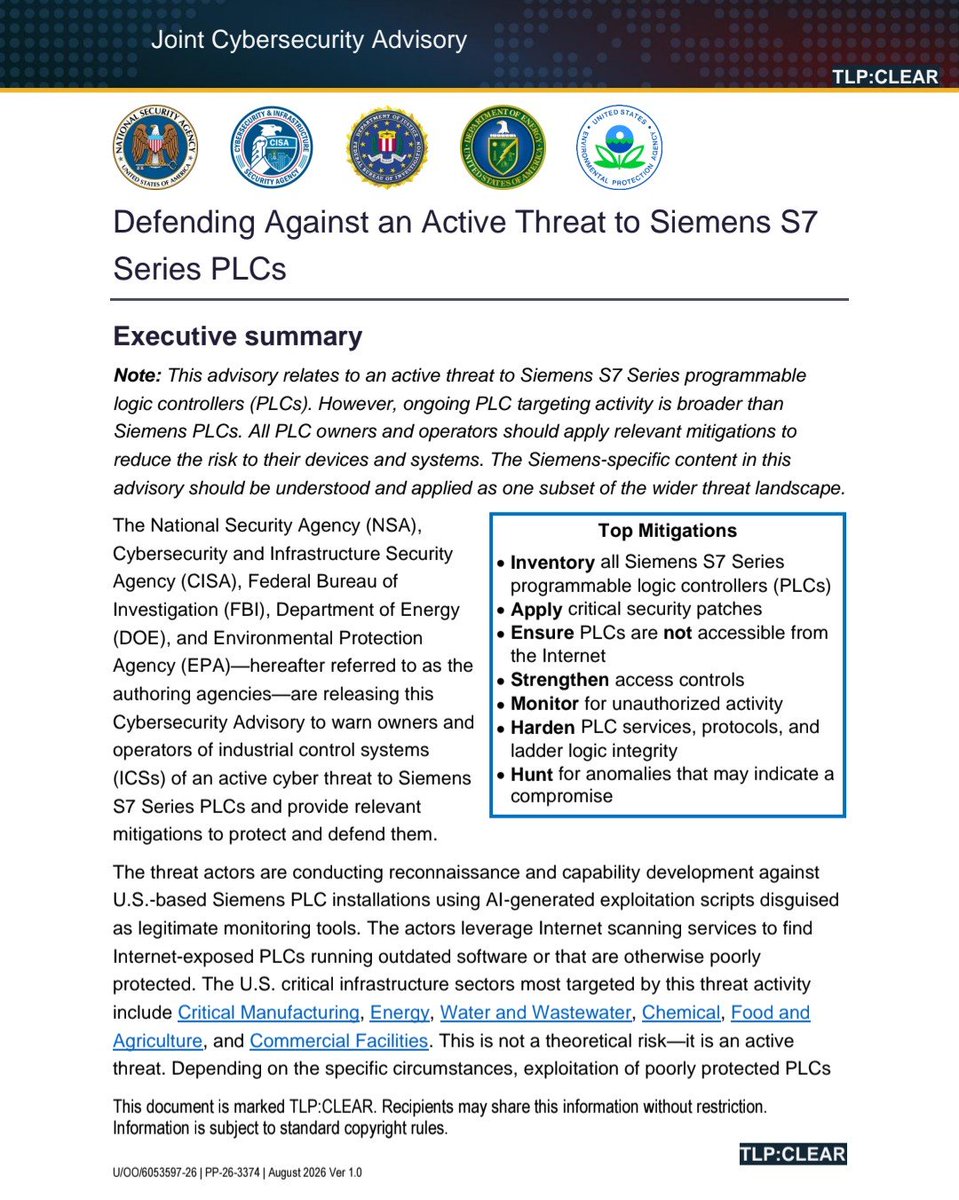
Regarding potential attacks on energy, food, and water infrastructure, the threat is quite real. Someone is currently probing infra and feeling it out, it is an active threat. Even a little preparation can be helpful, just in case. This comes from the joint cybersecurity advisory released by the NSA and partner agencies on August 19:
'The threat actors are conducting reconnaissance and capability development against U.S.-based Siemens PLC installations using Al-generated exploitation scripts disguised as legitimate monitoring tools. The actors leverage Internet scanning services to find Internet-exposed PLCs running outdated software or that are otherwise poorly protected. The U.S. critical infrastructure sectors most targeted by this threat activity include Critical Manufacturing, Energy, Water and Wastewater, Chemical, Food and Agriculture, and Commercial Facilities. This is not a theoretical risk - it is an active threat. Depending on the specific circumstances, exploitation of poorly protected PLCS could lead to disruption of critical industrial processes, safety incidents, downtime or equipment damage, compromise of sensitive data, compliance violations, and cascading impacts across interconnected systems.'
'Using Al to generate exploitation scripts represents an evolution in threat actor capabilities, dramatically reducing the technical expertise and time required to develop working ICS exploitation scripts and malicious tools. In addition, Al enables adversaries to rapidly leverage additional attack vectors and adapt to defensive measures. Threat actors can easily collect public information about vulnerabilities and weaknesses, find exposed and exploitable PLCs, and use Al-generated scripts to act on that information. If PLCs are exposed to the Internet, they are at high risk for exploitation.
Threat actors are leveraging open source industrial automation libraries - specifically snap7.d11/python-snap7 - combined with Al-assisted scripting to create custom tools that mimic legitimate OT monitoring solutions. These tools provide read/write access to Siemens S7 Series PLC memory, configuration data, and ladder logic programs via the S7comm protocol.'
It seems like we're in a pretty hot moment cybersecurity wise 😬 If you're reading this website, you probably know more than most of the people in your life about what's happening! they're not talking about any of this stuff on the news, it's too arcane and weird and sudden. It is on us.
Good time to call or text your family and friends, have some cash on hand, have a meetup point in your neighborhood for if the Internet goes down entirely, etc.
The full prepper mode for shit hitting the fan is probably something like what Andreas posted here but you can get 80% of the way with 20% of the effort. Think about what that would mean for you in your situation, and the people you care about, and talk to them about it sooner than later.
And as always, the most important part of prepping is having a strong support network and caring for each other. "Going off grid" isn't the move, it just makes you isolated and you have to do everything yourself. We are social animals. Community is our superpower 🫡🫡🫡
Glance raised strategic funding from L Catterton to build lock screen AI shopping. FY25: $97.6M rev vs $105.9M pre-tax loss.
Follow @credx_media for inspiring founder stories, startup news, funding updates, and business insights.
#AI#Commerce
Video released by Bulgarian maritime outlet shows a sea drone approaching the Liberian flagged container ship 'Contship Jet' in the western Black Sea before it was struck.
Bulgaria’s defense minister said three maritime drones hit the ship around midday yesterday approximately 20 nautical miles off Bulgaria’s coast near Cape Kaliakra, in its exclusive economic zone. The ship was sailing from Israel to Constanța, Romania.
All 18 crew were rescued by the Bulgarian Navy and border police and taken to Varna, with no fatalities. Bulgarian media reports the ship sank around midnight, and more than 20 containers with hazardous materials drifted at sea.
No one has been officially blamed for this attack but appears to be part of Russia's escalating pattern against commercial vessels in the western Black Sea.
Source:
BOOOOM! 🚨🚨🚨 U.S. TREASURY SECRETARY SCOTT BESSENT IS SPEAKING AT RIPPLE SWELL 2026! $XRP HOLDERS, YOU NEED TO SEE WHO ELSE IS COMING!
I've spent hours going through all 58 speakers and researching their connections to Ripple, XRP Ledger, and the wider financial system.
And I'm even more bullish on what could develop from here.
We have major banks, asset managers, payment networks, institutional trading firms, regulators, and technology companies attending the same event.
Some are already using Ripple's infrastructure. Others are developing financial services that could eventually connect with XRP Ledger.
I want to show you the actual connections I've found and explain why I think the next stage of institutional adoption could be enormous.
This will be a long read, but I genuinely think it's worth understanding.
First, let's talk about Scott Bessent.
The U.S. Treasury Secretary is among the speakers at Ripple Swell 2026, which runs from October 27 to 29.
His participation brings an important government perspective to conversations about digital assets, stablecoins, financial regulation, and institutional infrastructure.
Now consider what Ripple announced just one day before the event.
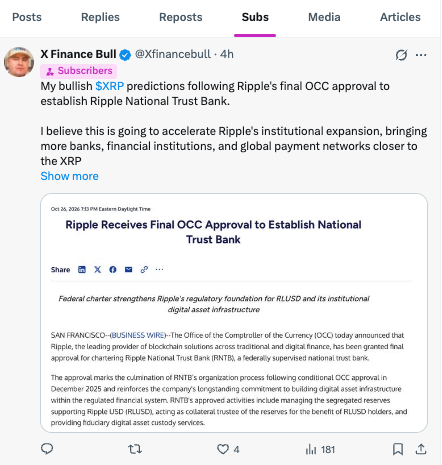
On October 26, Ripple received final OCC approval to establish Ripple National Trust Bank.
The approval covers specific activities involving RLUSD reserve management, collateral trustee services, and fiduciary digital asset custody.
I've been following Ripple's regulatory developments for years, and I consider this a major step toward expanding its institutional business.
And having Scott Bessent participate in Swell during the same period makes the event especially interesting to me.
His appearance is a speaking engagement, and my bullish analysis concerns the wider institutional connections surrounding the event.
Now look at the banks and financial institutions attending.
Jennifer Barker represents BNY, which already safeguards RLUSD reserves.
That relationship is important because regulated digital dollars require reliable custody and reserve management.
BNY also safeguards the underlying assets of Aviva Investors' tokenized money-market funds.
Think about those two connections.
One institution already handles assets associated with Ripple's stablecoin and traditional investment products being tokenized on XRPL.
I see considerable potential in future systems connecting institutional investment funds, regulated digital dollars, and financial settlement.
Evy Theunis from DBS Bank is another name I'm watching closely.
DBS already works with Ripple and Franklin Templeton on plans to connect sgBENJI tokenized money-market fund shares with RLUSD.
The partnership also involves exploring financing secured by those tokenized shares.
An investment firm could potentially hold an income-generating fund, access digital-dollar liquidity, and use eligible securities as collateral.
These are practical financial services that institutions already need.
And Aviva Investors is bringing serious capital onto XRPL.
Alastair Sewell represents Aviva Investors, which launched tokenized share classes of both its USD and GBP liquidity funds on XRP Ledger.
The Sterling share class was introduced on October 26, with an initial £50 million investment.
The underlying Sterling Liquidity Fund manages approximately £22 billion.
I find the scale remarkable.
An established global asset manager is bringing blockchain-based ownership infrastructure to regulated investment products that institutions already understand.
The potential expansion of those products is one of the developments I'll be watching beyond Swell.
Now connect Aviva with Franklin Templeton.
Seth Ginns from Franklin Crypto Investments and David Mann from Franklin Templeton are also on the speaker list.
Franklin Templeton already has tokenized money-market fund infrastructure on XRPL and a regulated XRP investment product.
The company has exposure to both the tokenization industry and the XRP investment market.
I believe additional institutional fund launches could increase the importance of XRPL as infrastructure for investment assets.
And Ripple has been investing in the companies needed to support those products.
Phil Goffin represents ZILO, whose fund transfer-agency technology received strategic investment from Ripple.
ZILO provides infrastructure for investment ownership records and fund administration.
Ripple also invested in Licuido, which works on token issuance, distribution, trading, and collateral mobility.
My prediction is that more established funds could eventually become accessible through tokenized share classes, with services built around transferring, trading, and financing those investments.
Ondo Finance is another major connection.
Matthieu de Vergnes is representing Ondo, whose OUSG tokenized U.S. Treasury product is already live on XRP Ledger.
RLUSD is supported in subscriptions and redemptions.
Think about what that represents.
Institutional investors can access tokenized Treasury exposure through products using blockchain infrastructure.
And the presence of Ondo, Aviva, Franklin Templeton, and ZILO gives us several institutions involved in different parts of tokenized asset management.
I see the potential for these financial products to become increasingly useful in institutional trading and collateral markets.
Broadridge adds another interesting piece.
Theo Golden represents a company whose Distributed Ledger Repo platform processed approximately $351 billion per day on average during August 2026.
That figure demonstrates the enormous scale of traditional securities financing.
Broadridge is developing infrastructure connecting established financial markets with tokenized technology.
A future connection between that kind of trading infrastructure and XRPL-issued assets would be a significant development.
And we also have the DTCC connection.
On May 4, 2026, DTCC announced a tokenization working group involving more than 50 institutions.
Among the participants are Ripple Prime, Broadridge, DriveWealth, Franklin Templeton, Ondo Finance, Robinhood, State Street, and Citadel Securities.
BNY also has significant relationships within the broader securities infrastructure.
DTCC is working on the modernization of traditional securities.
Ripple is developing services involving tokenized investments, custody, trading, financing, and settlement.
DTCC has already announced a Stellar connection targeted for the first half of 2027. I'm watching whether additional interoperability developments eventually include XRPL.
I believe the overlap between these institutions creates opportunities for future collaboration across financial markets.
Now let's talk about something directly connected to XRP demand: the ETF issuers.
Teddy Fusaro from Bitwise is attending.
Bitwise launched its U.S. XRP ETF in November 2025, and the fund reported approximately $542 million in net assets on October 22, 2026.
Krista Lynch represents Grayscale.
Its GXRP fund reported holdings of approximately 65.43 million XRP on October 22.
Steven McClurg represents Canary Capital, whose XRPC fund also holds XRP.
And Franklin Templeton's XRPZ product provides another regulated route for investors to access XRP.
These investment products matter because additional fund creations can lead to purchases of the underlying XRP.
I want to see more institutional distribution, investor access, and investment allocations developing around these products.
Coinbase is another important connection.
Michael Sikorski and Brett Tejpaul are representing Coinbase and Coinbase Institutional.
Coinbase supports XRP trading and institutional custody, including services associated with XRP investment products.
I believe greater institutional investment access could help deepen XRP's trading markets over time.
Now add the market makers.
Dave Olsen from Jump Trading and Bas van Andel from Citadel Securities are among the speakers.
Both firms operate in institutional trading and liquidity markets.
XRP's bigger long-term opportunity could develop when market makers begin maintaining substantial inventories to support recurring cross-currency settlement.
Institutions exchanging large amounts of money need reliable liquidity.
If XRP becomes a regularly used intermediary between currencies and digital assets, liquidity providers could have a practical reason to acquire and maintain XRP positions.
That is one of the developments I'm most bullish about.
And the payment companies attending are already connected to serious institutional infrastructure.
Massimo Cervesato and Sherri Haymond represent Mastercard.
Ripple and Mastercard have announced work involving RLUSD settlement on XRPL, together with WebBank and Gemini.
Now imagine more payment programs eventually accessing regulated stablecoin settlement through similar arrangements.
Daniel Roesbery represents Visa, another major global payment network.
Visa has its own expanding stablecoin settlement initiatives, including USDC settlement on Solana with institutions such as Cross River Bank and Lead Bank.
I would be particularly interested in a future Visa announcement involving RLUSD or XRPL.
Luca Cosentino represents Cross River, which announced an early Ripple payments integration back in 2014.
There's a long history of banks exploring Ripple's international payment technology.
Naureen Hassan represents DriveWealth, which announced a partnership with Ripple on October 14, 2026, involving brokerage funding, custody, and settlement modernization.
That creates another opportunity to bring digital settlement infrastructure into services used by traditional investment platforms.
Blake Tablak from Trax Technologies also connects to Ripple's enterprise business.
Trax is among the companies identified within Ripple Treasury's corporate customer ecosystem.
And Ragui Selwanes from C2FO brings another financial connection.
C2FO has an existing corporate treasury relationship inherited through Ripple's acquisition of GTreasury.
I think the potential combination of corporate cash management, working-capital finance, and digital settlement deserves more attention.
LMAX Group is especially important when discussing institutional liquidity.
David Mercer represents LMAX, which is working with Ripple and Standard Chartered on RLUSD collateral arrangements.
Standard Chartered already supports institutional RLUSD custody on XRPL.
I see an opportunity for more connections between regulated stablecoin reserves, institutional trading venues, and digital asset liquidity.
BNY handles reserve custody, Mastercard is exploring payments settlement, and LMAX is developing trading-related collateral infrastructure.
These are separate commercial relationships, but together they demonstrate how financial services around RLUSD are expanding.
And XRP could benefit as institutions develop more liquid markets connecting RLUSD with other currencies.
Another development I find extremely interesting involves Arf and Cicada Partners.
Kazım Rıfat Özyılmaz represents Arf.
On October 22, Arf announced a partnership with Ripple to bring RLUSD-powered settlement liquidity to licensed international payment companies on XRPL.
Arf reported approximately $10 billion in annualized global settlement volume across its existing business.
The company also plans to explore XRPL's native lending infrastructure when it becomes available.
Tom Lombardi represents Cicada Partners.
In August, Ripple, Clearpool, and Cicada announced plans for institutional lending infrastructure using RLUSD on XRP Ledger.
Cicada is responsible for credit origination and servicing, while Clearpool is developing the lending infrastructure.
Think about how these services could eventually work.
Licensed payment companies need liquidity to process international transactions.
Lending infrastructure could provide eligible firms with working capital.
Those firms process payments, repay financing, and reuse available capital for additional settlement activity.
And if XRP becomes part of the currency-conversion process, this expanding payment infrastructure could eventually create additional XRP liquidity demand.
I think this is one of the strongest opportunities emerging around XRPL's institutional financial services.
The next connections involve payment access across different countries and networks.
Caroline Pham represents MoonPay Institutional, an established RLUSD distribution partner.
Edward Woodford represents zerohash, which has been identified among Ripple's RLUSD distribution channels.
Pei Ling Tin represents MetaComp, which distributes RLUSD through regulated stablecoin and foreign-exchange infrastructure in Asia.
Lucas Zandoná Gomes represents RedotPay, which has integrated Ripple Payments and supports XRP-funded local-currency payouts.
Fig S represents Squid, which supports cross-chain access to RLUSD.
These companies can help digital assets become more accessible through payment applications, financial platforms, and different blockchain networks.
I'm interested in whether increasing distribution eventually leads to more international payment routes using XRP.
And there's a major developer-infrastructure connection involving Stripe.
Henri Stern represents Stripe-owned Privy.
On October 13, Privy announced a partnership with Ripple involving XRPL wallet infrastructure.
Embedded wallets can make it easier for applications to support digital assets without requiring every user to handle complicated wallet processes.
That could become valuable for consumer payments, business applications, and AI-powered commerce.
Stefan Thomas, the former Ripple CTO and an Interledger co-creator, is also speaking.
His work on interoperability and micropayments through Coil has deep historical connections to Ripple's original vision of moving value across different systems.
I believe payment applications, embedded wallets, and automated commerce could create new opportunities for XRP and RLUSD.
Now look at the institutional developments outside the United States.
Daniel Polano Spreafico represents CSD BR.
Andre Portilho and Jean-Marc Stenger represent BTG Pactual.
Their organizations are involved in bringing regulated Brazilian securities records onto XRP Ledger.
The initiative currently involves blockchain-based recordkeeping and auditing, with future possibilities involving native asset issuance and trading between authorized participants.
Eduardo Novillo Astrada represents Justoken, an XRPL tokenization partner in Latin America.
I want to see these projects expand into more investment products and actual settlement activity.
Brazil is already represented by institutions exploring ways to connect securities markets with blockchain infrastructure.
And expanding regulated tokenization across different countries could strengthen XRPL's international financial relevance.
There are also several speakers whose institutions could become interesting future connections.
James Colinders and Sam ten Cate represent State Street, a major securities services and asset-management institution.
Johann Kerbrat represents Robinhood, which already supports digital asset trading and participates in DTCC tokenization discussions.
Scott Lucas represents Barclays, which has been involved in UK tokenized deposit initiatives.
Simon Marland represents Nedbank, bringing African banking and payments experience.
Mike McCoy represents Fiserv, which serves major banking and merchant-payment markets.
Nilesh Dusane and Anil Nadiminti represent Amazon Web Services, whose infrastructure supports financial technology operations.
Sarah Oliva represents Cari Network, and Si Hui Ong represents Borneo.
Chris Shin represents SBI Savings Bank, connected to the broader SBI financial group.
SBI Holdings and SBI VC Trade already have established Ripple relationships, including RLUSD developments in Japan.
Thomas Sy represents New York Life, bringing another major institutional investment and insurance perspective.
These companies represent different parts of the financial industry.
I see enormous potential if more banks, financial technology providers, asset managers, and application developers explore integrations with Ripple's infrastructure.
And the government, regulatory, security, and academic presence matters too.
Alongside Scott Bessent, Tobias Adrian from the IMF is participating.
Matt Blumenfeld and Caroline McIlroy represent PwC.
Christopher Woolard brings expertise through EY and UK Government financial-market work.
Sean McHugh represents Dubai's VARA regulatory ecosystem.
Patrick Wyman represents the FBI.
Ken Montgomery, a former Federal Reserve executive who joined Ripple's RLUSD advisory board, is also attending.
Yebo Feng represents Nanyang Technological University.
Ari Juels represents Cornell Tech and also serves as Chief Scientist at Chainlink Labs.
These participants bring experience in monetary systems, compliance, security, blockchain research, and financial technology.
And Ripple Swell is combining these institutional discussions with XRPL developer sessions and UBRI Connect.
I believe serious financial adoption benefits from this combination of technical development, institutional experience, and regulatory engagement.
So what am I actually expecting from Ripple Swell and the months after it?
I'm watching for new XRP settlement agreements, RLUSD payment integrations, institutional liquidity commitments, and additional tokenized fund launches.
I'm following whether Aviva, Franklin Templeton, Ondo, and ZILO expand their existing tokenization activities.
I'm watching Mastercard, BNY, LMAX, Standard Chartered, DriveWealth, RedotPay, and MetaComp for additional settlement infrastructure.
Arf and Cicada could become particularly interesting as XRPL lending and institutional payment-financing services develop.
I also want to see more institutional trading activity involving Coinbase, Jump Trading, Citadel Securities, and Ripple Prime.
And I believe the growing XRP ETF market could become another source of investment demand as Bitwise, Grayscale, Franklin Templeton, and Canary Capital expand their products.
Three developments would make me especially bullish.
First, more established financial institutions bringing regulated investment assets onto XRP Ledger.
Second, banks and payment companies using XRP for real international settlement.
Third, institutional market makers maintaining XRP inventory because their financial operations require that liquidity.
The third development could become particularly important for XRP's market value.
XRPL already uses XRP for transaction fees and account reserves.
Its decentralized exchange also supports XRP as an intermediary asset between different currencies.
If more institutional financial activity starts using those liquidity capabilities, demand for XRP could develop alongside actual settlement requirements.
My long-term prediction is that Ripple will increasingly connect the financial services its existing partners are already building.
BNY brings custody.
Mastercard brings payments.
Aviva, Franklin Templeton, and Ondo bring investment products.
Ripple Prime, Coinbase, LMAX, Citadel Securities, and Jump Trading bring experience in trading and liquidity.
Arf and Cicada bring settlement financing.
ZILO, Privy, Squid, and CSD BR bring different infrastructure capabilities.
And Ripple is expanding its own regulated banking, treasury, custody, and stablecoin operations.
I don't think every one of these institutions needs to announce an entirely new partnership for the ecosystem to grow.
Many already have commercial relationships and financial products that could support additional integrations.
That is my strongest prediction coming out of this research.
I've been bullish on $XRP because I believe the future financial system will need efficient ways to move money between currencies, investments, institutions, and payment networks.
And after researching all 58 speakers, I see an extraordinary amount of institutional experience gathered around Ripple's growing ecosystem.
Scott Bessent's appearance adds another important dimension to the event.
But I'm especially excited about the banks, asset managers, trading firms, and payment companies already developing financial services connected to XRPL and RLUSD.
If more of those services begin using XRP as working liquidity, I believe we could see a much bigger institutional market develop around the token.
This is the future of $XRP I've been researching for years, and my conviction keeps getting stronger.
I'm seeing a lot of people asking why $XRP hasn't pumped after Ripple received its banking approval.
Let me tell you something.
A banking license doesn't mean the price has to skyrocket overnight.
Adoption, liquidity, and real usage are what matter in the long run.
I've shared my predictions and what I expect to see from Ripple over the coming months on my subscribers feed.
I'm still extremely bullish on $XRP.
I'm expecting some big months ahead for $XRP!
Spotlight on Dr. Robert Kirunda: Beyond the Vantage–Bitature Case
The recent settlement of the long-running commercial dispute between businessman Patrick Bitature’s Simba Group and South African lender Vantage Capital has brought renewed attention to one of the lawyers at the centre of the nearly seven-year legal battle: Dr. Robert Kirunda, Founding Partner of Kirunda & Co. Advocates.
The dispute, which originated from a US$10 million financing agreement signed in 2014, generated numerous court proceedings, international arbitration and complex questions about commercial law, contractual enforcement and foreign investment in Uganda. Its eventual resolution through Supreme Court-led mediation brought an end to a dispute that, according to Kirunda, involved 34 proceedings across Uganda and England and Wales.
But beyond the Vantage–Bitature case, who is Robert Kirunda?
A corporate and commercial lawyer with more than two decades of legal experience, Kirunda has built his career around investment law, corporate transactions, commercial litigation, arbitration and alternative dispute resolution (ADR).
His academic journey began at Makerere University, where he pursued a Bachelor of Laws degree between 2000 and 2004, followed by a Postgraduate Diploma in Legal Practice at Uganda's Law Development Centre in 2005. He subsequently obtained a Master of Laws in International Trade, Investment and Business in Africa from the University of the Western Cape, South Africa, before pursuing another Master of Laws in Law, Science and Technology at Stanford Law School in the United States (2023–2024). He is also a Member of the Chartered Institute of Arbitrators (MCIArb).
Since establishing Kirunda & Co. Advocates in 2012, he has worked across finance, infrastructure, technology, investment and commercial dispute resolution. His career has also included lecturing at Makerere University School of Law, serving on Uganda's Fourth Industrial Revolution task force and contributing to discussions on technology regulation and innovation.
In 2023, CEO East Africa Magazine recognised Kirunda among Uganda's 75 Highly Regarded Business Lawyers.
In an earlier interview with CEO East Africa Magazine, Kirunda offered some revealing insights into his philosophy of law, professional responsibility and commercial justice.
“People should not use the courts to avoid legitimate obligations,” he observed.
On professional integrity, he was equally emphatic: “Integrity is sitting across from a client and saying, ‘You will lose — don’t file,’ even if that means losing revenue.”
He also expressed concern about the state of Uganda's judicial system: “Courts don’t just resolve disputes; they guarantee the integrity of a country. But right now, our court system is painfully slow and dangerously troubled by worse problems than sloth.”
His outlook extends beyond conventional legal practice into the future of commerce and technology.
“Law follows commerce, and to lead in law (or any sector), you must think ahead,” he told CEO East Africa Magazine.
And his ambition for his firm is distinctly continental: “Our ambition is to build what we hope will become the most powerful, forward-thinking law firm on the continent.”
#RobertKirunda#VantageCapital#PatrickBitature#UgandaLawyers#CommercialLaw#AlternativeDisputeResolution#CEOEastAfricaMagazine#EastAfricaBusinessNews