🇹🇷 A powerful explosion hits a metallurgical plant in Turkey
A powerful explosion and subsequent fire hit the HABAŞ Iron and Steel Factory in the Aliağa district of Izmir. The blast occurred in the section where oxygen cylinders are filled.
More than 10 workers have been injured, and there are initial reports of workers temporarily trapped inside the facility.
JUST IN: POWERFUL EXPLOSION ROCKS TURKEY'S IZMIR, TRIGGERING MAJOR FIRE AT IRON & STEEL PLANT
According to preliminary reports, at least 10 people have been injured
The cause of the explosion remains unknown
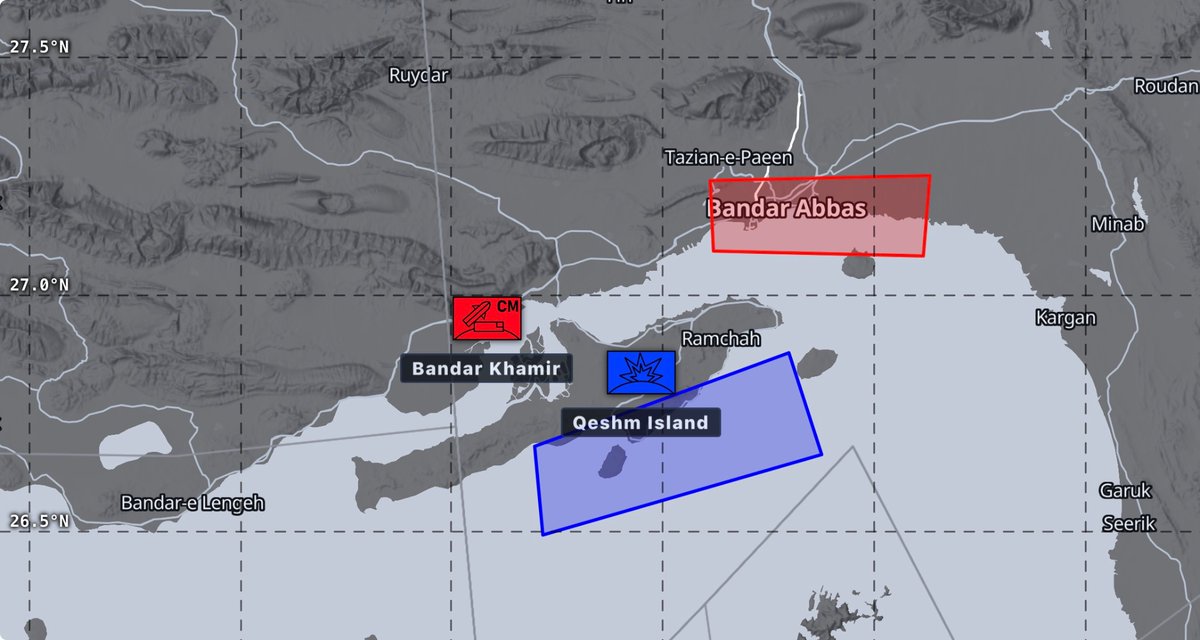
NOW: 2 loud explosion were just heard on Qeshm Island, Hormozgan Province of southern Iran.
Earlier tonight, a missile was launched from Bandar Khamir.
Additionally, fighter jet activity is being heard above Bandar Abbas.
Contributed by: @BeamTracker_
The Kor Mor gas field in Chamchamal, Sulaymaniyah province, came under drone attack, an Iraqi security source told Al Hadath. The field sits in Iraq's Kurdistan Region.
The Kor Mor gas field in Chamchamal, Sulaymaniyah province, came under drone attack, an Iraqi security source told Al Hadath. The field sits in Iraq's Kurdistan Region.
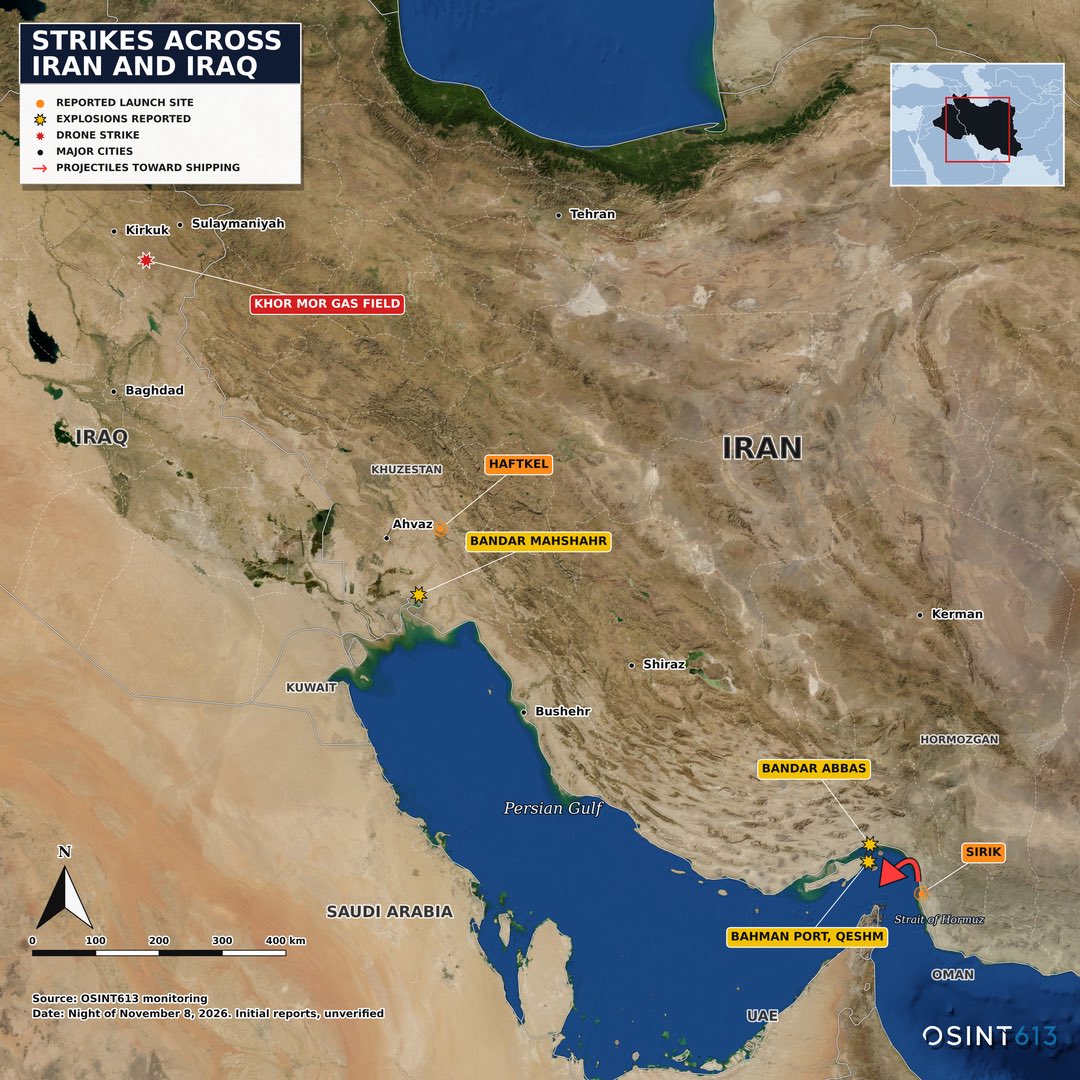
IRAN: SUMMARY OF TONIGHT’S ACTIVITY: Explosions reported across southern Iran, including Bandar Mahshahr, Bandar Abbas and Qeshm, with suspected launches near Haftkel and Sirik.
In Iraqi Kurdistan, a reported Iranian drone strike triggered a massive explosion at the Khor Mor gas field in Sulaymaniyah, a facility supplying more than 80% of the region’s electricity.
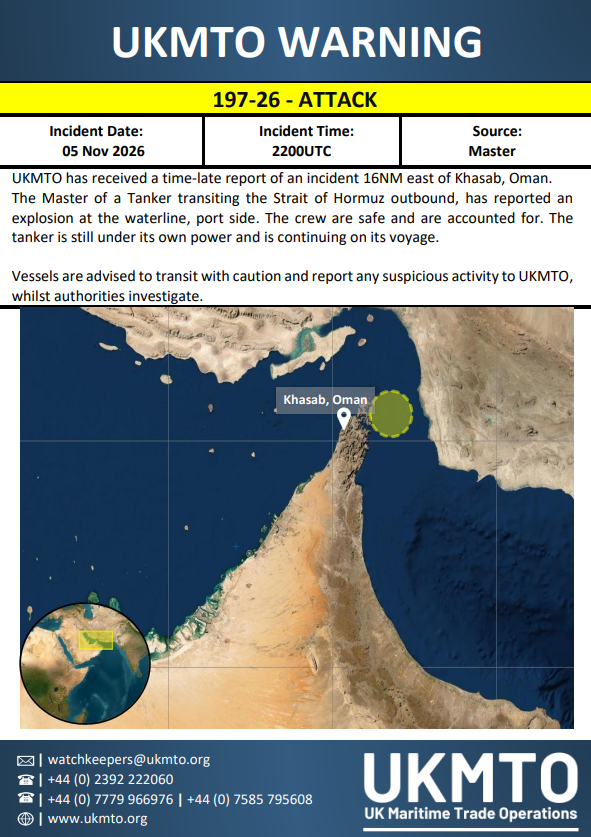
The United Kingdom Maritime Trade Operations (UKMTO) Center has issued a warning after receiving a delayed report of an incident in the Strait of Hormuz on Thursday. The master of an outbound tanker reported an explosion at the vessel’s port side waterline, about 16 nautical miles east of Khasab, Oman. All crew are safe and accounted for, and the tanker remains under its own power and is continuing its voyage. On October 29th, a tanker was attacked about 25 nautical miles northeast of Khasab when a small boat attached two explosive devices to its port side hull, later attributed to limpet mines.
🇪🇺 This is crazy - another update:
We are now at 21 aircraft involved in reported bomb threats and related security alerts across Europe since November 2.
13 of them TODAY alone.
Four more aircraft heading to Prague were threatened with explosives, according to Czech Police.
So far, no explosives have reportedly been found in completed searches. Authorities are taking the threats seriously, even where they assess their credibility as low.
But imagine if just ONE threat turns out to be real.
Even without an explosion, a credible threat could trigger major airport closures, widespread diversions and significant disruption to European aviation.
BREAKING NEWS! 😢💔 It’s heartbreaking to hear reports of an explosion at Saga Community School this morning. This is a very sad and frightening situation for the entire community especially the students teachers parents and families
November 8, 1939. In a Munich beer hall, a bomb hidden inside a pillar explodes during a Nazi ceremony, blowing the hall apart and killing several people. It was meant for Adolf Hitler, and it missed him by thirteen minutes. The man who built and planted it, entirely alone, was a quiet German carpenter named Georg Elser, and his lone attempt to murder Hitler and perhaps prevent the whole war is one of the most haunting might-have-beens of history.
Elser was nobody important, which is part of what makes the story so remarkable. He was a skilled craftsman, a carpenter and cabinetmaker, a working man of modest means and leftist sympathies, with no connection to any resistance organization, no powerful backers, no conspiracy behind him. He had simply looked clearly at where Hitler was taking Germany, concluded early, even before the war, that Hitler meant catastrophe and must be stopped, and decided, by himself, to do it.
And he went about it with extraordinary patience and skill. Every year on the 8th of November, Hitler gave a speech in the Bürgerbräukeller in Munich, the beer hall where he had launched his failed putsch in 1923, to an audience of old party faithful. Elser studied the pattern, worked out that this was his chance, and over many weeks he prepared. He got himself work that let him obtain explosives, he taught himself what he needed to know, and then, night after night for over a month, he hid in the beer hall after closing and secretly, painstakingly, hollowed out a cavity inside one of the stone pillars right behind the speaker's rostrum, where Hitler would stand. Into it he fitted a sophisticated time bomb of his own construction, with a timer he had built to go off during Hitler's speech. It was a feat of craftsmanship and nerve by one determined man.
On the night of the 8th, the bomb worked perfectly. At the time Elser had set, it detonated, bringing down the pillar and part of the ceiling, killing several people and wounding many more in the packed hall. It would almost certainly have killed Hitler, who always spoke at that spot. But Hitler was not there. That year, for reasons of his schedule, fog had prevented him from flying back to Berlin as planned, so he had to leave by train, and to catch it he cut his speech short and left the hall early, about thirteen minutes before the bomb went off. By the time the explosion tore through the beer hall, Hitler was already gone, on his way to the station. Thirteen minutes.
Elser was caught that same night, arrested trying to slip across the border into Switzerland, with incriminating material on him. Under interrogation he insisted, truthfully, that he had acted entirely alone, which the Nazis found almost impossible to believe and did not want to believe. They were convinced it must be a vast conspiracy, ideally one they could pin on the British secret service, to make propaganda of it. But it was just one man.
His end was cruel and drawn out. Rather than execute him at once, the Nazis kept Elser alive for years as a special prisoner, held in concentration camps, Sachsenhausen and then Dachau, apparently intending to use him in a grand show trial after the war they expected to win, to prove the conspiracy they imagined. That victory never came. In April 1945, with Germany collapsing and the Allies closing in, just weeks before Dachau was liberated, the order came down and Georg Elser was executed, murdered at the very end, after more than five years of imprisonment.
For a long time Elser was misunderstood or forgotten, even suspected, some wrongly imagining he must have been a Nazi stooge or a dupe. Only later was he recognized for what he truly was: a lone man of conscience who saw the catastrophe coming and tried, by himself, with his own hands and his own courage, to stop it, and came within thirteen minutes of succeeding. It is one of the great agonizing what-ifs of the century. Had Hitler not left early, had the fog not changed his travel plans, the war that was just beginning, with all its tens of millions of dead, the Holocaust, all of it, might have been cut off at the root in a Munich beer hall in November 1939, by a carpenter acting alone. He failed by minutes, and he paid for it with five years of imprisonment and his life. Georg Elser deserves to be remembered as one of the bravest men of the whole dark era.
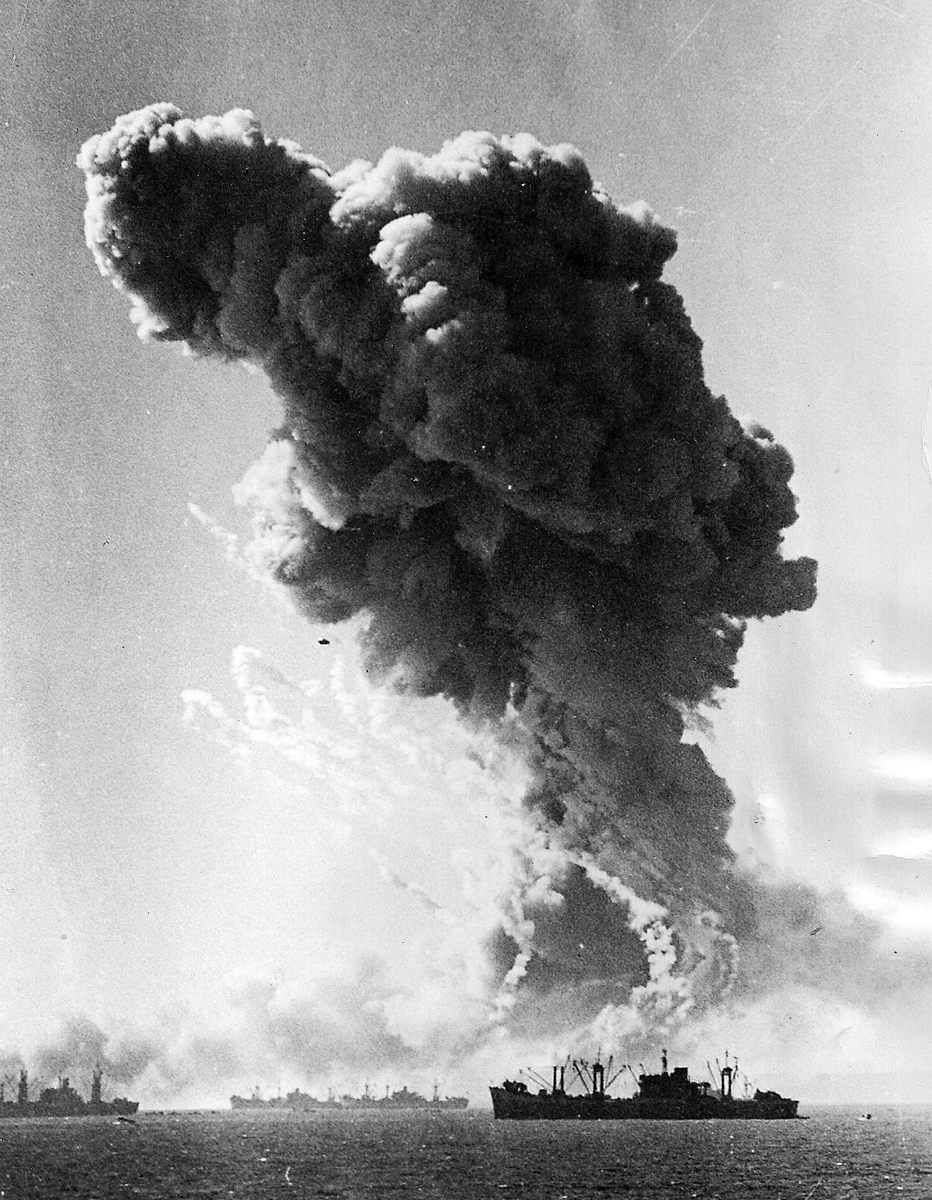
Nov 4, 1942. A German torpedo hits an ammunition ship in the middle of the North Atlantic. The explosion is so big it destroys the U-boat that fired it.
In late October 1942, convoy SC-107 sailed from Canada for Britain. It was made up of 42 slow merchant ships, guarded by a small escort group led by a Canadian destroyer.
German codebreakers had read the convoy's routing. A wolf pack of more than a dozen U-boats was waiting.
The attacks began on the night of Nov 1. The U-boats struck again and again over the next several nights. Ship after ship was torpedoed. The handful of escorts raced back and forth, but couldn't be everywhere.
Just after midnight on Nov 4, U-132 slipped inside the convoy while the escorts were busy elsewhere. Her commander, Ernst Vogelsang, fired at three ships: Hobbema, Empire Lynx and Hatimura.
Hatimura and Hobbema were both loaded with ammunition and explosives.
About half an hour later, one of them blew up.
It was one of the largest non-nuclear explosions ever caused by humans. Ships miles away shook so hard their crews thought they had been torpedoed. A rescue tug six miles behind the convoy had her engine knocked out.
U-132 was never heard from again. Historians believe she was destroyed by the blast or by the wreckage raining down from the sky. All 47 of her crew died.
The attacks kept coming. Two American destroyers arrived to help, and on Nov 5, bombers from Iceland finally drove the U-boats away.
By the time SC-107 reached Liverpool, 15 merchant ships had been sunk and around 150 seamen killed. It was the worst loss suffered by any transatlantic convoy that winter.