Four Vedas (ऋग्वेद सामवेद यजुर्वेद अथर्ववेद) - A Short Introduction
#Longthread
In Hinduism, Veda refers to a collection of ancient texts that are considered to be the foundation of the religion (Veda means knowledge /wisdom). These texts contain hymns, rituals, and philosophical teachings that have been passed down through generations.
The Vedas and Upanishads have had a profound influence on Sanatan Dharma and Ancient Indian culture. They have inspired countless works of art, literature, and music, and continue to be studied and revered by spiritual seekers around the world. There are four Vedas in Hinduism, each with a specific purpose and focus. They are
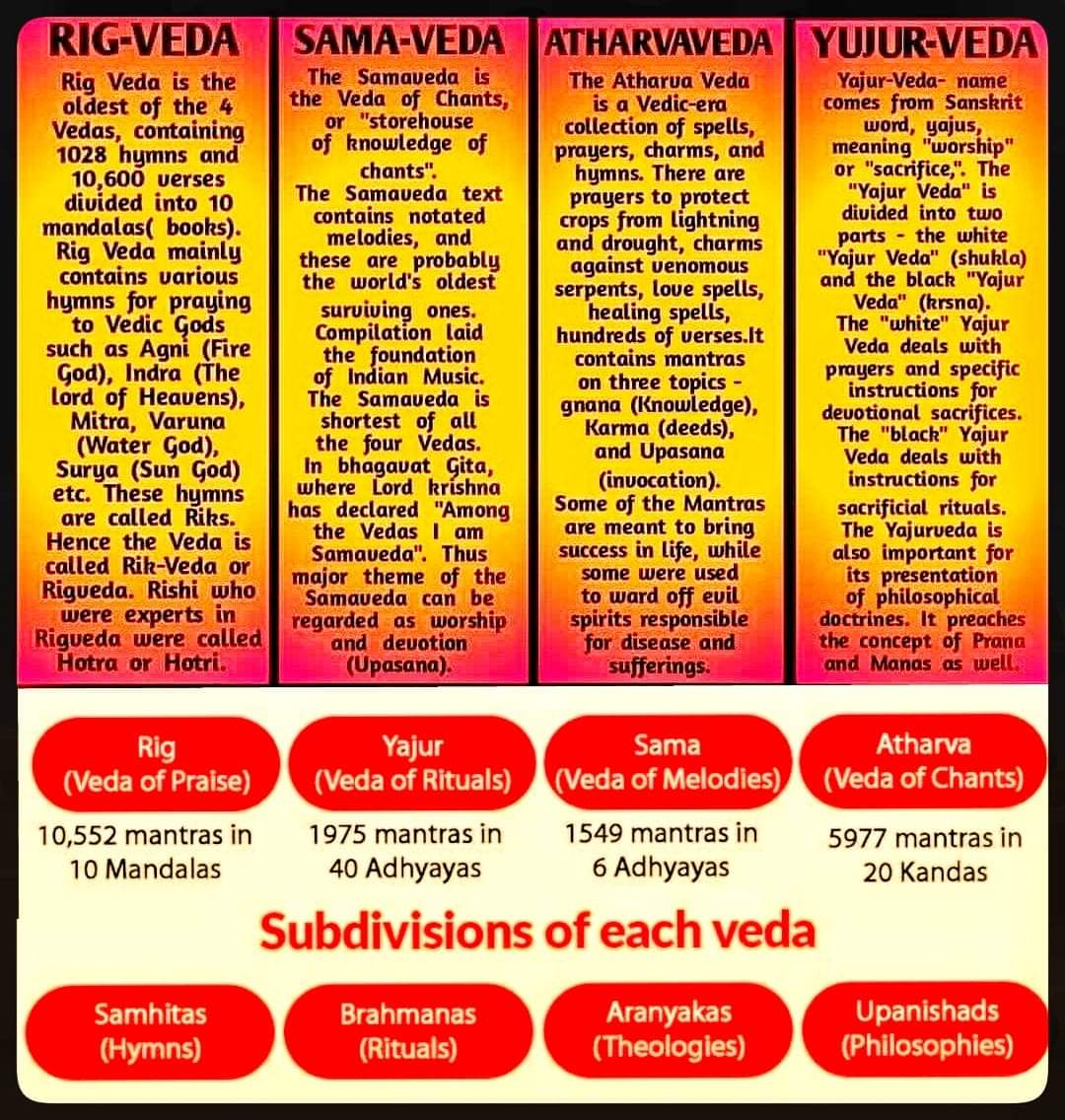
Rigveda: The Rigveda is the oldest of the four Vedas and contains 8 octaves (Ashtakas), there are 64 Chapters and 10,552 hymns /Mantras. The hymns are dedicated to various deities and are used in rituals and prayers. The Rigveda is also known for its philosophical teachings, which include the concept of Brahman, the ultimate reality, and the importance of following dharma, or moral duty. Rig Veda gives knowledge of science, matter of the universe like sun, moon, air, fire, body etc.
Yajurveda: The Yajurveda contains 40 Chapters, there are 1975 Mantras /hymns and rituals that are used in sacrificial ceremonies. The offerings which were given in the fire kindled in the altar were known as 'Yaag'. The prose mantras composed for this purpose are called 'Yajus'. It is divided into two parts; the Shukla Yajurveda and the Krishna Yajurveda. The Shukla Yajurveda contains hymns and prayers, while the Krishna Yajurveda contains instructions for performing rituals. Yajurved gives knowledge of all the deeds and duties to be performed by men, women, guru, students, leaders, king, agriculturist etc.,
Samaveda: There are 27 Chapters containing 1875 Mantras, primarily a collection of hymns that are used in rituals and prayers. These hymns are often chanted, and their musical qualities are emphasized. The mantras were recited in two ways- simple recitation as per the meter or melodiously like a song. These melodies are compiled in Samveda. The Samaveda is also known for its emphasis on meditation and spiritual practices. This veda is the origin of Indian Classical Music. Samved gives knowledge how to worship God who gives peace and long happy life etc. In this way, details of Yoga philosophy, qualities, supreme deeds and nature of the God are also given.
Atharvaveda: The Atharvaveda contains across 20 Stems (Kandangal), there are 5977 Mantras/ hymns and rituals that are used in everyday life. It includes spells and incantations for various purposes, such as healing, protection, and prosperity. This is the compilation of mantras meant for worldly desires. A manifestation of emotions is seen in atharvaveda. The Atharvaveda is also known for its teachings on ethics and morality. Along with pacificatory rites, some black magic is also included in this veda. Atharvaved gives details of God, medical science and details of medicine etc.
Total number of Mantras in all the four Vedas put together are 20379. Certain mantras of the Rigveda are repeated in other 3 Vedas too. For example, over 1200 mantras of the Rig Veda are repeated in Atharva Veda. Each Veda is comprised of 4 Parts, namely
Mantra Samhitas / hymns
Brahmanas ( meaning and explanation of the Mantras)
Aranyakas (these explain the philosophy behind the ritual practices mentioned in the vedas)
Upanishads (they are commentary on Vedas and thus contain the essence of Hinduism). Each of the Vedas also contains Upanishads, which are philosophical texts that explore the nature of reality and the self. There are over 200 Upanishads, but the most well-known are the principal Upanishads, which are 12 in number. These Upanishads are: