Yesterday’s Modular community meeting is now on YouTube.
Brian shares EmberJSON, his Modular Community Grant project: a reusable serialization framework for Mojo, inspired by Rust’s serde, plus a fast SIMDJSON-style JSON parser built on compile-time reflection and annotations.
Watch the recording:
Rune Energy is focusing on creating #dataCenters where there is already excess power, eliminating the drain data centers usually have on the power grid. Its modular data centers will connect to solar farms that produce more energy than can be used.
The infrastructure, called Tesseract Synthetic Brick Technology Kits, will use Lok-N-Blok's modular building components, which resemble Lego-like blocks.
Check out the Afag O-Ring Feeding Solution from Emerson.
Built for fast-paced manufacturing environments, this modular solution helps streamline O-Ring handling while giving you the flexibility to adapt as production needs change.
🔗 Learn more:
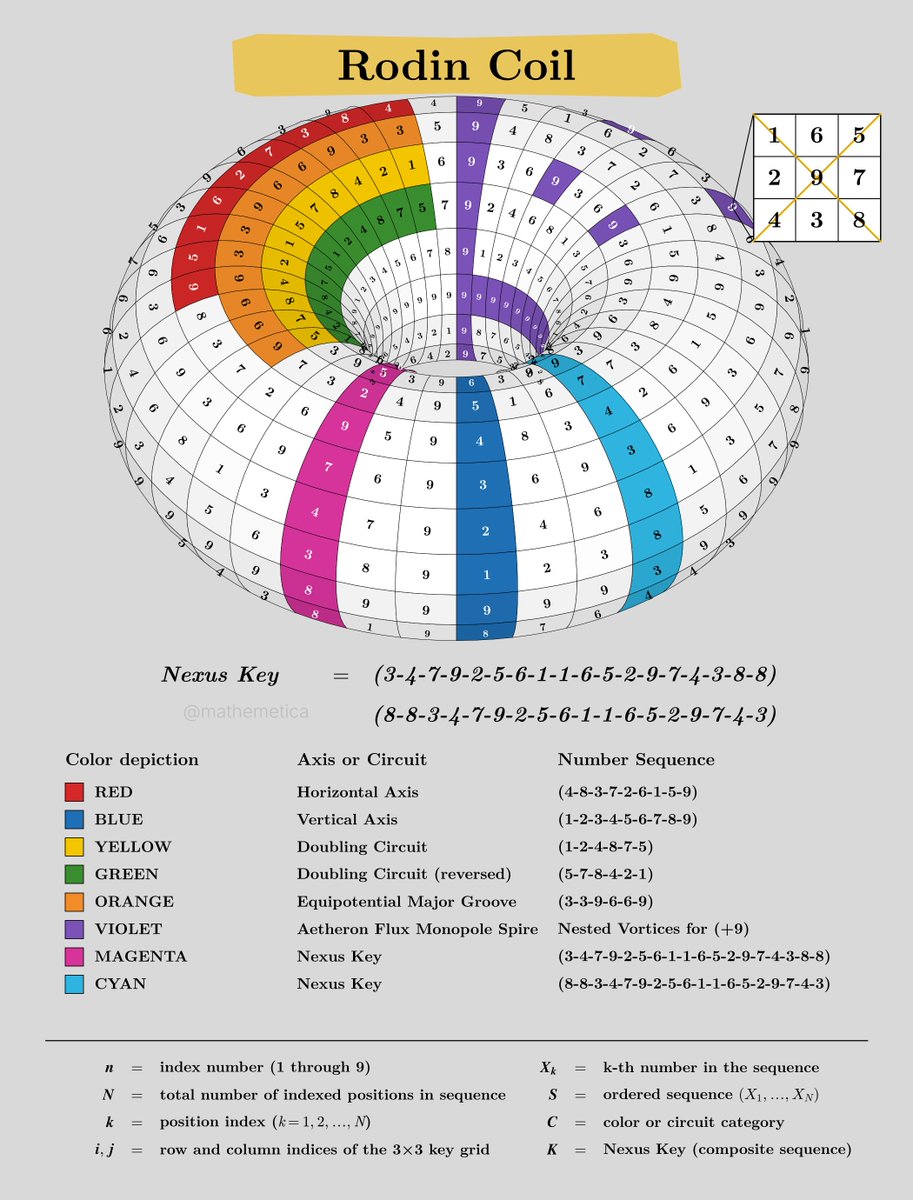
Numbers on the Rodin Coil do not just sit; they form closed circuits around the torus.
Powers of two reduce to the cycle 1-2-4-8-7-5. The triad 3-6-9 stays separate. The Nexus Key joins them into an 18-digit path that covers every digit twice.
Color bands mark the axes, doubling circuits and nested vortices, turning the grid into one continuous winding.
Scattered digits reveal a precise modular architecture.
BREAKING: A U.S. startup is developing spacecraft that can assemble themselves in orbit, potentially enabling massive satellites to build, expand and repair themselves in space.
Rendezvous Robotics has raised $20 million to develop modular, roughly 1-meter-wide hexagonal tiles that use electromagnetic forces to autonomously connect, creating structures far larger than what a single rocket could launch.
The technology could enable satellites to expand their solar arrays, antennas and computing systems after launch, or replace damaged components without launching an entirely new spacecraft.
Backed by Toyota Ventures and MaC Venture Capital, the company plans to test 32 self-assembling tiles aboard the ISS in December, followed by a 2028 demonstration involving seven independent tiles assembling and reconfiguring in orbit.
build a medieval town for an open-world game with claude opus 5.5 + blender + image gen...
the trick is building a kit, not a town, smart way to set it up:
- step 1: generate concept art of the town: castle on a hill, ring streets, central plaza
- step 2: generate references for each building type: timber house, stone house, tower, wall
- step 3: have opus model a modular kit in blender: walls, roofs, doors, windows, stairs
- step 4: have opus combine the kit into 5-10 house variants with different roof colors
- step 5: export to unreal engine and lay out the town in code: plaza > ring streets > houses
- step 6: place the castle, the walls and the towers on the high ground
- step 7: fill the gaps: trees, flowers, statues, fences, a forest around the town
- step 8: walk it in third person and fix anything that looks off up close
who does what:
> image gen: the look of every building
> blender + opus: the modular kit and the variants
> unreal engine: terrain, lighting, the open world
> opus 5.5: layout code, placement, fixes
> you: direction, and walking every street
make 10 good house variants and let code place 500. modeling 500 houses by hand takes forever (Founder: Shikhar)
Thanks for the feedback! Glad you're enjoying our inference handbook 🔥 Let us know what else you'd like us to include and check out MAX: now source-available!
Share
Copied
Sahil@sahil0x01
I've almost finished 50% of this handbook, its really really good, easy to understand, covers a ton of stuff and I'm loving it.
I can surely finish this by the end of this week
I've almost finished 50% of this handbook, its really really good, easy to understand, covers a ton of stuff and I'm loving it.
I can surely finish this by the end of this week
Opus 5.5 → Blender → Unreal Engine → a full city.
If you want to try this workflow yourself:
Have the AI write Blender Python scripts for modular assets (walls, roofs, windows)
Export as FBX
Use Unreal’s PCG tools to scatter buildings and trees across terrain
Iterate on lighting last
Bookmark this for your next project 🔖
Share
Copied
Shikhar@xikhar
Opus 5.5 created this entire city in unreal engine.
All assets are made with blender.
This is the worst it will ever be.
D1 is a modular robot developed by Hong Kong-based Direct Drive Tech.
It can connect into a larger quadrupedal robot or separate into smaller units depending on the task.
This flexible design helps it navigate challenging terrain and carry heavier loads.
In Santa Clara today for the LLVM Developers’ Meeting? Head to the Mojo Internals Deep Dive and Roadmap, a full-day workshop with the Mojo team, running from 8:30 AM to 5 PM PT:
Not in Santa Clara? Join us virtually for today’s community meeting at 10 AM PT, where Brian walks through EmberJson, his pure Mojo JSON library supported by the Modular Community Grant Program:
i was wrong about effect
when @schickling bent my ear for an hour at next conf (rip) 2 years ago i told him it would never happen
impossible nobody has time for all that because
@EffectTS_ is a lifestyle choice,
developers resist change,
it's too much surface area and vocabulary
all true, for humans, but the calculus totally changes with agents and effect's extremely robust nature isn't cognitive load for my smooth ass brain
now being all in, accepting the lifestyle choice, and building modular bullet proof apps can be your default
love this for us
THIS IS A PURE F*CKING GOLDMINE
Anthropic just documented how Claude Code remembers your project across sessions, and most people are using it wrong
The classic mistake: dumping everything into one 500-line CLAUDE.md. Every line loads into every session, eats your context, and the longer the file gets, the worse Claude follows it. Anthropic itself recommends keeping CLAUDE.md under 200 lines.
Here's how it actually works. Claude Code memory has several layers:
→ CLAUDE.md is what you write: build commands, conventions, "always do X" rules. It loads into every session, so keep only what truly matters.
→ .claude/rules/*.md are modular rules. Add a paths field with glob patterns to the frontmatter, and the rule loads only when Claude opens matching files. Your API rules stay out of the way while you work on the frontend.
→ Auto memory is what Claude writes for itself: your corrections, your preferences, context it can't pull from the code. It lives in ~/.claude/projects/<repo>/memory/ and is shared across all git worktrees of the same repo.
→ MEMORY.md is the auto memory index. Only the first 200 lines or 25KB load at startup. Claude moves the details into separate topic files and reads them on demand.
Commands worth knowing:
→ /memory to view and edit all your memory files and toggle auto memory on or off
→ /context to check what actually loaded into the session
→ /doctor prompt-audit to have Claude find stale instructions, references to files that don't exist, and rules that contradict each other. Nothing changes without your approval
A prompt to clean it all up:
Reorganize my Claude Code memory setup:
1. Run /doctor prompt-audit and list stale or conflicting instructions
2. Keep CLAUDE.md under 200 lines: only build commands, conventions, and always-on rules
3. Move instructions that apply to specific parts of the codebase into .claude/rules/*.md with `paths` frontmatter
4. Remove anything you can derive from the code itself (directory layouts, dependency lists)
Show every change as a diff first. Don't edit anything until I say go.
Docs:
Save this, you'll need it
10 reasons .NET is better than Java
Java has more developers than .NET.
And for most new backends, it's still the wrong choice.
I've built .NET apps for 13+ years.
Here's an honest list from both sides:
10 reasons .NET is better than Java
1. Faster web apps
↳ ASP .NET Core beats Spring Boot in most TechEmpower benchmarks.
2. One official web stack
↳ ASP .NET Core, EF Core, DI and config all come from Microsoft. In Java, you pick between Spring, Quarkus and Micronaut.
3. No licensing questions
↳ .NET is MIT-licensed. With Java, teams check if they run paid Oracle JDK or a free build.
4. Less boilerplate
↳ C# has properties and records. No getters, setters or Lombok.
5. LINQ
↳ One query syntax for lists and databases. Java Streams feel verbose next to it.
6. async/await since 2012
↳ Java got virtual threads only in Java 21.
7. Null safety in the compiler
↳ Nullable reference types warn you before a NullReferenceException hits production.
8. Real generics
↳ List<int> stores ints, with no boxing. Java erases generic types at runtime.
9. Less annotation magic
↳ You see every DI registration in Program(.)cs. Spring wires half your app through Component and classpath scanning.
10. One language for every app
↳ Web, desktop, iOS, Cloud, AI, IoT, Android and games with Unity. All in C#.
---
👉 5 reasons Java is better than .NET
1. Bigger talent pool
↳ More developers and more senior people on the market.
2. Big data world
↳ Kafka, Spark, Flink and Elasticsearch run on the JVM. The .NET clients often lag behind.
3. Virtual threads
↳ You write simple blocking code and it scales. No async/await spreading through every method.
4. GC options for huge heaps
↳ ZGC and Shenandoah keep pauses under a millisecond, even on 100+ GB heaps.
5. Many languages, one runtime
↳ Kotlin, Scala and Clojure all run on the JVM and share the same libraries.
📌 C# started in 2000 as Microsoft's answer to Java.
Then it pulled ahead: LINQ in 2007, async/await in 2012, records in 2020.
Java got Streams in 2014 and records in 2021.
→ Java owns the enterprise and big data world
→ .NET has the more modern language and a simpler stack
Pick Java when your company already runs on the JVM or lives on Kafka and Spark.
Pick .NET when you start a new backend and want to ship features fast with less code.
Which would you pick for your next backend: .NET or Java?
——
➕ Follow me to improve your .NET and Architecture Skills