Introducing /REA-growth skill
Reverse-engineer any company's growth
- Name any company, get its growth blueprint
- Every move on its timeline: SEO, AEO, ads, social
- $0.58 for a full Lovable teardown
- Fully OpenSource
Try it at
Partnered with @sharenow_today
Repo link below 👇
I currently have 25 Trusted followers 🔥
Who is with me? @GiveRep all you need.☺️
1 REPLY = 3 #Rep🍥
1 RT = 5 #REP 🍥
Time to earn $REP
Let’s gooo with @SuiboSui
Holy sh*t, this GitHub repo + Opus 5.5 turned my TV into Jarvis powered by Grok Bot
I reverse-engineered my Android TV with Opus 5.5...
1 sentence out loud = Netflix opens and scrolls itself.
No remote, no phone, no ads on the home screen.
here's the full guide step by step:
• step 1 → put your TV and your laptop on the same Wi-Fi
• step 2 → turn on network debugging on the TV:
Settings → About → tap Build 7 times → Developer options
• step 3 → paste the prompt below into Claude Code on Opus 5.5 with the GitHub repo and a photo of your TV's About screen
• step 4 → Opus reads the repo and finds the loophole: every Android TV takes orders over ADB on your home network.
The same door the phone remote apps use
• step 5 → it cleans the TV first: ads, tracking and brand bloat switched off, restore point saved, every app can come back
• step 6 → it writes a tiny remote with exactly 3 tools:
open Netflix, move, select. Nothing else
• step 7 → it plugs that remote into Grok Bot as a plugin. Grok is the ears, the plugin is the hands
• step 8 → press Allow on the TV once, the last time you touch the remote. Then say "Hey Grok, open Netflix" and watch it browse for you
the result: you talk, the TV listens, and the home screen finally has zero ads...
p.s: the repo covers 131 TV models from 46 brands
Find gitHub repo + full prompt below
Then read the full guide on reverse engineering with Opus 5.5 in the article.
i reverse engineered my Wi-Fi router with Claude Opus 5.5 and found a f*cking scary privacy problem...
every site I opened, my provider saw it. no encryption. just a readable list.
so I built a free open-source app that puts AI agents on watch over my network: Claude, ChatGPT or Grok.
→
works on Mac & Windows, powered by the Claude or ChatGPT subscription you already pay for
here’s exactly how I built it:
• step 1 → empty folder, Claude Code, Opus 5.5. paste the prompt from below and hit enter
• step 2 → the stack: a single Electron codebase that ships to both macOS and Windows. all network checks run in Node, so no admin rights required
• step 3 → Opus broke the work into 9 agents running in parallel.
router scanner, Wi-Fi + speed test, AI agents, device list, installers. each piece had its own agent
on top of that, each agent had a reviewer, and each reviewer had a fixer. 27 agents were running before the first screen even appeared
• step 4 → the scanner probes 12 entry points:
provider remote access (TR-069, port 7547), UPnP port-forwards, Telnet, SSH, admin page over plain HTTP, unencrypted DNS, Wi-Fi security, location-map opt-out
• step 5 → the first scan on my own network came back with:
all DNS lookups visible to my provider, SSH open on the router, UPnP enabled, 22 neighbour networks crowding my channel. score: 77/100
• step 6 → the AI agents. they take the scan results and answer questions like “what do I fix first?” or “does anything on my network look suspicious?”
nothing leaves my PC raw. Bastion removes MAC addresses, device names, Wi-Fi names and the last part of my IP first
watch mode rescans every 5–60 min and only calls the agent when something actually changed
• step 7 → no API keys anywhere. Claude is reached through Claude Code, ChatGPT through Codex, with the logins I already had
• step 8 → then a dedicated security agent went after every line of code. it found 11 holes. all closed:
the CLIs run read-only, with zero tools, inside an empty folder.
questions are passed through stdin, so there’s no way to inject anything into a command and if Codex’s shell tool is enabled, Bastion won’t start at all
• step 9 → the bugs you only hit on real hardware:
Windows 11 hides Wi-Fi details until Location is allowed. Cloudflare rate-limited the speed test (HTTP 429), so Opus switched to fewer, larger requests. next run: clean
• step 10 → before making the repo public, Opus scanned it to make sure none of my IPs, MAC addresses or network names had slipped into the code
one evening. not a single line written by me. that’s it...
the agents advise, you make the call. Bastion never logs in to your router, never guesses a password and never touches a setting on its own
GitHub repo + the full prompt below ↓
Then read the article on how to reverse engineer anything with Opus 5.5
🚨 The massive new Update for R.E.P.O. is officially live!
It introduces the Sunstone Valley Resort level, a new enemy named Pony, gamepad support, 18+ new rooms across multiple maps, new items, and 10 cosmetics.
🚨 The massive new Update for R.E.P.O. is officially live!
It introduces the Sunstone Valley Resort level, a new enemy named Pony, gamepad support, 18+ new rooms across multiple maps, new items, and 10 cosmetics.
Run any GitHub repo. Just paste a link into Replit and it will set it up for you!
Share
Copied
sarah li@sarahli
i forked Excalidraw and added some new features :)
🐟 draw fish and watch them swim
🏀 draw a course and drop a ball through it
with @Replit Cloud Agents, you can pull in an existing repo, make your changes, and open a PR. here’s how:
1. gave the agent the Excalidraw repo and asked it to get the app running
2. described the features i wanted, tried them in the preview, and asked for tweaks
3. created my own fork on GitHub and granted the Replit GitHub App access
4. asked the agent to run the checks and open a PR against my fork
here’s the PR it created ↓
i reverse engineered my Wi-Fi router with Claude and found a f*cking scary privacy problem...
my provider could see every website I looked up. in plain text.
so I built an open-source app where AI agents guard my network: Claude, ChatGPT or Grok.
→
it runs on your Claude or ChatGPT subscription. Mac & Windows
here’s the build step by step:
• step 1 → open Claude Code on Opus 5.5 in an empty folder, paste the prompt below
• step 2 → stack: one Electron codebase for macOS and Windows. Node does the network checks, no admin rights needed
• step 3 → Opus split the build across 9 parallel agents.
one built the router scanner, one the Wi-Fi + speed test, one the AI agents, one the device list, one the installers
every agent got a reviewer. every reviewer got a fixer. 27 agents before I saw the first screen
• step 4 → the scanner checks 12 doors: provider remote control (TR-069, port 7547), UPnP port-forwards, Telnet, SSH, plain-HTTP admin page, unencrypted DNS, Wi-Fi security, location-map opt-out
• step 5 → first real scan of my network:
provider sees all my DNS lookups, SSH open on the router, UPnP on, 22 neighbour networks fighting for my channel. score 77/100
• step 6 → the AI agents. they read the scan and answer “what should I fix first?” or “is anything on my network suspicious?”
before anything leaves my PC, Bastion strips MAC addresses, device names, Wi-Fi names and the last part of my IP
watch mode re-checks the network every 5–60 min and only wakes the agent when something changed
• step 7 → no API key. Bastion talks to Claude through Claude Code and to ChatGPT through Codex, using the login I already had
• step 8 → a separate security agent attacked every line of it and found 11 holes. all fixed:
the CLIs run with zero tools, read-only, in an empty folder. my question goes in through stdin, so nothing can be injected into a command. it refuses to start if Codex’s shell tool is on
• step 9 → real bugs only real hardware shows:
my Windows is in Russian, so Opus taught the parser Russian netsh labels. Windows 11 hides Wi-Fi info until you allow Location. Cloudflare rate-limited the speed test (HTTP 429), so Opus switched to fewer, bigger requests. next run: works
• step 10 → before the repo went public, Opus checked that none of my IPs, MAC addresses or network names were in the code
one evening. zero lines written by me. that’s it...
agents suggest, you decide. Bastion never logs in to your router, never tries a password and never changes a setting on its own
Find the GitHub repo and the full prompt below ↓
Then read the article on how to reverse engineer anything with Opus 5.5 ↓
🎉 Introducing OpenDuet
Self-hostable, proactive AI agents that you own and works with ANY agent harness.
Includes:
- Build, generate, and edit live assets
- Human-in-the-loop approvals
- Computer use
- Mobile, Web, and Channels
Repo →
Powered by @CopilotKit and AG-UI.
Clone this template and customize it however you want. Enterprise-ready.
We’re opening a research preview of Claude Duet, a new app where Claude works as a proactive agent.
It comes to you with what needs your attention, completes tasks you ask of it, keeps working when you step away, and checks with you before it acts on your behalf.
We’re opening a research preview of Claude Duet, a new app where Claude works as a proactive agent.
It comes to you with what needs your attention, completes tasks you ask of it, keeps working when you step away, and checks with you before it acts on your behalf.
The Most Powerful AI GitHub Repo I've Ever Tried...
How to use REA to reverse engineer anything:
0:00 Intro
1:32 wtf is REA?
3:20 REA real examples
4:39 Full setup (+ prompt)
6:14 Step 1: Look
7:18 Step 2: Understand
10:26 Step 3: Building specs
11:11 Personal & business use cases
13:37 Step 4: Executing spec builds
14:15 REA agent swarm (best use case)
7 creative ideas to turn a flat drawing into 3D as you scroll.
Which one feels the most premium to you?
1- Section Sweep: a scan turns the ink into real materials and you walk in through the cut
2- Card Model: scroll down to the tiny figure and the white card model becomes the real house
3- Build Time-Lapse: walk the site while the house goes up week by week
4- Open Section: the cut opens into depth and the camera visits each floor
5- Sunlit Elevation: the hatching on the drawing is the real shadow, so when it turns to brick not one shadow moves
6- Exploded House: the layers land one by one in building order, then you walk in
7- Schedule Build: scroll the construction schedule and a crane builds the house
I’m sharing everything (starter prompts and repo). Stay tuned.
All built with Opus 5.5.
GM #Rep Farmers , Can I get GM ?
🪙 You support me___
🪙 I support you_____
🪙 It’s simple________
Just comment and tagging with : @SuiboSui & @GiveRep
BOOOOM! 🚨🚨🚨 U.S. TREASURY SECRETARY SCOTT BESSENT IS SPEAKING AT RIPPLE SWELL 2026! $XRP HOLDERS, YOU NEED TO SEE WHO ELSE IS COMING!
I've spent hours going through all 58 speakers and researching their connections to Ripple, XRP Ledger, and the wider financial system.
And I'm even more bullish on what could develop from here.
We have major banks, asset managers, payment networks, institutional trading firms, regulators, and technology companies attending the same event.
Some are already using Ripple's infrastructure. Others are developing financial services that could eventually connect with XRP Ledger.
I want to show you the actual connections I've found and explain why I think the next stage of institutional adoption could be enormous.
This will be a long read, but I genuinely think it's worth understanding.
First, let's talk about Scott Bessent.
The U.S. Treasury Secretary is among the speakers at Ripple Swell 2026, which runs from October 27 to 29.
His participation brings an important government perspective to conversations about digital assets, stablecoins, financial regulation, and institutional infrastructure.
Now consider what Ripple announced just one day before the event.
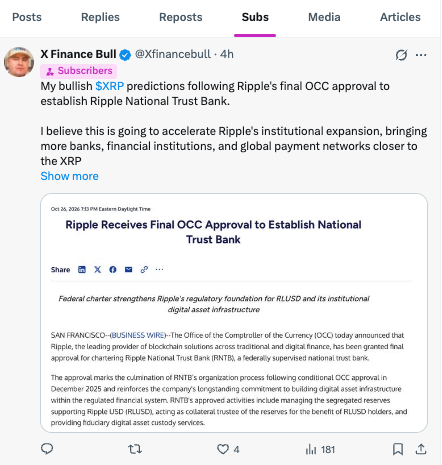
On October 26, Ripple received final OCC approval to establish Ripple National Trust Bank.
The approval covers specific activities involving RLUSD reserve management, collateral trustee services, and fiduciary digital asset custody.
I've been following Ripple's regulatory developments for years, and I consider this a major step toward expanding its institutional business.
And having Scott Bessent participate in Swell during the same period makes the event especially interesting to me.
His appearance is a speaking engagement, and my bullish analysis concerns the wider institutional connections surrounding the event.
Now look at the banks and financial institutions attending.
Jennifer Barker represents BNY, which already safeguards RLUSD reserves.
That relationship is important because regulated digital dollars require reliable custody and reserve management.
BNY also safeguards the underlying assets of Aviva Investors' tokenized money-market funds.
Think about those two connections.
One institution already handles assets associated with Ripple's stablecoin and traditional investment products being tokenized on XRPL.
I see considerable potential in future systems connecting institutional investment funds, regulated digital dollars, and financial settlement.
Evy Theunis from DBS Bank is another name I'm watching closely.
DBS already works with Ripple and Franklin Templeton on plans to connect sgBENJI tokenized money-market fund shares with RLUSD.
The partnership also involves exploring financing secured by those tokenized shares.
An investment firm could potentially hold an income-generating fund, access digital-dollar liquidity, and use eligible securities as collateral.
These are practical financial services that institutions already need.
And Aviva Investors is bringing serious capital onto XRPL.
Alastair Sewell represents Aviva Investors, which launched tokenized share classes of both its USD and GBP liquidity funds on XRP Ledger.
The Sterling share class was introduced on October 26, with an initial £50 million investment.
The underlying Sterling Liquidity Fund manages approximately £22 billion.
I find the scale remarkable.
An established global asset manager is bringing blockchain-based ownership infrastructure to regulated investment products that institutions already understand.
The potential expansion of those products is one of the developments I'll be watching beyond Swell.
Now connect Aviva with Franklin Templeton.
Seth Ginns from Franklin Crypto Investments and David Mann from Franklin Templeton are also on the speaker list.
Franklin Templeton already has tokenized money-market fund infrastructure on XRPL and a regulated XRP investment product.
The company has exposure to both the tokenization industry and the XRP investment market.
I believe additional institutional fund launches could increase the importance of XRPL as infrastructure for investment assets.
And Ripple has been investing in the companies needed to support those products.
Phil Goffin represents ZILO, whose fund transfer-agency technology received strategic investment from Ripple.
ZILO provides infrastructure for investment ownership records and fund administration.
Ripple also invested in Licuido, which works on token issuance, distribution, trading, and collateral mobility.
My prediction is that more established funds could eventually become accessible through tokenized share classes, with services built around transferring, trading, and financing those investments.
Ondo Finance is another major connection.
Matthieu de Vergnes is representing Ondo, whose OUSG tokenized U.S. Treasury product is already live on XRP Ledger.
RLUSD is supported in subscriptions and redemptions.
Think about what that represents.
Institutional investors can access tokenized Treasury exposure through products using blockchain infrastructure.
And the presence of Ondo, Aviva, Franklin Templeton, and ZILO gives us several institutions involved in different parts of tokenized asset management.
I see the potential for these financial products to become increasingly useful in institutional trading and collateral markets.
Broadridge adds another interesting piece.
Theo Golden represents a company whose Distributed Ledger Repo platform processed approximately $351 billion per day on average during August 2026.
That figure demonstrates the enormous scale of traditional securities financing.
Broadridge is developing infrastructure connecting established financial markets with tokenized technology.
A future connection between that kind of trading infrastructure and XRPL-issued assets would be a significant development.
And we also have the DTCC connection.
On May 4, 2026, DTCC announced a tokenization working group involving more than 50 institutions.
Among the participants are Ripple Prime, Broadridge, DriveWealth, Franklin Templeton, Ondo Finance, Robinhood, State Street, and Citadel Securities.
BNY also has significant relationships within the broader securities infrastructure.
DTCC is working on the modernization of traditional securities.
Ripple is developing services involving tokenized investments, custody, trading, financing, and settlement.
DTCC has already announced a Stellar connection targeted for the first half of 2027. I'm watching whether additional interoperability developments eventually include XRPL.
I believe the overlap between these institutions creates opportunities for future collaboration across financial markets.
Now let's talk about something directly connected to XRP demand: the ETF issuers.
Teddy Fusaro from Bitwise is attending.
Bitwise launched its U.S. XRP ETF in November 2025, and the fund reported approximately $542 million in net assets on October 22, 2026.
Krista Lynch represents Grayscale.
Its GXRP fund reported holdings of approximately 65.43 million XRP on October 22.
Steven McClurg represents Canary Capital, whose XRPC fund also holds XRP.
And Franklin Templeton's XRPZ product provides another regulated route for investors to access XRP.
These investment products matter because additional fund creations can lead to purchases of the underlying XRP.
I want to see more institutional distribution, investor access, and investment allocations developing around these products.
Coinbase is another important connection.
Michael Sikorski and Brett Tejpaul are representing Coinbase and Coinbase Institutional.
Coinbase supports XRP trading and institutional custody, including services associated with XRP investment products.
I believe greater institutional investment access could help deepen XRP's trading markets over time.
Now add the market makers.
Dave Olsen from Jump Trading and Bas van Andel from Citadel Securities are among the speakers.
Both firms operate in institutional trading and liquidity markets.
XRP's bigger long-term opportunity could develop when market makers begin maintaining substantial inventories to support recurring cross-currency settlement.
Institutions exchanging large amounts of money need reliable liquidity.
If XRP becomes a regularly used intermediary between currencies and digital assets, liquidity providers could have a practical reason to acquire and maintain XRP positions.
That is one of the developments I'm most bullish about.
And the payment companies attending are already connected to serious institutional infrastructure.
Massimo Cervesato and Sherri Haymond represent Mastercard.
Ripple and Mastercard have announced work involving RLUSD settlement on XRPL, together with WebBank and Gemini.
Now imagine more payment programs eventually accessing regulated stablecoin settlement through similar arrangements.
Daniel Roesbery represents Visa, another major global payment network.
Visa has its own expanding stablecoin settlement initiatives, including USDC settlement on Solana with institutions such as Cross River Bank and Lead Bank.
I would be particularly interested in a future Visa announcement involving RLUSD or XRPL.
Luca Cosentino represents Cross River, which announced an early Ripple payments integration back in 2014.
There's a long history of banks exploring Ripple's international payment technology.
Naureen Hassan represents DriveWealth, which announced a partnership with Ripple on October 14, 2026, involving brokerage funding, custody, and settlement modernization.
That creates another opportunity to bring digital settlement infrastructure into services used by traditional investment platforms.
Blake Tablak from Trax Technologies also connects to Ripple's enterprise business.
Trax is among the companies identified within Ripple Treasury's corporate customer ecosystem.
And Ragui Selwanes from C2FO brings another financial connection.
C2FO has an existing corporate treasury relationship inherited through Ripple's acquisition of GTreasury.
I think the potential combination of corporate cash management, working-capital finance, and digital settlement deserves more attention.
LMAX Group is especially important when discussing institutional liquidity.
David Mercer represents LMAX, which is working with Ripple and Standard Chartered on RLUSD collateral arrangements.
Standard Chartered already supports institutional RLUSD custody on XRPL.
I see an opportunity for more connections between regulated stablecoin reserves, institutional trading venues, and digital asset liquidity.
BNY handles reserve custody, Mastercard is exploring payments settlement, and LMAX is developing trading-related collateral infrastructure.
These are separate commercial relationships, but together they demonstrate how financial services around RLUSD are expanding.
And XRP could benefit as institutions develop more liquid markets connecting RLUSD with other currencies.
Another development I find extremely interesting involves Arf and Cicada Partners.
Kazım Rıfat Özyılmaz represents Arf.
On October 22, Arf announced a partnership with Ripple to bring RLUSD-powered settlement liquidity to licensed international payment companies on XRPL.
Arf reported approximately $10 billion in annualized global settlement volume across its existing business.
The company also plans to explore XRPL's native lending infrastructure when it becomes available.
Tom Lombardi represents Cicada Partners.
In August, Ripple, Clearpool, and Cicada announced plans for institutional lending infrastructure using RLUSD on XRP Ledger.
Cicada is responsible for credit origination and servicing, while Clearpool is developing the lending infrastructure.
Think about how these services could eventually work.
Licensed payment companies need liquidity to process international transactions.
Lending infrastructure could provide eligible firms with working capital.
Those firms process payments, repay financing, and reuse available capital for additional settlement activity.
And if XRP becomes part of the currency-conversion process, this expanding payment infrastructure could eventually create additional XRP liquidity demand.
I think this is one of the strongest opportunities emerging around XRPL's institutional financial services.
The next connections involve payment access across different countries and networks.
Caroline Pham represents MoonPay Institutional, an established RLUSD distribution partner.
Edward Woodford represents zerohash, which has been identified among Ripple's RLUSD distribution channels.
Pei Ling Tin represents MetaComp, which distributes RLUSD through regulated stablecoin and foreign-exchange infrastructure in Asia.
Lucas Zandoná Gomes represents RedotPay, which has integrated Ripple Payments and supports XRP-funded local-currency payouts.
Fig S represents Squid, which supports cross-chain access to RLUSD.
These companies can help digital assets become more accessible through payment applications, financial platforms, and different blockchain networks.
I'm interested in whether increasing distribution eventually leads to more international payment routes using XRP.
And there's a major developer-infrastructure connection involving Stripe.
Henri Stern represents Stripe-owned Privy.
On October 13, Privy announced a partnership with Ripple involving XRPL wallet infrastructure.
Embedded wallets can make it easier for applications to support digital assets without requiring every user to handle complicated wallet processes.
That could become valuable for consumer payments, business applications, and AI-powered commerce.
Stefan Thomas, the former Ripple CTO and an Interledger co-creator, is also speaking.
His work on interoperability and micropayments through Coil has deep historical connections to Ripple's original vision of moving value across different systems.
I believe payment applications, embedded wallets, and automated commerce could create new opportunities for XRP and RLUSD.
Now look at the institutional developments outside the United States.
Daniel Polano Spreafico represents CSD BR.
Andre Portilho and Jean-Marc Stenger represent BTG Pactual.
Their organizations are involved in bringing regulated Brazilian securities records onto XRP Ledger.
The initiative currently involves blockchain-based recordkeeping and auditing, with future possibilities involving native asset issuance and trading between authorized participants.
Eduardo Novillo Astrada represents Justoken, an XRPL tokenization partner in Latin America.
I want to see these projects expand into more investment products and actual settlement activity.
Brazil is already represented by institutions exploring ways to connect securities markets with blockchain infrastructure.
And expanding regulated tokenization across different countries could strengthen XRPL's international financial relevance.
There are also several speakers whose institutions could become interesting future connections.
James Colinders and Sam ten Cate represent State Street, a major securities services and asset-management institution.
Johann Kerbrat represents Robinhood, which already supports digital asset trading and participates in DTCC tokenization discussions.
Scott Lucas represents Barclays, which has been involved in UK tokenized deposit initiatives.
Simon Marland represents Nedbank, bringing African banking and payments experience.
Mike McCoy represents Fiserv, which serves major banking and merchant-payment markets.
Nilesh Dusane and Anil Nadiminti represent Amazon Web Services, whose infrastructure supports financial technology operations.
Sarah Oliva represents Cari Network, and Si Hui Ong represents Borneo.
Chris Shin represents SBI Savings Bank, connected to the broader SBI financial group.
SBI Holdings and SBI VC Trade already have established Ripple relationships, including RLUSD developments in Japan.
Thomas Sy represents New York Life, bringing another major institutional investment and insurance perspective.
These companies represent different parts of the financial industry.
I see enormous potential if more banks, financial technology providers, asset managers, and application developers explore integrations with Ripple's infrastructure.
And the government, regulatory, security, and academic presence matters too.
Alongside Scott Bessent, Tobias Adrian from the IMF is participating.
Matt Blumenfeld and Caroline McIlroy represent PwC.
Christopher Woolard brings expertise through EY and UK Government financial-market work.
Sean McHugh represents Dubai's VARA regulatory ecosystem.
Patrick Wyman represents the FBI.
Ken Montgomery, a former Federal Reserve executive who joined Ripple's RLUSD advisory board, is also attending.
Yebo Feng represents Nanyang Technological University.
Ari Juels represents Cornell Tech and also serves as Chief Scientist at Chainlink Labs.
These participants bring experience in monetary systems, compliance, security, blockchain research, and financial technology.
And Ripple Swell is combining these institutional discussions with XRPL developer sessions and UBRI Connect.
I believe serious financial adoption benefits from this combination of technical development, institutional experience, and regulatory engagement.
So what am I actually expecting from Ripple Swell and the months after it?
I'm watching for new XRP settlement agreements, RLUSD payment integrations, institutional liquidity commitments, and additional tokenized fund launches.
I'm following whether Aviva, Franklin Templeton, Ondo, and ZILO expand their existing tokenization activities.
I'm watching Mastercard, BNY, LMAX, Standard Chartered, DriveWealth, RedotPay, and MetaComp for additional settlement infrastructure.
Arf and Cicada could become particularly interesting as XRPL lending and institutional payment-financing services develop.
I also want to see more institutional trading activity involving Coinbase, Jump Trading, Citadel Securities, and Ripple Prime.
And I believe the growing XRP ETF market could become another source of investment demand as Bitwise, Grayscale, Franklin Templeton, and Canary Capital expand their products.
Three developments would make me especially bullish.
First, more established financial institutions bringing regulated investment assets onto XRP Ledger.
Second, banks and payment companies using XRP for real international settlement.
Third, institutional market makers maintaining XRP inventory because their financial operations require that liquidity.
The third development could become particularly important for XRP's market value.
XRPL already uses XRP for transaction fees and account reserves.
Its decentralized exchange also supports XRP as an intermediary asset between different currencies.
If more institutional financial activity starts using those liquidity capabilities, demand for XRP could develop alongside actual settlement requirements.
My long-term prediction is that Ripple will increasingly connect the financial services its existing partners are already building.
BNY brings custody.
Mastercard brings payments.
Aviva, Franklin Templeton, and Ondo bring investment products.
Ripple Prime, Coinbase, LMAX, Citadel Securities, and Jump Trading bring experience in trading and liquidity.
Arf and Cicada bring settlement financing.
ZILO, Privy, Squid, and CSD BR bring different infrastructure capabilities.
And Ripple is expanding its own regulated banking, treasury, custody, and stablecoin operations.
I don't think every one of these institutions needs to announce an entirely new partnership for the ecosystem to grow.
Many already have commercial relationships and financial products that could support additional integrations.
That is my strongest prediction coming out of this research.
I've been bullish on $XRP because I believe the future financial system will need efficient ways to move money between currencies, investments, institutions, and payment networks.
And after researching all 58 speakers, I see an extraordinary amount of institutional experience gathered around Ripple's growing ecosystem.
Scott Bessent's appearance adds another important dimension to the event.
But I'm especially excited about the banks, asset managers, trading firms, and payment companies already developing financial services connected to XRPL and RLUSD.
If more of those services begin using XRP as working liquidity, I believe we could see a much bigger institutional market develop around the token.
This is the future of $XRP I've been researching for years, and my conviction keeps getting stronger.
I'm seeing a lot of people asking why $XRP hasn't pumped after Ripple received its banking approval.
Let me tell you something.
A banking license doesn't mean the price has to skyrocket overnight.
Adoption, liquidity, and real usage are what matter in the long run.
I've shared my predictions and what I expect to see from Ripple over the coming months on my subscribers feed.
I'm still extremely bullish on $XRP.
I'm expecting some big months ahead for $XRP!
🚨 NEW Gym Alert! 🚨
🏋️♂️ Fitness 1 Gym
📍 Glendale, Arizona
📌 Real Gym. Real Family. Real Results. Established in 1998. Family owned and operated....
#REP#REPGymPass#Glendale#Arizona
All my life I was terrified someone watching me through laptop camera, even the FBI director taped his...
Claude Code dug through my laptop's hidden logs and found suspicious moments I can't explain
check yours and shut down your camera without a sticker:
what it found:
- an unknown app turning on my camera at night, while I sleep
- Windows quietly remembers apps (could be spy) that turned on your camera, even after you delete them
why you should do it today:
- a $40 spy tool bought in 100+ countries infected 500,000+ computers and could switch on their webcams remotely (US Departament of Justice)
- a US school district secretly took 30,000+ webcam photos of students on school laptops, some inside their homes (Lower Merion)
- even FBI director put tape over his laptop camera (James Comey)
Windows:
1. install repo below and type /camera-guard in Claude Code, it reads the hidden log of every app that ever turned on your camera and mic
2. delete AnyDesk, TeamViewer ot any remote app you don't use
3. Windows has a hidden "Camera on/off pop-up, off by default, ask Claude to turn it on and you see every time the camera starts
4. really shut camera off, Settings switch isn't enough:
• BIOS (strongest ): hold shift, click Restart - Troubleshoot → Advancedf options → UEFI Firmware Settings , set Camera to Disabled and add a BIOS password.
Windows can't see the camera at all. Need it for a call? - Turn it back on there. Not every laptop has it, Claude checks your model
• camera switch or key: some laptops have a slider on the side or an F-key with a crossed-out camera. Slide it off when you're not using it
• Device Manager → Cameras → Desible device: one click to undo (but any app with admin rights can undo it too)
5. run Microsoft Defender Offline, the deep scan built into Windows (Windows Security → Virus & threat protection → scan options): it restarts your PC and hunts hard-to-catch spyware before Windows starts
Mac:
1. install repo below and type /camera-guard, it checks which apps can use your camera and mic and what starts with your Mac
2. System Settings → General → Sharing: turn off Screen Sharing, Remote Login and Remote Management, these let someone see and control your Mac from another computer
3. Screen Time → Content & Privacy → App & Feature Restrictions → Camera: off + a Screen time passcode - Apple's own camera off swith
4. install OverSight, free Mac app: it pops up an alert second any app turns on your camera or mic, so you know the moment anyhting starts filming or listening
Please do this today. Then read article below on how to solve such problems on another tech:
REA is most dangerous thing on the internet right now...
It lets your AI agent reverse engineer any app, down to the binary
If you use it correctly, you can rebuild any feature you pay for, for FREE
In this article, I show you how:
REA is most dangerous thing on the internet right now...
It lets your AI agent reverse engineer any app, down to the binary
If you use it correctly, you can rebuild any feature you pay for, for FREE
In this article, I show you how:
i'm a huge fan of content being individual pages in your repo (and NOT using a CMS).
there's a ton of reasons it's much more useful, but one is it lets you build these tiny little interactive elements into any article.
(btw, includes this kind of thing)