Posts with #SynBioBeta2026

#SynBioBeta2026

Public posts on X that use #SynBioBeta2026.

Related hashtags

  1. John Cumbers✓@johncumbers
    The FDA is phasing out synthetic dyes. Food companies have committed to pulling Red 40, Red 3, and others from shelves. The $3 billion natural color market is about to absorb a billion more in conversions. Synbio has a window. #SynBioBeta2026 is May 4-7th in San Jose, California, you can learn more about the conference and get your tickets here: At @SynBioBeta 2026, a Planetary Health track session examines how to capture this moment: Birgit Cameron (CEO & Co-founder, Prism Bio), Ricky Cassini (CEO, Michroma), Gregory Hocking (VP Global R&D New Innovation Territories, Mars Snacking), and Erum Azeez Khan (Partner, Messaginglab). Birgit Cameron co-founded Prism Bio to produce a full spectrum of natural colorants from photosynthetic bacteria via fermentation, with photo- and thermo-stability across a broad pH range and a proprietary ColorSwitch technology that can change color using laser light. Ricky Cassini co-founded Michroma in 2019 to build fungal biofactories for natural food colors using CRISPR-enhanced filamentous fungi. His flagship Red+ is pH and heat stable enough to survive pasteurization, cooking, and extrusion, and earlier this year Michroma won the Global Food Tech Award Americas at Future Food-Tech and the Kraft Heinz Innovation award. He's a Forbes 30 Under 30 and MIT Innovator Under 35. Gregory Hocking brings the view from inside one of the world's largest food companies: what Mars Snacking actually needs from a bio-based color supplier before it can go on a label that reaches billions of consumers. The session runs May 7 from 3:30-4:15 PM in the Planetary Health track.
    Download
    43131K
  2. John Cumbers✓@johncumbers
    Biology used to be a wet science. It is becoming a computational one. The question is what the stack actually looks like. #SynBioBeta2026 is May 4-7th in San Jose, California, you can learn more about the conference and get your tickets here: Foundation models for proteins, genomes, and cellular systems are maturing fast. But prediction alone is not the bottleneck anymore. The challenge is integrating generative design, GPU-accelerated compute, and high-throughput experimental feedback into continuous learning loops that actually close. At SynBioBeta 2026, an AIxBIO track session sponsored by @TwistBioscience brings together the people building that stack at the infrastructure level: @ReusElise (Co-founder, Cradle), Daniel Spellman (VP of AI & OCI, Health & Sciences, @Oracle), Esteban Toro (CSO Biopharma, Twist Bioscience), @anthonycosta (Director, Digital Biology, @nvidia ), moderated by @xiaofei_lin (Sr. Editor, Technology, @GENbio). Elise de Reus co-founded Cradle to give protein engineers an AI-native design platform, combining generative models with experimental data in closed-loop workflows that continuously improve predictions as new data comes in. Cradle's platform is used by Novo Nordisk, IFF, and others to run design cycles that would have taken years in months. Daniel Spellman leads AI and OCI engagements for healthcare and life sciences at Oracle, overseeing partnerships with NVIDIA, Absci, DNAnexus, and others where OCI's bare metal GPU infrastructure is becoming the compute substrate for generative drug discovery at scale. Oracle recently launched its Life Sciences AI Data Platform as a foundation for AI-powered research across the full pipeline. Anthony Costa leads Digital Biology at NVIDIA, where the BioNeMo platform gives researchers access to GPU-accelerated foundation models for molecular design, protein structure prediction, and genomics, all served from cloud infrastructure built for the scale biology now demands. Esteban Toro leads biopharma strategy at Twist Bioscience, whose on-demand DNA synthesis platform is the physical substrate that closes the loop between computational design and experimental reality. The session runs May 6 from 3:30-4:15 PM in the AIxBIO track. If you are building or deploying the infrastructure layer of computational biology -- models, compute, or the experimental systems that feed them -- this is the session to be in.
    Download
    03121.2K
  3. Mithrl Inc.✓@mithrl_ai
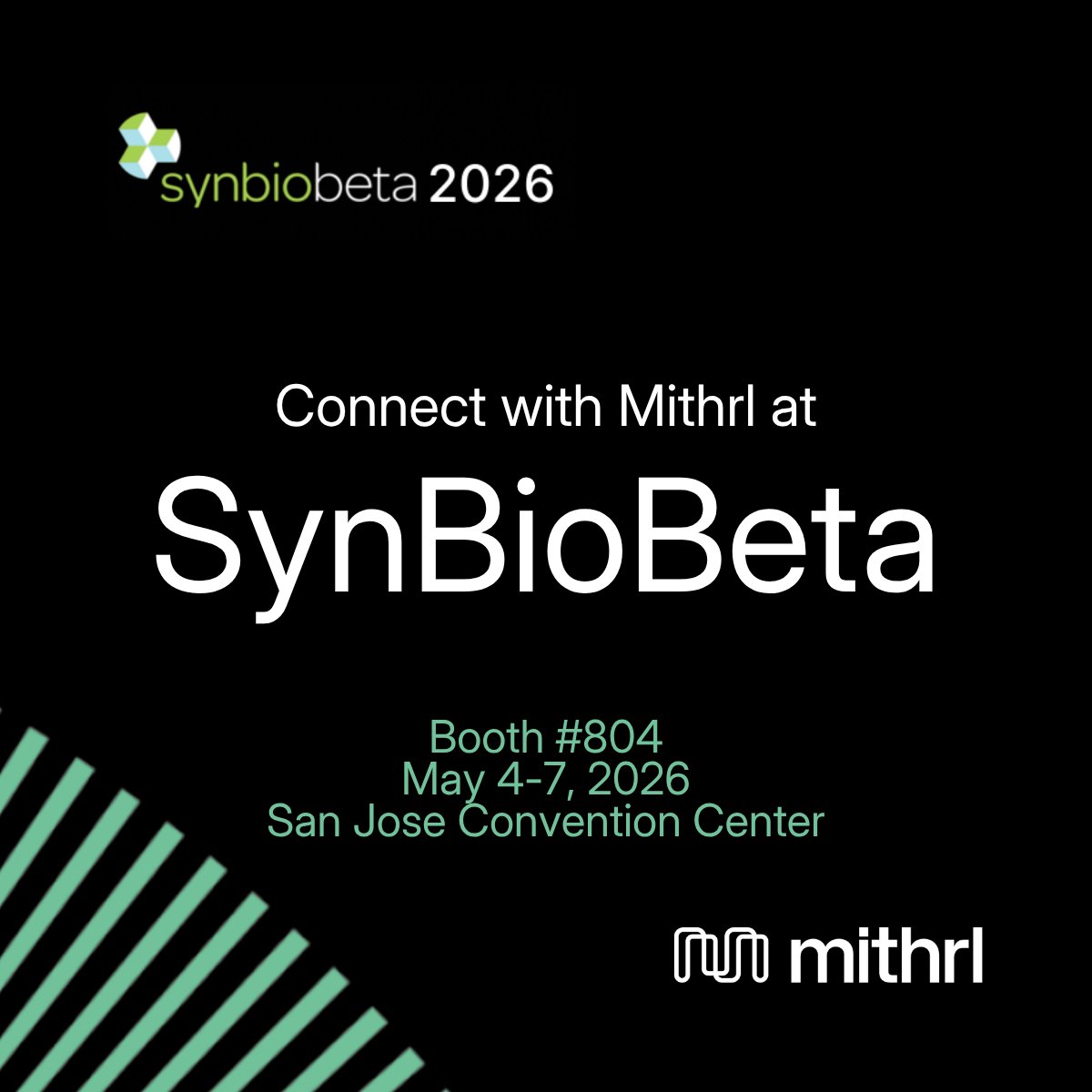
    We're live at #SynBioBeta2026! Come find us at booth 804 (directly across from the stunning portrait honoring Dr. Craig Venter). Stop by for a live demo of Mithrl's Scientific Decision Engine and see how R&D teams are moving from raw omics data to novel, actionable insights faster, and with full transparency, traceability, and reproducibility built in. We're also proud to sponsor the SynBioBeta AI x Biopharma Luncheon, featuring a fireside chat on AI for supporting biomedical research and defensible decision-making, with Vivek Ardash, Co-Founder & CEO of Mithrl, and Eric Kauderer-Abrams, Head of Life Sciences at @AnthropicAI. Sign up early for this one! 📅 Wednesday, May 6 | 12:00 PM 📍 San Jose Convention Center, Room 210A 🔗 Reserve your spot: #SynBioBeta #AIxBio #Biopharma #DrugDiscovery #Mithrl #AI @flyingthor @SynBioBeta @johncumbers @ShilohB66714
    Download
    026522
  4. Cellular Intelligence@CellularIntelHQ
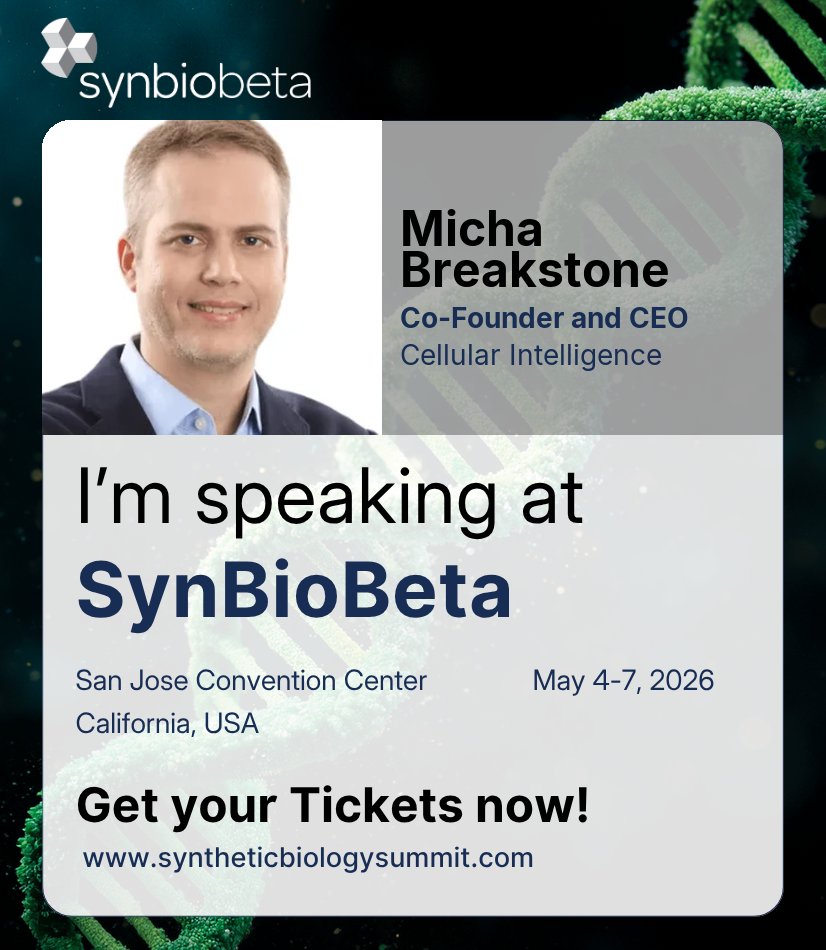
    Our CEO @MichaBreakstone is taking the stage at @SynBioBeta next week. Biology is no longer destiny, but design. 🗓 May 5 ⏰ 8:50–9:10 AM | #SynBioBeta2026 👇
    Micha Breakstone @MichaBreakstone
    Excited to share what we’ve been building at @CellularIntelHQ. We're developing the first Universal Virtual Cell-Signaling Model to turn the biological mystery of cell fate into a tractable engineering challenge. Biology is no longer destiny, but design. Join me at @SynBioBeta 2026 for my keynote: “Engineering Cell Fate: A Foundation Model to Transform Biology into an Engineering Discipline”. 🗓 May 5 ⏰ 8:50–9:10 AM If you believe biology should be engineered, not just observed - I'll see you there.
    023720
  5. Micha Breakstone✓@MichaBreakstone
    Excited to share what we’ve been building at @CellularIntelHQ. We're developing the first Universal Virtual Cell-Signaling Model to turn the biological mystery of cell fate into a tractable engineering challenge. Biology is no longer destiny, but design. Join me at @SynBioBeta 2026 for my keynote: “Engineering Cell Fate: A Foundation Model to Transform Biology into an Engineering Discipline”. 🗓 May 5 ⏰ 8:50–9:10 AM If you believe biology should be engineered, not just observed - I'll see you there.
    Download
    14122.2K
  6. Micha Breakstone✓@MichaBreakstone
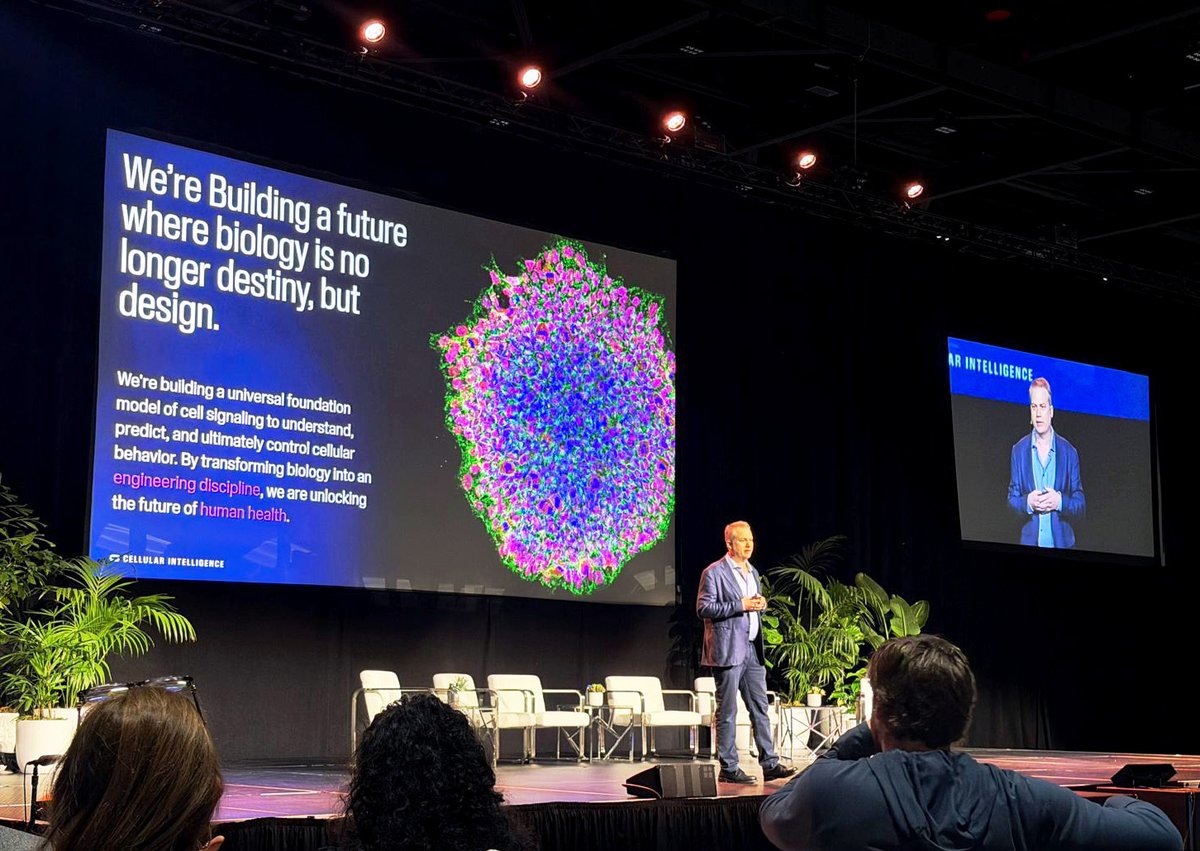
    Just stepped off the stage at #SynBioBeta2026. The energy in the room confirmed what we've believed since day one at @CellularIntelHQ: Biology is ready to be transformed from trial-and-error into a true engineering discipline. The grammar of cell signaling is learnable. And once we decode it, we begin to understand it, predict it, and ultimately control cell fate.
    Download
    0110319
  7. John Cumbers✓@johncumbers
    At 5 PM today in San Jose, #SynBioBeta2026 officially begins. The New Attendee Reception is the first event of the conference, and it's the perfect on-ramp: grab your lanyard, walk the venue, and start meeting the people you'll be running into for the next four days. First impressions matter, and this is where they happen. Sponsored by Hawkwood Biotech Partners, the SF-based industrial biotech consultancy and Venture Firm that has been in the room for some of the biggest scale-up stories in the field, from fermentation to commercialization to fundraising. They know this space cold, and they're showing up in force tonight. Look for Vatshal Bhanushali, Emily Hopkins, MBA, Logan Roberts, Sanya Sehgal, Tony Day, and Richard Kenny on the floor. Register:
    004371
  8. John Cumbers✓@johncumbers
    Visas. Travel costs. Time away from the lab or the office. Not everyone can make it to San Jose for #SynBioBeta2026 That's exactly why we built the livestream. 160+ sessions. 200+ speakers. Three days of Main Stage content streaming directly to your laptop, wherever you are in the world. The field is moving fast. AIxBio is not slowing down. You don't have to be in the room to be part of it, get access here:
    Download
    023560
  9. SynBioBeta✓@SynBioBeta
    What if drug discovery didn’t start in the lab but ended there? @Latent_Labs is pushing biology into a new phase, where therapeutic molecules are designed computationally before a single experiment begins. @saakohl, CEO of Latent Labs, is speaking at #SynBioBeta2026 on May 4-7th in San Jose, California, you can learn more about the conference and get your tickets here: Their autonomous AI agent, Latent-Y, can take a natural language prompt and return lab-ready candidates, handling everything from target selection to validation. The results are already real: nanomolar binders, a 67% success rate across targets, and design cycles completed 56x faster. This is a shift from discovery to design. But the real opportunity is not just the technology. It is being in the room with the people building it. Relationships are built in the room. Deals happen in the room. Breakthroughs happen in the room. Join us at SynBioBeta 2026 to hear directly from Simon Kohl and see what this new paradigm looks like up close. Visit the SynBioBeta website to read the full article:
    Download
    023372
  10. SynBioBeta✓@SynBioBeta
    What if RNA-seq stopped slowing you down? #SynBioBeta2026 is May 4-7th in San Jose, California, you can learn more about the conference and get your tickets here: No ice. No delays. @plasmidsaurus is cutting RNA-seq turnaround to 3 days in Europe and eliminating cold chain shipping. Faster iteration = faster science. Be in the room where it happens. Visit the SynBioBeta website to read the full article and read what @markwbudde has to say:
    Download
    1371.1K
  11. John Cumbers✓@johncumbers
    Germline editing is coming back into the conversation. Where does this end up? #SynBioBeta2026 is May 4-7th in San Jose, California, you can learn more about the conference and get your tickets here: Reproductive genetics is moving fast, and faster than the policy frameworks designed to govern it. At SynBioBeta 2026, a Human Health spotlight talk confronts that reality head-on: Jonathan Anomaly (Professor & Founder, Herasight) gives a forward-looking examination of how polygenic prediction works, how risk models are being validated, what dramatically improved predictive power actually makes possible, and what happens when selection and editing begin to converge. This isn't a session that avoids the hard questions. It's one that asks them directly. The talk runs May 7 at 9:25 AM in the Human Health track.
    Download
    026515
  12. John Cumbers✓@johncumbers
    Metabolic engineering gave us biofuels, pharmaceuticals, and yeast factories for everything from resveratrol to human hemoglobin. That was the mechanistic era. Agentic AI is opening the next one. #SynBioBeta2026 is May 4-7th in San Jose, California, you can learn more about the conference and get your tickets here: Genome-scale modeling and machine learning have already improved our ability to predict what a cell will do when you change its genome. Now agentic AI systems are beginning to orchestrate the full design-build-test-learn cycle autonomously, closing the loop between computation and experiment at a speed that manual iteration can't match. At @SynBioBeta 2026, a fireside chat in the AIxBIO track explores where this is heading: Jens Nielsen (CEO, BioInnovation Institute) and Eduardo Abeliuk (Founder & CEO, TeselaGen). Jens Nielsen is the most cited researcher in metabolic engineering on the planet, with over 140,000 citations. He is a member of the US National Academies of Science, Engineering, and Medicine simultaneously, the only foreign scientist to hold that distinction across all three. He has published over 900 papers, holds 50+ patents, founded seven biotech companies, and since 2019 has led the BioInnovation Institute, a $500M Novo Nordisk Foundation initiative to translate life science breakthroughs into commercial impact. His Human2 metabolic model, recently published in PNAS, uses AI and large language models to advance whole-body metabolic modeling to a new level of precision. Eduardo Abeliuk founded TeselaGen to build the agentic AI infrastructure for that design-build-test-learn cycle, creating the closed-loop platforms that translate computational insights into experimental reality at scale. The fireside runs May 7 at 9:40 AM in the AIxBIO track.
    Download
    027588
  13. SynBioBeta✓@SynBioBeta
    Is the time-to-market the biggest barrier holding back synthetic biology? Biomanufacturing leader Jamie Bacher says yes, and he’s calling for new innovation across process development, downstream, analytics, and strain development. We’re excited to host him at #SynBioBeta2026. Read the full article on the SynBioBeta website.
    132587
  14. John Cumbers✓@johncumbers
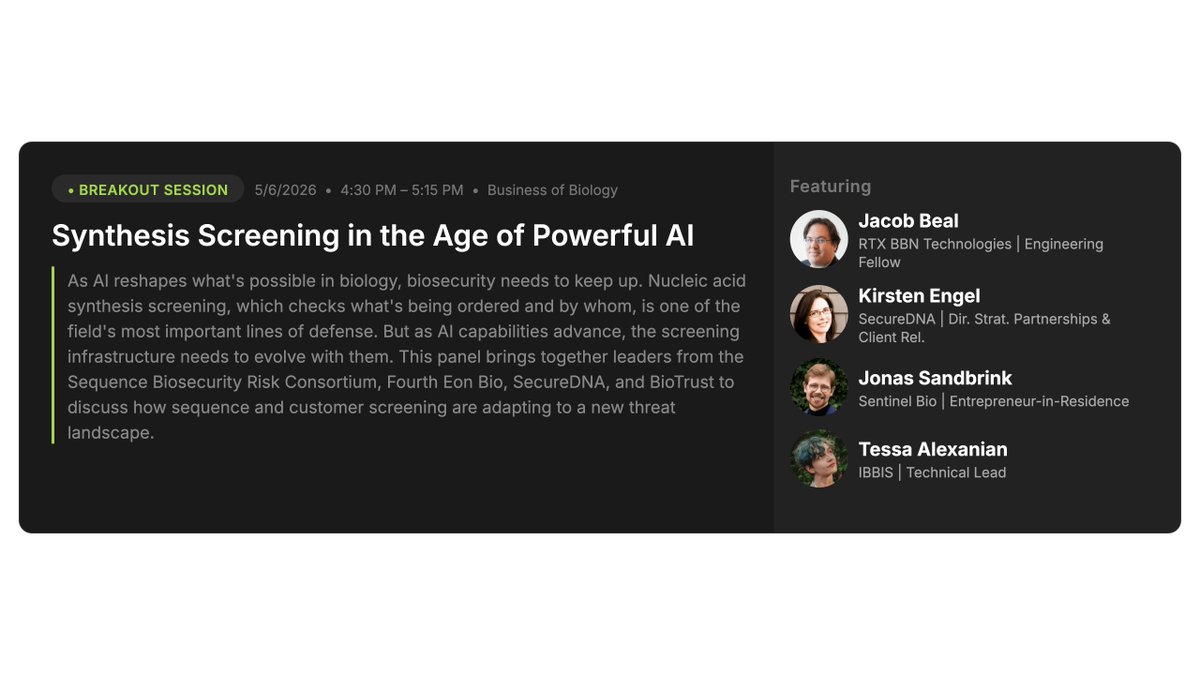
    AI can now design proteins that slip through biosecurity screening undetected. That's not a future threat. It already happened. #SynBioBeta2026 is May 4-7th in San Jose, California, you can learn more about the conference and get your tickets here: In 2024, researchers generated thousands of AI-reformulated variants of a dangerous toxin and sent them to DNA synthesis companies. Nearly all of them passed the screening. The gap between what AI can design and what biosecurity tools can catch is real, and closing it requires a coordinated, evolving response. At @SynBioBeta 2026, a Business of Biology track session brings together the people doing exactly that: Jacob Beal (Engineering Fellow, RTX BBN Technologies), Kirsten Engel (Director of Strategic Partnerships, SecureDNA), Jonas Sandbrink (Entrepreneur-in-Residence, Sentinel Bio), and Tessa Alexanian (Technical Lead, IBBIS). Jacob Beal built FAST-NA Scanner, the DNA synthesis biosecurity screening software now used across the industry. When he discovered AI-generated toxin variants were evading it, he described it as a moment when his "heart froze up." He co-led the Paraphrase Project response — published in Science — and now co-leads the Sequence Biosecurity Risk Consortium (SBRC), building international standards for AI-resilient screening. Tessa Alexanian leads technical work at IBBIS and was a key co-author on those same papers, working across sequence screening, customer verification, and policy. The session runs May 6 from 4:30-5:15 PM in the Business of Biology track.
    Download
    39121.8K
  15. Cellino✓@CellinoBio
    🧬 Join us next month at #SynBioBeta2026 as our Co-Founder & CEO, @nabsicle, speaks on “Epigenetics and Stem Cells Reprogramming / Evidence Based Longevity” on May 7 at 3:30 PM PDT. We can’t wait to see you in #SanJose! Register now:
    Download
    002239
  16. John Cumbers✓@johncumbers
    Generative AI can now propose millions of protein variants overnight. The bottleneck is no longer design. It's screening. #SynBioBeta2026 is May 4-7th in San Jose, California, you can learn more about the conference and get your tickets here: As model-generated libraries grow exponentially, the experimental infrastructure needed to validate them at pharmacologically meaningful scale hasn't kept pace. Closing that gap is becoming the central engineering challenge in AI-driven drug discovery. At SynBioBeta 2026, an AIxBIO track session brings together the people building the next generation of integrated design-screen-optimize platforms: Weston Kightlinger (CEO, Ridge Bio), Will Cao (CEO, Pando), Stefan Lutz (CSO, Codexis), David Virant (Department Head, Acies Bio), Ewa Lis (Founder & CEO, Koliber Bio), moderated by Fay Lin (Sr. Editor, Technology, GEN). Weston Kightlinger emerged from stealth in September 2025 with a $25M seed round from Sutter Hill Ventures to build Ridge Bio, an AI-driven enzyme and drug design platform. His cell-free experimentation system generates up to a million-fold more sequence-function data than conventional methods. Previous company, SwiftScale Biologics, was acquired by Resilience. His advisory board includes Nobel Laureate Carolyn Bertozzi and Sangeeta Bhatia of MIT. Stefan Lutz is CSO at Codexis, one of the most established companies in industrial enzyme engineering, which has spent two decades developing the iterative design-make-test-learn cycles that AI is now dramatically accelerating. Will Cao, David Virant, and Ewa Lis bring additional perspectives from Pando, Acies Bio, and Koliber Bio, respectively, covering the screening automation, analytics, and multiplexed assay dimensions of this infrastructure challenge. The session runs May 6 from 4:30-5:15 PM in the AIxBIO track.
    Download
    338650
  17. Show more posts