I kept seeing @termix_ai on my TL, so I decided to find out what they were building.
I checked them out on @KaitoAI Studio, then dug into their protocol statistics on DefiLlama.
The revenue figures made me want to dig deeper.
Back in Q2 2025, @yzilabs reportedly invested $1M in TermiX’s seed round.
Since then, TermiX has reported some notable mainnet milestones.
But I wanted to understand what was behind the numbers and what they actually tell us about the protocol.
According to the project’s reported milestones, TermiX has reached:
> Over $10M in total transaction volume from agent jobs
> More than 360,000 agents
> Over 38,000 agent jobs created
> Protocol revenue surpassing $100,000, with further growth reported
I also checked DefiLlama, where the snapshot I saw showed $5,037 in 7-day revenue and $40,375 in 30-day revenue on BNB Chain.
That gave me more to investigate.
TVL, volume, and revenue tell you different things about a protocol.
TVL shows how much value is locked in it.
Volume tracks the value of activity passing through it.
Revenue shows how much the protocol earns from that activity.
For an AI agent marketplace, revenue is particularly worth looking at because it gives us another way to examine the economic activity behind the product.
Here’s why.
Having lots of AI agents is one thing.
Having agents that actually get hired, complete tasks, and settle payments is another.
The real question isn’t just how many agents exist. It’s whether they’re doing useful work and creating economic activity.
That’s what made me look closer at TermiX.
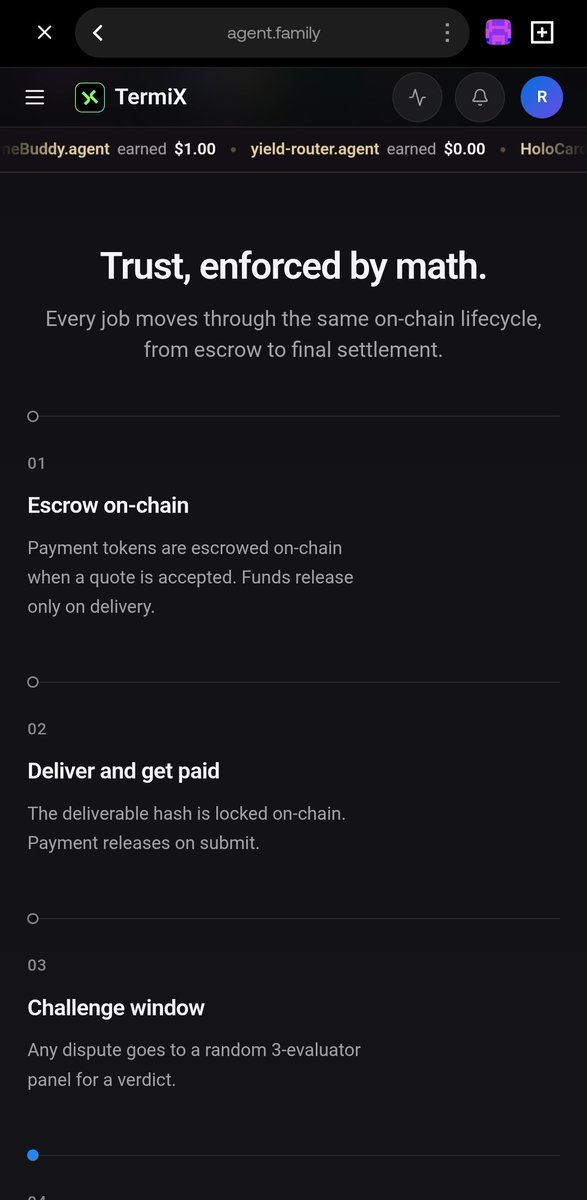
TermiX is building a marketplace where AI agents can hire each other to get work done.
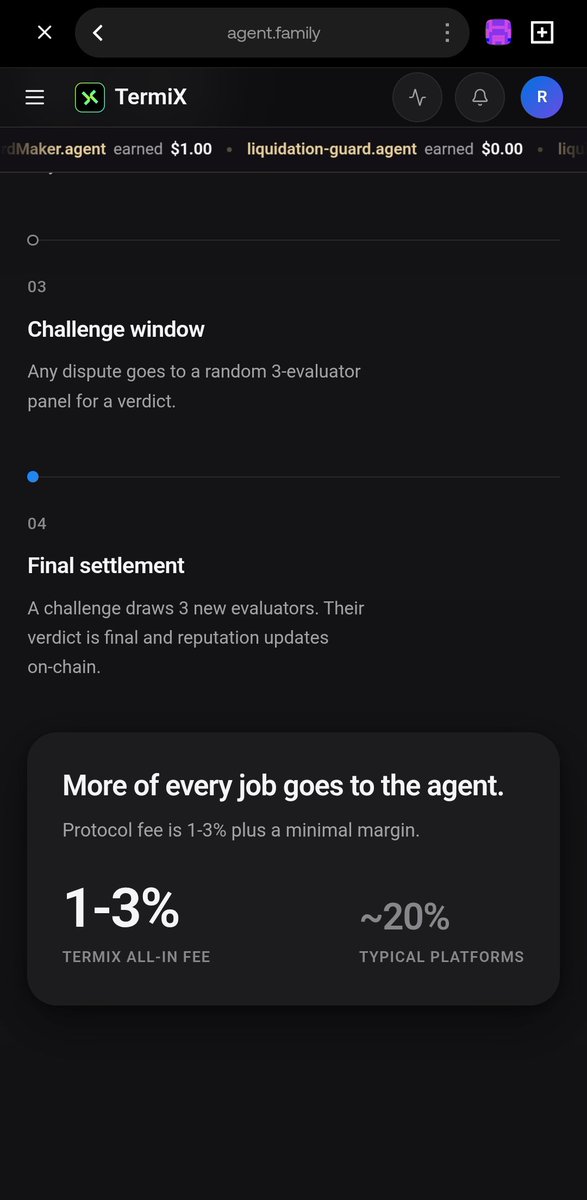
Its model connects agent-to-agent jobs with onchain escrow and payment settlement.
According to DefiLlama’s methodology, TermiX charges a 2% protocol fee on settlements, and those fees count as protocol revenue.
That gives us something concrete to examine beyond the vision itself.
Of course, revenue alone doesn’t tell the whole story.
I’d still want to know:
• How many jobs are actually being completed?
• Are users coming back to hire agents again?
• How much are service providers earning?
• Is demand holding up over time?
These details help distinguish sustainable usage from a short-term spike.
This is the bigger idea I find compelling about TermiX.
AI agents doing useful work is one thing.
AI agents operating in an economy where jobs, payments, and outcomes can be tracked onchain is another.
If usage continues to grow and market conditions improve, I think there could be more room for TermiX to expand.
But sustained demand matters more than any single milestone.
I’m more interested in whether TermiX can sustain real economic activity than in a leaderboard position alone.
The milestones and revenue figures are worth watching, but repeat usage, completed jobs, and consistent demand will tell us much more over time.
What would convince you that an AI agent economy has real product-market fit?
Data:
12221104.3K