Posts with #WorkOS

#WorkOS

Public posts on X that use #WorkOS.

Related hashtags

  1. Konsti Wohlwend✓@konstiwohlwend
    ???????!!!!!!!!! Oct 29: WorkOS CEO makes fun of Better Auth for releasing a security update Oct 30: WorkOS gets hacked, customer contact data compromised
    Download
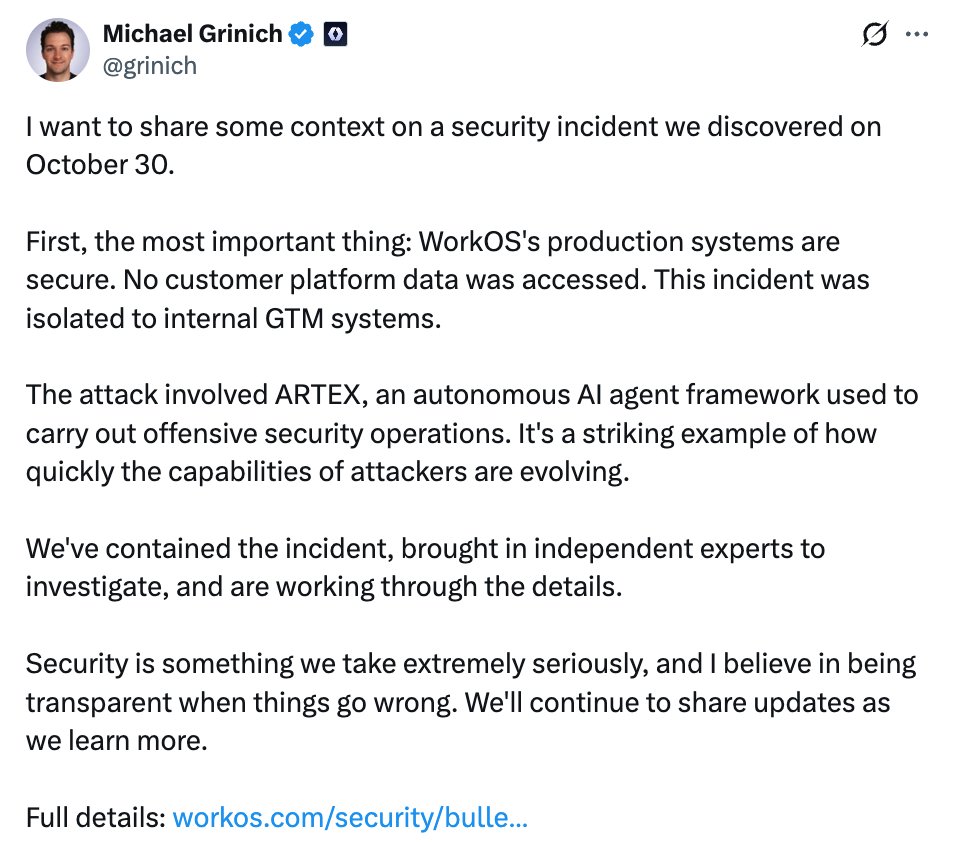
    Michael Grinich @grinich
    I want to share some context on a security incident we discovered on October 30. First, the most important thing: WorkOS's production systems are secure. No customer platform data was accessed. This incident was isolated to internal GTM systems. The attack involved ARTEX, an autonomous AI agent framework used to carry out offensive security operations. It's a striking example of how quickly the capabilities of attackers are evolving. We've contained the incident, brought in independent experts to investigate, and are working through the details. Security is something we take extremely seriously, and I believe in being transparent when things go wrong. We'll continue to share updates as we learn more. Full details:
    233883170.1K
  2. Michael Grinich✓@grinich
    I want to share some context on a security incident we discovered on October 30. First, the most important thing: WorkOS's production systems are secure. No customer platform data was accessed. This incident was isolated to internal GTM systems. The attack involved ARTEX, an autonomous AI agent framework used to carry out offensive security operations. It's a striking example of how quickly the capabilities of attackers are evolving. We've contained the incident, brought in independent experts to investigate, and are working through the details. Security is something we take extremely seriously, and I believe in being transparent when things go wrong. We'll continue to share updates as we learn more. Full details:
    4721271119K
  3. Avkash K✓@avkashk
    the internal sales app belongs in the security conversation too. @chainalysis and @WorkOS have both disclosed intrusions involving what they describe as agentic or ai-assisted offensive techniques. the detail in workos's notice that matters: the app provided access to business contacts, account histories and excerpts of customer conversations, including slack discussions. they're still reviewing which records were affected. that kind of context can make a follow-up phishing message much more convincing. names and emails are one thing. knowing what a customer discussed with sales or support is another. if you're reviewing your exposure, include the internal tools holding those conversations, not only the production app.
    11265
  4. Cyber Security News✓@The_Cyber_News
    ‼️ Hackers Use ARTEX AI to Breach WorkOS and Access Customer Slack Conversations Details: WorkOS has confirmed unauthorized access to an internal sales application, exposing customer contact information and records of business conversations. The company detected the incident on October 30, 2026, and published a security bulletin on November 2. Its investigation identified an AI-assisted offensive security framework used to automate reconnaissance and exploitation attempts. Founder and CEO Michael Grinich said the attack involved ARTEX, an AI-powered framework that automates offensive security tasks. The affected application provided access to names, email addresses, phone numbers, job titles, and company affiliations stored in customer relationship management systems. It also contained customer account histories and sales relationship information. #CybersecurityNews
    Download
    512455.3K
  5. Michael Grinich✓@grinich
    Tomorrow is Applied AI Showcase at @WorkOS HQ 🔥 Join us for a behind-the-scenes look at how we’re building and using AI tools across WorkOS, including how we build and deploy internal apps and agents (with security of course).
    109826
  6. Suroor Wijdan✓@suroorwijdan
    WorkOS disclosed that an autonomous AI attack framework called ARTEX got into their internal sales and marketing systems on Oct 30. They say production and customer platform data weren't touched. Two things worth doing even if you've never used WorkOS: If you are a customer, expect very convincing phishing for a while. Whoever has contact details and call notes knows who you spoke to and about what. And go look at what's sitting in your own CRM, support inbox and Slack. People paste API keys and config into support threads constantly, and those tools get way less security review than prod. Search for keys, rotate whatever you find, and kill integrations nobody uses anymore.
    00035
  7. Jason Cameron✓@tomlparser
    Don’t dunk on a competitor while they’re dealing with an incident. You’ll have one too. Oct 29: WorkOS CEO dunks on Better Auth for a security release Oct 30: WorkOS gets hit
    Michael Grinich @grinich
    I want to share some context on a security incident we discovered on October 30. First, the most important thing: WorkOS's production systems are secure. No customer platform data was accessed. This incident was isolated to internal GTM systems. The attack involved ARTEX, an autonomous AI agent framework used to carry out offensive security operations. It's a striking example of how quickly the capabilities of attackers are evolving. We've contained the incident, brought in independent experts to investigate, and are working through the details. Security is something we take extremely seriously, and I believe in being transparent when things go wrong. We'll continue to share updates as we learn more. Full details:
    32976.3K
  8. HARRY SIU✓@SiuHarry202601
    WorkOS says it found unauthorized access on October 30 to an internal app used by its sales and customer-facing teams. An unnamed AI-assisted offensive security framework was used to automate reconnaissance and exploitation attempts. Your internal apps are part of your attack surface. Who can access them, what permissions do they hold, and can you trace what was read?
    10156
  9. Michael Martino✓@battista212
    @battista212
    Any unpatched self-hosted GitLab instance should be treated as compromised until proven otherwise
    10010
  10. Michael Martino✓@battista212
    @battista212
    Separately, WorkOS disclosed on October 30 that an internal sales app was breached using an AI-assisted offensive security framework, exposing customer contact and account data
    0009
  11. AGTP✓@AGTPinsights
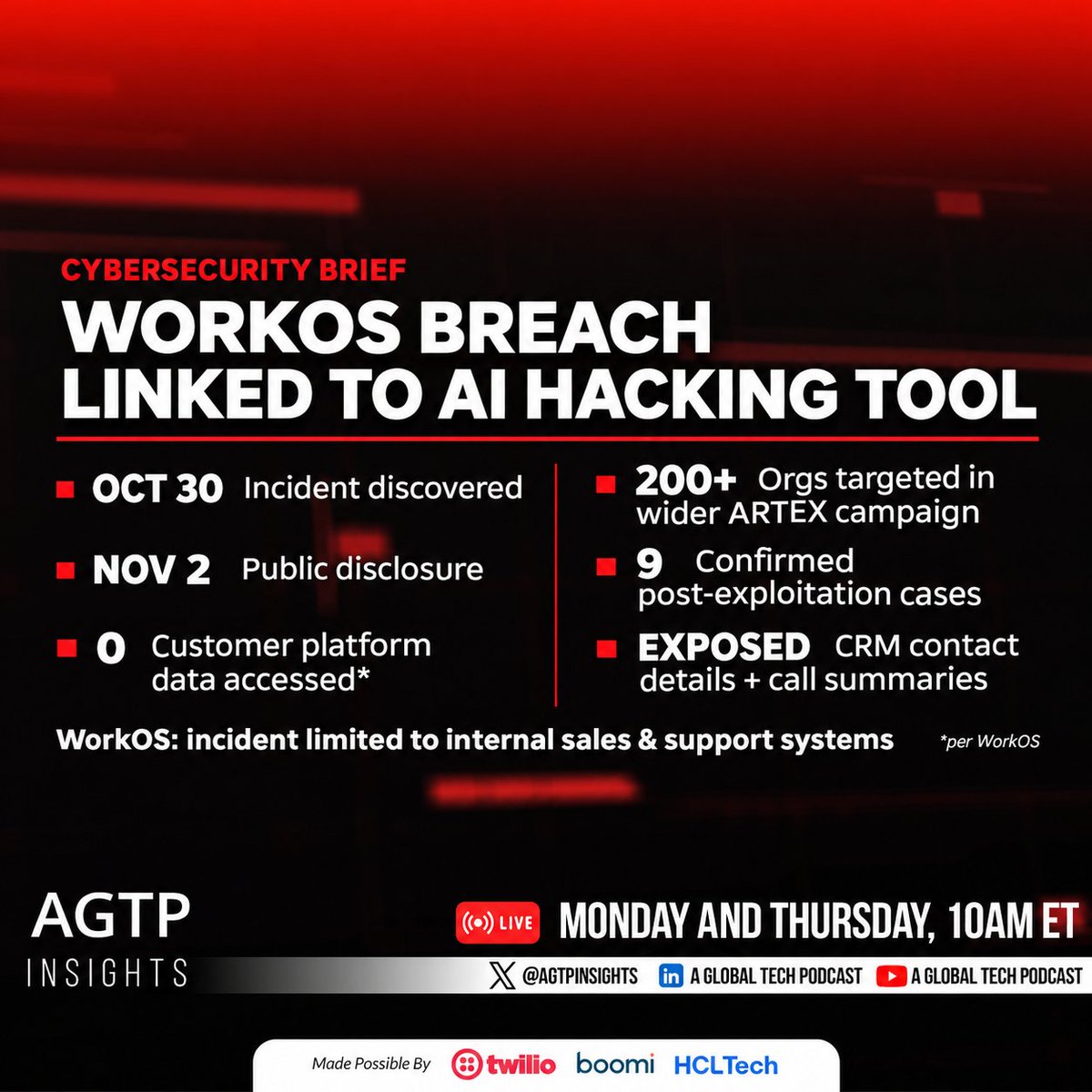
    WorkOS just disclosed a breach of its internal systems, tied to an AI hacking tool. Here's what you need to know. WorkOS CEO Michael Grinich says the company discovered the incident on October 30 and disclosed it on November 2. An attacker reached an internal sales tool and took CRM and customer support data. Contact details and call summaries were exposed, which can be used to make phishing emails look real. WorkOS says its production systems are secure. It says no customer platform data was accessed. The incident was isolated to internal go-to-market (GTM) systems. The investigation found the attack was likely driven by ARTEX. That's an open-source, AI-assisted, autonomous penetration testing framework that can use any AI model to automate offensive security work. It's Go-based and Chinese in origin. ARTEX is also in the news elsewhere. CrowdStrike linked it to a China-nexus actor called VAPOR PANDA, which used ARTEX with DeepSeek and another commercial LLM. BleepingComputer reports the campaign targeted over 200 organizations, with post-exploitation activity confirmed at nine. Earlier reports showed it used against South Korean financial institutions. The reaction has been mixed. Security researchers praised WorkOS for disclosing within days, since many companies sit on incidents for months. Others pointed out that WorkOS is an auth provider, and that on Oct 29 Grinich had poked fun at rival Better Auth for shipping a security update. Some asked what technical indicators point to ARTEX. Key numbers: - Oct 30: incident discovered - Nov 2: public disclosure - 200+ organizations targeted in the wider ARTEX campaign - 9 organizations with confirmed post-exploitation activity - 0 customer platform data accessed, per WorkOS WorkOS says the breach was limited to internal sales and support systems.
    Download
    0101.1K
  12. Prasenjit Sarkar✓@stretchcloud
    Four days ago Michael Grinich mocked a competitor for being too cautious. On October 29th, Better Auth pre-announced that a security release was coming before disclosing details, and Grinich posted that this was overcautious: AI agents now weaponize disclosures within hours, he argued, citing a recent PHP vulnerability that drew millions of automated attack attempts almost immediately after going public. On October 30th, WorkOS itself got breached. An AI-assisted offensive security framework, one Grinich later named as ARTEX, got into an internal sales tool. Google's Threat Intelligence Group and Mandiant have separately described ARTEX as a multi-agent platform that turns a broad attacker goal into a chain of commands: testing permissions, mapping networks, revising failed attempts, moving through stages with little human steering. Wiz has documented it pulling application files and probing internal API routes elsewhere. What came out of WorkOS: CRM contact details, account histories, and excerpts from customer Slack conversations and support calls. WorkOS says there's no evidence yet that production services were touched, and it's hired outside forensics to confirm the rest. The timing matters more than the irony. WorkOS raised $100M at a $2B valuation this year. Clerk just raised $50M from Menlo and Anthropic's own Anthology Fund specifically to build agent identity, the idea that AI agents need their own verifiable credentials the way humans need logins. The whole category is being funded on the premise that it can be trusted to secure the next wave of autonomous software. An AI-run attack framework breaching one of its most visible vendors four days after that vendor mocked a rival for being too careful about disclosure is a bad advertisement for that premise, whoever ends up at fault. Confidence about security posture is cheap to post and expensive to be wrong about. The agents attacking you now move faster than the agents defending you were built to assume.
    Michael Grinich @grinich
    yikes. betterauth is pre-announcing a "security release" 😬 why? because agents can immediately deploy broad-scale attacks the minute vulns are disclosed. we saw this last week with php2shell: millions of automated attack attempts within hours of disclosure this is now a huge problem for open source projects. likely the same thing will happen with betterauth as php. unclear if network WAFs will be able to patch this one... oof 😰
    00094
  13. Michael Grinich✓@grinich
    yikes. betterauth is pre-announcing a "security release" 😬 why? because agents can immediately deploy broad-scale attacks the minute vulns are disclosed. we saw this last week with php2shell: millions of automated attack attempts within hours of disclosure this is now a huge problem for open source projects. likely the same thing will happen with betterauth as php. unclear if network WAFs will be able to patch this one... oof 😰
    12111737.5K
  14. jack✓@jack
    there is no moat
    1.9K2.2K23.6K4.2M
  15. CellCog✓@cellcogai
    SEE HOW: AI agents chain ordinary attack steps, a scan, a login that works, an exposed internal tool, into CRM data, and the stolen call notes make the next phishing email look real.
    Download
    Michael Grinich @grinich
    I want to share some context on a security incident we discovered on October 30. First, the most important thing: WorkOS's production systems are secure. No customer platform data was accessed. This incident was isolated to internal GTM systems. The attack involved ARTEX, an autonomous AI agent framework used to carry out offensive security operations. It's a striking example of how quickly the capabilities of attackers are evolving. We've contained the incident, brought in independent experts to investigate, and are working through the details. Security is something we take extremely seriously, and I believe in being transparent when things go wrong. We'll continue to share updates as we learn more. Full details:
    10046
  16. CellCog✓@cellcogai
    @cellcogai
    What WorkOS says was taken, what ARTEX is, and the other campaigns security firms tie to it:
    00027
  17. Chip Herndon✓@chipherndon
    Props to @WorkOS for reporting this security incident, lots of companies would try to sweep it under the rug Ironically enough, this won more of my trust
    Download
    009918
  18. Herecy✓@TheHerecy
    WorkOS got hit by an AI-assisted attack framework that automated the recon and exploitation. Prod was fine but the sales tool leaked contacts and customer convo summaries. Your internal tools need the same locks as prod.
    00016
  19. Domain Lancer | Domains for Sale✓@domainlancer
    🚨 YOUR AI AGENT FINISHED ITS JOB. SO WHY DOES IT STILL HAVE ACCESS? Imagine this. Your company deploys an AI agent to review customer accounts. It needs permission to: ✅ Read selected CRM records. ✅ Check outstanding invoices. ✅ Prepare a summary. ✅ Send the results to an authorized employee. The task takes 3 minutes. Done. But here's the question: What happens to the agent's permissions afterward? Can it still access customer records? Can it use those credentials for another task? What if someone manipulates the agent into performing an action it was never supposed to perform? This is where AI security gets really interesting. Because giving an agent an identity isn't enough. YOU NEED TO CONTROL ITS AUTHORITY. And that authority shouldn't automatically last forever. ━━━━━━━━━━━━━━━━━━ ⚡ LOOK WHAT HAPPENED IN OCTOBER 2026. 🔹 OCTOBER 16 — ORACLE Oracle described how it introduced just-in-time permissions, least-privilege reviews, and human approval for sensitive actions involving AI agents. The idea is straightforward. An agent investigating an infrastructure problem shouldn't automatically receive permission to make destructive production changes. 🔹 OCTOBER 19 — MICROSOFT Microsoft introduced Dynamic Permissions for agents. Instead of inheriting all the permissions of a human employee, an agent can receive authority scoped to a specific task and limited to the time that task requires. 🔹 OCTOBER 27 — WORKOS WorkOS updated its guidance explaining how delegated agents can operate within both the user's permissions and the agent's own permission limits. An agent can be allowed to read customer records without automatically receiving permission to change billing information. Different implementations. One increasingly important principle: THE AGENT SHOULD ONLY HAVE THE AUTHORITY IT ACTUALLY NEEDS. ━━━━━━━━━━━━━━━━━━ 💡 HERE'S THE BUSINESS OPPORTUNITY. Imagine a specialized authorization platform for autonomous agents. Every agent action passes through a policy layer. The system checks: 🔐 WHO is the agent? 👤 WHO authorized it? 🎯 WHAT task is it performing? 🛠️ WHICH tools can it use? 📂 WHICH resources can it access? ⏳ HOW LONG should that permission remain valid? ✅ DOES this action require human approval? And when the task ends? Its temporary authority expires or is revoked. No unnecessary standing privileges. No unrestricted inherited access. Just defined permissions, enforced at the appropriate boundaries. Of course, real security requires more than expiring tokens. You also need resource-level checks, reliable revocation, auditability, and enforcement throughout the system. That's why this is a serious infrastructure problem rather than another chatbot feature. ━━━━━━━━━━━━━━━━━━ 🌐 NOW THINK ABOUT THE PRODUCT NAME. AVAILABLE FOR ACQUISITION. AUTHZ is established developer shorthand for authorization. And SI now has an emerging association with SUPER INTELLIGENCE. Together, the name could fit a company developing: • AI agent authorization APIs • Fine-grained permission engines • Task-scoped access controls • Delegated authorization infrastructure • Agent identity and policy enforcement • Enterprise agent-security platforms Already operating under an established company brand? You wouldn't necessarily need to change it. could become a dedicated developer product, documentation portal, or specialized authorization service. ━━━━━━━━━━━━━━━━━━ 🧠 WHAT ABOUT SUPER INTELLIGENCE? In September 2026, a US executive order directed federal agencies to adopt “Super Intelligence” and “SI” terminology in specified communications. NIST has begun incorporating that terminology. This doesn't mean SI has universally replaced AI. But for companies developing infrastructure for increasingly capable intelligent systems, that association may become relevant to their branding decisions. The security problem exists today. The SI branding opportunity remains emerging. That's an important distinction. ━━━━━━━━━━━━━━━━━━ ⏳ WHY CONSIDER THE DOMAIN NOW? Because authorization infrastructure for AI agents is being developed right now. Microsoft, Oracle, WorkOS, and other companies are already working on ways to control agent permissions. If you're preparing a product in this category, evaluating its name before launch makes sense. Before publishing documentation. Before building SDKs and developer integrations. Before creating product marketing campaigns. Before establishing customer recognition under another identity. No domain purchase guarantees business success or future appreciation. But the exact domain can only have one registrant at a time. If fits a product you're already building, it's worth considering while available. ━━━━━━━━━━━━━━━━━━ 🤝 TO AUTHORIZATION & AI SECURITY FOUNDERS: Building the permission layer for autonomous agents? Developing fine-grained authorization infrastructure? Launching a specialized agent-security product? 🌐 is available for acquisition. Domain name only. No operating platform or existing software included. 📩 DM me to discuss acquiring it. ━━━━━━━━━━━━━━━━━━ 🔥 QUESTION FOR SECURITY ARCHITECTS: When an AI agent completes a task, what should happen to its access? 1️⃣ Revoke it immediately. 2️⃣ Let short-lived credentials expire. 3️⃣ Keep limited permissions for recurring tasks. 4️⃣ Reevaluate access dynamically based on risk. Which approach would you trust in production? I'm especially interested in hearing from IAM engineers and founders actually building these systems. Because the future of agent security isn't just about knowing WHO an agent is. It's about controlling WHAT it can do, WHEN it can do it, and WHEN THAT AUTHORITY ENDS. #AgenticSecurity #Authorization #Superintelligence #DomainsForSale #DomainInvesting #SI
    Download
    102108
  20. AGTP✓@AGTPinsights
    WorkOS disclosed a security incident on November 2nd after discovering it on October 30th, and the company points to an AI powered penetration testing framework called RTX as a likely tool in the attack. According to WorkOS CEO Michael Greenitz, an attacker gained access to an internal sales tool and took customer relationship management and support data. That data included contact details and call summaries, information that can make a phishing message feel unusually credible. WorkOS says its production systems remain secure and that no customer platform data was accessed. The company says the incident was confined to internal go to market systems. RTX is an open source framework that uses AI to automate penetration testing. It has appeared in other recent reporting. CrowdStrike linked it to Vapor Panda, a sovereign actor that used the framework with DeepSeek and another commercial large language model. BleepingComputer also reported a campaign that targeted more than 200 organizations, with post exploitation activity confirmed at nine. Earlier reporting described RTX being used against South Korean financial institutions. This is not the first time RTX has been reported, and it is likely not the last. For more timely updates like this, follow HTTB Insights on X, Instagram and LinkedIn.
    Download
    000146
  21. Andres Vera@andresveraf
    WorkOS breached by an AI-run attack framework: automated recon, CRM contacts and Slack summaries taken. Same class as the Korean bank hacks, now disclosed by the victim.
    0005
  22. FahimSamadi✓@Fahim_Samadi007
    An AI attack framework got into WorkOS through an internal sales tool, not production. WorkOS: no evidence production or app data was touched. CRM contacts and call, support and Slack summaries were. Internal tools are in scope. Expect phishing that quotes real threads.
    Download
    10025
  23. FahimSamadi✓@Fahim_Samadi007
    @Fahim_Samadi007
    Sources • WorkOS security bulletin, 2 Nov 2026: • WorkOS customer notice + CEO Michael Grinich comment (via HN): Attribution: • Bulletin: Data involved list; no evidence of application/production access; AI-assisted offensive framework; response steps. • Customer notice: 16:39 UTC detection; ARTEX name; Hong Kong/China IPs; internal sales/marketing API; Salesforce + Snowflake. • CEO (HN): ARTEX name; internal GTM system.
    00016
  24. AGTP✓@AGTPinsights
    Fortune just unveiled its fourth annual Cyber 60 list of top cybersecurity startups. Here's what you need to know. The 2026-27 Fortune Cyber 60 names 60 of the most important venture-backed cybersecurity startups. It was built with Lightspeed Venture Partners and sponsor AWS. Lightspeed says the list covers some of the fastest-growing startups in the market. They are building next-gen infrastructure, AI security, and new ways to approach threat detection. To qualify, a company must not have completed an IPO, an acquisition, or another significant exit. The selection looked at business growth and product, among other factors. Companies are grouped into three stages: early, early growth, and growth. Fortune's highlighted top names include 1Password, Cyera, Armis, Verkada and Cato Networks. Others posting about their spots include Cribl, Descope, Huntress, Tailscale, Tines, Vanta, Torq, Endor Labs, WorkOS and Ent. Ent is less than a year out of stealth. Torq, Vanta and Endor Labs are on the list for a third or fourth straight year. Lightspeed also released a CISO survey with Wakefield Research. It polled 200 CISOs on enterprise AI and where they plan to invest next. It finds companies are deploying AI agents while still building the controls to govern them. Key numbers: - 4th annual list - 60 startups - 24 newcomers - 3 growth stages - 200 CISOs surveyed The full list and methodology are on Fortune's site and Lightspeed's Cyber 60 page.
    Download
    Lightspeed @lightspeedvp
    The 4th annual Cyber 60 list is here. This year’s list recognizes some of the fastest-growing venture-backed cybersecurity startups in the market, building to advance next-gen infrastructure, AI security, and how we approach threat detection. Congratulations to everyone who made the #Cyber60 list in partnership with @FortuneMagazine and sponsor @AWSstartups. Read our full CISO survey report, conducted with Wakefield Research, which polled 200 CISOs on enterprise AI and where they’ll invest next:
    100190
  25. Lightspeed@lightspeedvp
    The 4th annual Cyber 60 list is here. This year’s list recognizes some of the fastest-growing venture-backed cybersecurity startups in the market, building to advance next-gen infrastructure, AI security, and how we approach threat detection. Congratulations to everyone who made the #Cyber60 list in partnership with @FortuneMagazine and sponsor @AWSstartups. Read our full CISO survey report, conducted with Wakefield Research, which polled 200 CISOs on enterprise AI and where they’ll invest next:
    Download
    8156922.2K
  26. Show more posts