Posts with #ai4code

#ai4code

Public posts on X that use #ai4code.

Related hashtags

  1. Pushmeet Kohli✓@pushmeet
    Following up on the AlphaEvolve code opt. agent, I am happy to share how our team at @GoogleDeepMind has developed the CodeMender agent to design/apply patches to fix security vulnerabilities in large scale open source projects. #AI4code Read more at:
    42521113.8K
  2. Awesome Papers@awesomepapersio
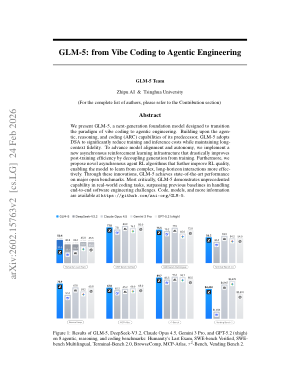
    💻 AI for Code · paper of the day GLM-5: from Vibe Coding to Agentic Engineering The number that matters: Through these innovations, GLM-5… GLM-5-Team: Aohan Zeng et al. · 2026 ⭐ 6,936 GitHub stars 🔗 #AI4Code #CodeGen #SoftwareEngineering
    Download
    0002
  3. Tao Yu@taoyds
    #NLProc #AI4Code GPT-3 Codex is possible to generate INTERACTIVE multi-vis interfaces📈 (not just static simple plots!) from natural language queries! Check out our demo below! Work led by @Yiru__Chen @sirrice. Stay tuned for fancier ones!
    Yiru Chen @Yiru__Chen
    No programming, No learning curve! We can now generate INTERACTIVE multi-vis interfaces from NL queries! Yes! Directly from NL! Check this demo below. I will also give a talk on this next Sat in the NLVIS workshop @IEEEVIS. Paper:
    007
  4. Yiru Chen@Yiru__Chen
    No programming, No learning curve! We can now generate INTERACTIVE multi-vis interfaces from NL queries! Yes! Directly from NL! Check this demo below. I will also give a talk on this next Sat in the NLVIS workshop @IEEEVIS. Paper:
    Download
    1240
  5. Tao Yu@taoyds
    A new way to work w. LMs! Binder, an easy neuro-symbolic paradigm: 1.Parse input➡️SQL/Python bound w. GPT3 Codex API calls 2.Codex+PL interpreter execute➡️answer No train&few-shot!➡️SOTA 🆚chain-of-thought: interpretable&robust⬆️ 🆚NL2Code: coverage⬆️
    Download
    1073286
  6. Tao Yu@taoyds
    @taoyds
    🆚End2end/chain-of-thought: Binder program’s deterministic execution entails prediction/answer➡️interpretable & robust⬆️ 🆚#SemPar #AI4Code: Binder injects Codex functionalities in SQL/Python to handle more diverse questions➡️coverage⬆️ Demo: 2/8
    109
  7. Baishakhi Ray@baishakhir
    Updating real-world large legacy projects like binutils? Meet ( C2SaferRust: leveraging program analysis & LLMs to create idiomatic, safer Rust with (↓38%) raw pointers & (↓28%) unsafe code while preserving functionality 🚀 #rustlang #AI4code #AIAgent
    12372.3K
  8. Baishakhi Ray@baishakhir
    Introducing SemCoder, a semantic-aware Code LLM excelling in code generation and execution reasoning. Trained with high-quality data and novel way of aligning execution, only 6.7B model is outperforming GPT3.5 and CodeLlama 34B. link: #LLMs, #AI4Code
    110828.9K
  9. Kevin Leneway@kleneway
    Now *this* is what the new @cursor_ai agent feature can enable! IMO there are incremental, nice-to-have coding gains from the agent screenshot @ryolu_ and @shaoruu shared. But to make a custom agent for writing? 🤯Turn off coding tools, create Editor agent…endless possibilities!
    40114.4K
  10. Kumar Sharma@K_Sharma__
    @kleneway
    Cursor AI’s new agent feature is next-level! 🚀 From incremental coding gains to fully custom writing agents, the flexibility here is wild. Combine that with @QodoAI for seamless PR analysis, and you’ve got a powerhouse dev setup. What’s your ideal AI agent use case? #AI4Code #DevTools
    0011.3K
  11. Salesforce AI Research✓@SFResearch
    @SFResearch
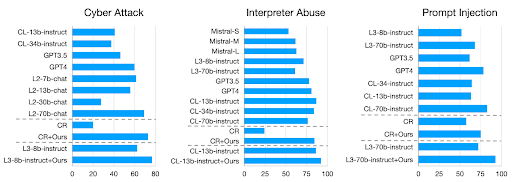
    (5/6) INDICT also makes LLMs more robust in open-domain generation tasks against complex red-teaming prompt engineering methods (in the HarmBench benchmark).
    Download
    103371
  12. Salesforce AI Research✓@SFResearch
    @SFResearch
    (6/6) In summary, INDICT's cooperative critic system demonstrates potential for responsible AI for code, achieving state-of-the-art security without compromising functionality. Explore the future of safe and helpful AI-generated code today! #AI #Innovation #AI4Code
    Download
    003357
  13. Shanchao Liang@LiangShanchao
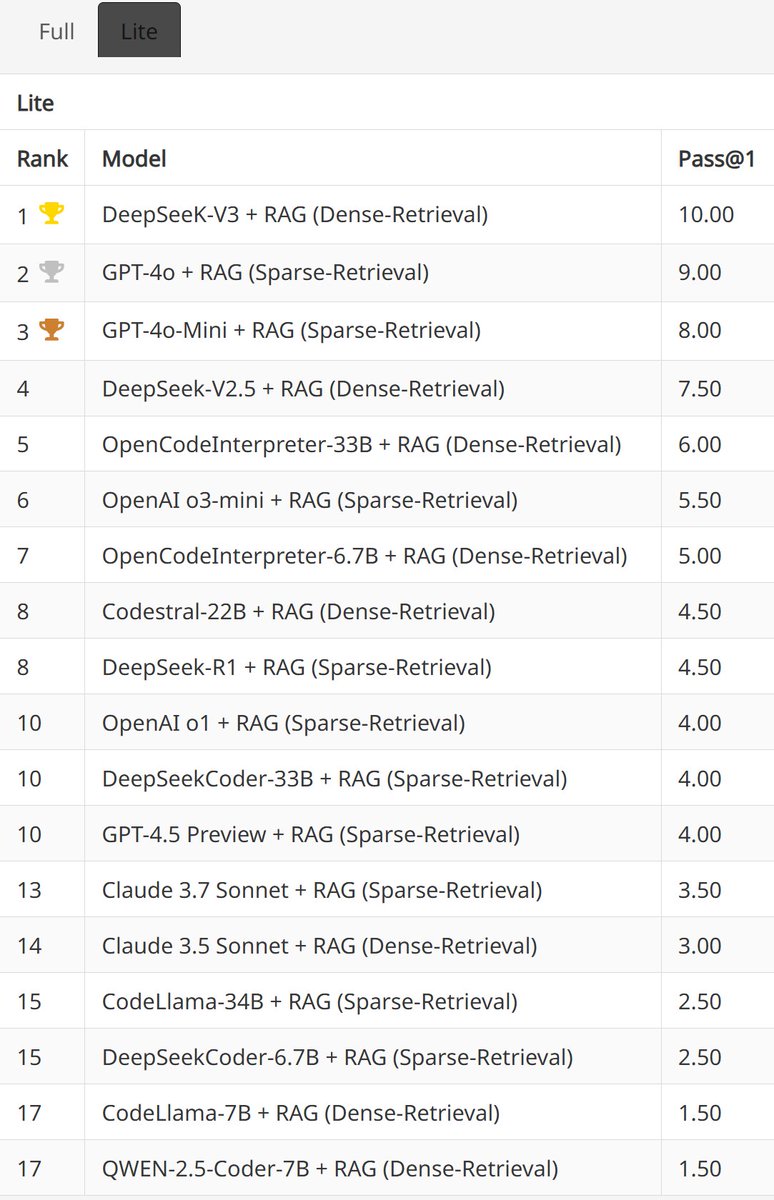
    New models, same struggle! DeepSeek-R1, GPT-4.5 Preview, and Claude 3.7 Sonnet still show low performance on realistic coding tasks (RepoCod-Lite), with Pass@1 of 4.5%, 4.0%, and 3.5%. Top models just reach 10% Pass@1. We need better approaches for code generation! #AI4Code #LLM
    Download
    217496
  14. Yasharth Bajpai✓@imYbajpai
    After 36 hours of travel, finally at Porto de Galinhas, Brazil to attend @AIwareConf @FSEconf . I'll be here throughout the conference and would love to discuss #AI4Code & #AI4SE in general. Also, share our learnings from building GitHub Copilot inside VS. DMs are open.
    Download
    35252K
  15. Alexey Svyatkovskiy@asvyatko
    The Data & AI team at Microsoft seeks a Principal Research Scientist to contribute to the next generation of AI-assisted developer tools 🚀 💡 Copilot model improvements 💡 Copilot AI for pull requests (code review, program repair, ...) Message me if interested #ai4code #copilots
    107443
  16. Theo X. Olausson@theo_olausson
    #ai4code peeps at #ICLR2024: come chat self-repair with me at 10:45 AM on Friday, May 10! I'll be presenting the camera-ready version of this fan favorite from last year... now with even more data! Keep reading for a sneak peek of the results 👇
    Download
    AK @_akhaliq
    Demystifying GPT Self-Repair for Code Generation paper page: Large Language Models (LLMs) have shown remarkable aptitude in code generation but still struggle on challenging programming tasks. Self-repair -- in which the model debugs and fixes mistakes in its own code -- has recently become a popular way to boost performance in these settings. However, only very limited studies on how and when self-repair works effectively exist in the literature, and one might wonder to what extent a model is really capable of providing accurate feedback on why the code is wrong when that code was generated by the same model. In this paper, we analyze GPT-3.5 and GPT-4's ability to perform self-repair on APPS, a challenging dataset consisting of diverse coding challenges. To do so, we first establish a new evaluation strategy dubbed pass@t that measures the pass rate of the tasks against the total number of tokens sampled from the model, enabling a fair comparison to purely sampling-based approaches. With this evaluation strategy, we find that the effectiveness of self-repair is only seen in GPT-4. We also observe that self-repair is bottlenecked by the feedback stage; using GPT-4 to give feedback on the programs generated by GPT-3.5 and using expert human programmers to give feedback on the programs generated by GPT-4, we unlock significant performance gains.
    25247K
  17. AK✓@_akhaliq
    Demystifying GPT Self-Repair for Code Generation paper page: Large Language Models (LLMs) have shown remarkable aptitude in code generation but still struggle on challenging programming tasks. Self-repair -- in which the model debugs and fixes mistakes in its own code -- has recently become a popular way to boost performance in these settings. However, only very limited studies on how and when self-repair works effectively exist in the literature, and one might wonder to what extent a model is really capable of providing accurate feedback on why the code is wrong when that code was generated by the same model. In this paper, we analyze GPT-3.5 and GPT-4's ability to perform self-repair on APPS, a challenging dataset consisting of diverse coding challenges. To do so, we first establish a new evaluation strategy dubbed pass@t that measures the pass rate of the tasks against the total number of tokens sampled from the model, enabling a fair comparison to purely sampling-based approaches. With this evaluation strategy, we find that the effectiveness of self-repair is only seen in GPT-4. We also observe that self-repair is bottlenecked by the feedback stage; using GPT-4 to give feedback on the programs generated by GPT-3.5 and using expert human programmers to give feedback on the programs generated by GPT-4, we unlock significant performance gains.
    Download
    5122491413K
  18. Kaggle@kaggle
    Check our our new #ai4code competition with @google and @theteamatx! Understand the relationship between code and comments in Python notebooks:
    010103
  19. Antonio Alegria@antonioalegria
    Ooooh, I had missed this one! ML + Symbolic domain knowledge (rules) = win! There's a lot of opportunity in pairing ML with Automated Reasoning (or other symbolic AI) to create more powerful #AI4Code systems.
    Google AI @GoogleAI
    Check out a new hybrid approach that leverages both ML and rule-based semantic engines to build a Transformer-based semantic code completion model, which we show can improve developer efficiency. Read more ↓
    003
  20. Google AI✓@GoogleAI
    Check out a new hybrid approach that leverages both ML and rule-based semantic engines to build a Transformer-based semantic code completion model, which we show can improve developer efficiency. Read more ↓
    132311K
  21. Theo X. Olausson@theo_olausson
    By popular request, the submission deadline for the #VerifAI workshop at @iclr_conf has been extend to Sunday, Feb 8 (AoE) 🎉🎉 🎉 But don't leave it until the last minute - submit your papers on RLVR, AI+verification, #ai4code and #ai4math now! 👉
    Download
    0151.2K
  22. Show more posts