Posts with #annotations

#annotations

Public posts on X that use #annotations.

Related hashtags

  1. Jobfound Remote Jobs 👨‍💻@JobFound5
    🚨 GET PAID TO TRAIN AI FROM HOME! THIS REMOTE JOB IS HIRING! A company is hiring Remote Data Entry / Annotation! Pay: $18/hour (~$3,120/month) Work from home ✅ High school diploma required 📊 Basic Excel skills needed Let us know if you are Interested 👇
    502115.9K
  2. Kateryna Ostapenko✓@Klymen10ko
    we're hiring video data annotators automatic onboarding, open globally apply here 👇
    Download
    762292.2K903K
  3. Bernardo Almeida@deAlmeida_BP
    🚀 NTv3, new release! Excited to release updated Nucleotide Transformer models, with better genome function prediction across 15 species, gene annotation in mammals, plants and insects, and regulatory sequence design 🧬 Revised preprint and details 👇
    Download
    3313656
  4. 😟msafi@kemboi017
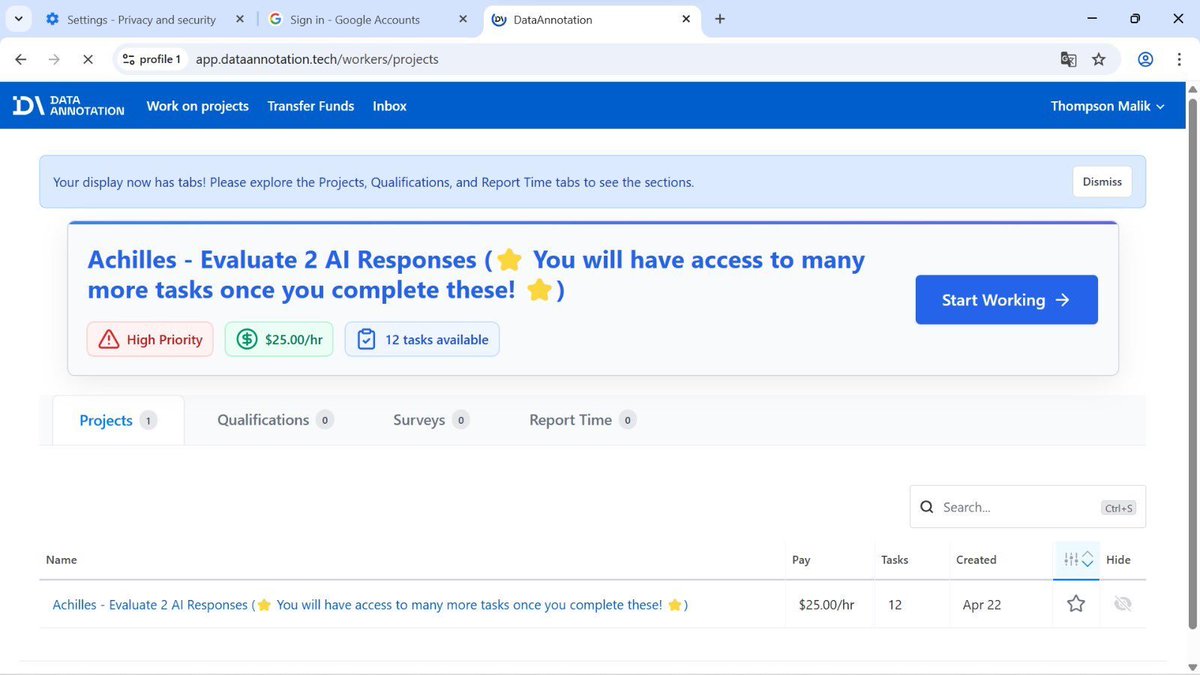
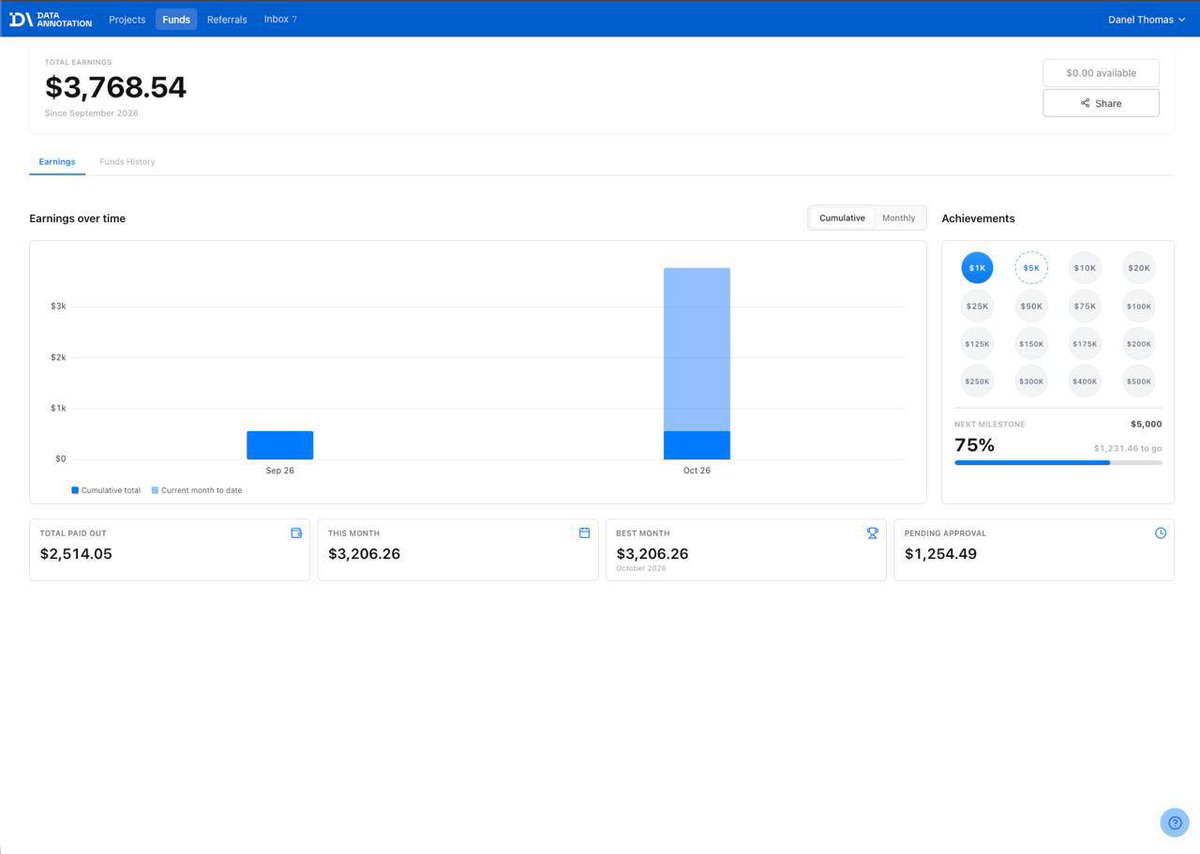
    DATA ANNOTATION UPDATE Currently working through assessments! Generalist account- $25/hr Ready for verification Who else is exploring DataAnnotation? Want to learn about AI platforms, assessments & new opportunities? Join my WhatsApp & Telegram communities Links in bio
    Download
    405368
  5. Dammy✓@OlatunjiAyokan2
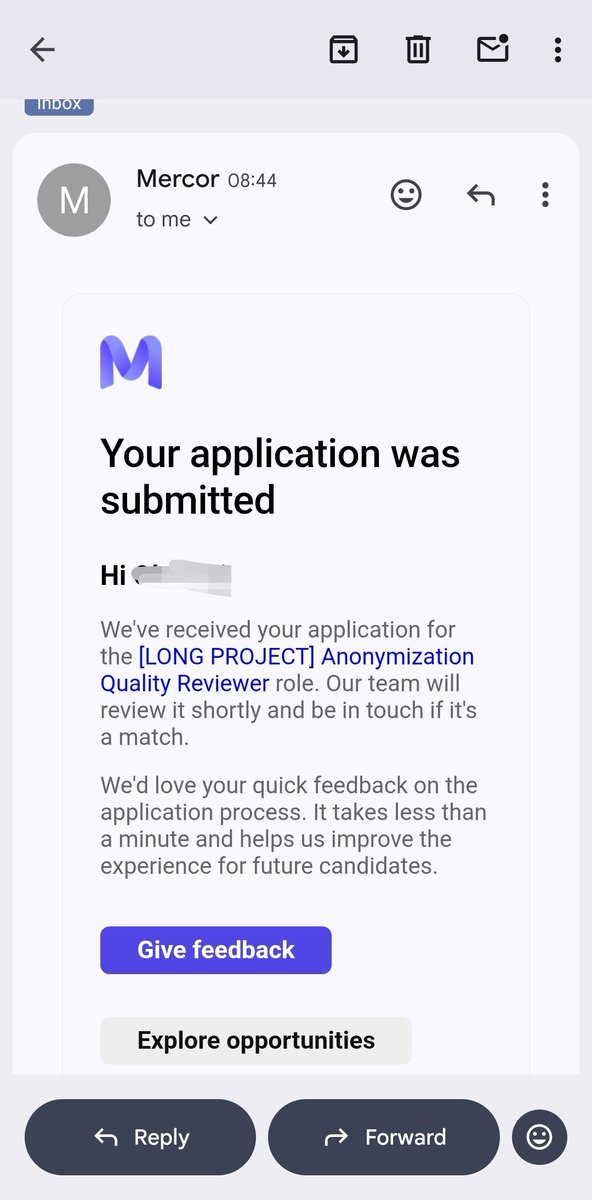
    🚨 Mercor is offering $45–$60/hour for Anonymization Quality Reviewers! This is a long-term remote contract opportunity. Your job is to review business documents, emails, chat logs and other records to ensure personal information (PII) is correctly identified and classified. What they're looking for: • QA or quality review experience • AI evaluation or data annotation experience • Strong attention to detail • Clear written communication • Ability to follow detailed, changing guidelines 💰 $45–$60/hour 🌍 Remote 📌 Hourly contract If you have experience in QA, AI evaluation or data annotation, check this out. Apply here:
    Download
    1110819.6K
  6. RNA-Seq Blog@RNASeqBlog
    Researchers developed SpliceCOV, a machine learning tool that filters noise from RNA sequencing data, improving transcriptome assembly, splice-site identification and gene annotation. - @JohnsHopkins - @JHUCompSci
    0618602
  7. Life Code✓@69LifeCode
    Get $20/Hr Data Annotation Specialist AI Trainer Job - Full Guide Laptop or phone Internet Ability to detect the difference in data (images and videos) If you have all these, then check this high recruiting opportunity
    37424K
  8. diva🤭✓@divawears1
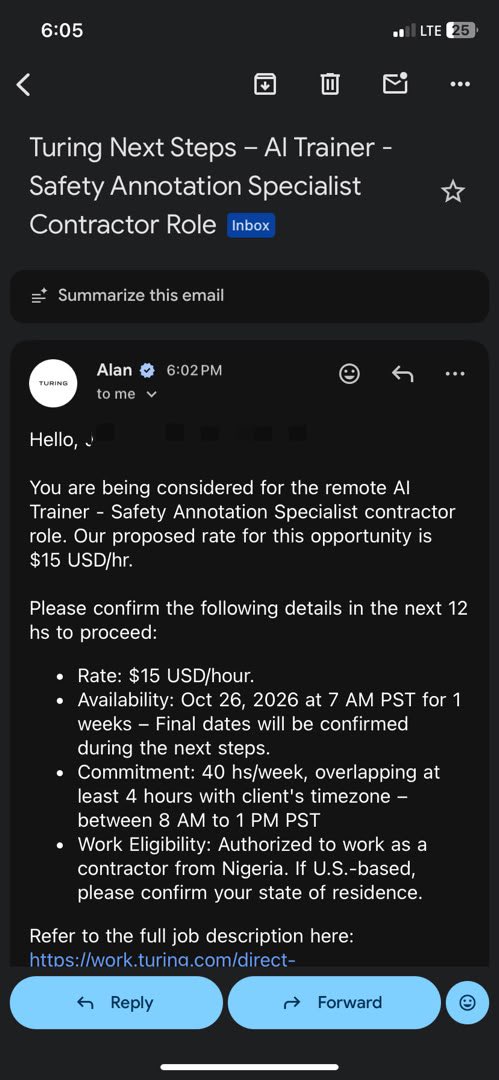
    Turing has another annotation role open to Nigerians Al Trainer - Data Annotation Specialist (Safety) $15/hr | 40hrs/week| Remote You'll review Al responses, check them against safety policies, give ratings, and explain why you chose each rating If you've done data annotation, content moderation, QA, policy review, or Al evaluation, this is one to check out. Link is in the comments👇🏾
    Download
    191410513.2K
  9. Emma Scharfman✓@EmmaScharfmann
    So much happened in AI for Science on the 🤗 Hub this month! I summarized what these new models and datasets are about, to make them accessible to anyone curious about AI for Science 🚀
    8247612.5K
  10. CTM.js | UI developer@Babypharmavolu1
    What exactly is going on with this video Annotation project 🤦🏽‍♂️ Got onboarded since Saturday and all I have gotten for the past 5 days is a single task after spending hours on your Onboarding process. How is that fair?? And How exactly am I supposed to complete this?? 🤦🏽‍♂️🤦🏽‍♂️🤦🏽‍♂️
    Download
    Kateryna Ostapenko @Klymen10ko
    we’re hiring for these roles right now
    50295K
  11. Kateryna Ostapenko✓@Klymen10ko
    we’re hiring for these roles right now
    0176.6K
  12. Dammy✓@OlatunjiAyokan2
    🚨 Platforms You Can Earn From Online! 💰🔥 1. Micro1 2. Mercor 3. Outlier 4. DataAnnotation 5. Prolific 6. User Interviews 7. Test IO 8. uTest 9. TELUS Digital AI 10. OneForma 11. Appen 12. Clickworker 13. CrowdGen 14. Toloka 15. Turing 16. Remotasks 17. Alignerr 18. Handshake AI 19. Respondent 20. Fiverr 21. Upwork 22. TransPerfect DataForce 23. Neevo 24. Welocalize 25. RWS 💻 From AI training and data annotation to paid research studies, app testing, and freelancing, there are different ways to earn online. ⚠️ Availability, eligibility, and payment methods vary by country and platform. Which one have you earned from before? 👇🔥
    55531412.3K
  13. ShareX✓@ShareX
    Which annotation toolbar do you prefer? @CubityFirst designed new toolbar icons and updated the overall style, and we're trying to decide whether the new version is better than the previous one. One thing we're particularly unsure about is the use of the accent color on the icons. Do you think it looks better with or without it?
    Download
    120181.5K
  14. Sharon Li✓@SharonYixuanLi
    When an LLM agent executes a long task, the hardest question is usually not whether it failed but where. Which step actually broke the run? 🧵 That’s the failure attribution problem, and it’s becoming central to debugging agentic systems. But current approaches have a real cost problem: 1. Prompting-based pipelines, where an LLM reads the whole trajectory and judges each step, are slow and expensive to run. 2. Post-trained attribution models need failure trajectories labeled at the step level, which are painful to collect and hard to scale. We think a practical failure attribution model should be lightweight and shouldn’t need step-level labels on failures at all. So in our #neurips2026 paper, “Tracing Agentic Failure from the Flow of Success,” we ask: can you find where an agent went wrong by learning only what going right looks like? Meet OAT 🌾 The idea: treat failure attribution as one-class learning. We train only on successful trajectories, using neural controlled differential equations to model how successful runs evolve in latent space. Think of it as learning the “flow” of a healthy agent trajectory. At inference, we take a failed trajectory and score every step by how far it drifts from those learned success dynamics. Steps that deviate most get flagged as the likely error steps. The algorithm doesn't rely on any step-level annotation. What we found: ⚡ With just 100 successful trajectories for training, OAT runs 200-5000× faster than prompting-based baselines (including GPT-5 judge). 📈 It also outperforms them on accuracy: about +20% F1 score. So you don’t have to trade cost for quality here. You can get both. Why I’m excited about this: successful runs are cheap and plentiful, while carefully annotated failures are not. Building diagnostics on top of the data we already have feels like the right direction as agent systems grow longer and more complex. Huge thanks to my amazing student @Samuel861025 for leading the effort, and collaborators from Microsoft Research @ShaleenDeep and Yiwen Zhu. 📄 Paper:
    Download
    304626013.6K
  15. Dammy✓@OlatunjiAyokan2
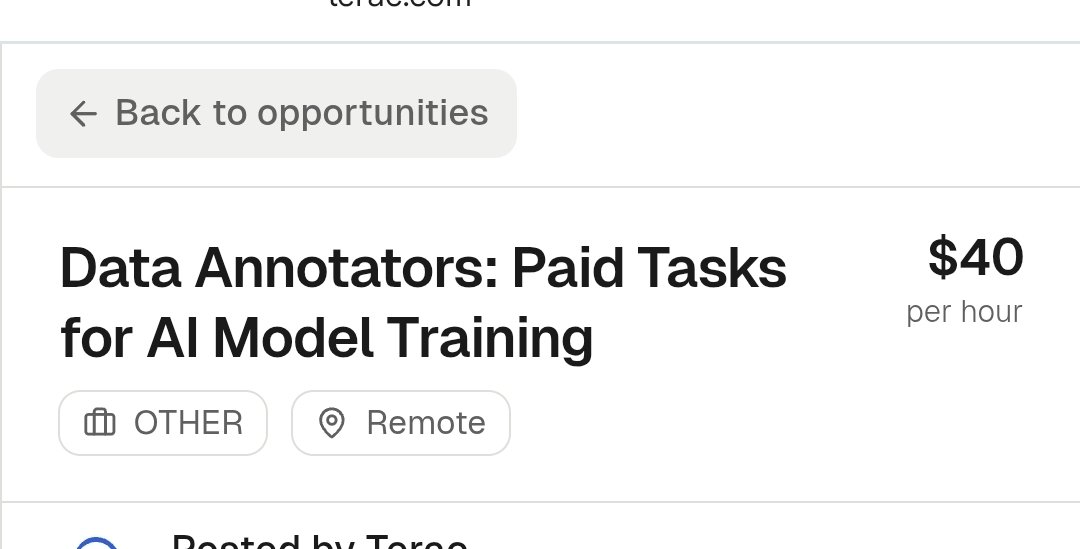
    🚨 $40/HR FOR AI DATA ANNOTATION! 💰 Terac is looking for experienced Data Annotators to help train and improve AI models. 💰 Pay: $40/hour 🌍 Remote ⏰ Flexible schedule 🤖 Tasks include labeling data, reviewing content, and evaluating AI responses. Experience in data annotation, data labeling, or AI evaluation is required. Not eligible for this one? You can still earn when someone you refer gets paid! Check the comments for the link.
    Download
    56796.4K
  16. Sebastian S. Cocioba🪄🌷@ATinyGreenCell
    Something I would love Ai to be good at is chassis-agnostic regulatory element annotation engine. A very accurate and precise one, with room for experimental input which can inform the prediction. I may try to vibecode a plant version, leveraging all the great FOSS ML plant tools
    002260
  17. Nurhayat Yurtaslan✓@nurhayatdev
    Anatomy of Technology — Visual Encyclopedia Series 🔬 Generated with @Alibaba_Qwen Qwen Image 2.1 (8-bit) #Qwen Base Prompt: Create a premium educational infographic about [SUBJECT], presented as part of a modern visual encyclopedia series. STYLE: Scientific editorial design, realistic 3D visualization, technical illustrations, Swiss typography, and modular data panels. COMPOSITION: One large central 3D subject, surrounded by precise callout lines, annotated components, detailed close-ups, structured information cards, and context-specific diagrams. COLORS: Warm off-white background, sophisticated neutral tones, and restrained accent colors inspired by the subject. MODULES: Overview, Key Components, How It Works, Essential Facts, Technical Specifications, Comparison, Applications, and Detailed Views. FINISH: Museum-quality educational design, realistic materials, precise lighting, crisp typography, generous negative space, high resolution. FORMAT: Vertical 3:4 editorial poster. Full prompts for each visual in the replies 👇
    Download
    102349
  18. Nurhayat Yurtaslan✓@nurhayatdev
    @nurhayatdev
    1/ Apple Silicon: Anatomy of a Processor Generated with @Alibaba_Qwen Qwen Image 2.1 (8-bit) #Qwen Prompt: Create a premium, highly detailed educational infographic titled "ANATOMY OF APPLE SILICON", presented as part of the "Anatomy of Technology" visual encyclopedia series. VISUAL DIRECTION: A sophisticated fusion of scientific editorial design, photorealistic 3D hardware visualization, precision engineering diagrams, and contemporary Swiss information design. MAIN COMPOSITION: A massive, realistic 3D Apple Silicon processor positioned at the center, shown in a dramatic exploded-view configuration. Separate the chip packaging, silicon die, CPU clusters, GPU architecture, Neural Engine, memory interface, and thermal layers into floating technical components. Use precise thin connector lines, numbered annotations, and elegantly aligned labels. INFORMATION MODULES: 01 — PROCESSOR PROFILE: Architecture, fabrication process, unified memory concept, and power-efficiency principles. 02 — EXPLODED ARCHITECTURE: Annotated processor layers and functional hardware blocks. 03 — COMPUTE UNITS: CPU, GPU, and Neural Engine roles presented as three structured information cards. 04 — MEMORY SYSTEM: A compact visual diagram explaining unified memory architecture. 05 — DATA JOURNEY: A numbered flow showing how computational tasks move through the system. 06 — DETAIL FOCUS: Four square macro-style close-ups of silicon structures, interconnects, chip packaging, and processor surface textures. ART DIRECTION: Warm ivory background, graphite black, brushed titanium, subtle copper accents, realistic semiconductor materials, physically accurate lighting, microscopic surface details, elegant shadows, and generous negative space. TYPOGRAPHY: Modern Swiss editorial typography, strong uppercase headings, compact scientific labels, precise alignment, crisp readable English. FORMAT: Vertical 3:4 scientific journal poster, ultra-high resolution, professional information design. AVOID: Futuristic fantasy circuitry, random glowing effects, excessive gradients, invented hardware specifications, inaccurate architecture claims, cluttered layouts, illegible labels, and cartoon aesthetics.
    Download
    102121
  19. Nurhayat Yurtaslan✓@nurhayatdev
    @nurhayatdev
    2/ Flutter: Anatomy of a Rendering Engine Generated with @Alibaba_Qwen Qwen Image 2.1 (8-bit) #Qwen Prompt: Create a premium educational infographic titled "ANATOMY OF THE FLUTTER RENDERING ENGINE", belonging to the "Anatomy of Technology" visual encyclopedia series. VISUAL DIRECTION: Scientific editorial design combined with dimensional software architecture visualization, technical diagrams, realistic 3D interface layers, and Swiss typography. MAIN COMPOSITION: A large exploded 3D smartphone interface floating in the center. Visually separate the interface into distinct transparent technical layers: Widget Tree, Element Tree, RenderObject Tree, Layout, Painting, Compositing, and Rasterization. Show the logical relationships between layers using elegant fine connector lines, precise annotation markers, and subtle directional arrows. Treat software structures as explanatory visual metaphors rather than physical hardware. INFORMATION MODULES: 01 — ENGINE PROFILE: Flutter framework, Dart language, rendering pipeline, and cross-platform concept. 02 — LAYER ANATOMY: A technical exploded-view breakdown of the rendering architecture. 03 — FRAME LIFECYCLE: A numbered sequence showing how a frame progresses through build, layout, paint, compositing, and rasterization. 04 — THREE CORE TREES: Widget Tree, Element Tree, and RenderObject Tree explained through compact comparison panels. 05 — PERFORMANCE FOCUS: Frame budget, rebuild behavior, rendering workload, and optimization concepts without invented benchmarks. 06 — DETAIL FOCUS: Four close-up panels showing widget composition, layout constraints, paint commands, and the final rendered interface. ART DIRECTION: Warm off-white background, graphite labels, muted Flutter-inspired blue accents, translucent glass interface planes, subtle metallic details, soft studio lighting, precise geometric diagrams, spacious editorial layout. TYPOGRAPHY: Minimal Swiss information design, clean hierarchy, carefully spaced English labels, technical precision. FORMAT: Vertical 3:4, ultra-sharp editorial technology poster. AVOID: Random code fragments, inaccurate framework architecture, overlapping annotations, excessive neon, generic cyberpunk styling, unreadable text, and decorative clutter.
    Download
    201110
  20. Andrew Ambrosino✓@ajambrosino
    hi all, two things: 1. usage limits are back to being double – your feedback worked 2. we today kicked off an intense sprint to dramatically improve the app simplicity and performance. i will oversee this. more to come. now, send me your complaints
    Tibo @thsottiaux
    Day 25/ We are doubling all usage limits for all Pro 100/200/500 tiers and Business Premium, effective today. We heard your kind feedback and won’t be reducing usage limits for Pro 200, so your Work and Codex usage will stay the same. We’re also going to continue offering extended limits for dots for now, and usage of your dot will still continue to be separate from your default usage. And we'll of course also keep shipping better models and other efficiency improvements that increase your effective usage over time.
    761401.8K71.5K
  21. Tibo✓@thsottiaux
    Day 25/ We are doubling all usage limits for all Pro 100/200/500 tiers and Business Premium, effective today. We heard your kind feedback and won’t be reducing usage limits for Pro 200, so your Work and Codex usage will stay the same. We’re also going to continue offering extended limits for dots for now, and usage of your dot will still continue to be separate from your default usage. And we'll of course also keep shipping better models and other efficiency improvements that increase your effective usage over time.
    4.4K1.5K22.7K1.4M
  22. Michael Carpenter✓@wiggycorp
    @ajambrosino
    @ajambrosino Hey it’s probably a RAM thing but when I use annotation a lot (which I do) it tends to get really buggy and eventually crash my computer. I have an 8GB RAM M1 MacBook. It’s likely the computer but I figured I’d bring it up, in case it wasn’t the RAM alone.
    0061.5K
  23. Madu🀄️@maadu_sm
    Data Annotation Sign-Up Link: Eligibility requirement: You must be a US citizen and pure white After signing up, send me the following information using the exact template below. Fill in all details accurately. DA PROFILE TEMPLATE Check Comment👇
    Download
    202363
  24. Show more posts