Posts with #component
#component
Public posts on X that use #component.
Related hashtags


Stop building every UI component from scratch. These 10 libraries will save you time. 1. — Copy ready React components. 2. — UI components and blocks. 3. — Animated React components. 4. — React UI components. 5. — Interactive UI and micro-interactions. 6. — Ready-made UI transitions. 7. — Playful, physics-driven components. 8. — Animated UI components. 9. — Retro 8-bit UI components. 10. — Chart components for dashboards. Save this for your next project 🔖277182942.3K
UI/UX Designers, this might be one of the best free resources for exploring world-class design systems. Design Systems Surf is a massive curated collection of design systems featuring visual styles, UI components, patterns, and references from some of the best product teams in the industry. Can’t believe this resource is free. Bookmark it for later 💜114766533.4K
The best UI components ready to use, save this 👇 Beautiful UI components for modern products. Ready-to-use React components. Animated React components. Free animated components. UI transitions and animations. Distinctive UI components. Animated React components ready to use. 153 spring-powered animations for your UI. UI components and building blocks. What did I miss?135048425.4K
Industrial robotic arms combine mechanical joints, motors, controllers and specialised tools to perform repeatable tasks. From picking and placing components to welding and assembly, each part of the system contributes to controlled movement. #HuBot #IndustrialRobotics #RoboticArm #Manufacturing #AutomationTechnology701061651.8K
10 websites every design engineer should bookmark 👇 1 - — Deep dives into UI design, typography, animation and design engineering. 2 - — Inspect spacing, typography, colors and animations on live websites. 3 - — Premium animated React components, UI blocks and templates. 4 - — Animated React components and ready-made UI blocks. 5 - — Custom SVG gauges for dashboards. 6 - — Copy-ready audio components for React. 7 - — Diagrams and graphs for React and MDX. 8 - — Render Mermaid diagrams as lightweight SVGs. 9 - — A guide to icons and visual language. 10 - — Creative SVG and visual experiments. What did I miss?142629512.6K
Introducing AnnotateKit: an agent-readable feedback tool for your iOS apps (available now). Sketch, add notes, attach images as feedback. Agents get screenshots, coordinates, components & device metadata to make fast, surgical edits to your code. Link to install below ↓📱95281.3K
Before people dismiss implanted biosensors as impossible, they should know about the Bonnie Kellerby case. Jesse Beltran describes a period before 2015 when unusual frequency emissions were being documented around people, and in some cases radiological imaging also showed foreign bodies. Bonnie Kellerby became one of those cases. Three objects were surgically removed from her. Those physical specimens were later examined, and Jesse says they were identified as biosensors. That means this wasn’t simply someone saying they believed something had been implanted. There was radiological evidence. There was surgical removal. There were physical specimens. There was laboratory examination. And the Bonnie Kellerby material later became part of a larger body of analytical work involving photomicrography, SEM/EDS, Raman and Micro-FTIR examination. Now look at how far bioelectronics have advanced. Researchers have already demonstrated syringe-injectable mesh electronics incorporating silicon nanowire devices capable of interfacing with biological tissue. Nature Nanotechnology: So what happens when yesterday’s relatively discrete biosensor becomes today’s microscopic, flexible or distributed bioelectronic system? That question becomes even more important when you look at the newly published GHOST study. Twenty-two participants were scanned over 63 days using standardized EDD-24XT NLJD procedures. At baseline, all 22 showed second-harmonic-dominant responses classified by the instrument as “Probability Silicon.” After 63 days of MasterPeace use: Mean Signal Intensity Score decreased approximately 79%. Active Signal Spots decreased approximately 67%. Mean Signal Intensity per Detection Site decreased approximately 38%. READ THE PUBLISHED GHOST STUDY: This is one of the biggest reasons people following our work want to get on MasterPeace. The study documented substantial measurable changes in the nonlinear responses being detected. Create your free MasterPeace account: Now connect the dots. Older cases involved physical objects large enough to locate and surgically remove. Modern bioelectronics research includes mesh electronics, semiconductor nanowires, nanoscale sensors and increasingly sophisticated human-machine interfaces. Are investigators still looking for yesterday’s technology? Could modern systems be smaller, more flexible and more distributed than conventional implants? What should doctors, researchers and investigators be looking for when people report unusual frequencies, tones, pressure, vibrations, cognitive interference or Havana Syndrome/V2K-type experiences? And why should these reports be dismissed before anyone looks for measurable technical evidence? Explore the patents, studies, government documents and technical research: Get on the Mind Nexus email list: FULL INTERVIEW: PRIVATE ONE-ON-ONE SCANNING & DOCUMENTATION — RENO, NEVADA Mind Nexus offers private RF and NLJD Scanning & Documentation appointments designed to document anomalous frequencies and nonlinear responses and determine whether findings justify further investigation. Phase 1 — Scanning & Documentation. RF scanning documents anomalous frequencies around a person and possible emissions within the surrounding environment. NLJD scanning uses nonlinear harmonic responses to look for semiconductor-type electronic anomalies, including components that may not be actively transmitting. Phase 2 — Coaching & Next Steps may be available after results are reviewed and can include coaching, frequency research, controlled verification, expert review and identifying outside professionals who may need to examine the findings. Scanning is NOT a medical diagnosis. Our scans detect anomalous frequencies around a person and within the environment, not inside the body. Findings are for informational purposes only and can support personal investigations. Petition · Stop Non-Consensual Human Testing Goal: 1,000,000 signatures: Facebook: @MindNexusLive Instagram: @MindNexusEvents X: @MindNexusLive YouTube: @MindNexusLive Rumble: @MindNexusLive #MindNexus #BonnieKellerby #Biosensors #Bioelectronics #GHOSTStudy #MasterPeace #NLJD #RadioFrequency #Neurotechnology #Nanotechnology #HavanaSyndrome #V2K #CognitiveLiberty #HumanAutonomyMind Nexus @MindNexusLive@RealAlexJones handed the fourth hour of his show over to Mind Nexus, and all three founders, Jesse Beltran, Mike Grady, and Deserie Foley, used that hour to lay out what we’ve been documenting, why we believe AHI/Havana Syndrome-type experiences extend beyond government personnel, and what people can actually do next. @INFOWARS We started with the government’s own record. Congress held the 2024 hearing “Silent Weapons: Examining Foreign Anomalous Health Incidents Targeting Americans in the Homeland and Abroad,” with former Pentagon investigator Lt. Col. Greg Edgreen among the witnesses. The National Academies had already concluded that directed, pulsed RF energy was the most plausible mechanism among those it considered for some of the distinctive Havana Syndrome cases. That’s the foundation. Then we moved into what Mind Nexus has actually been finding. Jesse walked through the technical side of our work, RF detection, spectrum analysis, Non-Linear Junction Detection, the EDD-24XT, patents, scan results, case documentation, and examples involving material that was later physically removed and examined. We showed the equipment. We showed the reports. We showed patents. We showed congressional testimony. We showed research. We showed images and case material from people who came to us because they were experiencing things they couldn’t explain. The point wasn’t to tell people what to believe. The point was to ask what can actually be detected and documented? Government employees experiencing AHI have received congressional hearings, specialized medical attention, intelligence investigations and federal resources. GAO later interviewed 65 AHI patients about their experiences navigating treatment. But what happens when a civilian reports similar pressure, tones, vibrations, neurological disruption, unexplained RF activity or other unusual experiences? Who scans their environment? Who preserves their data? Who checks for repeatable technical anomalies? Who takes them seriously enough to investigate? Mike connected those findings to the congressional record, public research, government documentation and a basic question that still isn’t being answered... If AHI is serious enough for congressional hearings when government personnel report it, what happens when civilians report similar experiences? Deserie brought it back to the human side,families, people looking for answers, and the need for a real path forward instead of endless fear and confusion. And Jesse showed what that path begins with... Measurement. Documentation. Repeatability. Evidence. We also talked about solutions. That includes reducing unnecessary environmental and toxic burden and supporting the body’s natural elimination pathways. We discussed MasterPeace as one of the wellness tools people can explore as part of that broader approach. This broadcast was important because we weren’t talking around the issue. We put the research, scans, patents, government hearings, case material and questions on the table for MILLIONS OF PEOPLE to examine themselves. If Havana Syndrome deserves investigation when it happens to diplomats, intelligence officers and military personnel, why shouldn’t unexplained AHI-type reports from civilians be technically investigated too? What if the biggest mistake is assuming we already know the answer before anyone takes measurements? Watch. Research. Ask questions. Then follow the evidence. Get on our email list: One-on-one scanning: Our documentation process includes RF detection and Non-Linear Junction Detection using the EDD-24XT. We document anomalous frequencies around a person and possible emissions within the surrounding environment. Scanning is NOT a medical diagnosis. Our scans detect anomalous frequencies around a person and within the environment, not inside the body. Findings are for informational purposes only and can support personal investigations. Petition · Stop Non-Consensual Human Testing Goal: 1,000,000 signatures: Create your free MasterPeace account: Documents and research: Facebook: @MindNexusLive Instagram: @MindNexusEvents X: @MindNexusLive YouTube: @MindNexusLive Rumble: @MindNexusLive #MindNexus #AlexJones #JesseBeltran #MikeGrady #DeserieFoley #HavanaSyndrome #AnomalousHealthIncidents #AHI #DirectedEnergy #RFDetection #NLJD #Neurotechnology #HumanRights #InformedConsent #Stop30249611103.7K
@RealAlexJones@RealAlexJones handed the fourth hour of his show over to Mind Nexus, and all three founders, Jesse Beltran, Mike Grady, and Deserie Foley, used that hour to lay out what we’ve been documenting, why we believe AHI/Havana Syndrome-type experiences extend beyond government personnel, and what people can actually do next. @INFOWARS We started with the government’s own record. Congress held the 2024 hearing “Silent Weapons: Examining Foreign Anomalous Health Incidents Targeting Americans in the Homeland and Abroad,” with former Pentagon investigator Lt. Col. Greg Edgreen among the witnesses. The National Academies had already concluded that directed, pulsed RF energy was the most plausible mechanism among those it considered for some of the distinctive Havana Syndrome cases. That’s the foundation. Then we moved into what Mind Nexus has actually been finding. Jesse walked through the technical side of our work, RF detection, spectrum analysis, Non-Linear Junction Detection, the EDD-24XT, patents, scan results, case documentation, and examples involving material that was later physically removed and examined. We showed the equipment. We showed the reports. We showed patents. We showed congressional testimony. We showed research. We showed images and case material from people who came to us because they were experiencing things they couldn’t explain. The point wasn’t to tell people what to believe. The point was to ask what can actually be detected and documented? Government employees experiencing AHI have received congressional hearings, specialized medical attention, intelligence investigations and federal resources. GAO later interviewed 65 AHI patients about their experiences navigating treatment. But what happens when a civilian reports similar pressure, tones, vibrations, neurological disruption, unexplained RF activity or other unusual experiences? Who scans their environment? Who preserves their data? Who checks for repeatable technical anomalies? Who takes them seriously enough to investigate? Mike connected those findings to the congressional record, public research, government documentation and a basic question that still isn’t being answered... If AHI is serious enough for congressional hearings when government personnel report it, what happens when civilians report similar experiences? Deserie brought it back to the human side,families, people looking for answers, and the need for a real path forward instead of endless fear and confusion. And Jesse showed what that path begins with... Measurement. Documentation. Repeatability. Evidence. We also talked about solutions. That includes reducing unnecessary environmental and toxic burden and supporting the body’s natural elimination pathways. We discussed MasterPeace as one of the wellness tools people can explore as part of that broader approach. This broadcast was important because we weren’t talking around the issue. We put the research, scans, patents, government hearings, case material and questions on the table for MILLIONS OF PEOPLE to examine themselves. If Havana Syndrome deserves investigation when it happens to diplomats, intelligence officers and military personnel, why shouldn’t unexplained AHI-type reports from civilians be technically investigated too? What if the biggest mistake is assuming we already know the answer before anyone takes measurements? Watch. Research. Ask questions. Then follow the evidence. Get on our email list: One-on-one scanning: Our documentation process includes RF detection and Non-Linear Junction Detection using the EDD-24XT. We document anomalous frequencies around a person and possible emissions within the surrounding environment. Scanning is NOT a medical diagnosis. Our scans detect anomalous frequencies around a person and within the environment, not inside the body. Findings are for informational purposes only and can support personal investigations. Petition · Stop Non-Consensual Human Testing Goal: 1,000,000 signatures: Create your free MasterPeace account: Documents and research: Facebook: @MindNexusLive Instagram: @MindNexusEvents X: @MindNexusLive YouTube: @MindNexusLive Rumble: @MindNexusLive #MindNexus #AlexJones #JesseBeltran #MikeGrady #DeserieFoley #HavanaSyndrome #AnomalousHealthIncidents #AHI #DirectedEnergy #RFDetection #NLJD #Neurotechnology #HumanRights #InformedConsent #Stop30241810915952.1K
I made a UI library that looks like it was drawn by hand. Benji's stageshow skill helped make this demo video. It scripts a macOS cursor through real components, flags visual bugs, and records it frame by frameBenji Taylor @benjitaylorStageshow: a skill that helps your agent make better faux UI stills, animations, bento grids, and more. npx skills add benjitaylor/skills --skill stageshow47711.4K52.1K
Stageshow: a skill that helps your agent make better faux UI stills, animations, bento grids, and more. npx skills add benjitaylor/skills --skill stageshow44773014.1K1.5M
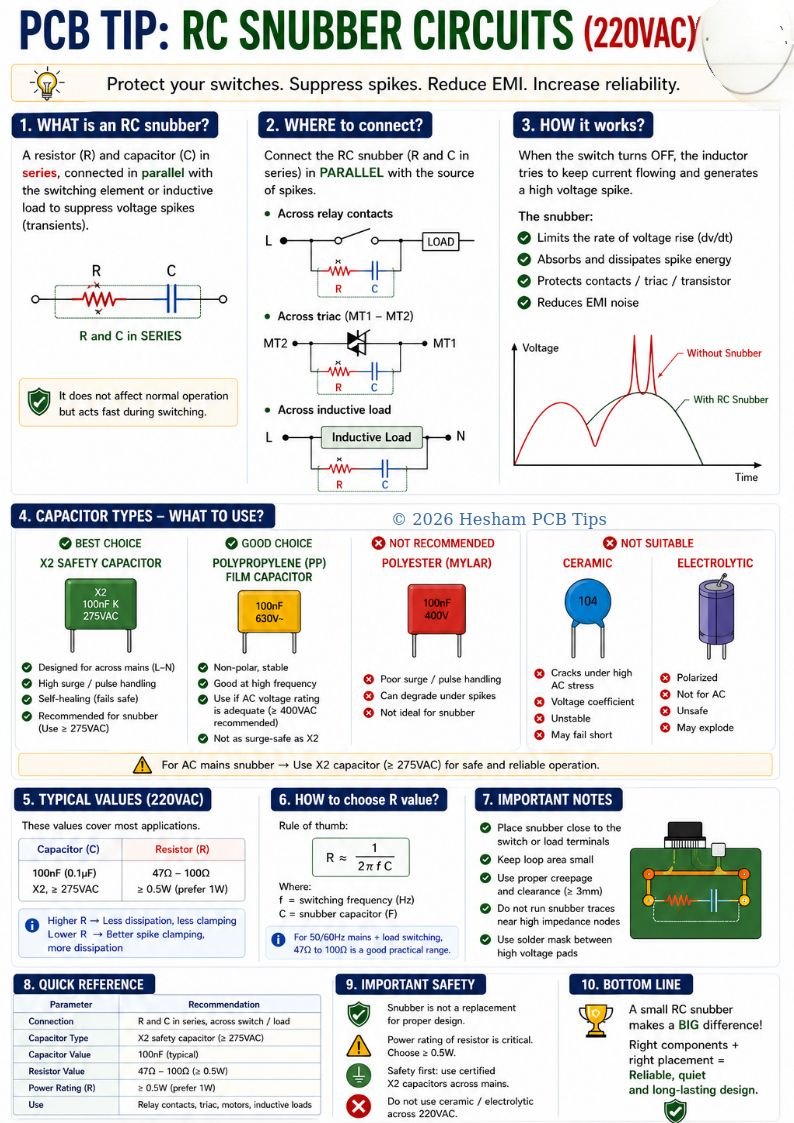
RC Snubber for 220VAC: Don’t Let the Wrong Capacitor Ruin Your Design ⚡ Switching AC loads (relays, triacs, motors)? Voltage spikes are unavoidable — but you can control them with a properly designed RC snubber. 👇 Here’s what you need to know: 🔹 What is an RC snubber? A resistor + capacitor in series, connected in parallel with the switching element or the inductive load. 🔹 Why use it? ✔️ Suppresses voltage spikes (transients) ✔️ Reduces arcing on relay contacts ✔️ Protects triacs & switches ✔️ Lowers EMI noise 🔹 Where to connect it? • Across relay contacts • Across triac (MT1–MT2) • Across inductive load (motor, solenoid, pump) 🔹 Capacitor type — this is critical ✅ Recommended: Polypropylene film capacitor (Class X2) → Rated ≥ 275VAC → Designed for across-mains use → High pulse handling + self-healing ⚠️ Acceptable (with caution): Non-X2 polypropylene → Must be properly rated for AC & pulses ❌ Not suitable: • Polyester (Mylar) — poor surge handling • Ceramic — can crack under AC stress • Electrolytic — polarized, unsafe on AC 🔹 Typical values (220VAC) • Capacitor: 100nF (0.1µF) X2 • Resistor: 47Ω – 100Ω (≥ 0.5W) 🔹 Pro tips ✔️ Place snubber close to the switching element ✔️ Respect creepage & clearance ✔️ Voltage rating alone isn’t enough — type matters 🎯 Bottom line: A snubber only works if you choose the right components. 👉 Stick with X2 polypropylene capacitors for safe, reliable designs. #PCBDesign #Electronics #HardwareTips #EmbeddedSystems #PowerElectronics110972.6K
Why are NPN transistors more widely used than PNP? While both NPN and PNP bipolar junction transistors (BJTs) are essential tools for engineers, NPN versions are significantly more popular. If you’ve spent any time looking at datasheets or schematics, you’ll notice they dominate the landscape. Based on insights from Electronics Notes, here are the three primary reasons why NPN is the go-to choice: 1. Faster Performance (Carrier Mobility) The biggest technical advantage comes down to physics. NPN transistors use electrons as their majority charge carriers, while PNP transistors rely on holes. • Electrons move much more freely and quickly through the crystal lattice of the silicon than holes do. • This higher "mobility" means NPN transistors can switch faster and provide better performance in high-frequency applications. 2. Standardized Negative Grounding In the world of electronics—from automotive systems to consumer gadgets—negative grounding has become the universal standard. • The polarity of NPN transistors is naturally compatible with negative ground configurations. • This makes them easier to integrate into standard circuit designs without needing complex power supply arrangements. 3. Lower Production Costs Manufacturing economics play a huge role. Most silicon-based components are most efficiently produced using large N-type silicon wafers. • Interestingly, producing a PNP transistor with equivalent performance to an NPN often requires nearly three times more surface area on the wafer. • Since wafer space is at a premium, this makes PNP transistors more expensive to manufacture, driving the industry toward the more cost-effective NPN alternative. The Bottom Line: While PNP transistors are still vital for specific tasks (like push-pull amplifiers or high-side switching), the NPN transistor's speed, compatibility, and cost-efficiency make it the undisputed heavyweight champion of the bipolar world. For more information, check out the link to my website in the comments. #Electronics #electroniccomponents #ElectricalEngineering #TechTips #Transistors #NPN #PNP #electronicsnotes64330612.8K
Beta Blocker on default settings is good. Set up properly, it's a different program. Here's every setting that matters for the best blocking on Windows: what it actually does, what I'd pick, and the one thing no setting can fix. Most of these apply the next time protection starts, so set them, then stop and start once. 1. Put your graphics card to work Settings > Performance > Use the graphics card. Turn it on. This is the biggest upgrade there is. Every check runs on your graphics card instead of your processor, so you get more checks a second and room for much higher detail. NVIDIA, AMD and Intel all work. On a laptop with two graphics chips, set Graphics card to the stronger one. Automatic already tries to pick it for you. 2. Let your PC know it matters To save power, Windows likes to hand programs the weaker chip. Stop it: Settings > System > Display > Graphics > Add desktop app > choose Beta Blocker > set GPU preference to High performance. NVIDIA users can also open NVIDIA Control Panel > Manage 3D settings > Program settings, add Beta Blocker, and set Power management mode to Prefer maximum performance. On a laptop, plug in the charger and set Settings > System > Power & battery > Power mode to Best performance. On battery, the graphics card slows right down. 3. Detail level (the big one) Settings > Detection > Detail level. Before every check, Beta Blocker makes a smaller copy of your screen. The detail level is how big that copy is: Battery saver: 320 pixels Lightweight: 480 Standard: 640 (where everyone starts) High accuracy: 800 Best accuracy: 1024 A bigger copy catches smaller and more distant things: thumbnails, people in the background, a face in the corner of a stream. Each check also takes longer. What I'd pick: Gaming PC with a decent graphics card: Use Best accuracy. It checks about 2.5 times as many pixels as Standard, and on an RTX 5080 the detector still takes only about 9 milliseconds per check. Mid-range card or a gaming laptop: High accuracy. No graphics card: Standard, or Lightweight if the fans get loud. The trade-off is real. Higher detail makes your graphics card work harder, so a laptop runs hotter and its battery goes faster. Battery saver and Lightweight also always use plain boxes, whatever Look you picked. 4. Strictness Settings > Detection > Strictness. Balanced is the default. Strict lowers how sure Beta Blocker needs to be and catches smaller, partly hidden things. Relaxed does the opposite and gives you fewer false alarms. If your goal is "nothing gets past", choose Strict. If harmless things keep getting blocked, go back to Balanced. Want finer control? Advanced detection lets you move each part on its own, from Much less to Much more. Blocking faces? Set Any face to More and leave everything else alone. 5. Frame rate: match your display Settings > Performance > Frame rate. "Match the detail level" gives you 60 a second on Best accuracy. If your display runs at 120 or 144 Hz and your graphics card is strong, set it to match. Blocks stay locked onto anything that moves, especially in games and fast video. Your PC caps the real rate, so going higher than it can handle does nothing. Step 8 shows you where that limit is. 6. Tracking and movement All in Settings > Performance: Tracking: keep Smooth. Blocks move with the picture between checks instead of jumping from one check to the next. Stretch with movement: keep it on. While something moves, its block grows a little in that direction, so no edge slips out. Follow scrolling: keep it on. Blocks move with the page as you scroll. Blur while scrolling: off by default, and the strongest setting for feeds. Scroll fast and the page blurs until you stop. Set Blur when to Any scrolling if you want every scroll covered. 7. Stop flicker If a block blinks on and off in a video, the detector missed a frame or two. Settings > Performance > Keep after a miss. Automatic works for most people. If you still see flicker, try 0.25 seconds. Only go up to 1 second if you need it: long holds can leave a block behind after the thing has gone. 8. Turn on the performance readout Settings > Performance > Show performance. It shows scans per second, scan time and graphics use in a corner of your display, and it's hidden from recordings. How to use it: if scans per second sit well below your frame rate, drop the detail level one step. If graphics use is low and everything is smooth, go one step higher. Two minutes of this and you've found the best setting for your exact PC. 9. Games Use Borderless or Windowed mode. Exclusive full screen can draw over the blocks. Keep the game on a protected display, or pick it under What to protect > One program. 10. Protect only what you need What to protect lets you choose your displays. Every protected display shares the same checks, so protecting one display instead of three gives that one display more checks a second. 11. Pick a Look that fits your PC Solid box costs almost nothing. Blur, mosaic, images and animated styles cost more. On a slower PC, a box keeps the checks fast. On a fast PC, use whatever you like. 12. What no setting can fix Your hardware, as you can expect the biggest limitation to Beta Blocker will be the strength of your components. A better PC will block in around 9ms, where as a slower one could be around 90ms. Both are faster than a blink but 90ms is alot more noticeable. The short version: Gaming PC: graphics card on, Use High performance in Windows, Best accuracy, Strict, frame rate matched to your display, Smooth tracking, Blur while scrolling on. Laptop with a graphics card: charger in, High performance, High accuracy, Strict, Match the detail level. No graphics card: Use Standard, Balanced, Solid box, one protected display. Set it once and it stays set. Beta Blocker remembers every one of these, so this is a one-time job.15721.2K50.5K
ForumElectrical.com@ForumEIectricalTypes of Sensors Used in Modern Industrial Automation Sensors are essential components of industrial automation systems. They detect physical parameters, monitor process conditions, and provide feedback signals to PLCs, control systems, and instrumentation devices for accurate monitoring and process control. 1. Inductive Proximity Sensor: Detects metallic objects without physical contact using an electromagnetic field. Commonly used for metal part detection and machine positioning. 2. Photoelectric Sensor: Detects objects using a transmitted, reflected, or interrupted light beam. Available in through-beam, retro-reflective, and diffuse-reflective configurations. 3. Capacitive Proximity Sensor: Detects both conductive and non-conductive materials, including plastics, powders, liquids, and granular substances, by sensing changes in capacitance. 4. Position Sensor: Measures the linear or angular displacement and position of moving components. Common types include potentiometric, LVDT, rotary encoder, and linear encoder sensors. 5. Vibration Sensor: Measures machine vibration, acceleration, velocity, or displacement to monitor equipment condition and identify potential mechanical faults in rotating machinery. 6. Level Sensor: Detects or measures the level of liquids and bulk solids in tanks, vessels, and silos. Common technologies include ultrasonic, radar, capacitive, and float-type sensors. 7. Pressure Sensor: Measures the pressure of gases and liquids and converts it into an electrical signal. For example, a 0–10 bar pressure transmitter can be used in pump and process control applications. 8. Load Cell: Converts applied mechanical force or weight into an electrical signal, commonly using strain-gauge technology. Used in industrial weighing systems, batching, and material handling. 9. Temperature Sensor: Measures process and equipment temperature for monitoring and automatic control. Common types include RTDs, thermocouples, thermistors, and infrared temperature sensors. Selecting the correct sensor depends on the measurement range, operating environment, accuracy, response time, sensing technology, and PLC interface requirements. #IndustrialAutomation #AutomationEngineering #PLCAutomation #IndustrialSensors #ProximitySensors #InductiveSensor #PhotoelectricSensor #CapacitiveSensor #PositionSensor #VibrationMonitoring #LevelMeasurement #PressureTransmitter #LoadCell #TemperatureSensor #ProcessInstrumentation #InstrumentationEngineering #MachineMonitoring #ProcessControl #IndustrialControlSystems #ManufacturingAutomation #ElectricalEngineering1181582.4K
Some real examples of deslopifying UI interactive components with the Transitions UI agent. Each example compares the same component, built in one shot or with at most one edit using coding agents with their default setup vs with the Transitions agent.201157925.8K
Microsoft says Windows 11 is now up to 20% more responsive on 8GB PCs, with multitasking up to 40% faster, and it has shared some impressive numbers showing how much RAM its latest optimizations can save! Here's what Microsoft says has improved: - 20% faster responses: Start, Search, right-click menus, Settings, Snipping Tool, and File Explorer. - 40% faster multitasking: In Microsoft's lab test involving 20 Edge tabs, a 4K video, large Office files, Outlook, and File Explorer on the same 8GB PC. - 2GB more active data in RAM: Better memory compression and management reduce the need to move data to slower storage. - 900MB less memory growth: Across Windows, Edge, and Microsoft 365 apps in a multitasking test, including 360MB in savings from Office apps. 200MB saved by Widgets: On PCs with 8GB RAM or less, Widgets now loads only when opened. 33% faster Edge launches: Windows can skip an unnecessary process when Edge is already running. Of course, these are Microsoft's own results under specific testing conditions, so your experience will vary. However, I observed similar performance gains in my own tests: I genuinely like where Windows 11 is heading. Microsoft is also optimizing WinUI 3, reducing unnecessary background work, and making Windows components share web engines to save RAM. If Microsoft can make Windows 11 noticeably faster on 8GB PCs without requiring more expensive hardware, I think it'll be one of the most useful improvements the OS has received in years!791549.5K
@framer@Framer just launched Agent-First Templates! I got early access and used it to build Basis, an entire UI kit made for Framer Agent. To celebrate the launch 🎉, I'm giving away 5 free copies (worth $129 each)! Instead of relying on prebuilt sections, Basis gives you native components, a complete design system, and dedicated Agent skills to build fully custom SaaS websites. To enter: - Like this post - Follow (so I can DM you) - Reply belowFramer @framerIntroducing Agent Templates, Marketplace templates built to work with the Framer agent. Each one ships with skills, a design system page, and a short video that shows how the pieces fit together. Read the full update and guide26350878

- Show more posts