One week left to apply to YC Winter '27!
YC founders get:
🔸 $500K in funding
🔸 $12M+ in tokens, credits & deals
🔸Partners who were founders first, and are in your corner for life
🔸 Access to the best founder community in the world
🔸 Demo Day in front of thousands of top investors
Apply by Nov 2:
I spent the last week in San Francisco meeting founders, CEOs, and people at the frontier of AI.
Some observations I thought were worth sharing:
1. There’s a massive AI gold rush, and everyone knows. I met founders from London, Berlin, Croatia, and a dozen other countries who flew in to raise money and find customers.
2. Founders are raising venture capital to build personal brands on Instagram, TikTok, and LinkedIn. If the product fails, they can promote other products or become full-time creators. Career insurance.
3. AI influencers are PRINTING money. I heard of creators with 100,000 followers making $1M a year. AI companies have more cash than channels, and nearly every tech and career influencer I know has pivoted to AI.
4. AI companies are sponsoring billboards, buses, cafes, and crazy parties. AI marketing spend is insane right now.
5. But standing out has never been harder. There are 100 CRMs, 100 event planning tools, and 100 AI SDRs. When anyone can build the product, branding and storytelling decide the winner.
6. B2A (business to agents) is the new B2B. Marketers now create content and design products to sell to agents. Have you ever read a blog post meant for agents? It’s a little dystopian.
7. Many founders have a doomer AI mindset: pessimistic about the future, optimistic about their company. The people closest to the technology are often the most paranoid.
8. Company “aura” is a hot topic. CEOs are obsessed with making their companies sexy enough to attract top talent. With more missionaries than mercenaries, the founder’s vision matters more than ever.
9. I met so many people stuck in the abyss: wealthy enough to be choosy about their careers, not wealthy enough to stop working. Most are figuring out what’s next in the AI world.
10. Everyone is selling data. It’s not unusual to hear of a founder selling their company’s Slack data for half a million dollars.
11. Startup creation is becoming a factory: Y Combinator, HF0, Founders Inc. I visited a Founders Inc demo day that felt like a high school science fair, but with companies instead of volcanoes. Some founders were 16 and had already raised venture money.
12. Hacker houses are booming because founders want to compress time. At one, founders gave themselves six months to hit product-market fit. They eat, sleep, and work in the same house.
13. The gap between SF and everywhere else keeps widening. People here are more AI-pilled than ever, yet most people outside tech hubs have never heard of Instinct.
14. SF might be the only place where saying you work at Google makes people question your judgment. As in, why aren’t you building something?
15. The new flex is tiny teams. Gamma does $100M+ in revenue with 50 employees ($2M per employee). Five years ago, headcount was the flex.
I love my trips to SF. Thank you to everyone who welcomed me and showed me around.
Happy to be back home.
See you soon!
"The best founders are worldbuilders. They are able to envision a future world that doesn’t exist yet and share the intense excitement of that vision with investors."
New essay:
NEW FOUNDER ARCHETYPES IN THE AI AGE
Solo founders
- Why: Solo founders can do 100x with AI, so they can ship a v1 when previously they couldn’t have before
- Why not: Maybe a team of cofounders still makes more progress. Maybe you can agentically code but someone still needs to do a million meetings with customers. Maybe coding was never the main bottleneck for startups in the first place?
Non-technical founders
- Why: There’s elite talent that comes from areas like finance, consulting, who can’t code but are passionate about business. There’s also folks in creative industries who create all day but just not in code. Now they can build
- Why not: Why not: Maybe AI makes it easier to build a prototype, but there’s still a big gap between a demo and a reliable product that can scale. If everyone can build the first version, maybe technical judgment becomes more important in deciding what to build, what’s actually possible, and how to stay ahead as the product gets more complex. (especially true for product categories like dev tools/etc)
Domain experts
- Why: A doctor who works at a hospital understands all the problems they face each day. A real estate broker really gets the subtleties of their markets, their clients. Same with a soldier, teacher, etc. What if they could use software to solve their own problems and build business along the way?
- Why not: Hoteliers didn’t create Airbnb and the finance industry didn’t create Kalshi. Sometimes you just need an outsider’s view in order to reinvent an industry, versus building incremental improvements
Kids, high schoolers, college students
- Why: Young people have already been building products early on. Start with a Minecraft mod, a Roblox game, a Discord bot, and suddenly you’ve learned how to make something that thousands of other people use. Now add AI, and a kid with an idea can build way more, way earlier
- Why not: Building something your friends love is very different from building a company. You still have to hire, raise money, manage people, and figure out how to make money. And maybe young founders have an advantage in consumer products because they understand their peers, but much less of one when it comes to enterprise software, healthcare, or other industries where experience and relationships really matter. Sometimes you just need domain expertise
Content creators
- Why: They’re already creating. So instead of creating videos, maybe the same skills can go into creating software. Plus, they have distribution. They know what their followers care about, how to get their attention, and how to reach them without paying for ads. In the past, turning that audience into a software product meant finding a technical cofounder or hiring a team. Now a creator could build and launch something themselves, and immediately put it in front of millions of potential users.
- Why not: Having followers helps with a spike of distribution, but building a sustainable growth engine is something else. The most valuable products aren’t memes - they are long-running, long-growing products that need to be endlessly tweaked and iterated on. Does the DNA work?
Cloudflare knew its AI model had less memory than it advertised. Its tests checked for a success code, and 155 answers carrying other customers' data came back with one. The tests never checked what those answers said.
#founders
One founder can do a lot in 70 days. Imagine a house full of them.
Introducing Assembly by The Founding Co.
A fully funded, live-in founder residency in Hyderabad.
Our first program brought 12 founders together. Since then, they've raised funding, grown their companies, and started making a dent in their industries.
Now we're opening the doors again. This time, for you and your co-founder to come and build something that lasts!
Apply Now.
If an investor remembered one thing about your startup, what would you want it to be?
Tomorrow, meet the founders behind the ideas at The Startup Club’s FinTech Investment Conference.
October 29 18:00 CET · Online
#StartupPitch#FinTech#Founders#TheStartupClub
Hey X, I’m Fauzan.
Ex VC-backed founder, now building @CoffeeSpaceApp, helping founders find cofounders and startups hire their first team.
Looking to connect with founders on here.
What did you do before your startup?
#startups#founders#buildinpublic#startuplife
I'm from Simikot, a village in the Himalayas (Nepal). I now run a YC-backed company.
Between those two facts, the closest thing I had to a startup education was Paul Graham's essays.
Here are the 10 that actually changed what I did, and the line from each that stuck:
1. Do Things That Don't Scale.
-> Our first users didn't find us. I onboarded them one by one, by hand. That's not a phase to rush. It's where you learn what to build.
2. Startups in 13 Sentences
-> The entire startup playbook on one index card. If you read only one of these, read this one.
3. Founder Mode.
-> Conventional advice says hire great people and get out of their way. PG's counter: the founders who win stay deeply hands-on, even at scale. It's why I wear the hat.
4. Startup = Growth.
-> A startup is a company built to grow fast. If it isn't growing, it's just a job you gave yourself.
5. Be Good.
-> The best growth hack is making something people genuinely need. Everything else is downstream of that.
6. Billionaires Build.
-> The founders who win aren't the smoothest talkers. They're the ones still shipping when no one is watching.
7. The Hardest Lessons for Startups to Learn.
-> Almost everything that feels like progress is a distraction from the only two things that matter: users and growth.
8. The 18 Mistakes That Kill Startups.
-> Most startups aren't killed. They quietly die by their own hand, through avoidable mistakes. Here's the list.
9. How to Convince Investors.
-> You don't win investors by being impressive. You win them by being formidable, and that comes from traction, not slides.
10. How to Get Startup Ideas.
-> Don't brainstorm in a room. Live at the edge of a problem and notice what's missing. The best ideas look like toys.
If you're early and overwhelmed, don't read all 200. Read these 10. They saved me years, all the way to building @laminalabs (fastest video infrastructure for LLMs).
Links to all 10 in the comments 👇
📌 Save this. Send it to a founder who needs it.
Let's go beyond "thank you," on #VeteransDay & talk about the unique experiences Veterans gain through service that prepare them for #startup life.
Check out these strengths that prepare Veterans to be #founders & early #startup employees ⬇️
Hi @X
Founder here 👋
Building
Looking to #connect with:
🚀 Founders
🛠️ Builders
🤖 AI SaaS creators
🌏 Brands going global
If that’s you, say hi 👋 Let’s connect 🤝
There’s a misconception that a successful launch video needs to cost tens of thousands of dollars and feel like a high production commercial. But @FarzaTV has a different approach.
Farza is the founder of @heyclicky and previously built Buildspace, one of the largest online schools for people working on their own ideas. He’s been making videos for over a decade, and today his posts regularly get millions of views. Rather than treating launches as rare, high-stakes moments, he’s made them part of the everyday process of building a company.
Farza sat down with YC’s @aaron_epstein to share his playbook for turning demos into stories people actually want to watch. He breaks down how he scripts videos that still feel off the cuff, why founders should launch constantly, and and how to figure out which channels actually convert.
01:44 — Launch Constantly
03:38 — Start Shipping Demos
05:02 — Show the Process
06:07 — The Clicky Launch
07:43 — Write a Hook That Stops the Scroll
10:30 — Why Farza Scripts Every Video
12:04 — Designing the First 10 Seconds
15:15 — Demo-Driven Development
17:25 — You Have to Take a Thousand Shots
20:48 — Farza’s Formula for Videos That Convert
23:01 — Turning Demos Into Stories
24:53 — Show What You're Actually Building
29:11 — Finding Customers on Social Media
31:02 — Which Platforms Actually Convert?
39:01 — Why Farza’s First Hire Was a Filmmaker
40:49 — The Video Stack
45:41 — The 30-Day Launch Challenge
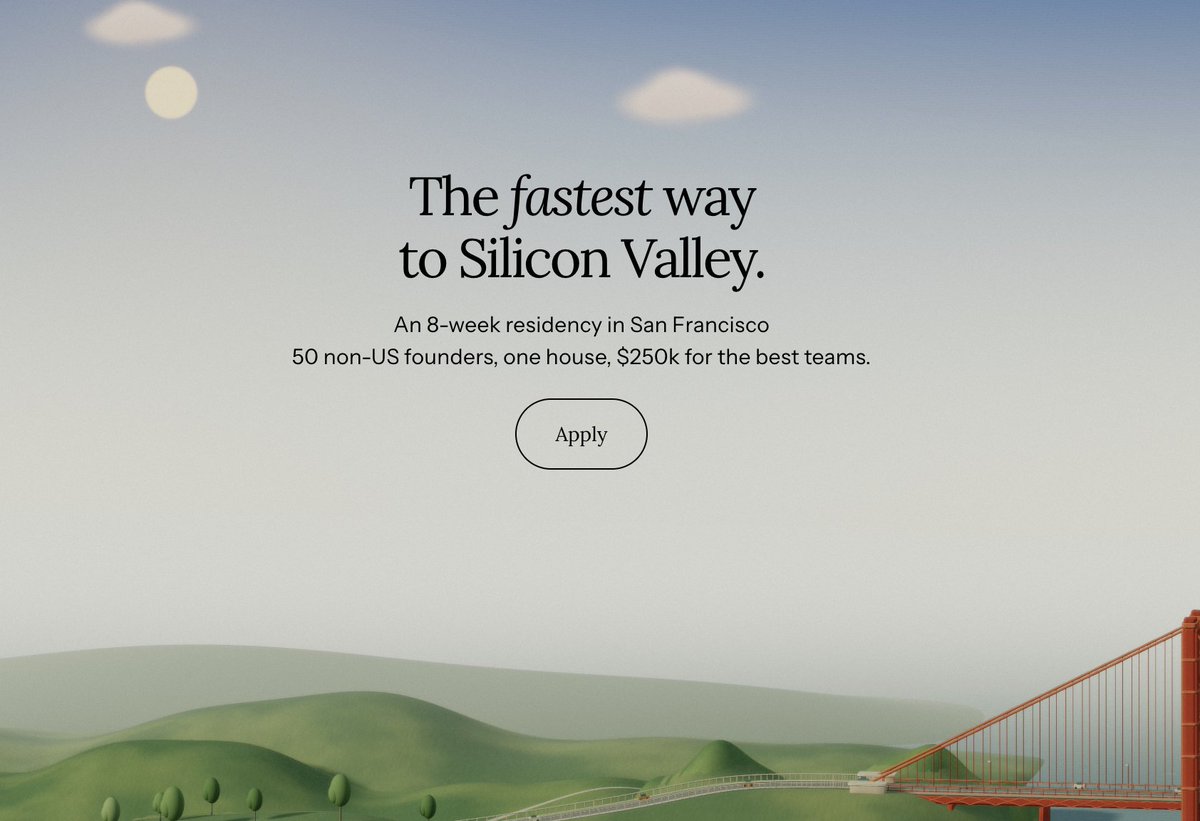
Non-US founder? This is your shortcut to Silicon Valley.
The Bridge is an 8-week residency in San Francisco.
• 50 non-US founders
• One house
• $250K for the best teams
• Free compute + a hardware lab
• Access to top Bay Area advisors and investors
• Three healthy meals a day
The best part: you can show up pre-idea and pre-team.
Most leave with a co-founder, a vision, first customers and a seed round.
It's part of Entrepreneur First, whose backers include the Collison brothers, Demis Hassabis, Reid Hoffman, Nat Friedman and Eric Schmidt.
You don't need to live in SF to build there.
You need 8 weeks.
Bookmark this + tag a founder outside the US.
Edison Partners is honored to be recognized by @Inc. Magazine as a 2026 Founder Friendly Investor. ⚡
This recognition celebrates investment firms that go beyond providing #capital to build #meaningfulpartnerships with #founders and support their companies through...
@X, help me connect with #founders, #marketers, and #product people building #AI startups
I'm Stakh, founder of Cargofy. We're building AI agents that run real logistics operations
Would love to meet more people building cool things here 👋
NYC, you showed up. 🗽
Thank you to the founders, investors, and AI leaders who joined us for Microsoft's AI Momentum: Fueling the Next Wave of Enterprise AI.
Special thanks to @betaworks, to our host Ayo Haruna, and to Bhaskar Lokanathan and the Microsoft for Startups technical team supporting founders every step of the way. 🙌
Watch the highlights 👇
A founder has two assumptions.
A: Customers will pay for the product.
B: The team can deliver it profitably.
Both are uncertain.
There's only enough money to test one first.
Which would you test: A or B?
#BusinessStrategy#founders