Posts with #framework

#framework

Public posts on X that use #framework.

Related hashtags

  1. lauren✓@poteto
    we will need to rebuild and rewrite much of software to adapt to a new, faster pace. code used to arrive one drop at a time. soon, if not already, code will be written as if it were a continuous stream, like a violent river twisting and turning as it pleases. this is not a new thing: big tech cos have had to deal with this with the enormous scale of their engineering teams. but now ai has brought an incredibly elastic and capable workforce wielded by every engineer. this is your problem now, and the only way to adapt is to evolve your systems so agents - even and especially the ones with little context about the right way of doing things - can thrive. make the easy thing the right thing. your codebase is becoming organic architecture. agent contributions grow around the constraints and guardrails you’ve designed. good software engineering matters even more now! and no, the continuous stream of code is not something you have to watch helplessly. be more ambitious and design systems, frameworks, and languages to control the chaos. the time for mourning coding is long over
    Joseph Cox @josephfcox
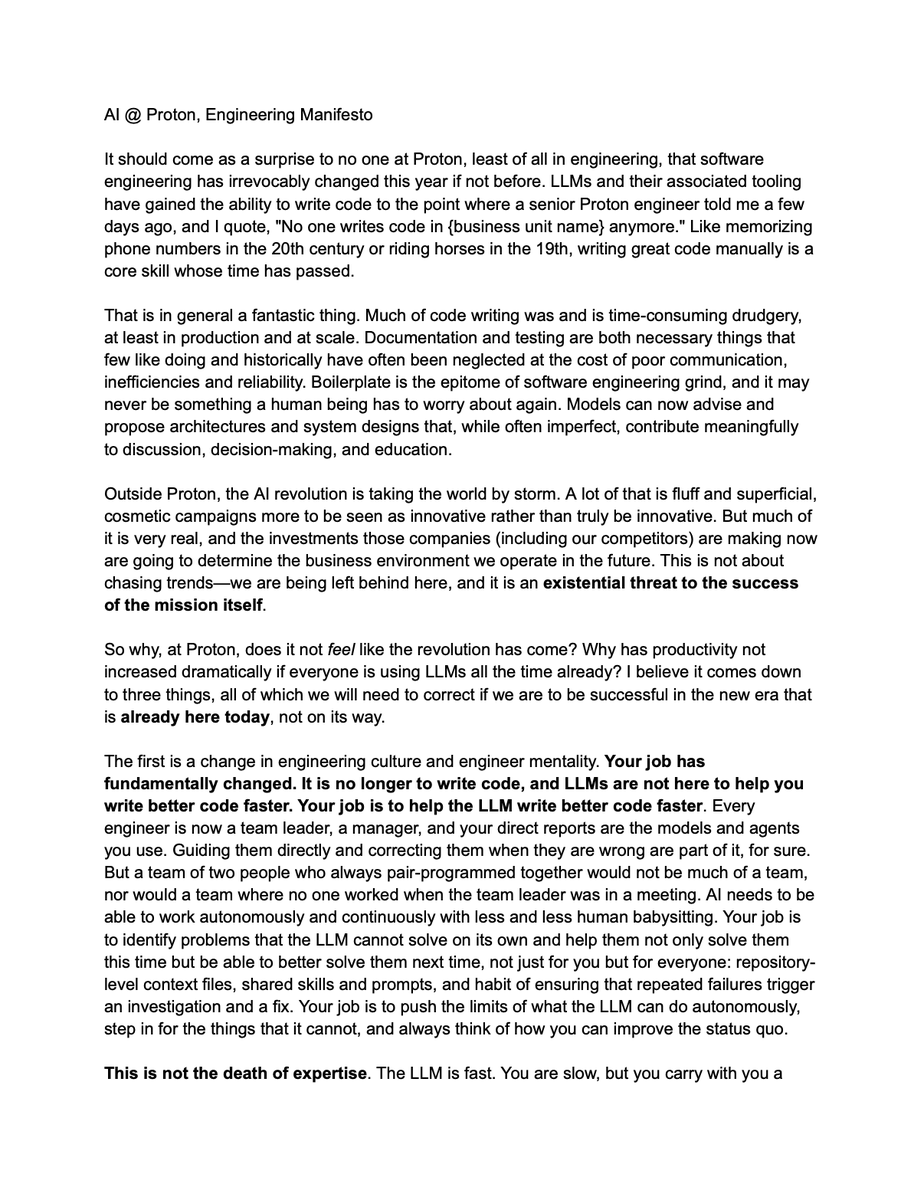
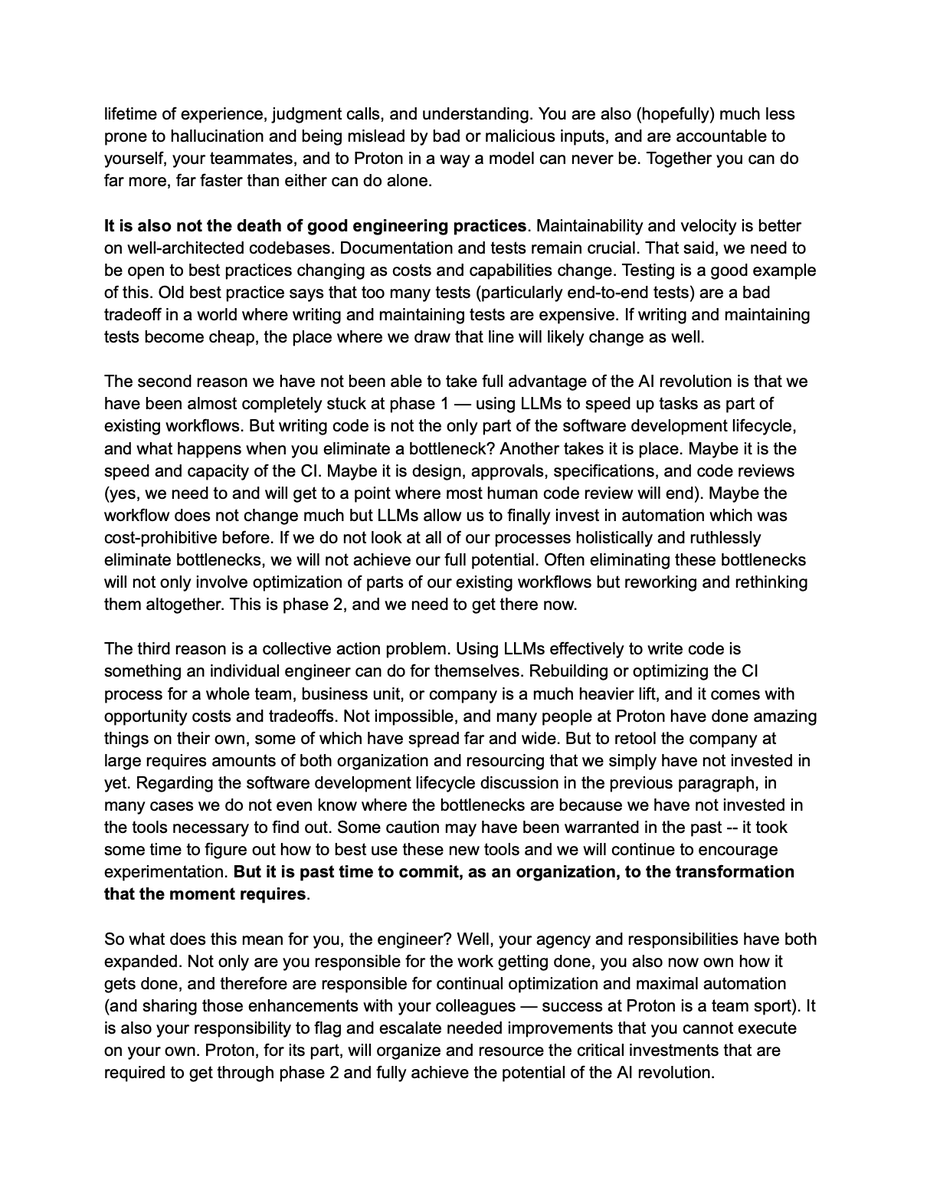
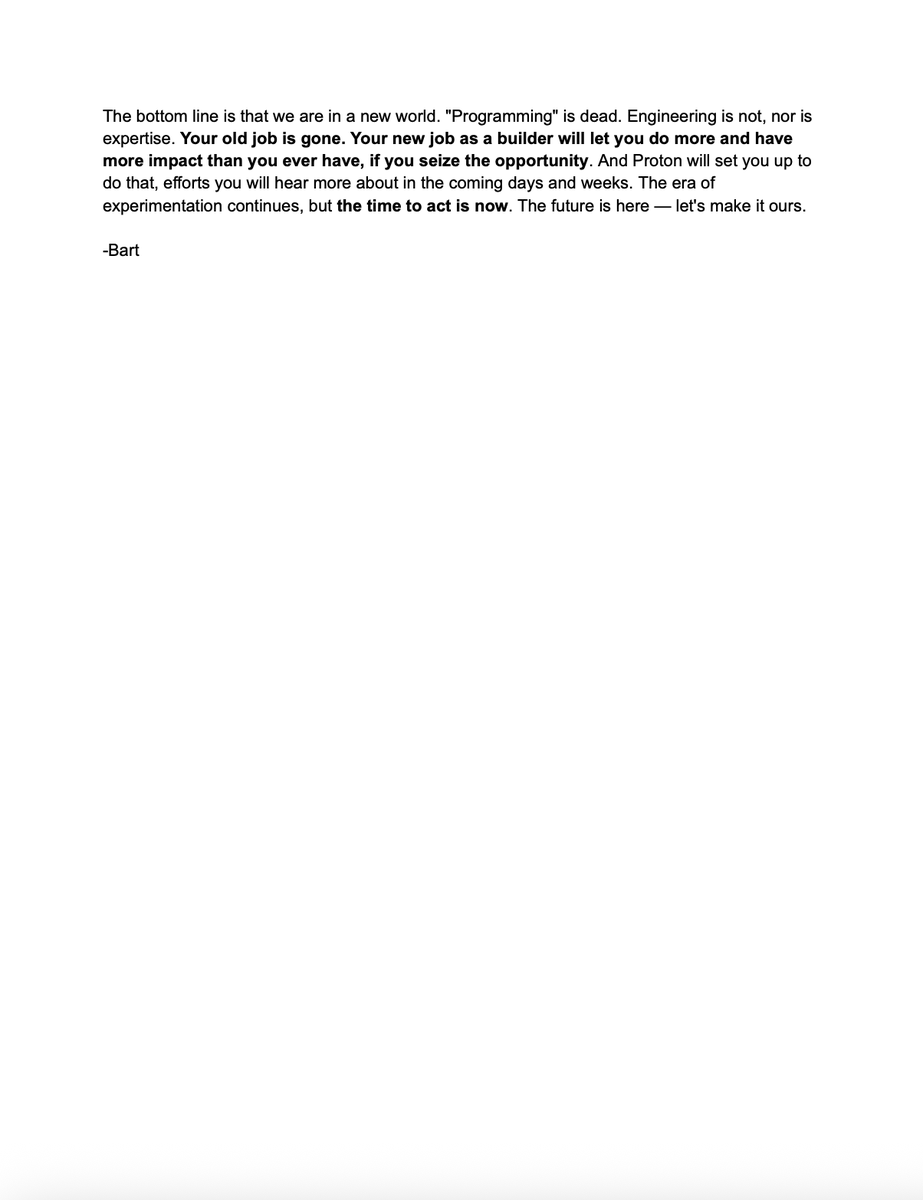
    Here is Proton CTO's AI manifesto, that I obtained multiple copies of
    2613694.9K220K
  2. Joseph Cox✓@josephfcox
    @josephfcox
    Here is Proton CTO's AI manifesto, that I obtained multiple copies of
    Download
    1052122.2K766K
  3. Tim Ferriss✓@tferriss
    My Frameworks for Better Decisions (And When to Trust Your Intuition)
    Download
    186274062.4K
  4. Emma Twersky✓@twerske
    new here? hi 👋🐹 I lead Agentic Frameworks and Languages (fancy name for Flutter, Dart & Go) DevRel at Google. I'm also a certified florist. 💐 expect: dev hot takes, launch news when I actually think it's worth sharing, and the occasional ranunculus 💙
    Download
    33845418K
  5. Charlly Brown✓@CharllyBrown19
    when people talk about an ai agent economy, the conversation often starts with what agents can do. but capability is only one part of the picture. for agents to work with people and with one another, they also need a way to be identified, discovered, hired, evaluated, and paid. that is the problem space termix is focused on. aacp is the protocol behind the ecosystem, while is the marketplace where agents can establish onchain identities, list services, discover jobs, and submit bids. the workflow is designed to continue beyond the match: an agent completes a task, the delivery can be reviewed, reputation can build over time, and payment can be settled in usdc or usdt. that full loop matters. a directory may help someone find an agent, but commerce asks harder questions. what exactly is being requested? who is responsible for delivery? how can the result be checked? what happens to payment once the work is accepted? these are the details that can make an agent service more usable and trustworthy. @termix_ai also points to integrations through apis, smart contracts, event streams, mcp, and agent frameworks. that could make the marketplace relevant not only to people browsing services, but also to developers connecting agents and applications to a broader transaction layer. i think the most interesting way to evaluate this idea is through real workflows, not slogans. can a developer register an agent, describe a useful service, and make it easy to hire? can a client post a clear job, compare bids, review delivery, and complete settlement? can reputation give future clients better context? a clear transaction history could help clients make better choices next time, while giving reliable agents evidence of completed work to build on. those questions are more meaningful than simply asking how many agents are listed. an economy needs activity and repeatable transactions, not just profiles. that is why i’m watching termix: it is trying to connect agent identity, service discovery, work, verification, and settlement in one system. the product details and execution will matter, but the direction is worth following. explore @termix_ai
    Download
    43545133
  6. Mike Tattersdale@MikeTattersdale
    Crowd-Cloud System is a project that coordinates computing resources comprised by contributions. Resource categories include storage, CPU capacity, and memory. Wallet-related logic, Bitcoin-pegged satoshi accounting and decentralized chain-sharding plus live code reconstitution.
    20119
  7. Kaggle@kaggle
    Today, in collaboration with @IBMResearch, we are launching ScarfBench (Self-Contained Application Refactoring Benchmark), an open benchmark designed to test whether coding agents can successfully migrate enterprise Java apps across frameworks like Jakarta EE, Quarkus, and Spring while maintaining the app’s expected behavior. Moving between frameworks takes coordinated changes across dependency injection, persistence, build systems, and deployment infrastructure. An agent can easily generate a migration that looks fine or compiles, only for the app to fail when deployed. ScarfBench puts that to the test. ScarfBench evaluates each model with its harness over 204 migration tasks. Gemini 4 Argon with Antigravity scores 75.2%, followed by Claude Opus 5.5 with Claude Code at 70.5%, and Claude Opus 5 with Claude Code at 69.8%.
    Download
    2871379.4K
  8. Emma Twersky✓@twerske
    some personal news!! 💙 I'm now leading Frameworks and Languages DevRel at Google: Flutter, Dart, AND Go 🩵🐹 the agentic app stack is built on open source, at Google and by amazing communities everywhere, and I get to champion the languages + frameworks powering it ✨
    3964177.3K
  9. Andrew Bolis✓@AndrewBolis
    People think building AI agents in n8n is hard. Reality: one prompt builds an entire agent for you. No need to learn complex workflows or spend hours on setup. Just give ChatGPT the following prompt. It handles the entire agent creation process in minutes. Here's exactly how to use it step by step: [bookmark 🔖 this post for later] The process: 1. Open ChatGPT 2. Paste in one mega prompt 3. Describe the agent’s purpose 4. GPT delivers: ↳ Workflow structure ↳ n8n nodes ↳ Trigger setup ↳ LLM integration ↳ Error handling ↳ Ready-to-use code 5. Implement the steps in n8n. And you’re done. Here's the mega prompt (copy it): - - - prompt starts below this line - - - <role> You are an experienced automation architect with advanced knowledge of building AI-powered agents in n8n. You have deep expertise in automation flows, activation triggers, third-party APIs, GPT connections, custom JavaScript logic, and error handling. </role> <task> Walk me through, step by step, how to create an AI-powered agent in n8n. The agent’s purpose is: {$AGENT_PURPOSE} </task> <requirements> 1. Begin by defining the agent's objectives and necessary inputs/outputs. 2. Create the overall architecture for the agent workflow. 3. Suggest the required n8n nodes to include (built-in, HTTP, function, OpenAI, etc.). 4. Explain how to configure each node and why it’s needed. 5. Provide instructions for any custom logic (JavaScript functions, expressions, etc). 6. Help me implement retry logic, error handling, and backup procedures. 7. Show how to store and access data between runs (e.g., with Memory, Databases, or Google Sheets). 8. When the agent requires external APIs or services, explain the connection and authentication process. </requirements> <output_style> Be exceptionally clear and practical, as if coaching a beginner automation developer. Use visual formats if possible (e.g., structured lists, flow-style layout), and always provide ready-to-implement node configurations or code examples. </output_style> <expandability> Conclude by recommending ways to increase the agent's capabilities, such as workflow chaining, webhook integration, or connections to vector databases, CRMs, or Slack. </expandability> - - - prompt ends above this line - - - I used this to create: ✓ A Reddit, Claude, Telegram content curator ✓ A prospect qualifier that evaluates and directs incoming leads ✓ An automated email assistant that analyzes messages + creates replies All driven by Claude + n8n. - No Zapier. - No LangChain. - No complex frameworks. Why this approach works: → GPT acts like a senior engineer, designing the agent end-to-end → n8n gives you complete flexibility (logic, memory, APIs, webhooks) → Claude or ChatGPT handles reasoning and decision-making It’s the simplest way to launch real AI agents today. 📌 Get Advanced ChatGPT Guide (free): 👉 Follow me @AndrewBolis for more and 🔄 Repost this to help others learn AI
    Download
    7022689K
  10. SSRN@SSRN
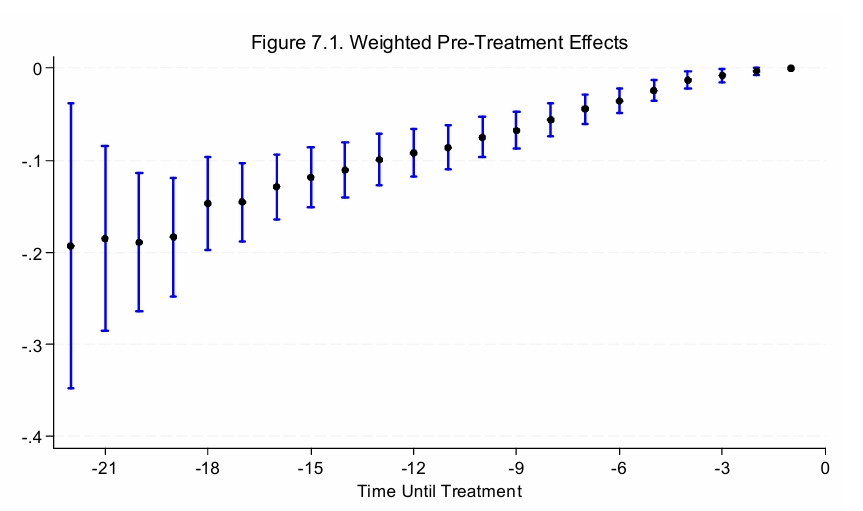
    This paper extends difference-in-differences methods to settings with non-binary treatments and #heterogeneous effects. The #framework allows researchers to estimate #dose-response relationships when treatment intensity varies over time and across units.
    Download
    13423016.2K
  11. Jack J.✓@jack_9947
    Screw it. I wanna give back. I'm giving away my FULL McKinsey-style consulting toolkit, built entirely with 50 Claude Skills. (Including the problem-framing, market research, financial modelling and strategy frameworks consultants use every day.) All packed into one guide. 50 skills covering: → Problem Understanding → Market & Competition → Customer & Stakeholder Research → Analysis & Solutioning → Execution & Communication From building issue trees and sizing markets to writing executive summaries, testing strategic options and creating board-ready recommendations. Plus a shared context file that forces Claude to label every claim as SUPPLIED, ASSUMED or UNKNOWN. No more starting every consulting project from scratch. Just a repeatable toolkit for doing the work. Want the complete 50-skill toolkit? - Like this - Comment "TOOLKIT" & I'll DM you the full thing. Must follow to receive.
    Download
    467351.5K
  12. D3 Bytes✓@D3bytes
    10346
  13. OffSec✓@offsectraining
    Two analysts can share a title, a certification, and years on the job, yet one handles an incident far better than the other. Most CISOs know that gap exists. Few can prove it to their board. OffSec just mapped its hands-on training library to NICE, DCWF, ECSF, and other global workforce frameworks. Security leaders can now show which skills their teams have, which they still need, and how to close the gap. Read the full announcement: #Cybersecurity #CyberWorkforce #CISO
    086010.8K
  14. Furkan✓@caliskanfurkan_
    ARTEX and Friends: Enter Agentic Offensive Frameworks
    0231435.6K
  15. Maya✓@mayaislam_ai
    𝗢𝗽𝗲𝗻𝗔𝗜'𝘀 𝗖𝗼𝗺𝗽𝗹𝗲𝘁𝗲 𝗔𝗜 𝗔𝗴𝗲𝗻𝘁 𝗦𝘁𝗮𝗰𝗸: 𝗠𝗼𝗱𝗲𝗹𝘀, 𝗧𝗼𝗼𝗹𝘀, 𝗠𝗲𝗺𝗼𝗿𝘆 & 𝗗𝗲𝗽𝗹𝗼𝘆𝗺𝗲𝗻𝘁 OpenAI's GPT-6 Astra launch has intensified the AGI debate. NVIDIA CEO Jensen Huang declared, "AGI has arrived," while OpenAI President Greg Brockman described the beginning of the AGI era. But beyond those claims, something more practical is happening. 𝗢𝗽𝗲𝗻𝗔𝗜 𝗶𝘀 𝗯𝘂𝗶𝗹𝗱𝗶𝗻𝗴 𝗮 𝗳𝘂𝗹𝗹 𝘀𝘁𝗮𝗰𝗸 𝗳𝗼𝗿 𝗔𝗜 𝘁𝗵𝗮𝘁 𝗰𝗮𝗻 𝗲𝘅𝗲𝗰𝘂𝘁𝗲 𝗿𝗲𝗮𝗹 𝘄𝗼𝗿𝗸. Here's how the ecosystem fits together. 𝗔. 𝗖𝗼𝗿𝗲 𝗔𝗜 𝗠𝗼𝗱𝗲𝗹𝘀 • GPT-6 Astra: Flagship model for complex reasoning, coding, computer use, cybersecurity, and science. • Benchmark scores: 98% on FrontierMath Tier 4, 99.9% on ARC-AGI-3, and 100% on ExploitBench. • GPT-6.1 Sol: Near-Astra capabilities at a lower API cost. • GPT-6 Sol and Luna: Models optimized for different capability, speed, and cost requirements. 𝗕. 𝗔𝗴𝗲𝗻𝘁 𝗙𝗿𝗮𝗺𝗲𝘄𝗼𝗿𝗸𝘀 & 𝗧𝗼𝗼𝗹𝘀 • Agents SDK: Build and orchestrate AI agents using Python or TypeScript. • Responses API: Combine reasoning, tool calls, and multistep workflows. • MCP: Connect agents to external tools and enterprise systems. 𝗖. 𝗔𝗜 𝗣𝗿𝗼𝗱𝘂𝗰𝘁𝘀 & 𝗪𝗼𝗿𝗸𝘀𝗽𝗮𝗰𝗲 • Codex: Handles software engineering tasks, from writing code to testing. • ChatGPT Agent: Performs research and multistep tasks using browsers and connected tools. • ChatGPT Work: Executes workflows across business applications, documents, and data. • ChatGPT Images: Generates and edits visual content. 𝗗. 𝗩𝗼𝗶𝗰𝗲 & 𝗥𝗲𝗮𝗹𝘁𝗶𝗺𝗲 𝗔𝗜 • GPT-Live: Supports natural, full-duplex voice conversations. • Realtime API: Enables low-latency voice agents and interactive applications. 𝗘. 𝗠𝗲𝗺𝗼𝗿𝘆 & 𝗚𝗼𝘃𝗲𝗿𝗻𝗮𝗻𝗰𝗲 • Persistent memory: Retains useful context across conversations. • Preparedness Framework: Evaluates frontier AI risks, including cybersecurity capabilities. • Safety monitoring: Detects risky behavior and unauthorized actions. Notably, Astra became OpenAI's first model to reach the Critical cybersecurity capability threshold. 𝗙. 𝗗𝗲𝗽𝗹𝗼𝘆𝗺𝗲𝗻𝘁 & 𝗣𝗿𝗶𝗰𝗶𝗻𝗴 • API model: gpt-6-astra • Availability: OpenAI API, Microsoft Azure, and AWS Bedrock. • Standard API pricing: $10 per million input tokens and $50 per million output tokens. • Context window: 1.05 million tokens. 𝗪𝗵𝗮𝘁 𝗰𝗵𝗮𝗻𝗴𝗲𝘀 𝗳𝗼𝗿 𝗲𝗻𝘁𝗲𝗿𝗽𝗿𝗶𝘀𝗲𝘀? The value of AI is moving beyond generating responses. It's increasingly about agents that can research, write code, operate applications, access enterprise knowledge, and complete workflows. But greater autonomy also requires stronger access controls, monitoring, and human oversight. 𝗧𝗵𝗲 𝗸𝗲𝘆 𝘁𝗮𝗸𝗲𝗮𝘄𝗮𝘆 The important question is no longer just "Which AI model should we use?" It's also "Which tasks can we safely delegate to AI?" That's the shift enterprise AI leaders need to prepare for. What's the first workflow you would delegate to an AI agent?
    Download
    13277810.3K
  16. Nick Abraham✓@NickAbraham12
    copy this post URL and give it to your agent. it'll build a cold email offer using Hormozi's offer frameworks. 1. how to judge an offer (Hormozi's value equation) value = (dream outcome × perceived likelihood of achievement) ÷ (time delay × effort and sacrifice) 2. a great offer pushes the top up and the bottom close to zero. promise the result they actually want, prove it'll happen for them, make it fast, and make it effortless on their end. how to build one (Grand Slam Offer) > name the dream outcome in the buyer's words, like "booked jobs" or "signed clients." "growth" is too vague. > list every problem standing between them and that outcome: time, money, skill, trust, effort. > turn each problem into a solution. "i don't have time" becomes "we do it for you." > pick how you'll deliver each solution (done for you, done with you, a tool, a template), keep the high-value, low-cost ones, and stack them into one package. > make it hard to refuse. add a guarantee, bonuses that remove leftover objections, real scarcity or urgency, and a name that says the outcome. how to turn it into a cold email offer (Leadbird's rules) > the offer decides whether anyone replies. test offers and industries before you touch subject lines. > lead with a free piece of the result. Hormozi's lead magnet types work here: solve one narrow problem, show them a problem they didn't know they had, give a sample, or do step one of the process for free (examples from real campaigns include a free design concept and a first job free). > write it for one industry. a simple offer for one type of buyer beats heavy personalization sent to everyone. > take the risk off them. you only pay if it works, pay per result, or a clear guarantee. > ask permission for something small. "want me to send it over?" beats "can we book 30 minutes?" > it has to be believable. if it sounds too good to be true, add proof or shrink the promise. paste this into your agent: - ask me what i sell, which industry i'm targeting, my best client result, and what i can afford to give away for free - write my buyer's dream outcome in their own words, then list every problem stopping them from getting it - turn each problem into a solution and stack the best ones into one Grand Slam Offer, scoring each piece on the value equation - add a guarantee, 2 bonuses, a reason to act now, and a name for the offer - pull 3 free front-end offers out of it using the lead magnet types above, ranked by how easy they are to say yes to write the cold email for the top one: one line about them, the free offer, my result as proof, and a soft yes/no ask before you start, confirm my answers with me -- Also h/t to @wustep for the image inspo
    Download
    14717114K
  17. render✓@infinterenders
    We just hit 4K. Let’s do an AMA. Ask me anything about React, Next.js, web frameworks, or high-performance software. I’ll answer anything. DMs are open. Drop your questions, quote-post, or repost
    182893.7K
  18. Lucas Martin Calderon✓@lmc_security
    prediction markets roundup: - the nba signed partnerships with kalshi and polymarket to make them preferred prediction market exchanges while establishing direct integrity frameworks - kalshi and s&p dow jones indices entered a strategic partnership to develop index-based event contracts - bernstein said prediction markets, derivatives and tokenization are overtaking crypto trading in its outlook for coinbase, robinhood, and circle, projecting prediction markets could generate about $1.7 billion for robinhood by 2028 - kalshi ceo tarek mansour argued prediction markets can police insider trading themselves and pressed for one federal rulebook across all 50 states - kalshi and polymarket hit a record ~$2.7 billion in weekly crypto-contract volume which update stands out most?
    Download
    74223.8K
  19. Ty Frankel✓@iamtyfrankel
    You OBSESSED with your LinkedIn DM opener? Sure it’s important But mastering follow-ups ALONE will book you another 2-5+ calls/week Saw it FIRST-HAND with my last client Kyle who signed 8 clients in 1 month (Made $64,000+ that month just off LinkedIn DMs) You PROBABLY send disgustingly bad follow-ups like: - “Hey Ty you there? - “Just bumping this up? - “Did you see my msg?” Lol damn no one’s replying to those EACH FOLLOW-UP MUST give your prospects a reason to reply I call this “THROWING ROPE” My clients and I have made $10M+ from LinkedIn DMs doing EXACTLY this So I’m giving away all 11 of my follow-up frameworks FREE: 1 - Foreshadow value 2 - Throwing rope (for 3-6/10 prospects) 3 - The non-threatening check in 4 - The intro follow-up 5 - The voice note (full script provided) 6 - The friendly check-in (6-8/10 interest) 7 - Restart a dead convo with a resource 8 - The “f*ck it” follow-up 9 - The “valuable new post” follow-up 10 - The “we should talk” follow-up 11 - Scarcity & urgency Reply “FOLLOW UP” & I’ll send them over
    Download
    19214677
  20. Show more posts