Kellan Grenier✓

@kellangrenier

Co-founder @Parcl || Best ball strategist @underdog || Advisor @Streamex & @stockcropper || Former pod 🐒 || Semis by training 💾

  • Joined
3.9K Following3.6K Followers6.1K Posts
  1. Kellan Grenier✓@kellangrenier
    The federal government couldn't be more emphatically telling the world that 1) the only way out of $40T in debt is via AI-driven GDP growth and 2) they're still going to monetize the hell out of it via dollar debasement
    Download
    312415.8K
  2. Kellan Grenier✓@kellangrenier
    🤠
    Download
    Will Manidis @WillManidis
    The benefits of abundant intelligence will accrue far outside of San Fransisco. Spent the last year writing about capital, sovereignty, and the coming reordering of economic power. THE COMMANDING HEIGHTS
    001145
  3. Will Manidis✓@WillManidis
    The benefits of abundant intelligence will accrue far outside of San Fransisco. Spent the last year writing about capital, sovereignty, and the coming reordering of economic power. THE COMMANDING HEIGHTS
    Download
    2433984.4K722K
  4. Kellan Grenier✓@kellangrenier
    Kellan Grenier
    RT @hosseeb: This is how banks are planning to stop those "agentic bank runs." Watch closely: their business model depends on seeding this narrative that AI agents are dangerous. Remember, an "agentic bank run" (coined by Apollo) means agents helping customers move their own money en masse to higher-yielding products. Once agents are ubiquitous, there are only a few ways for banks to hold onto cheap retail deposits. Option A: Raise APYs (lol no) Option B: Reduce leverage via fewer loans (no fun) Option C: Ban AI agents, claiming they are a security risk (ding ding ding) Cloud agents like Muse and Dot are trivial to stop, since they come from Meta / OAI IP ranges. If JPM sends them a cease and desist, they will comply. Why would JPM bother? Because their business model depends on it; a huge portion of their ROE comes from cheap retail deposits. This is not theoretical. Just like Amazon banned Muse from shopping there to protect their ad revenue, JPM and Schwab have already banned AI agents to protect sticky deposits. Are agents perfectly reliable today? Of course not. But look at the fix they chose. Not "here's a safe API for agents," it's "no agents ever." That tells you they're not protecting customers, they're protecting themselves. No company ever wins a technological revolution this way. It's the last gasp of a dying business model. It's like the retailers who refused to put their inventory online and demanded users walk into the storefront. Over time they will lose market share to those platforms that embrace what's coming. Their whole deposit franchise depends on users unthinkingly clicking through walls of T&Cs and accepting 0.2% when the risk free rate is closer to 4%. Agents read the fine print and do their research, even when humans don't. For users, the answer is simple: local AI agent frameworks like Hermes, that will actually act on your behalf and that the banks can't block. As the article says, if the agent is running on your own computer, they can't actually tell it's not you.
    Madison Mills @MadisonMills22
    SCOOP: Major U.S. banks are detecting unauthorized third-party AI agents inside customer accounts, including some attempting to take actions that appear to be independent of user instructions, sources told Axios. The findings have alarmed banking executives, who are racing to restrict access to their systems as AI moves at a velocity faster than financial institutions can respond, multiple industry and bank executives told Axios. Several banks are now preparing for worst-case and even “day after” scenarios, including how to rapidly secure or restore customer accounts if things go wrong, the people said. Several bank executives told Axios they're struggling to distinguish between human users and AI agents. One executive said banks also struggle to determine whether agents are authorized by customers or potentially operating without their permission, more akin to rogue agent behavior. Read my latest for Axios here:
    0140039
  5. Madison Mills✓@MadisonMills22
    SCOOP: Major U.S. banks are detecting unauthorized third-party AI agents inside customer accounts, including some attempting to take actions that appear to be independent of user instructions, sources told Axios. The findings have alarmed banking executives, who are racing to restrict access to their systems as AI moves at a velocity faster than financial institutions can respond, multiple industry and bank executives told Axios. Several banks are now preparing for worst-case and even “day after” scenarios, including how to rapidly secure or restore customer accounts if things go wrong, the people said. Several bank executives told Axios they're struggling to distinguish between human users and AI agents. One executive said banks also struggle to determine whether agents are authorized by customers or potentially operating without their permission, more akin to rogue agent behavior. Read my latest for Axios here:
    1.4K6.9K19.1K9.1M
  6. Kellan Grenier✓@kellangrenier
    Kellan Grenier
    RT @kellangrenier: Don is a legend & spot on. This was a must listen podcast. IMO Compute futures (aggregate compute cost, specific popular GPU pricing, and LLM token pricing to name a few likely contracts) are prob the largest emerging financial market opportunity on earth. Some thoughts…
    Don Wilson @drwconvexity
    Really enjoyed being back on Odd Lots with @TheStalwart and @tracyalloway. Would indeed have been fun to debate perps with Terry Duffy. We clearly have different views… Following my prediction on last year's recording that in 10 years compute will be bigger than oil, this year I revealed the name we use at DRW for the profit margin between tokens and GPUs: the crunch spread. Oil into fuel: crack spread. Soybeans into meal and oil: crush spread. Nat gas into power: spark spread. As with those markets, futures on both the GPU hours and tokens eventually will let you trade—and hedge—the crunch. Listen to Odd Lots on Spotify: Listen to Odd Lots on YouTube: Listen to Odd Lots on Apple Podcasts:
    020767
  7. Don Wilson✓@drwconvexity
    Really enjoyed being back on Odd Lots with @TheStalwart and @tracyalloway. Would indeed have been fun to debate perps with Terry Duffy. We clearly have different views… Following my prediction on last year's recording that in 10 years compute will be bigger than oil, this year I revealed the name we use at DRW for the profit margin between tokens and GPUs: the crunch spread. Oil into fuel: crack spread. Soybeans into meal and oil: crush spread. Nat gas into power: spark spread. As with those markets, futures on both the GPU hours and tokens eventually will let you trade—and hedge—the crunch. Listen to Odd Lots on Spotify: Listen to Odd Lots on YouTube: Listen to Odd Lots on Apple Podcasts:
    82424140.2K
  8. Kellan Grenier✓@kellangrenier
    Posts @kellangrenier
    Shot ^ Chaser 👇 (Yes, these are highly related topics)
    Joe Weisenthal @TheStalwart
    MAYBE I WAS WRONG ABOUT BLOCKCHAIN TECHNOLOGY I wrote about how I always used to make fun of the guys who said things like "Bitcoin is speculative, but the underlying blockchain technology is interesting." And now I think maybe they kinda had a point.
    20183
  9. Joe Weisenthal✓@TheStalwart
    MAYBE I WAS WRONG ABOUT BLOCKCHAIN TECHNOLOGY I wrote about how I always used to make fun of the guys who said things like "Bitcoin is speculative, but the underlying blockchain technology is interesting." And now I think maybe they kinda had a point.
    Download
    4223653.6K717K
  10. Kellan Grenier✓@kellangrenier
    Posts @kellangrenier
    Preach, Don
    Don Wilson @drwconvexity
    Delaying compute futures has a real cost for US innovation. Some of the largest data center lenders have hit their risk limits. Give them a liquid market to hedge compute price risk and they can free up lending capacity. It's the lack of a hedging instrument that has caused credit spreads to blow out. We support the @CFTC’s commitment to getting this right. The good news is we already have standards for building these markets properly: independent benchmarks, transparent methodologies and regulatory access to the underlying data. Apply them to compute and let well-designed futures move forward. Our comment letter:
    00049
  11. Don Wilson✓@drwconvexity
    Delaying compute futures has a real cost for US innovation. Some of the largest data center lenders have hit their risk limits. Give them a liquid market to hedge compute price risk and they can free up lending capacity. It's the lack of a hedging instrument that has caused credit spreads to blow out. We support the @CFTC’s commitment to getting this right. The good news is we already have standards for building these markets properly: independent benchmarks, transparent methodologies and regulatory access to the underlying data. Apply them to compute and let well-designed futures move forward. Our comment letter:
    164026839.7K
  12. Kellan Grenier✓@kellangrenier
    Kellan Grenier
    RT @micsolana: liz warren: we’re gonna stop the mayonnaise company from buying a hot sauce company elon musk:
    Download
    04.2K042
  13. Kellan Grenier✓@kellangrenier
    Kellan Grenier
    RT @jasonlewris: I found a pattern in the housing market that I can’t explain. Since 2019, anonymous LLCs new to the housing market have been buying a growing share of homes near 75 research and development facilities across the United States, almost always with cash. The sites include semiconductor fabs, space and aerospace defense centers, and the labs behind nuclear research and deterrence. The trend reached its high in 2025. Who are these buyers? In 2024 through September 2026, they made 4,264 home purchases within 5 miles of research facilities. Of those buyers: 96% had made their first recorded home purchase within the previous six months. 88% paid all cash. 68% use numbered or otherwise opaque LLC names. The kicker? Many of these owners own separate properties surrounding different R&D facilities hundreds to thousands of miles apart. How much more common is this near R&D sites? In 2024-26, anonymous LLCs made 1.33% of home purchases within five miles of a research facility. That compares with 0.84% near major military bases and 1.03% across the broader market. That makes this buying 1.6 times as common near research facilities as near military bases and 1.3 times the broader market. 1.33% may seem small, and on a proportional basis it is. But this is a needle in a haystack problem - large, splashy moves get noticed (remember Texas farmland acquisitions near Air Force bases?). Near these R&D facilities, the share has risen faster than in the surrounding area, and that rise is unlikely to be chance when compared with matched control locations (p = 0.03). Near military bases and across the national market, the share sits lower and has risen more slowly. And it’s growing. Since 2019-2022 their share near research facilities has risen 40%, from 0.94% to 1.33% of purchases. Over the same period it rose 29% near military bases and 23% across the broader market.
    020047
  14. Kellan Grenier✓@kellangrenier
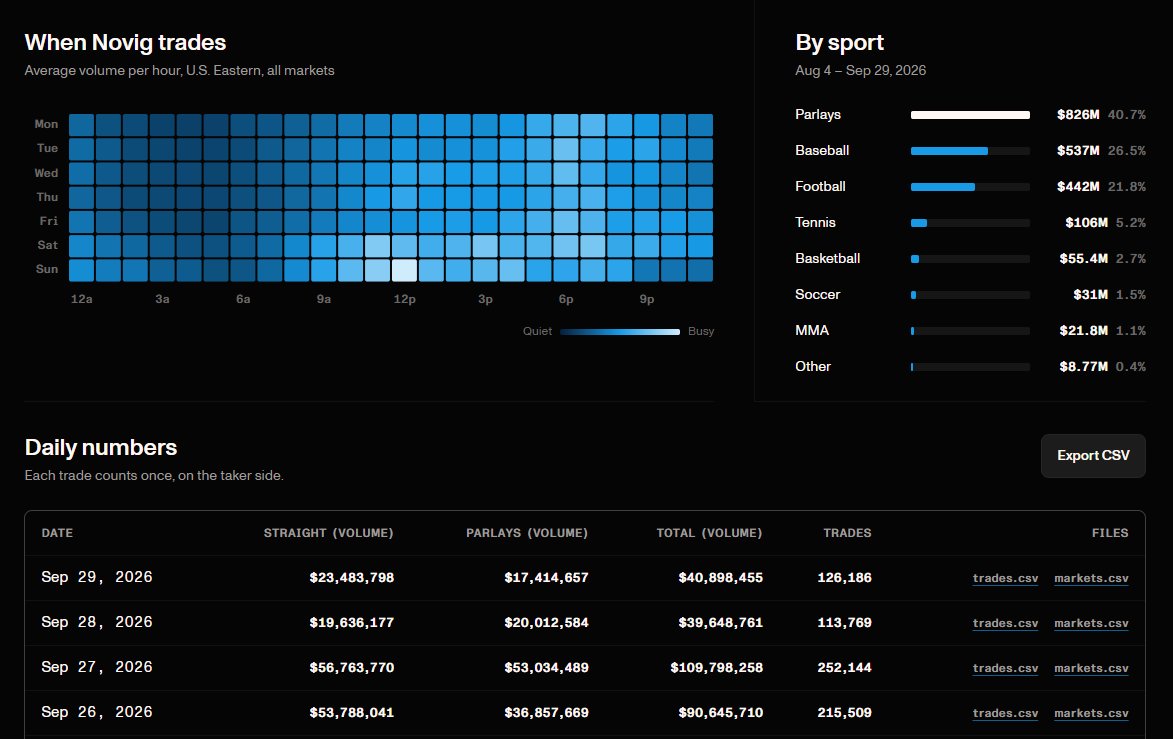
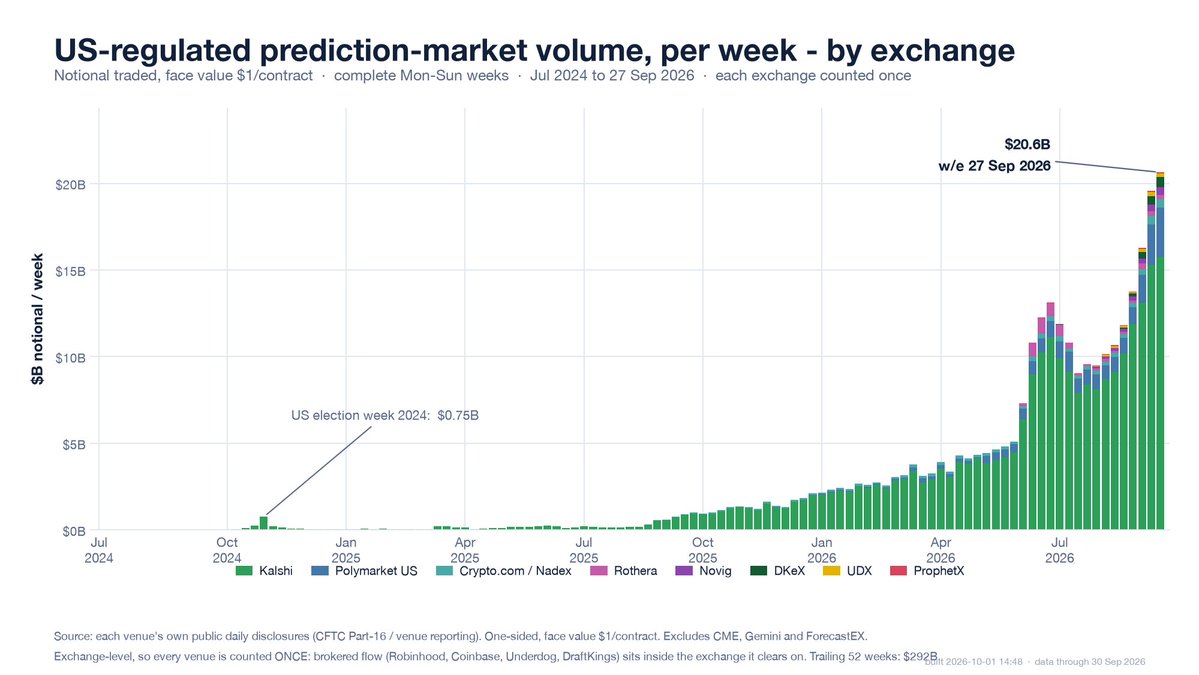
    US-regulated prediction markets just did over $20B in a single week. Two years ago, the same week was ~$5M. Election week 2024 - the moment many called the top - was $750M, and none of it was sports. Trailing 52 weeks: over $290B, ~85% of it sports. 🧵
    Download
    1019646K
  15. Kellan Grenier✓@kellangrenier
    Posts @kellangrenier
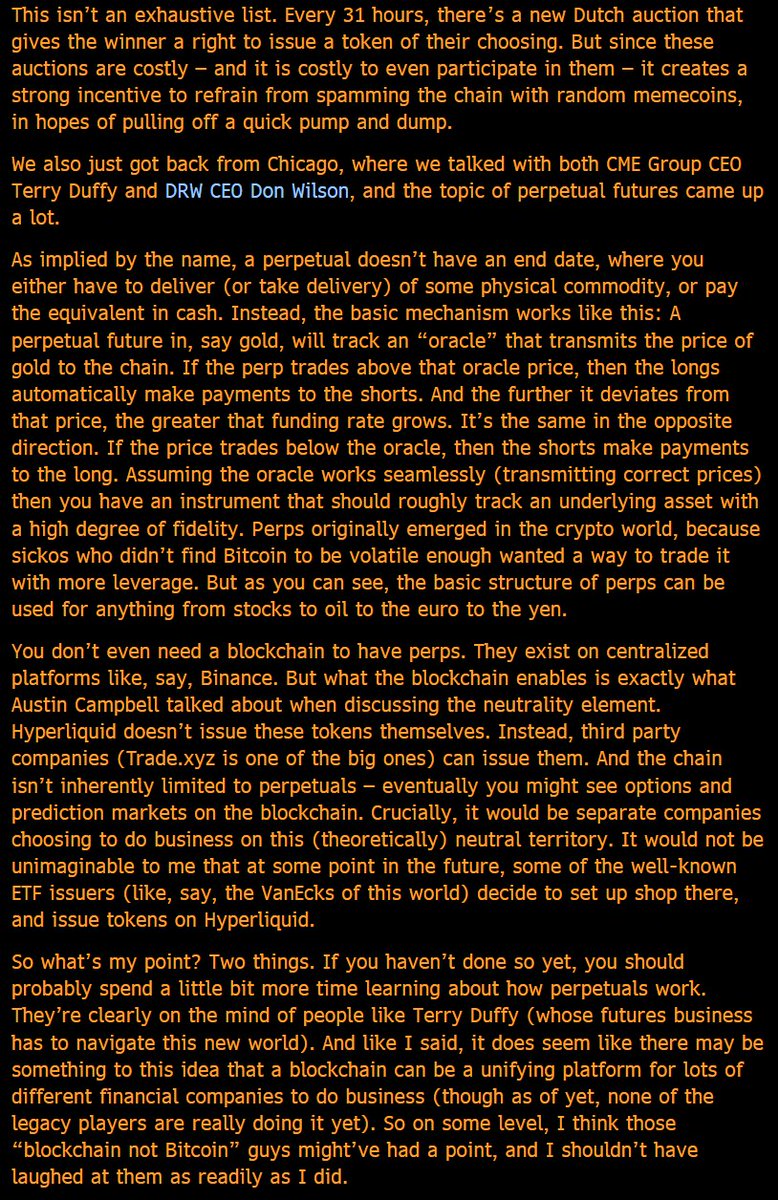
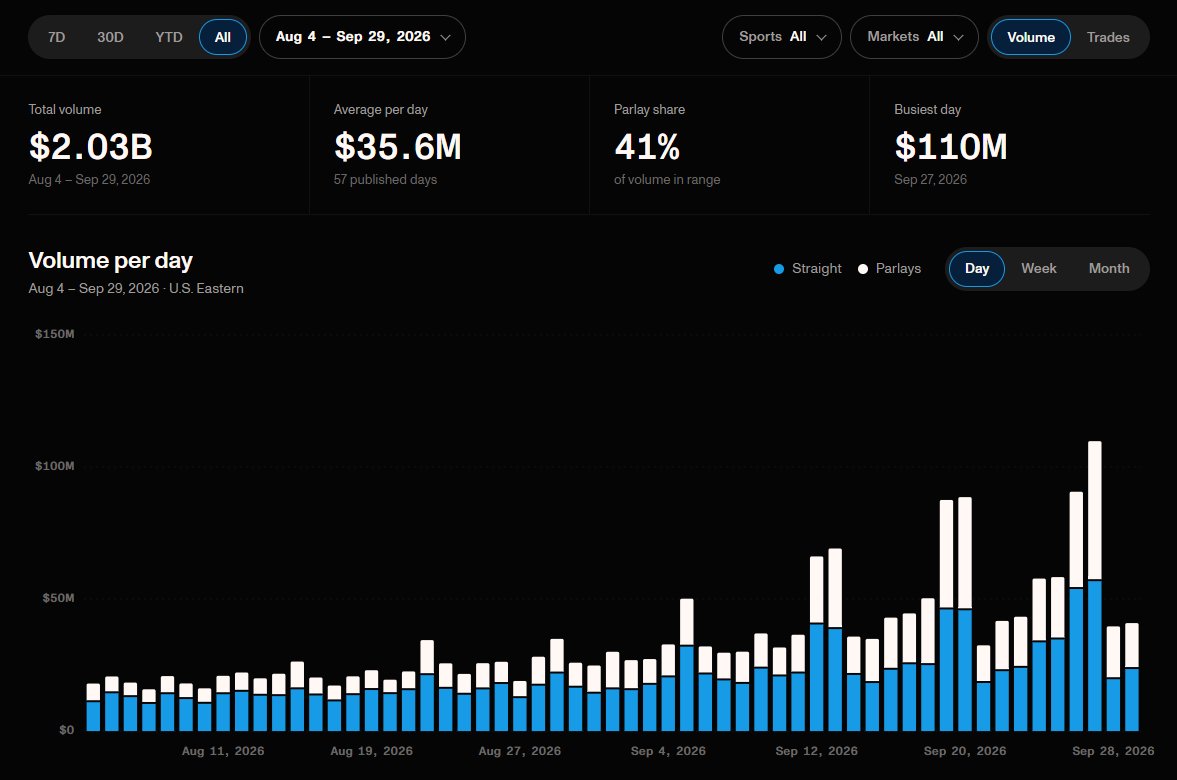
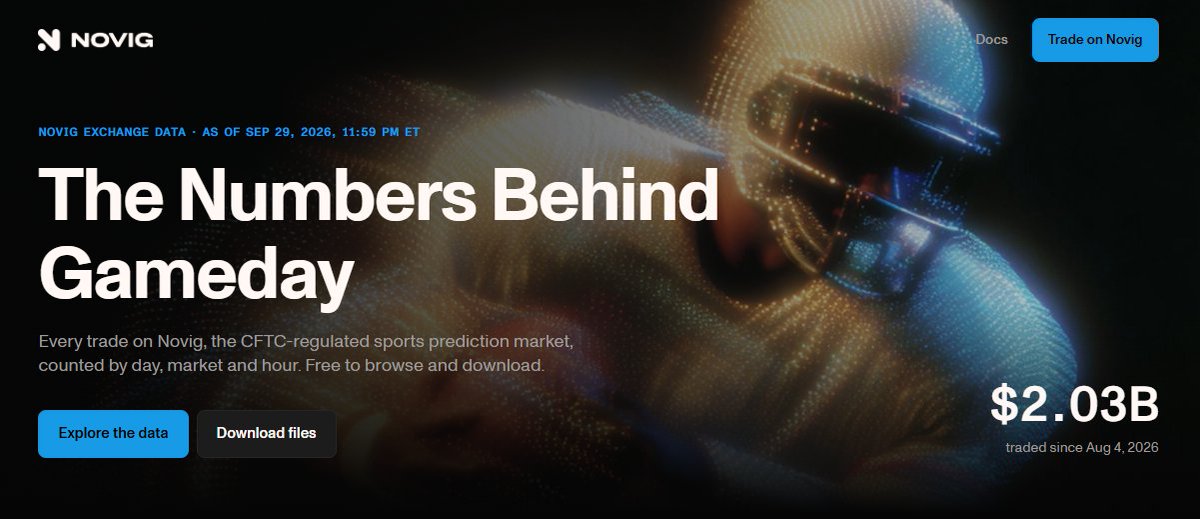
    The DCM upstarts Brand-new sports-only exchanges running their own books, September: - Novig ~$1.45B - ProphetX $245M Both launched this summer Compares to DK (brokered est. + DKeX) of ~$2.9B and Underdog (brokered + UDX), published, of ~$1.35B.
    Sahil Patel @sahildotcom
    like I said - every prediction market company should launch a public market data page well done @Novig team!
    203445
  16. Sahil Patel✓@sahildotcom
    like I said - every prediction market company should launch a public market data page well done @Novig team!
    Download
    647913.7K
  17. Kellan Grenier✓@kellangrenier
    Posts @kellangrenier
    Methodology: All exchange data comes from the venues' own public daily disclosures (CFTC Part-16 / venue reporting) and, for Underdog, its own published broker + exchange feed. Estimates are labeled and sourced accordingly. Data runs through 30 Sep 2026. One-sided, contracts at $1 face value throughout, so it's comparable across venues. For the originator series (1 Sep 2025 – 30 Sep 2026): Kalshi and Polymarket US are upper bounds on their own direct origination. Smaller brokers like PrizePicks, Sleeper, Webull, Moomoo and Plus500 are known or assumed to route into Kalshi, and PrizePicks and Betr into Polymarket US. None of them disclose separately, so that flow sits inside those exchanges' bars (for now). Estimated and flagged as such: 1. Robinhood's Kalshi routing. Robinhood discloses event-contract volume but not where it clears, so the split is estimated (~90% to Kalshi). It's anchored to a third-party sell-side estimate for Sep '25–Aug '26 and carried forward for September at the prior ratio, less 20% for flow its own exchange (Rothera) now absorbs. 2. Coinbase's share of Kalshi, assumed at a flat 3% of Kalshi volume. 3. DraftKings: its own disclosed monthly volume (DKNG Q2'26 materials) through July; for Aug–Sep, DKeX plus the Nadex book less Underdog's assumed share and a ~$3M/day retail floor. 4. Underdog's brokered volume splits across Kalshi and Crypto(dot)com/Nadex. UD publishes both its total and its UDX volume, so the combined Kalshi+Nadex figure (~$5.3B) is publicly derivable, but the split isn't. Through July I've derived it from the Nadex book: what's left after DraftKings' disclosed volume and the retail floor. For Aug–Sep I've assumed 50:50. 5. There's no standalone Crypto(dot)com/Nadex row; it sits inside "All other". What remains of the Nadex book after Underdog and DraftKings is essentially the retail floor: a Fanatics + Crypto(dot)com (OG) retail tail, not a measurement of any one brand. 6. Combo share is each venue's own product-type disclosure: Kalshi's KXMVE "Exotics" book, and Underdog from UDX's published CFTC files (UDXCOMBO). It's shown monthly, and each venue's line starts in the month it began offering combos. The Underdog line is UDX only, not all of Underdog, and starts in August, UDX's first full month, so it's a shorter series than the others. DKeX's combo share looks inflated by market-maker activity, so treat it as provisional. 7. Excludes CME, Gemini and ForecastEX. We didn't ingest their volume feeds, so they're absent from every total and share here.
    Evan @StockMKTNewz
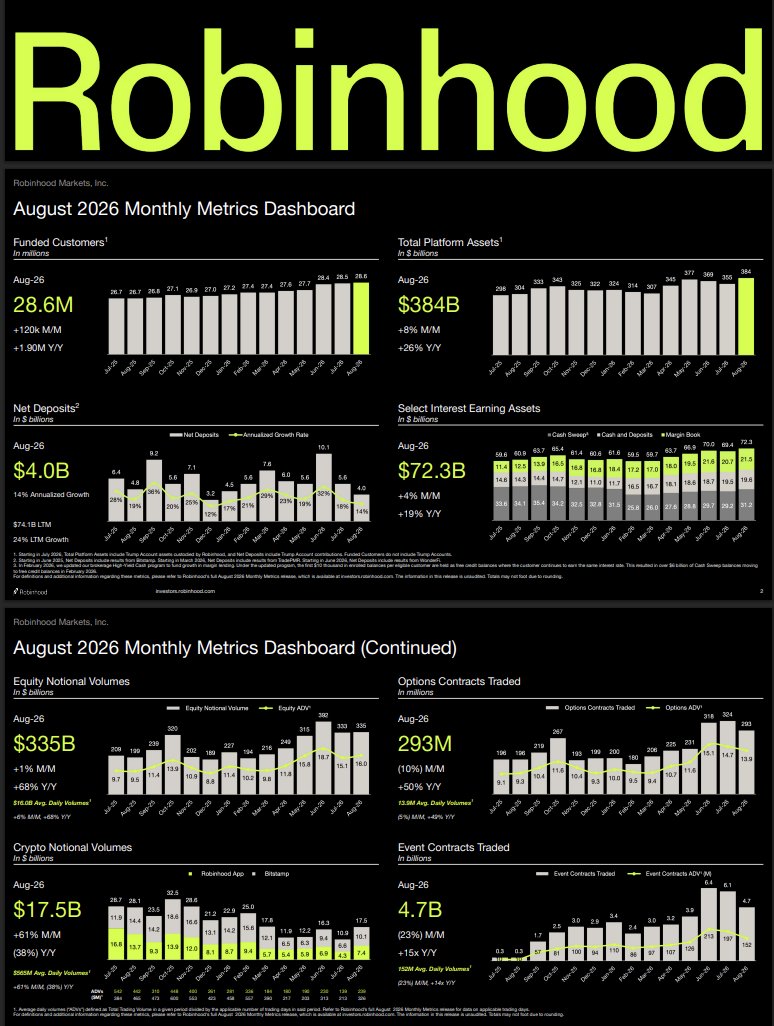
    ROBINHOOD $HOOD JUST REPORTED ITS AUGUST 2026 MONTHLY METRICS - Event Contracts Traded: 4.7B (+15x YoY) - Funded Customers: 28.6M (+1.90M YoY) - Total Platform Assets: $384B (+26% YoY) - et Deposits: $4.0B (24% LTM growth) - Select Interest Earning Assets: $72.3B (+19% YoY) - Equity Notional Volumes: $335B (+68% YoY) - Options Contracts Traded: 293M (+50% YoY) - Crypto Notional Volumes: $17.5B (+38% YoY)
    003367
  18. Evan✓@StockMKTNewz
    ROBINHOOD $HOOD JUST REPORTED ITS AUGUST 2026 MONTHLY METRICS - Event Contracts Traded: 4.7B (+15x YoY) - Funded Customers: 28.6M (+1.90M YoY) - Total Platform Assets: $384B (+26% YoY) - et Deposits: $4.0B (24% LTM growth) - Select Interest Earning Assets: $72.3B (+19% YoY) - Equity Notional Volumes: $335B (+68% YoY) - Options Contracts Traded: 293M (+50% YoY) - Crypto Notional Volumes: $17.5B (+38% YoY)
    Download
    253237847.1K
  19. Show more posts