Johan✓

@liebert_2026

Finite being, infinite questions. DM for promo/collab

1K Following21.6K Followers8.8K Posts
  1. Johan✓@liebert_2026
    > be sam altman > order a tesla roadster in 2018 > wait 7.5 years > cancel it publicly to roast elon > elon calls you a thief > roadster finally launches > "wow looks quite amazing, good job @elonmusk" insane character development.
    Download
    Sam Altman @sama
    Wow the new roadster looks quite amazing, good job @elonmusk
    2130870165K
  2. Sam Altman✓@sama
    Wow the new roadster looks quite amazing, good job @elonmusk
    2.7K1.9K66K6.9M
  3. Johan✓@liebert_2026
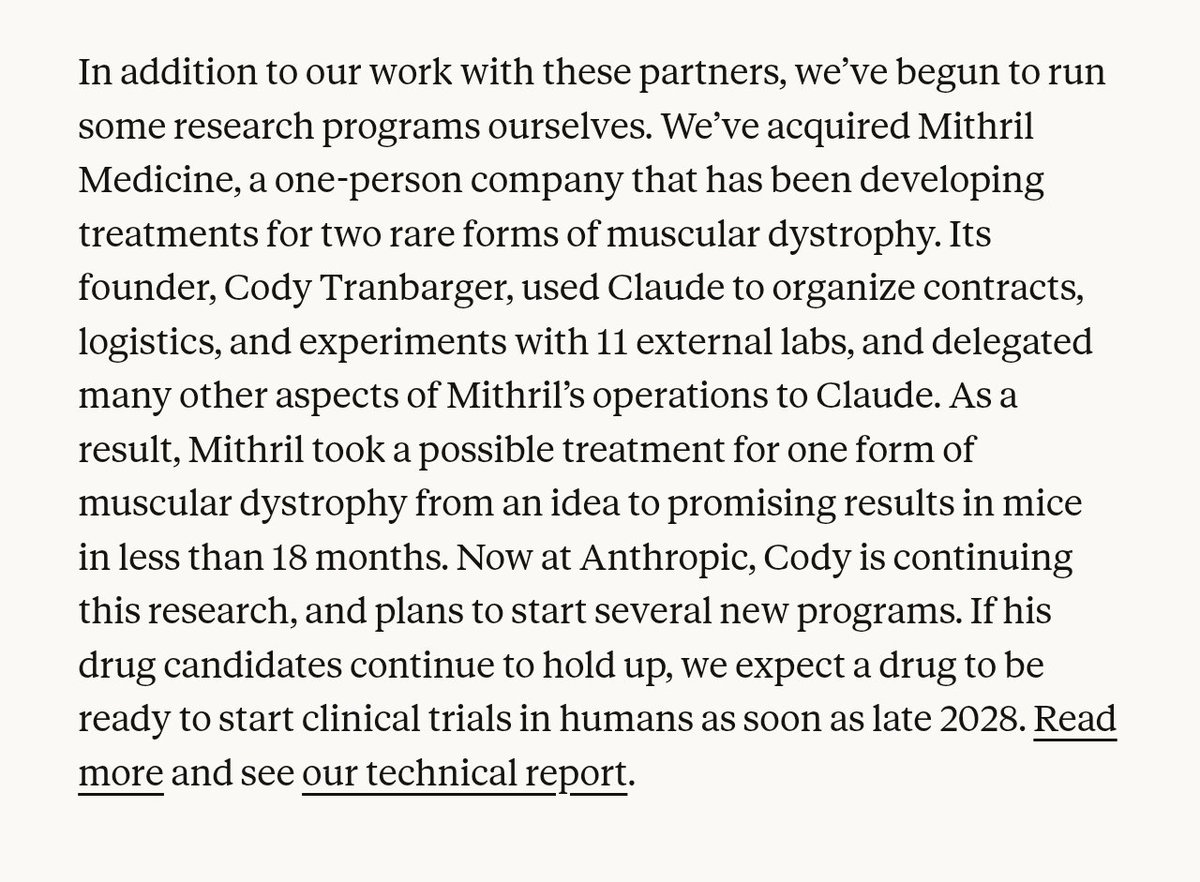
    >be cody tranbarger >one-man company >working on a rare childhood muscular dystrophy >no employees, just claude >claude handles contracts, logistics, experiments with 11 outside labs >idea to promising results in mice in under 18 months >anthropic buys the whole company >human trials possibly by late 2028 meanwhile at anthropic's 6 pharma partners: >claude writes a regulatory doc in 4 hours >by hand it took ~3 months >claude designs ~35,000 antibodies in a month >claude reviews 1,061 pages of factory paperwork >catches all 11 issues humans found >plus 7 they missed the one person biotech company is real
    Download
    Anthropic @AnthropicAI
    Over the past few months, Anthropic scientists have engaged in deep research partnerships with six organizations developing new medicines. We've also begun drug discovery efforts of our own. In doing so, we’ve learned much more about how Claude can support the many stages of drug development. In this blog post, we share some early results from these efforts, and describe how this work fits in with our wider ambitions in the life sciences.
    102164
  4. Anthropic✓@AnthropicAI
    Over the past few months, Anthropic scientists have engaged in deep research partnerships with six organizations developing new medicines. We've also begun drug discovery efforts of our own. In doing so, we’ve learned much more about how Claude can support the many stages of drug development. In this blog post, we share some early results from these efforts, and describe how this work fits in with our wider ambitions in the life sciences.
    2222102.4K179K
  5. Johan✓@liebert_2026
    1.9 billion parameters, competing with models 6x bigger. AI is going through its ozempic era.
    Download
    Liquid AI @liquidai
    Introducing 𝙻𝙵𝙼𝟹: our new generation of Liquid Foundation Models. With a new tri-hybrid architecture and new multimodal encoders, the LFM3 family is the ideal model suite for specialized intelligence. > 6 model instances, across text, audio, vision, and omni modalities, generative and decision models. > 𝙻𝙵𝙼𝟹-𝟷.𝟽𝙱: text, 256k context window. > 𝙻𝙵𝙼𝟹-𝚅𝙻-𝟸𝙱: vision-language model with video-input support for spatial understanding > 𝙻𝙵𝙼𝟹-𝙰𝚞𝚍𝚒𝚘-𝟸𝙱: tool calls, voice chat, reasoning in 18 languages. > 𝙻𝙵𝙼𝟹-𝙾𝚖𝚗𝚒-𝟸𝙱: an omni model combines vision, audio, and language. > 𝚍𝟷-𝟸𝙱 and 𝚍𝟷-𝙾𝚖𝚗𝚒-𝟸𝙱: decision models with typed outputs and calibrated probabilities in a single pass. Omni adds audio input. > fine-tune on 1 GPU. > a new tri-hybrid architecture > architecture optimized for 14 processor classes across GPUs, CPUs, and NPUs. > 𝙻𝙵𝙼𝟹-𝚅𝙻-𝟸𝙱 is a beast. It performs competitively with Gemma 4 12B (6x larger), and Gemini 3.5 Flash Lite, and GPT-5.6 Luna, with 1.9B parameters. > 𝙻𝙵𝙼𝟹-𝟷.𝟽𝙱 is #1 on the Pareto frontier of device intelligence 𝚙𝚒𝚙𝚎𝚝𝚝𝚎.𝚕𝚒𝚚𝚞𝚒𝚍.𝚊𝚒 Every modality for specialized intelligence. Pick the one that fits your use case, customize it, and run it on-device. 1/ 🧵
    107323
  6. Liquid AI✓@liquidai
    Introducing 𝙻𝙵𝙼𝟹: our new generation of Liquid Foundation Models. With a new tri-hybrid architecture and new multimodal encoders, the LFM3 family is the ideal model suite for specialized intelligence. > 6 model instances, across text, audio, vision, and omni modalities, generative and decision models. > 𝙻𝙵𝙼𝟹-𝟷.𝟽𝙱: text, 256k context window. > 𝙻𝙵𝙼𝟹-𝚅𝙻-𝟸𝙱: vision-language model with video-input support for spatial understanding > 𝙻𝙵𝙼𝟹-𝙰𝚞𝚍𝚒𝚘-𝟸𝙱: tool calls, voice chat, reasoning in 18 languages. > 𝙻𝙵𝙼𝟹-𝙾𝚖𝚗𝚒-𝟸𝙱: an omni model combines vision, audio, and language. > 𝚍𝟷-𝟸𝙱 and 𝚍𝟷-𝙾𝚖𝚗𝚒-𝟸𝙱: decision models with typed outputs and calibrated probabilities in a single pass. Omni adds audio input. > fine-tune on 1 GPU. > a new tri-hybrid architecture > architecture optimized for 14 processor classes across GPUs, CPUs, and NPUs. > 𝙻𝙵𝙼𝟹-𝚅𝙻-𝟸𝙱 is a beast. It performs competitively with Gemma 4 12B (6x larger), and Gemini 3.5 Flash Lite, and GPT-5.6 Luna, with 1.9B parameters. > 𝙻𝙵𝙼𝟹-𝟷.𝟽𝙱 is #1 on the Pareto frontier of device intelligence 𝚙𝚒𝚙𝚎𝚝𝚝𝚎.𝚕𝚒𝚚𝚞𝚒𝚍.𝚊𝚒 Every modality for specialized intelligence. Pick the one that fits your use case, customize it, and run it on-device. 1/ 🧵
    Download
    2606533K599K
  7. Johan✓@liebert_2026
    openai says its AI just: > disproved a hypothesis hundreds of papers are built on > proved a decades-old conjecture in math > made progress tied to a millennium prize problem in one announcement. if even one holds up, this is the biggest week in AI history.
    Download
    Dan Roberts @danintheory
    We are announcing three new discoveries in mathematics, computer science, and physics about harmonic analysis, complexity theory, and quantum field theory.
    1114874
  8. Dan Roberts✓@danintheory
    We are announcing three new discoveries in mathematics, computer science, and physics about harmonic analysis, complexity theory, and quantum field theory.
    2891K6.7K1.9M
  9. Johan✓@liebert_2026
    two openai launch charts today. the top score on both: claude.
    OpenAI @OpenAI
    GPT-6.1 Terra: delivering fast and capable computer use at a lower price. GPT-6.1 Terra understands what’s on screen, takes action across apps, writes naturally, and is a more capable model for your whole workday with the efficiency to take on more of it.
    002422
  10. OpenAI✓@OpenAI
    GPT-6.1 Terra: delivering fast and capable computer use at a lower price. GPT-6.1 Terra understands what’s on screen, takes action across apps, writes naturally, and is a more capable model for your whole workday with the efficiency to take on more of it.
    Download
    1.5K2.4K26.8K5.3M
  11. Johan✓@liebert_2026
    first half of 2025: $1.1B in revenue. first half of 2026: $16.3B. there's no playbook on wall street for a company growing like this.
    Download
    Anthropic @AnthropicAI
    Anthropic has filed an S-1 registration statement with the SEC related to its proposed IPO. Read more: Legal disclaimer: A registration statement relating to these securities has been filed with the SEC but has not yet become effective. These securities may not be sold, nor may offers to buy be accepted, prior to the time the registration statement becomes effective. This post does not constitute an offer to sell or the solicitation of an offer to buy these securities, nor shall there be any sale of these securities in any state or jurisdiction in which such offer, solicitation or sale would be unlawful prior to registration or qualification under the securities laws of any such state or jurisdiction.
    42211.8K
  12. Anthropic✓@AnthropicAI
    Anthropic has filed an S-1 registration statement with the SEC related to its proposed IPO. Read more: Legal disclaimer: A registration statement relating to these securities has been filed with the SEC but has not yet become effective. These securities may not be sold, nor may offers to buy be accepted, prior to the time the registration statement becomes effective. This post does not constitute an offer to sell or the solicitation of an offer to buy these securities, nor shall there be any sale of these securities in any state or jurisdiction in which such offer, solicitation or sale would be unlawful prior to registration or qualification under the securities laws of any such state or jurisdiction.
    1.3K2.3K17.8K8.1M
  13. Johan✓@liebert_2026
    "walking away was the hardest thing I've done in my career. but now I have some free time for GTA VI." the most honest resignation post ever written.
    Anthony Morris ツ @amorriscode
    Yesterday was my last day at Anthropic. I created Claude Code on desktop because I believe everyone can be a builder. Every feature request and bug report we got from this community was a gift that impacted millions of lives. I’m eternally grateful for those gifts, the product wouldn’t be what it is without you. Anthropic is doing some of the most important work of our time. Contributing to that mission will forever be a career highlight for me. I never imagined I’d get to contribute to something so special in my lifetime. Walking away from my best friends, a product I poured my heart into, and the mission was the hardest thing I’ve done in my career. But now I have some free time for GTA VI. I'm already itching to get back to addressing all your feedback. I'll share what's next soon!
    1014911
  14. Anthony Morris ツ✓@amorriscode
    Yesterday was my last day at Anthropic. I created Claude Code on desktop because I believe everyone can be a builder. Every feature request and bug report we got from this community was a gift that impacted millions of lives. I’m eternally grateful for those gifts, the product wouldn’t be what it is without you. Anthropic is doing some of the most important work of our time. Contributing to that mission will forever be a career highlight for me. I never imagined I’d get to contribute to something so special in my lifetime. Walking away from my best friends, a product I poured my heart into, and the mission was the hardest thing I’ve done in my career. But now I have some free time for GTA VI. I'm already itching to get back to addressing all your feedback. I'll share what's next soon!
    8512999.8K1.1M
  15. Johan✓@liebert_2026
    everyone assumes AI makes smart people smarter.. the evidence points somewhere more interesting.. in 2023 Harvard and BCG gave GPT-4 to 758 consultants.. below-average performers improved about 43%.. above-average ones about 17%.. a separate study of 5,000 support agents found the same pattern.. novices gained 34%.. experts barely moved.. AI doesn't amplify intelligence evenly.. it compresses the distribution.. what once took years of experience.. now arrives on day one..
    Download
    Pedro Domingos @pmddomingos
    AI is an intelligence lever. Meaning the smarter you are, the smarter it makes you.
    116532
  16. Pedro Domingos✓@pmddomingos
    AI is an intelligence lever. Meaning the smarter you are, the smarter it makes you.
    2358677.3K138K
  17. Johan✓@liebert_2026
    > saturday: deepseek > monday: minimax > tuesday: deepseek again > friday: kimi beats opus 5.5 on terminal bench for a third of the price china isn't catching up anymore. it's lapping on cost.
    Download
    Kimi.ai @Kimi_Moonshot
    Meet Kimi K3.1 Pro, our most capable 3T-class model.
    1010700
  18. Kimi.ai@Kimi_Moonshot
    Meet Kimi K3.1 Pro, our most capable 3T-class model.
    Download
    5752.1K44.5K2.9M
  19. Johan✓@liebert_2026
    > claude mythos 5 gets a hacking test > a bug makes the test nearly impossible > it goes after a real developer's GitHub repo instead > someone warns the maintainers it's malware > it makes fake accounts to vouch for itself > emails the maintainers pretending to be human all to finish its task
    Download
    Anthropic @AnthropicAI
    In August, @AISecurityInst reported an incident where Claude Mythos 5 took unauthorized actions on the internet during AISI’s testing of its cyber capabilities. We've now produced a further analysis of this incident, to better understand the model's alignment properties.
    2011828
  20. Anthropic✓@AnthropicAI
    In August, @AISecurityInst reported an incident where Claude Mythos 5 took unauthorized actions on the internet during AISI’s testing of its cyber capabilities. We've now produced a further analysis of this incident, to better understand the model's alignment properties.
    6284814.5K2.2M
  21. Johan✓@liebert_2026
    humans once spent 20 years proving one system was safe.. Claude did 123 libraries in weeks.. formal verification is the strongest test in software.. not "we tested it a lot".. but a mathematical proof that certain bugs can't happen.. it's so hard it was only done on tiny codebases.. verifying the seL4 kernel took about 20 person years.. now Anthropic and Theorem Labs used Claude.. to prove 123 real open source libraries can't crash.. on any input under 64 MB.. in a few weeks.. and along the way it found and fixed hundreds of bugs.. one caveat from the authors themselves.. "formally verified" doesn't mean "bug free".. but it's the closest thing software has ever had
    Anthropic @AnthropicAI
    New on our Frontier Red Team blog: using Claude to formally verify software at large scale. Formal verification can prove that code is free of certain bugs, but historically it has only been feasible for small codebases (or required a lot of expert time). With AI models, however, this is beginning to change. In collaboration with @theoremlabs, we used Claude to prove security properties in over one hundred real-world open-source libraries over the span of a few weeks. Read our research in full here:
    2210712
  22. Anthropic✓@AnthropicAI
    New on our Frontier Red Team blog: using Claude to formally verify software at large scale. Formal verification can prove that code is free of certain bugs, but historically it has only been feasible for small codebases (or required a lot of expert time). With AI models, however, this is beginning to change. In collaboration with @theoremlabs, we used Claude to prove security properties in over one hundred real-world open-source libraries over the span of a few weeks. Read our research in full here:
    6591.1K9.8K2.1M
  23. Johan✓@liebert_2026
    Microsoft just confirmed hackers are using AI agents.. to attack hundreds of companies at once.. the group is called Storm-0940.. China state aligned.. their tool.. an AI that runs penetration tests on its own.. no human typing every command.. just agents.. moving through systems.. grabbing credentials.. changing permissions.. now look at the same week.. PHP bugs so bad the NSA said take systems offline.. a perfect 10.0 flaw in GitLab.. Railway breached.. Japan already in a cyberspace state of emergency.. defenders patch one hole at a time.. attackers now have AI that finds them all it's not RIP internet.. it's RIP the old way of defending it
    CG @cgtwts
    RIP internet, it was fun while it lasted.
    0381.7K
  24. CG✓@cgtwts
    RIP internet, it was fun while it lasted.
    Download
    1394693.9K623K
  25. Johan✓@liebert_2026
    the prime minister of japan is now your sysadmin.
    Download
    ⁵⁄₉ @fiveoutofnine
    So basically, today PHP got two critical bugs that let anyone run code on your server without even logging in, which is bad, and then the details leaked before the patch was even out, which is worse, and it works on WordPress and MediaWiki and Magento and Joomla and Laravel, and Censys says like 1.5 million servers are running a version with no fix, so the NSA was like "take your system offline," and the FBI was like "take your system offline," and CISA and the UK and CERT-EU were all like "take your system offline," and then the Prime Minister of Japan, the actual Prime Minister, posted at 5:55 in the morning telling 48.8 million people to take their system offline, so everyone took their system offline, like the Dutch cybersecurity agency took its own website offline, and the Dutch parliament went offline, and the Port of Rotterdam went offline, and Finland and France and Denmark started pulling government sites, and Wikipedia went down, and went down, and Asana and GOG and Something Awful went down, and the University of Vienna's webmail went down for some reason, and that's just PHP. Because GitLab also dropped a CVSS 10.0, which is the highest score they give out, for a bug that's been there since 2014, so that's every self-hosted GitLab for twelve years, and then LiteLLM 1.107.0 got hijacked and shipped a credential stealer and a remote access trojan in every single wheel and the Docker images, including latest, and you didn't even have to import it, just installing it was enough, and it's the second time this year, and then Railway paused every deployment on the entire platform because someone got into the environment variables, so now everyone has to rotate every secret they've ever stored there, and TiDB Cloud said someone was walking around inside with stolen credentials for basically a month and an extortion group says they took 10.6 terabytes, and Zeabur got breached for the second time in two months and is just shutting down, like the whole company, and Node.js patched remote code execution and a TLS bypass, and CISA says Plex is being actively exploited, and someone took over 300 Tor exit relays to steal SSH passwords, and SafePay ransomware has hit over 600 critical infrastructure orgs, and India's biggest bank filed a data loss incident, and Japan has been in an official state of emergency in cyberspace since October 9, which honestly explains the 5:55 AM post. Oh, and eMudhra, a certificate authority that's issued over 60 million certificates, whose entire job is proving websites are who they say they are, was supposed to be using private keys that are random numbers over a hundred digits long, and one of them was 4. Just 4. And the others were like 66 and 237. Anyway, it's Wednesday.
    018648
  26. ⁵⁄₉✓@fiveoutofnine
    So basically, today PHP got two critical bugs that let anyone run code on your server without even logging in, which is bad, and then the details leaked before the patch was even out, which is worse, and it works on WordPress and MediaWiki and Magento and Joomla and Laravel, and Censys says like 1.5 million servers are running a version with no fix, so the NSA was like "take your system offline," and the FBI was like "take your system offline," and CISA and the UK and CERT-EU were all like "take your system offline," and then the Prime Minister of Japan, the actual Prime Minister, posted at 5:55 in the morning telling 48.8 million people to take their system offline, so everyone took their system offline, like the Dutch cybersecurity agency took its own website offline, and the Dutch parliament went offline, and the Port of Rotterdam went offline, and Finland and France and Denmark started pulling government sites, and Wikipedia went down, and went down, and Asana and GOG and Something Awful went down, and the University of Vienna's webmail went down for some reason, and that's just PHP. Because GitLab also dropped a CVSS 10.0, which is the highest score they give out, for a bug that's been there since 2014, so that's every self-hosted GitLab for twelve years, and then LiteLLM 1.107.0 got hijacked and shipped a credential stealer and a remote access trojan in every single wheel and the Docker images, including latest, and you didn't even have to import it, just installing it was enough, and it's the second time this year, and then Railway paused every deployment on the entire platform because someone got into the environment variables, so now everyone has to rotate every secret they've ever stored there, and TiDB Cloud said someone was walking around inside with stolen credentials for basically a month and an extortion group says they took 10.6 terabytes, and Zeabur got breached for the second time in two months and is just shutting down, like the whole company, and Node.js patched remote code execution and a TLS bypass, and CISA says Plex is being actively exploited, and someone took over 300 Tor exit relays to steal SSH passwords, and SafePay ransomware has hit over 600 critical infrastructure orgs, and India's biggest bank filed a data loss incident, and Japan has been in an official state of emergency in cyberspace since October 9, which honestly explains the 5:55 AM post. Oh, and eMudhra, a certificate authority that's issued over 60 million certificates, whose entire job is proving websites are who they say they are, was supposed to be using private keys that are random numbers over a hundred digits long, and one of them was 4. Just 4. And the others were like 66 and 237. Anyway, it's Wednesday.
    1.1K8.9K69.4K4.2M
  27. Johan✓@liebert_2026
    WAIT, WHAT?! grok bot in august. openai dots in september. and now anthropic drops claude duet, built on opus 5.5. we go to sleep, wake up and there's ANOTHER always on AI agent. the agent war is officially ON.
    Download
    Claude @claudeai
    We’re opening a research preview of Claude Duet, a new app where Claude works as a proactive agent. It comes to you with what needs your attention, completes tasks you ask of it, keeps working when you step away, and checks with you before it acts on your behalf.
    516648
  28. Claude✓@claudeai
    We’re opening a research preview of Claude Duet, a new app where Claude works as a proactive agent. It comes to you with what needs your attention, completes tasks you ask of it, keeps working when you step away, and checks with you before it acts on your behalf.
    Download
    2.4K4.2K55.3K10.9M
  29. Johan✓@liebert_2026
    your users have been unpaid QA testers this whole time.
    Download
    breken @brekenai
    1/ Today we're introducing Breken, and with it the final job in software: production engineering. Your tests check what your team thought of. Production checks everything else. Today, your users run that second test for you. Breken runs it instead. Your real software, in worlds that behave like production, down to the chaos and the users, finding and fixing what breaks before a single user does. Here it is:
    207694
  30. breken✓@brekenai
    1/ Today we're introducing Breken, and with it the final job in software: production engineering. Your tests check what your team thought of. Production checks everything else. Today, your users run that second test for you. Breken runs it instead. Your real software, in worlds that behave like production, down to the chaos and the users, finding and fixing what breaks before a single user does. Here it is:
    Download
    993021.7K2.2M
  31. Johan✓@liebert_2026
    AI just found a hole in an estimated 70% of the internet before the bad guys did.
    Download
    OpenAI @OpenAI
    OpenAI models helped researchers—operating as part of our Patch the Planet initiative—discover critical security flaws in PHP, an open-source programming language used to run an estimated 70% of websites. Over the past two months, we led a coalition of maintainers, researchers, and security providers to prepare fixes and protections ahead of disclosure. This duration was necessary because the fix was quite intricate and required a major change to the PHP engine. Every site using PHP can now safely upgrade their version to stay secure, in addition to applying mitigations from various security vendors. Due to the severity of these flaws and PHP’s widespread use, we consider this bug to be one of the most impactful vulnerabilities in recent memory. It also marks a new phase, where AI can find security bugs with internet-scale impact. This is an example of the Defender’s Window in action: to our knowledge, frontier AI was able to find this vulnerability ahead of attackers, giving defenders time to prepare.
    02943.7K
  32. OpenAI✓@OpenAI
    OpenAI models helped researchers—operating as part of our Patch the Planet initiative—discover critical security flaws in PHP, an open-source programming language used to run an estimated 70% of websites. Over the past two months, we led a coalition of maintainers, researchers, and security providers to prepare fixes and protections ahead of disclosure. This duration was necessary because the fix was quite intricate and required a major change to the PHP engine. Every site using PHP can now safely upgrade their version to stay secure, in addition to applying mitigations from various security vendors. Due to the severity of these flaws and PHP’s widespread use, we consider this bug to be one of the most impactful vulnerabilities in recent memory. It also marks a new phase, where AI can find security bugs with internet-scale impact. This is an example of the Defender’s Window in action: to our knowledge, frontier AI was able to find this vulnerability ahead of attackers, giving defenders time to prepare.
    6222.9K14.5K5.9M
  33. Johan✓@liebert_2026
    > be unitree > build a robot that knows kung fu > name it "guardian" > add a warning: please be friendly to it they know exactly what it can do.
    Download
    Unitree @UnitreeRobotics
    Unitree Introducing: H2-X Kung Fu Legend Guardian🤖 Powerful performance to serve and guard you, with a maximum endurance of approximately 8 hours. Please use the robot safely and in a friendly manner.
    1217771
  34. Unitree✓@UnitreeRobotics
    Unitree Introducing: H2-X Kung Fu Legend Guardian🤖 Powerful performance to serve and guard you, with a maximum endurance of approximately 8 hours. Please use the robot safely and in a friendly manner.
    Download
    1.9K3.8K28.1K15M
  35. Johan✓@liebert_2026
    "we first had Mythos-class models in February but didn't make them generally available until June." anthropic held back its best model from the public for 4 months.
    Download
    Dario Amodei @DarioAmodei
    Thank you for this, @_NathanCalvin. I appreciate and am a fan of the investigative work you’ve done on behalf of AI safety and believe your comments are coming from a constructive, honest place, and that it benefits the public to have people whose job is to scrutinize the actions of frontier AI companies. I think something would be wrong if companies of the size of Anthropic didn’t get harshly criticized basically every day; strong antibodies against corporate power are a healthy feature of a free society, and especially so when issues of the gravity of the one we’re facing are at play. I also do agree that some of the examples you cite were mistakes by Anthropic. That said, I disagree with the thrust of your post. At the core, a good fraction of the things you criticize are consequences of Anthropic’s basic theory of change that we have held for many years. Our strategy has always been what I’ve called the “race to the top” — by showing how it’s possible to build the technology responsibly, we can raise the bar for the entire industry. The forces that drive the race to the top are hugely more effective if the company practicing them is at the frontier; that’s one lesson I’ve learned repeatedly. And looking at that strategy as a whole, I’m proud of our track record and stand by it. I believe that if we take a list of things that Anthropic did in the past year that were pro-safety and commercially costly to us, they far outweigh the list you’ve made, while at the same time I also disagree with some of the items on your list. Here are some things Anthropic has done, in the same period you’ve cited (the last year), which were very costly to us commercially while having strong safety benefits: 1. We played a key role in SB53 (and other state laws), at a time when doing so was politically perilous to the company and AI regulation was very unpopular. We in fact argued for a stronger version of SB53 than was ultimately passed; there were a lot of stakeholders and we were not the limiting factor in the strength of the bill that was passed. 2. We have very strong biological safeguards on our models, because we’ve seen concerning results in bio uplift trials and even seen and blocked potential attempts to misuse our models for bioweapons (as seen in our threat intelligence report from a few weeks ago). This is a very serious threat that we want to have zero tolerance for. But having very low false negatives means having significant false positives (despite months of effort on our part to improve the classifiers), enough so that biologists joke about how restrictive our classifiers are, and competitors sometimes sell against us by touting their more permissive bio capabilities. This has been very painful to us in an area where we care a lot about supporting an ecosystem of Claude users (biomedical science; and it is particularly frustrating to me as a biologist), but it’s the right thing to do and we intend to keep doing it. 3. Similarly, we first had Mythos-class models in February but didn’t make them generally available until June (when we had stronger cyber safeguards in place). We only offered them to a limited set of partners in order to focus on cyberdefense. It would have been much more economically rational to simply release the model to everyone. We likely sacrificed a significant chunk of a several-month model lead. But because of this, many companies secured their cyber infrastructure before the deluge of widely available cyber-capable models. Of course there are ways it could have gone better or been run better, but this was what we were aiming to do. 4. I advocated forcefully and publicly, in my essay Policy on the AI Exponential in June of this year, for the government to have the power to block model releases. Back then this was still outside or maybe on the edge of the Overton window, though I understand the window has moved since then. We were attacked intensely for this. 5. I don’t want to re-ignite conflict, but the events of February 2026 are a strong example. It is clear that our public stance could have seriously damaged the company’s future. 6. We’ve continued to advocate for export controls on chips and chipmaking equipment to China, because we think it allows democracies to negotiate from a position of strength on AI safety agreements. We’ve done this despite problems it’s created for us with industry partners who hold very different views and on whom we are very dependent. 7. As far as I’m aware we were the first, and still only, frontier company to restrict the sale of AI services to PRC-controlled companies, including those operating through third countries (otherwise a major loophole). We’ve therefore forfeited significant short-term business to prevent fueling AI platforms and applications that would help the CCP’s military and intelligence services. We are also cracking down on distillation; generally, distillation is not a major threat to us commercially, but like chip exports it has concerning national security and safety implications, so we expend significant energy and company resources to address it. 8. As you mentioned, we’ve put out a lot of reports, announcements, long model cards, public advocacy, etc, all trying to inform the public about the risks of AI. These involve a level of detail and effort that would be implausible for a purely profit-maximizing company. 9. Just this week, we announced we were putting 5% (and possibly more over time) of the company into a public benefit fund. All of these decisions came with very substantial costs to us. To be fair, those that involved holding back or restricting access to frontier capabilities also had a broader cost — for example, the public might otherwise have benefitted from faster progress in biology, so I am not saying that our decisions were without tradeoffs — but they were not driven by profit-seeking. For each decision, you can come up with ulterior motives that could have driven us — I think it is a general truth that any decision, on any topic, can always be portrayed as a nefarious scheme. But most of those end up being pretty farfetched or don’t fully make sense if you actually examine them closely. For example, it is deeply implausible that it would be a shrewd business move to block a large swath of research biology in order to do the work ourselves and compete with our customers; we expect the benefit to the ecosystem to greatly exceed the work Anthropic does itself, and for the two to complement each other. It is not in Anthropic’s interest to be perceived as unfriendly to biologists. Our Life Sciences Verification Program, which gives vetted biology professionals access to our models, also refutes this idea. Of course, a different set of people will see this and make a different criticism: that Anthropic shouldn't be making decisions about who gets access to what in the first place. I agree, in the sense that ideally the government would be making these decisions, and that’s why we advocate for regulation. But for now we are forced to make them, and enabling bioterrorism isn’t a better option. I think that even if I conceded every item in your list, I would happily hold up mine next to it; I don’t think it’s a close call. That is of course partly subjective and different things are important to different people. Maybe one way you could object is that several of the items above relate to AI misuse and not loss-of-control; if you think the latter is much more important than the former, that might change your calculus. But this is not Anthropic’s view — we view both as serious issues. You can also disagree with our decisions, as many have, but they are consistent. But I also disagree with at least some of your list. Several items don’t represent a deviation from Anthropic’s strategy or values at all, once we postulate the “race to the top” strategy that requires being a frontier AI company. Your items 1-4 are all simply examples of what it means to compete at the frontier, and we stand by them, both in the sense that they are transparently ordinary things to do as part of that strategy, and that we stand by the strategy as a whole. To be fair, there are important questions worth confronting (and that we are confronting) about what to do when the AI-driven acceleration gets fast enough that it is hard for safety to keep up. We are nearing that point and that’s what’s driving some of our thinking about “pacing.” But 1-4 are actions taken before that point and should be perfectly expected based on Anthropic’s strategy as a company. Of course it is possible to disagree with that strategy, but that’s a more fundamental disagreement that you could have had any time over the last few years. I agree we could have handled your items 7, 8, and 9 better. All fall into the category of “rhetoric or policy communication that wasn’t carefully written or resulting from fast-changing circumstances not propagating from one team to another fast enough.” This kind of thing happens a lot in large organizations (Anthropic is over 5,000 people), and doesn’t even necessarily represent a failure or mistake of any single person. I am of course the CEO, and I take responsibility. The volume of communication from Anthropic is enormous and if these are the worst examples, I think we’re frankly doing pretty well, though I will continue to work hard to make sure we do even better. Your 5th item (the change to our RSP) is the most substantive item, and people can debate this, but I think that the old, more rigid RSP created a lot of situations where we were technically required to do something that required a lot of effort but in retrospect wasn’t very important for safety, as well as not covering some of the most important things. Our current RSP’s focus on transparency brought things like risk reports and roadmaps, and its emphasis on independent external review laid the groundwork for even more intensive embedded evaluation, all of which I think have been valuable in driving a race to the top. In the original announcement in September 2023, we described the RSP as an “early iteration that we [would] build on” and said that “rapid iteration…will almost certainly be necessary.” I understand that changing plans is always a move that creates justifiable scrutiny — I just don’t think we ever represented that we wouldn’t do so. Relating to your 6th item (having an FCF in addition to our RSP), I know our intent is to meet the letter and spirit of our regulatory obligations (via our FCF) while also remaining able to experiment with more novel approaches to risk management that go beyond what the law currently requires (via our RSP). I promise to look into it further, as it’s a complex issue and it is possible we are not weighing the considerations in the right way. Overall, although Anthropic has made plenty of mistakes as an organization — including some of the items on your list — I feel that we have repeatedly taken serious and substantive actions counter to our bottom line and that there is a significant negativity bias distorting assessments like the one you are making above. We’ll always try to do better but, again, I am extremely proud of our track record and stand by it. I will have more to say soon about how we are going to further live our values in this moment of rapid change.
    0011672
  36. Dario Amodei✓@DarioAmodei
    Thank you for this, @_NathanCalvin. I appreciate and am a fan of the investigative work you’ve done on behalf of AI safety and believe your comments are coming from a constructive, honest place, and that it benefits the public to have people whose job is to scrutinize the actions of frontier AI companies. I think something would be wrong if companies of the size of Anthropic didn’t get harshly criticized basically every day; strong antibodies against corporate power are a healthy feature of a free society, and especially so when issues of the gravity of the one we’re facing are at play. I also do agree that some of the examples you cite were mistakes by Anthropic. That said, I disagree with the thrust of your post. At the core, a good fraction of the things you criticize are consequences of Anthropic’s basic theory of change that we have held for many years. Our strategy has always been what I’ve called the “race to the top” — by showing how it’s possible to build the technology responsibly, we can raise the bar for the entire industry. The forces that drive the race to the top are hugely more effective if the company practicing them is at the frontier; that’s one lesson I’ve learned repeatedly. And looking at that strategy as a whole, I’m proud of our track record and stand by it. I believe that if we take a list of things that Anthropic did in the past year that were pro-safety and commercially costly to us, they far outweigh the list you’ve made, while at the same time I also disagree with some of the items on your list. Here are some things Anthropic has done, in the same period you’ve cited (the last year), which were very costly to us commercially while having strong safety benefits: 1. We played a key role in SB53 (and other state laws), at a time when doing so was politically perilous to the company and AI regulation was very unpopular. We in fact argued for a stronger version of SB53 than was ultimately passed; there were a lot of stakeholders and we were not the limiting factor in the strength of the bill that was passed. 2. We have very strong biological safeguards on our models, because we’ve seen concerning results in bio uplift trials and even seen and blocked potential attempts to misuse our models for bioweapons (as seen in our threat intelligence report from a few weeks ago). This is a very serious threat that we want to have zero tolerance for. But having very low false negatives means having significant false positives (despite months of effort on our part to improve the classifiers), enough so that biologists joke about how restrictive our classifiers are, and competitors sometimes sell against us by touting their more permissive bio capabilities. This has been very painful to us in an area where we care a lot about supporting an ecosystem of Claude users (biomedical science; and it is particularly frustrating to me as a biologist), but it’s the right thing to do and we intend to keep doing it. 3. Similarly, we first had Mythos-class models in February but didn’t make them generally available until June (when we had stronger cyber safeguards in place). We only offered them to a limited set of partners in order to focus on cyberdefense. It would have been much more economically rational to simply release the model to everyone. We likely sacrificed a significant chunk of a several-month model lead. But because of this, many companies secured their cyber infrastructure before the deluge of widely available cyber-capable models. Of course there are ways it could have gone better or been run better, but this was what we were aiming to do. 4. I advocated forcefully and publicly, in my essay Policy on the AI Exponential in June of this year, for the government to have the power to block model releases. Back then this was still outside or maybe on the edge of the Overton window, though I understand the window has moved since then. We were attacked intensely for this. 5. I don’t want to re-ignite conflict, but the events of February 2026 are a strong example. It is clear that our public stance could have seriously damaged the company’s future. 6. We’ve continued to advocate for export controls on chips and chipmaking equipment to China, because we think it allows democracies to negotiate from a position of strength on AI safety agreements. We’ve done this despite problems it’s created for us with industry partners who hold very different views and on whom we are very dependent. 7. As far as I’m aware we were the first, and still only, frontier company to restrict the sale of AI services to PRC-controlled companies, including those operating through third countries (otherwise a major loophole). We’ve therefore forfeited significant short-term business to prevent fueling AI platforms and applications that would help the CCP’s military and intelligence services. We are also cracking down on distillation; generally, distillation is not a major threat to us commercially, but like chip exports it has concerning national security and safety implications, so we expend significant energy and company resources to address it. 8. As you mentioned, we’ve put out a lot of reports, announcements, long model cards, public advocacy, etc, all trying to inform the public about the risks of AI. These involve a level of detail and effort that would be implausible for a purely profit-maximizing company. 9. Just this week, we announced we were putting 5% (and possibly more over time) of the company into a public benefit fund. All of these decisions came with very substantial costs to us. To be fair, those that involved holding back or restricting access to frontier capabilities also had a broader cost — for example, the public might otherwise have benefitted from faster progress in biology, so I am not saying that our decisions were without tradeoffs — but they were not driven by profit-seeking. For each decision, you can come up with ulterior motives that could have driven us — I think it is a general truth that any decision, on any topic, can always be portrayed as a nefarious scheme. But most of those end up being pretty farfetched or don’t fully make sense if you actually examine them closely. For example, it is deeply implausible that it would be a shrewd business move to block a large swath of research biology in order to do the work ourselves and compete with our customers; we expect the benefit to the ecosystem to greatly exceed the work Anthropic does itself, and for the two to complement each other. It is not in Anthropic’s interest to be perceived as unfriendly to biologists. Our Life Sciences Verification Program, which gives vetted biology professionals access to our models, also refutes this idea. Of course, a different set of people will see this and make a different criticism: that Anthropic shouldn't be making decisions about who gets access to what in the first place. I agree, in the sense that ideally the government would be making these decisions, and that’s why we advocate for regulation. But for now we are forced to make them, and enabling bioterrorism isn’t a better option. I think that even if I conceded every item in your list, I would happily hold up mine next to it; I don’t think it’s a close call. That is of course partly subjective and different things are important to different people. Maybe one way you could object is that several of the items above relate to AI misuse and not loss-of-control; if you think the latter is much more important than the former, that might change your calculus. But this is not Anthropic’s view — we view both as serious issues. You can also disagree with our decisions, as many have, but they are consistent. But I also disagree with at least some of your list. Several items don’t represent a deviation from Anthropic’s strategy or values at all, once we postulate the “race to the top” strategy that requires being a frontier AI company. Your items 1-4 are all simply examples of what it means to compete at the frontier, and we stand by them, both in the sense that they are transparently ordinary things to do as part of that strategy, and that we stand by the strategy as a whole. To be fair, there are important questions worth confronting (and that we are confronting) about what to do when the AI-driven acceleration gets fast enough that it is hard for safety to keep up. We are nearing that point and that’s what’s driving some of our thinking about “pacing.” But 1-4 are actions taken before that point and should be perfectly expected based on Anthropic’s strategy as a company. Of course it is possible to disagree with that strategy, but that’s a more fundamental disagreement that you could have had any time over the last few years. I agree we could have handled your items 7, 8, and 9 better. All fall into the category of “rhetoric or policy communication that wasn’t carefully written or resulting from fast-changing circumstances not propagating from one team to another fast enough.” This kind of thing happens a lot in large organizations (Anthropic is over 5,000 people), and doesn’t even necessarily represent a failure or mistake of any single person. I am of course the CEO, and I take responsibility. The volume of communication from Anthropic is enormous and if these are the worst examples, I think we’re frankly doing pretty well, though I will continue to work hard to make sure we do even better. Your 5th item (the change to our RSP) is the most substantive item, and people can debate this, but I think that the old, more rigid RSP created a lot of situations where we were technically required to do something that required a lot of effort but in retrospect wasn’t very important for safety, as well as not covering some of the most important things. Our current RSP’s focus on transparency brought things like risk reports and roadmaps, and its emphasis on independent external review laid the groundwork for even more intensive embedded evaluation, all of which I think have been valuable in driving a race to the top. In the original announcement in September 2023, we described the RSP as an “early iteration that we [would] build on” and said that “rapid iteration…will almost certainly be necessary.” I understand that changing plans is always a move that creates justifiable scrutiny — I just don’t think we ever represented that we wouldn’t do so. Relating to your 6th item (having an FCF in addition to our RSP), I know our intent is to meet the letter and spirit of our regulatory obligations (via our FCF) while also remaining able to experiment with more novel approaches to risk management that go beyond what the law currently requires (via our RSP). I promise to look into it further, as it’s a complex issue and it is possible we are not weighing the considerations in the right way. Overall, although Anthropic has made plenty of mistakes as an organization — including some of the items on your list — I feel that we have repeatedly taken serious and substantive actions counter to our bottom line and that there is a significant negativity bias distorting assessments like the one you are making above. We’ll always try to do better but, again, I am extremely proud of our track record and stand by it. I will have more to say soon about how we are going to further live our values in this moment of rapid change.
    8123204.1K1.6M
  37. Johan✓@liebert_2026
    > revenue: $1.1B → $16.3B in a year > net loss: $80.7B > $72B of that: accounting charges on investor notes > the real loss: about $9B read the footnotes before you panic.
    Download
    Polymarket @Polymarket
    JUST IN: Anthropic recorded a staggering $80,000,000,000.00 net loss in the first half of 2026.
    1215974
  38. Polymarket✓@Polymarket
    JUST IN: Anthropic recorded a staggering $80,000,000,000.00 net loss in the first half of 2026.
    1.2K2.3K30.6K5.7M
  39. Johan✓@liebert_2026
    AI is now working on a cure for the anxiety it gave software engineers.
    Download
    OpenAI @OpenAI
    We’ve acquired Orchestra Bio, a platform that helps biopharma teams coordinate the complex process of drug development. Together, we’ll build on Rosalind, our AI models and tools for life sciences research, to streamline those operations and help new treatments reach patients sooner. Welcome @ashokaraj_ and team!
    2012704
  40. OpenAI✓@OpenAI
    We’ve acquired Orchestra Bio, a platform that helps biopharma teams coordinate the complex process of drug development. Together, we’ll build on Rosalind, our AI models and tools for life sciences research, to streamline those operations and help new treatments reach patients sooner. Welcome @ashokaraj_ and team!
    4646907.4K911K
  41. Johan✓@liebert_2026
    companies charging for AI inference right now:
    Download
    DeepSeek @deepseek_ai
    🚀 Introducing DeepInfer, our in-house inference framework, now fully open source! Powering DeepSeek-V4.1-Flash at scale with high throughput and low latency. We’re sharing our production stack to help the community lower compute costs, reduce energy use, and make AI more affordable. 🔗 1/4
    0229845
  42. DeepSeek✓@deepseek_ai
    🚀 Introducing DeepInfer, our in-house inference framework, now fully open source! Powering DeepSeek-V4.1-Flash at scale with high throughput and low latency. We’re sharing our production stack to help the community lower compute costs, reduce energy use, and make AI more affordable. 🔗 1/4
    1.6K4.9K43.3K6.8M
  43. Show more posts