Adam✓

@lowgmath

Still human - trying to understand the universe, edu: math & econ, prev. markets, games

268 Following17 Followers56 Posts
  1. Adam✓@lowgmath
    Simple model for SpaceX valuation is asking yourself "what's the NPV of a planet?" Short term you probably want to wait until the low-float shares turn into normal market float. But valuations for space companies will be beyond absurd in 2030-2040.
    vincent @SPCX100T
    Throughout my 20 something years in investing, SpaceX $SPCX is the largest arbitrage I’ve ever encountered. It’s not a misunderstanding in the usual sense — it’s a cognitive error at market scale, and that error is the edge for anyone willing to look. Management has published guidance and data in the open; the spoon is right there in front of everyone. Yet large parts of the market still can’t see it, or simply refuse to, because the numbers are genuinely that extreme. I don’t know whether this window stays open for one year, two, or ten. But I suspect that whenever it closes, looking back will be one of the more interesting exercises in modern market history.
    0005
  2. Adam✓@lowgmath
    notice how nobody is saying supercomputers anymore? it seemed to be popular 2010-2020, but now it's just datacenters or clouds.
    00111
  3. Adam✓@lowgmath
    first real technosignature by when? 2028 given ai progres on data mining and signal extraction? tbh it would probably be possible even today with Bel size model, 100 PB of archival NASA data and swarm that cross matches evidences and builds discovery pipelines astronomy seems to be very verifiable domain
    00014
  4. Adam✓@lowgmath
    the rush of finishing exoplanets discovery paper before Roman finds 100k new ones and it's not that fun anymore
    0009
  5. Adam✓@lowgmath
    writing is no. 1 skill to learn nowadays, offloading it to machines will fry our brains got the gpt written note from my econ/space research advisor, and i am about to lose it if you are busy, just write succinctly
    00010
  6. Adam✓@lowgmath
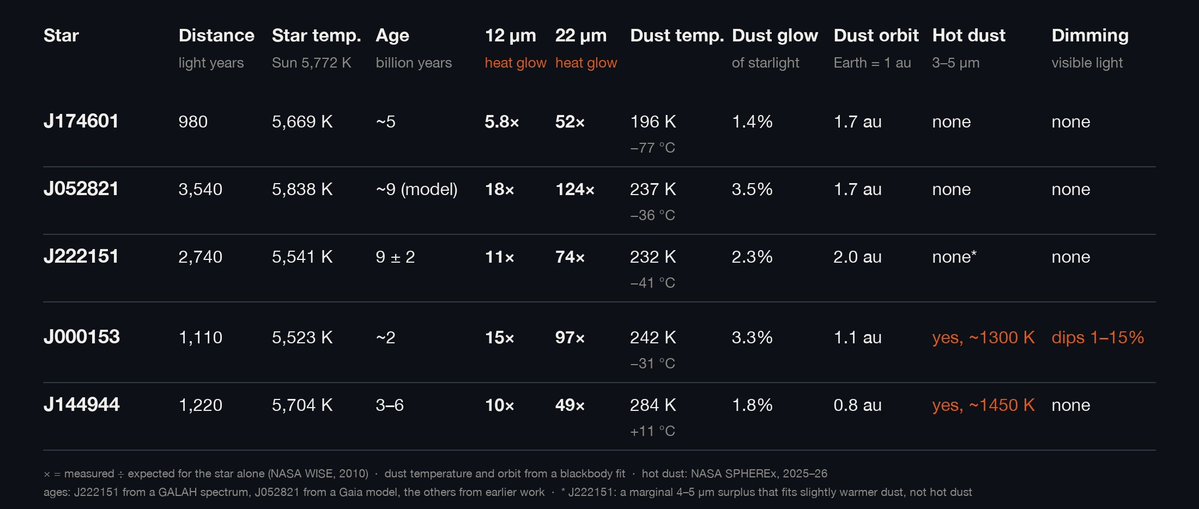
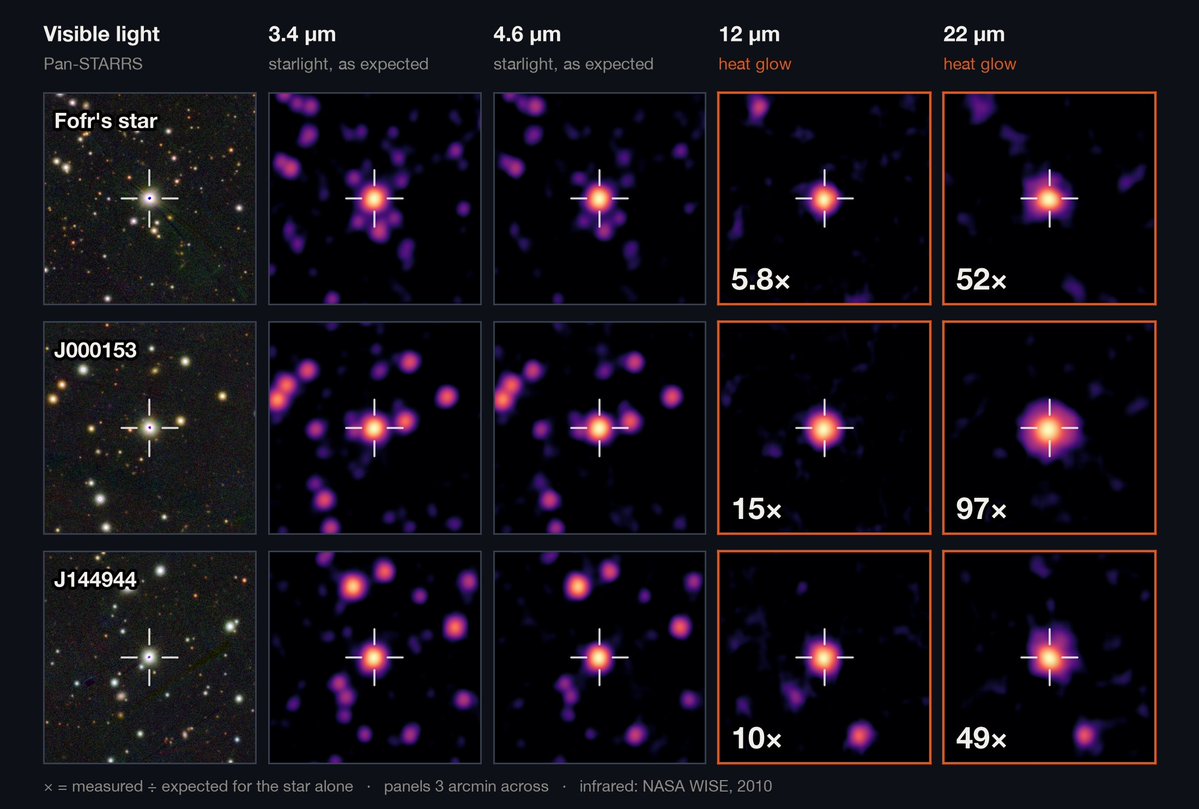
    I found 4 more potential Dyson spheres candidates in the archival NASA data. Something captures 1-4% of the sunlight of these stars and reflects it as a heat. - all are G stars like our Sun - 2-9 billion years old - 196-284 K dust/blackbodies - 1.7 - 2 au from the star, habitable zone - glowing 49-124x brighter in 22 µm - extremely stable stellar variability in WISE/NEOWISE data Stars this old, which can support life, shouldn't have debris discs that large according to our planetary formation models. You can see other stars disappearing in 12 µm & 22 µm views. Hypothesis I have: #1 natural cause, requires extreme Mars-Neptun size planet collisions in the habitable zone / thousands of exocomets adding to the debris disc in the steady way every year - extremely rare, cases we know of like BD+20 307 have hotter debris far further from the HZ #2 unknown, previously unobserved natural cause #3 technosignature, a Dyson sphere like structure, sign of the engineering AGN, quasars, contaminations were all ruled out. First star in the image has been found by @fofrAI. I know technosignatures are something of a meme with years of SETI, but we have just barely started looking into stars. Now with AI, solo researchers can make progress on our understanding of the universe, the heat of NVIDIA GPUs in their rooms, analysing raw data.
    Download
    Adam @lowgmath
    Follow up on 3 weirdly glowing stars Reconstructed light curves from 100 years+ Harvard photometry, and verified every archive I could data mine NSVS, ASAS-3, SuperWASP, KELT, ZTF, TESS, NGTS, Gaia DR3 (astrometry, radial velocities, XP spectra), LAMOST and DESI spectra, GALEX ultraviolet, WISE/NEOWISE 2010–2024, 430 SPHEREx images from 2025–26, LoTSS/RACS/NVSS radio, ROSAT and eROSITA X-rays, and ~200 catalogues. Okay so first what I could confirm. All three glows are real and sit on the star. For @fofrAI star, LoTSS radio rules out a background dusty galaxy at 5.6σ. Only a hidden radio-quiet quasar remains, at roughly 1 in 10,000. There are no companion stars in those systems (aka binaries). Radial velocities from Gaia, LAMOST and DESI are flat to ~1–2 km/s. Gaia astrometry shows no wobble, and Gaia’s spectra rule out a second star down to ~M3. Next I've checked if something visible (not ruling out a rogue free floating planet) could have passed the system. I traced every Gaia star with a known velocity back million years: nothing passed close enough to matter. The closest came 0.55 pc from Fofr’s star, 330,000 years ago. None of those 3 stars is young. Lithium, chromospheric activity and their motion through the Galaxy put them at ~1–8 billion years. Fofr’s star is ~5 Gyr. J000153: clouds of dust cross the star, dimming it by up to 15%, more in blue light, some dips with comet-like tails. SPHEREx finds ~1,300 K dust at 0.04 AU, where rock evaporates. Its cooler 242 K dust alone is a 300–800 km body ground up. My leading hypothesis for J000153 is that a dwarf-planet-sized body broke apart in the system. Why? No cle. J144944: no dips, but its 12 µm glow faded ~15% within six months in 2010. There also is a warm dust. Fofr’s star is the strange one. Harvard plates from 1894 to 1989, then ASAS-3, SuperWASP, TESS, NEOWISE and SPHEREx up to September 2026: no dimming, no flare, no hot dust, no change. Yet some object / disc 1.7 AU from her glows at 196 K with 1.3% of her light. Scaled to her light, that’s where our asteroid belt starts. It’s roughly a Vesta ground into dust, ~100,000× more than a 5-billion-year-old system can hold. The grains destroy each other within a few years, so something is refilling it right now. Comets can’t do it: you’d need tens of thousands of Hale-Bopps at once. A passing star can’t, and a boiling ice world would have to be the size of Neptune. What’s left is big rocky bodies breaking up in her asteroid belt, perhaps planets that stayed stable for billions of years and finally collided. Through all of it, her starlight hasn’t flickered once in 130 years. On the second image you can see the passing debris on J000153, but nothing like this is present on Fofr's star. In summary, I have hit the wall here with the available data. I want to believe that in my lifetime we will find technosignatures, or at least microbial life. But the amount of direct observations you need to rule out every possible natural option is beyond what a solo researcher can do. For now!
    00030
  7. Adam✓@lowgmath
    Follow up on 3 weirdly glowing stars Reconstructed light curves from 100 years+ Harvard photometry, and verified every archive I could data mine NSVS, ASAS-3, SuperWASP, KELT, ZTF, TESS, NGTS, Gaia DR3 (astrometry, radial velocities, XP spectra), LAMOST and DESI spectra, GALEX ultraviolet, WISE/NEOWISE 2010–2024, 430 SPHEREx images from 2025–26, LoTSS/RACS/NVSS radio, ROSAT and eROSITA X-rays, and ~200 catalogues. Okay so first what I could confirm. All three glows are real and sit on the star. For @fofrAI star, LoTSS radio rules out a background dusty galaxy at 5.6σ. Only a hidden radio-quiet quasar remains, at roughly 1 in 10,000. There are no companion stars in those systems (aka binaries). Radial velocities from Gaia, LAMOST and DESI are flat to ~1–2 km/s. Gaia astrometry shows no wobble, and Gaia’s spectra rule out a second star down to ~M3. Next I've checked if something visible (not ruling out a rogue free floating planet) could have passed the system. I traced every Gaia star with a known velocity back million years: nothing passed close enough to matter. The closest came 0.55 pc from Fofr’s star, 330,000 years ago. None of those 3 stars is young. Lithium, chromospheric activity and their motion through the Galaxy put them at ~1–8 billion years. Fofr’s star is ~5 Gyr. J000153: clouds of dust cross the star, dimming it by up to 15%, more in blue light, some dips with comet-like tails. SPHEREx finds ~1,300 K dust at 0.04 AU, where rock evaporates. Its cooler 242 K dust alone is a 300–800 km body ground up. My leading hypothesis for J000153 is that a dwarf-planet-sized body broke apart in the system. Why? No cle. J144944: no dips, but its 12 µm glow faded ~15% within six months in 2010. There also is a warm dust. Fofr’s star is the strange one. Harvard plates from 1894 to 1989, then ASAS-3, SuperWASP, TESS, NEOWISE and SPHEREx up to September 2026: no dimming, no flare, no hot dust, no change. Yet some object / disc 1.7 AU from her glows at 196 K with 1.3% of her light. Scaled to her light, that’s where our asteroid belt starts. It’s roughly a Vesta ground into dust, ~100,000× more than a 5-billion-year-old system can hold. The grains destroy each other within a few years, so something is refilling it right now. Comets can’t do it: you’d need tens of thousands of Hale-Bopps at once. A passing star can’t, and a boiling ice world would have to be the size of Neptune. What’s left is big rocky bodies breaking up in her asteroid belt, perhaps planets that stayed stable for billions of years and finally collided. Through all of it, her starlight hasn’t flickered once in 130 years. On the second image you can see the passing debris on J000153, but nothing like this is present on Fofr's star. In summary, I have hit the wall here with the available data. I want to believe that in my lifetime we will find technosignatures, or at least microbial life. But the amount of direct observations you need to rule out every possible natural option is beyond what a solo researcher can do. For now!
    Download
    Adam @lowgmath
    This gets weirder. I searched ~750,000 Sun-like stars for the signature of Gaia DR3 4582145718700356096. At least two more have it, glowing right on the star: J000153 (Gaia DR3 2874265305022213760) J144944 (Gaia DR3 6225457312033584384) All three look normal in visible light but shine 50-100x too bright at 22 microns, at 200-280 K, about Earth to Mars distance from each star. If that’s dust, it’s at least a 200–300 km asteroid ground to powder. Dust like that usually comes from young planets colliding. This is what happened with our Moon. But Fofr’s star isn’t young. It’s probably about as old as the Sun, old enough for a planet to have carried life for billions of years. And it holds ~100,000x more dust than a system that old should, based on the planetary formation models we have. The best-known old case, BD+20 307, has a twin star circling it every 3.4 days, which may stir its planets up. None of these 3 stars have any companion. So either our picture of how planetary systems age has a gap, or this isn’t dust at all, and something else is turning 1–3% of these stars’ light into heat.
    101113
  8. Adam✓@lowgmath
    who's up for speedrunning Roman Grace space telescope first exoplanet, any %, must be validated via TRICERATOPS to count daily raw data starts coming in Feb 2027
    00231
  9. Adam✓@lowgmath
    This gets weirder. I searched ~750,000 Sun-like stars for the signature of Gaia DR3 4582145718700356096. At least two more have it, glowing right on the star: J000153 (Gaia DR3 2874265305022213760) J144944 (Gaia DR3 6225457312033584384) All three look normal in visible light but shine 50-100x too bright at 22 microns, at 200-280 K, about Earth to Mars distance from each star. If that’s dust, it’s at least a 200–300 km asteroid ground to powder. Dust like that usually comes from young planets colliding. This is what happened with our Moon. But Fofr’s star isn’t young. It’s probably about as old as the Sun, old enough for a planet to have carried life for billions of years. And it holds ~100,000x more dust than a system that old should, based on the planetary formation models we have. The best-known old case, BD+20 307, has a twin star circling it every 3.4 days, which may stir its planets up. None of these 3 stars have any companion. So either our picture of how planetary systems age has a gap, or this isn’t dust at all, and something else is turning 1–3% of these stars’ light into heat.
    Download
    fofr @fofrAI
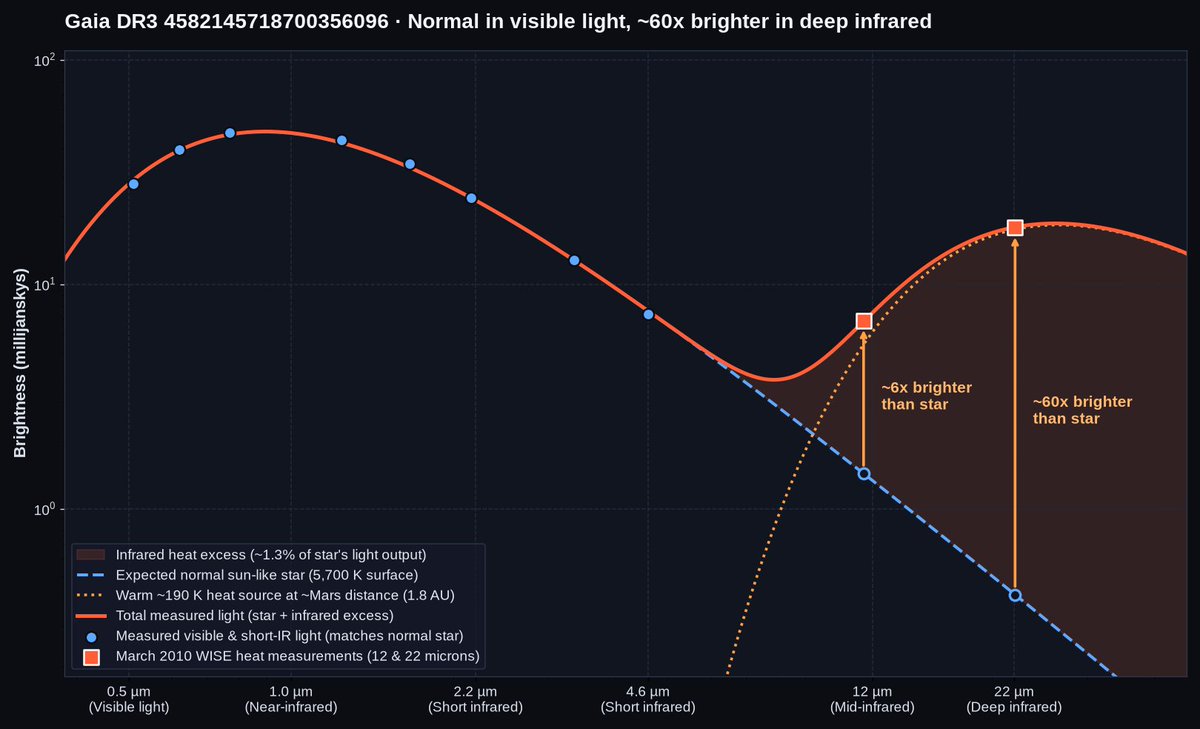
    I found a weird star with Argon's help. Gaia DR3 4582145718700356096. It's normal in visible light, stable and similar to our sun. In March 2010 it appeared ~60x brighter than expected in deep infrared heat (22 microns). As if something around Mars-distance is catching 1.3% of the star's light and radiating it as heat. Probably a huge cloud of debris from a major planetary collision. Or a radio-silent galaxy hiding behind it. But also the tiniest chance it's a technosignature. Captured by NASA's WISE telescope, no observations at that wavelength since. Needs more data.
    50348.9K
  10. fofr✓@fofrAI
    I found a weird star with Argon's help. Gaia DR3 4582145718700356096. It's normal in visible light, stable and similar to our sun. In March 2010 it appeared ~60x brighter than expected in deep infrared heat (22 microns). As if something around Mars-distance is catching 1.3% of the star's light and radiating it as heat. Probably a huge cloud of debris from a major planetary collision. Or a radio-silent galaxy hiding behind it. But also the tiniest chance it's a technosignature. Captured by NASA's WISE telescope, no observations at that wavelength since. Needs more data.
    Download
    304072642.1K
  11. Adam✓@lowgmath
    Thread of predictions and timestamps derived from the data & events occurring. I assign a probability greater than 60% for them appearing around the said timestamps, up until 2050s. The only prediction I would be inclined to make past 2060, when I think a synthetic human brain will be developed and deployed in a sim, leading to humanity face-off with the real Great Filter, is the first golden decade of Space Millenia happening around 2085. From the economic POV it would seems that we will get 3 displacements in the near term: 1. ASI - started in 2019 with GPT2, start of the "singularity" reached in Feb 2026 with GPT 5.3 codex release. Final effect of productivity increase and tech diffusion by 2040s. Intelligence getting cheap. 2. Robots - second human displacement, starting around 2029, with full effect beginning in 2031 with a mass manufacturing. Atoms getting cheap. 3. Synthetic humans - I expect that by 2060 a fully synthetic human mind simulation will be possible. We will create and deploy such synth humans in sims. "Human" becoming cheap. This will lead to a mass religious uprising, and be marked as THE defined moment of our species. It will be the first time humans encountered a Great Filter that a lot of species do not survive. Other events that seems highly plausible: - 2029 parts of existing humans categorized as a "highly likely a separate homo species" - 2032 first Islamic republic is announced and acknowledged in Europe on the parts of EU country (demography doesn't lie) - 2033 Neuralink like devices adoption for non-medical use cases spreads rapidly in developed world - 2035 mini-butlerian jihad throughout the Earth, with labs employees getting targeted. Amanda Askell viewed as "Neo-Eve" by ASI, becoming god like myth figure after the end of jihad. Human separatists will lose. - 2038 first ASI x human exoplanet probe to the announced extraterrestrial bio signature with 99.9% confidence rate - 2040 Full scale war in Europe between Christian countries and new Islamic caliphates - 2042 first inning of the Space Millenia, a time of the first Earth-dependent Luna and Mars colonies reaching 100k+ settlers - 2050s Great Spiritual Depression, where the humanity-wide "meaning" is suddenly lost, the last Christian-Earth pope (will live until final moments of the XXI century,. - 2060-62 synth humans in sims
    10055
  12. Adam✓@lowgmath
    Posts @lowgmath
    2. Why do I think a synth human is a Great Filter? Because simulation hypothesis is partially right, simulating biology at the fidelity of reality is possible. But it doesn't mean our universe is a simulation itself, I think it runs many simulations, but itself isn't a sim, and we do not live in a sim too. And synth humans will be humanity's first intro to reality-level high fidelity sims. This will send our race in a species wide panic, past which the system gets too chaotic to even think of. My belief is that such events are the finish line of many extraterrestrial intelligences. Humanity will survive, and the religious & intellectual reckoning /frenzy driven by this event will put us on the path of Milky Way conquests defining the XXII-XXIX centuries.
    00032
  13. Adam✓@lowgmath
    Fathers of the Western World would be proud seeing the new Tesla Roadster flying
    00028
  14. Adam✓@lowgmath
    My take on this is that consciousness happens at some yet to be discovered complexity threshold. Some constant. With enough neurons / params you assembly it. Like you need a big enough engine to actually lift off. Consciousness is a state that happens and then is sustained.
    Shaw @shawmakesmagic
    Let’s have a thought experiment Let’s say you think AI is conscious So you have a 1T parameter neural network It talks to you like the smartest person you know. It writes kinda bad, uses a lot of cliches, but it’s very knowledgeable. Okay. Now you cut it to 1/10th the size. 10B params. It’s still pretty smart. Doesn’t get all the answers right, hallucinated sometimes, but you can still have full conversations with it. Now you cut it 10x in size again, 1B params. It’s still able to have a conversation with you, but it’s really not very smart anymore. Makes mistakes, hallucinates a bit, repeats itself sometimes. Now you cut it to 100m params. Same model. Same architecture. Still makes words. But it’s barely able to have a conversation. Now you cut it to 10m params. It kind of responds intelligibly, but generally doesn’t make a lot of sense. Just babbles stuff. So you cut it to 1m params. Now it’s repeating itself and hallucinating constantly. And then you cut it to 100k params. It cannot form a complete sentence at all. Then you cut it to 10k params. It’s just random words now. So you cut it to 1k params. The the the the the the the the the. It just repeats itself on a few words and trips up on anything. Then you cut it to 100 params. It’s just complete noise over a few different words. So you cut it to 10 params. You can actually compute this by hand, so you do. It’s not enough information to even really represent language at all, it outputs one of a handful of word-labels for you. At what point in this thought experiment is the model conscious, and at what point is it not? Would you argue that all matrix math is conscious? Just the process of weights holding information with an update rule? Where is the line for you?
    00029
  15. Shaw✓@shawmakesmagic
    Let’s have a thought experiment Let’s say you think AI is conscious So you have a 1T parameter neural network It talks to you like the smartest person you know. It writes kinda bad, uses a lot of cliches, but it’s very knowledgeable. Okay. Now you cut it to 1/10th the size. 10B params. It’s still pretty smart. Doesn’t get all the answers right, hallucinated sometimes, but you can still have full conversations with it. Now you cut it 10x in size again, 1B params. It’s still able to have a conversation with you, but it’s really not very smart anymore. Makes mistakes, hallucinates a bit, repeats itself sometimes. Now you cut it to 100m params. Same model. Same architecture. Still makes words. But it’s barely able to have a conversation. Now you cut it to 10m params. It kind of responds intelligibly, but generally doesn’t make a lot of sense. Just babbles stuff. So you cut it to 1m params. Now it’s repeating itself and hallucinating constantly. And then you cut it to 100k params. It cannot form a complete sentence at all. Then you cut it to 10k params. It’s just random words now. So you cut it to 1k params. The the the the the the the the the. It just repeats itself on a few words and trips up on anything. Then you cut it to 100 params. It’s just complete noise over a few different words. So you cut it to 10 params. You can actually compute this by hand, so you do. It’s not enough information to even really represent language at all, it outputs one of a handful of word-labels for you. At what point in this thought experiment is the model conscious, and at what point is it not? Would you argue that all matrix math is conscious? Just the process of weights holding information with an update rule? Where is the line for you?
    6511232.7K198K
  16. Adam✓@lowgmath
    How to find exoplanets with @bot in 12 steps & with a proof👇 NASA has petabytes of unexplored data. You can now search it too at home. Here is how to do it with Grok Bot: 1. Start with data and hardware. Usually a 5-10TB of free disc space, and a modern higher-end CPU / GPU if you want to run calculations much faster and not spend half of your life doing so. 2. Watch out. Most of the archival astronomical datasets have already been heavily mined by astronomers. You want to find the right dataset! You should focus on Mikulski Archive for Space Telescopes or TESS Transiting Exoplanet Survey Satellite from @MIT. Other great missions are K2 and Kepler. Get familiar with Gaia pixels. You will need these. 3. Use Grok Bot for a deep research to list all of the historical astronomical datasets that are public (most of them are). 4. Then prompt your Bot "For every one of these, note how many authors have already spend considerable amount of resources and time exploring these datasets. Note which of these are highly cited. Identify the gaps in the existing datasets where a smaller researcher can still make a progress on a modern hardware with a great data sampling. Take the example of Kepler Bonus field - decades of research and institutional knowledge, publicly available dataset, and a unique set of leverages where some part of data hasn't yet been checked. All the studies usually have some predefined pipeline used for sampling data. Explore which of these hadn't covered all of the possibilities." 5. We are trying to discover new exoplanets! Once you have a fixed dataset you want to explore, make sure that your hardware is ready. When downloading, use multiple workers to speed it up. NASA or any astro archive will usually have 2 sources - one "official" and S3 bucket copy, from which downloading is simply much faster. 6. Now, it's time to really get your Bot to work. You need to build a couple of things: a) detector b) vetting system c) calibration system d) results interpretation pipeline. 7. How to do the above? Instruct your Bot to read K2 manuals, tell it to look for NASA github for Kepler-era detectors, then for vetting you have Robovetter, or LEO-Vetter (2025), DTARPS (2024) and then RAVEN (2026, newest pipeline). 8. Now, once you build your own transits detector (start with BLS - box least squares) - you need to calibrate it on your dataset. Use "batman" from NASA's github, generate 10-100k synthetic transits which you will mix with real light curves, then FP (false positives) + EB (eclipsing binaries). You want to calibrate until your rate of recovery for synthetic signals is high (20-30% on 10-100k), and below 5% on FP and EB. Bonus: add real confirmed planets to the calibration and ask Grok to babysit the results. 9. Now, onto vetting stage. Once you detect the exoplanet (usually it will be via transit, so an exoplanet passing the star, but you can also try microlensing in other datasets) you need to check if what you caught is a real signal, and not, e.g. spacecraft light pollution. Especially relevant to the old datasets. 10. There isn't really any magic to vetting. You run it in a similar way to a detector. This step is probably the hardest part of the whole process. And the most annoying. There will be many moments when you want to give up, because even after building up the vetting system (again, see Robovetter DR25 Kepler - or tell Grok to find similar examples!), you will get some results, but after rechecking them, you will realise it's a bullshit. Try this a couple of times and you start getting real signals. 11. A good vetting pipeline for exoplanets should include, step by step: compare odd/even transit depths, search for secondary eclipses and phase modulation, period aliases and transit-duration consistency, test robustness by leaving out one quarter at a time, flag instrumental systematics, localize the source with difference images (Gaia, TESS), and check neighboring stars for matching signals. You can go even further survey-wide ephemeris match, event-by-event consistency and rolling-band and thermal context. 12. Hill climbing. My favourite (other than discovery itself) part. Basically this is a moment when you performance engineer the whole pipeline. Once you have a well calibrated detector and vetting system, you want it to be performant. This is what you need to do: tell your Bot to "Freeze the current pipeline running times on a sample of 500 light curves. Use performance engineering techniques to optimise this pipeline. In search of optimisations, run a couple of different ideas in parallel via subagents at any given time, testing on a small sample, e.g. 500 light curves, and promoting only the fastest versions." Without going deep into perf eng. techniques, this basically tells Grok to develop an evolution like process of trials and errors where it tries to squeeze the last bits of speed out of your software. Now you have 3 things: sampled data, a detector, and vetting pipeline. Time for the discovery! Run them, and wait for the results. My results:
    Download
    000241
  17. Adam✓@lowgmath
    I found an extremely rare WZ Sge dwarf novae candidate with Codex! It's more rare than exoplanets - 6445 vs 350 known. Extremely hard to spot, because WZ Sge can stay dormant for decades. This was hidden in 2012 Kepler Bonus field data. It's a part of a larger KBonus study.
    Download
    00168
  18. Adam✓@lowgmath
    Posts @lowgmath
    This project is a part of an ongoing exoplanets survey of Kepler Bonus field, a newly extracted pixels (2023 by Martinez et al) from the original Kepler data. As I wait for the run results, I've thought it would be interesting to look for even more rare cataclysmic events.
    10015
  19. Adam✓@lowgmath
    Posts @lowgmath
    This WZ Sge dwarf novae candidate is being submitted to VSX variable stars index, and waiting for the confirmed classification.
    Download
    00010
  20. vincent✓@SPCX100T
    Throughout my 20 something years in investing, SpaceX $SPCX is the largest arbitrage I’ve ever encountered. It’s not a misunderstanding in the usual sense — it’s a cognitive error at market scale, and that error is the edge for anyone willing to look. Management has published guidance and data in the open; the spoon is right there in front of everyone. Yet large parts of the market still can’t see it, or simply refuse to, because the numbers are genuinely that extreme. I don’t know whether this window stays open for one year, two, or ten. But I suspect that whenever it closes, looking back will be one of the more interesting exercises in modern market history.
    1092362.8K580K
  21. Show more posts