Raanan Bar-Cohen
RT @IainMacBets: No exaggeration, this guy might be the best interview in pro sports right now
04.7K03

@raanan
Co-Founder @ResoluteVC: We lead super early seed rounds, including @ActiveFence @AppZen @AvenCard @greenhouse @HelloHeartApp @opendoor @paces_ai @ujetcx @vercel
Tesla @TeslaRoadster

Moritz Kremb @moritzkrembI told Claude to make a video about what it's like to be European One day later...

Peter H. Diamandis, MD @PeterDiamandisCongrats to @PalmerLuckey and Anduril for winning the Wildfire XPRIZE - for detecting and suppressing a wildfire within 10 minutes of ignition!


Vercel @vercelJev was adopted faster than any other model in AI Gateway history. In the first day, @typesafeai reached ~13% of teams, 2x the GPT-5.6 family and 6x Fable 5.1.


Brandon Luu, MD @BrandonLuuMDFrequent video gamers performed on cognitive tests like non-gamers that were ~13.7 years younger


el.cine @EHuangluchina’s AI robot just hit 14.5 m/s

Guillermo Rauch @rauchgThis was wild to watch unfold. We ran 𝚒𝚜-𝚊𝚐𝚎𝚗𝚝𝚒𝚌 in a loop against until it got to 100/100. It made us close quite a few gaps. We worked hard to make sure the criteria is high quality and worth your time & tokens.

Sawyer Merritt @SawyerMerrittJPMorgan after meeting with Tesla recently in Fremont: "Tesla indicated it is intentionally holding back on adding Model Y units to the robotaxi fleet, expressing confidence in its ability to scale Cybercab in the near-term. On FSD V15, Tesla views this release as a step-change in performance, comparable to the leap from V13 to V14. The V15 upgrade encompasses seven core technologies, with ~40% of those currently being tested in the robotaxi fleet, where initial feedback has been encouraging. Tesla continues to focus on minimizing regression in core driving functions as it introduces new functionalities to the system, and FSD V15 is seen as the primary gateway to scaling unsupervised FSD. While the current AI/HW4 stack is capable of running V15 and supporting unsupervised FSD, Tesla’s AI4.5 compute system is designed to future-proof against rising compute (~10% higher FLOPS) and memory (~2x higher) demands as robotaxi models scale and context windows expand. Management also reiterated that the Cybercab is just the initial form factor, with additional vehicle types expected to follow as the platform evolves (citing the obovan demo from the 10/10 event as an example). Optimus is on track for SoP in the coming months with commercial sales expected as early as 2H27. The Gen 3 unveil will be timed closer to SoP to protect competitive advantage, while the scope of Gen 4 (in terms of capability, cost, and scalability) will be informed by Gen 3 field experience." JPMorgan toured Tesla's Fremont factory and met with the IR team, and maintained its $TSLA price target of $475.


SpaceX @SpaceXDeployment of all three BlueBird satellites confirmed

Maor Shlomo @MaorShlomoTLDR: I’ve started a small fund from my Base44 money that’s focused on cancer research and breakthrough therapies. I’ve invested in 7 incredible companies in the past 4 months and plan to do more as my liquidity allows. Listing my investment thesis below I welcome anyone like me who has been blessed financially to join me and find ways to finally manage or even end this disease. Longer - I honestly believe cancer is humanity's worst enemy. ~40% will be diagnosed with it, and out of which a ~third won’t make it. And numbers are currently not getting dramatically better. For many it might sound like a statistic But for some of us who have been there ourselves or had to go through it with a person we love, it’s one of the worst things you can imagine. I had to go through it with my mom - who passed away 4 months ago and whom I miss and think about every single day since. This field needs a dramatic push. The current wave of technology and AI is doing a lot of good in the world, But cancer therapy is one of those things that are not moving nearly fast enough. And there’s no good reason for that - AI is creating so much opportunity right now. Here's my thesis on how things will play out: For drug development, the bottleneck will shift to 1. Manufacturing 2. Real world testing "In silico" is going to accelerate incredibly fast. AI is identifying new target proteins and designing new molecules, drastically shortening timelines. AI will create an abundance / inflation of ideas. It will help design molecules faster than anything historically possible. This is already happening. Play with Claude Science or Codex and you'll be surprised at how far you can get with just a few prompts. We need a better way to *manufacture and test* the 1000s of ideas coming from AI models spitting out potential drug candidates 1. Manufacturing: i.e. how fast can we synthesize a potential drug Not too far into the future, companies with manufacturing excellence will win over companies with the smartest scientists. Being able to synthesize a drug candidate fast - together with efficient methods to test efficacy (more on that below), basically means you get more shots at a target hence more chances at succeeding. This is the same exact lesson the software industry learned about the importance of fast iterations. Companies like Starget Pharma are leveraging AI heavily to iterate on drug candidates + figured out in-house manufacturing in a way that lets them iterate on drugs almost as fast as if they were a software company iterating on features. 2. Real world testing: i.e. how fast can we get a call on a drug's efficacy. We need better real-world indicators for drug efficacy than mouse / animal models. The success rate of animal models -> human clinical trials is less than 8%. Breaking down this bottleneck will change the entire industry. Developing an oncology drug and taking it through all clinical trials usually cost >> $ 100m Thus taking the wrong bet is devastating (but still, happens a lot). Giving drug development companies the ability to better understand the efficacy and mechanisms of their drugs will change a lot. Esp in the age of abundant drug candidates. Furthermore - and once those methods proved efficient - Joining forces with regulators to shorten (or even skip) some clinical trials altogether will cut years from the process and save many lives by bringing new drugs to market faster. CuResponse is pioneering functional testing - taking real cancer biopsies and showing drug efficacy with very high precision. Can be used for precision oncology as well as testing new drugs. Cellint is providing a fully automated cell-culture R&D platform for companies and researchers. ---- I’d love to see a future where there are “cloud services” for drug development companies. A company should eventually be able to submit a drug candidate programmatically and receive: 1. The synthesized drug. 2. Testing across cells, tissues, organoids, and tumoroids. 3. Structured results showing what worked, what failed, and why. 4. A recommended next iteration derived from the biological reactions. I’ve invested in all of the above companies and am searching for additional companies to bring this “cloud services for drug dev” vision to life. ---- Alongside it, I am also investing in direct therapeutic moonshots. I invested in Baccine, which is developing a bacteria-based cancer immunotherapy platform and deserves an entire separate post. I’m also a proud LP in Even One Ventures - @sytses ’s fund to fight cancer. Sid and Jacob Stern are an inspiration to me as I’m making my first steps in the field, and I bet their companies will make a massive impact. And 3 other incredible companies focused on how therapies are delivered - where I’ll elaborate in future posts. ---- I’m still obviously spending most of my time on Base44. Which is a plus for the companies - as we’re able to support them with tools, software, AI agents, etc. I’m looking for people to join me - invest side by side or help one of the companies. I don’t have a name for the fund yet, nor an email or a website I will get to it this weekend and will post it in the comments.

Justin Skycak @justinskycakYou cannot be creative at a high level unless you are robotic at a low level.


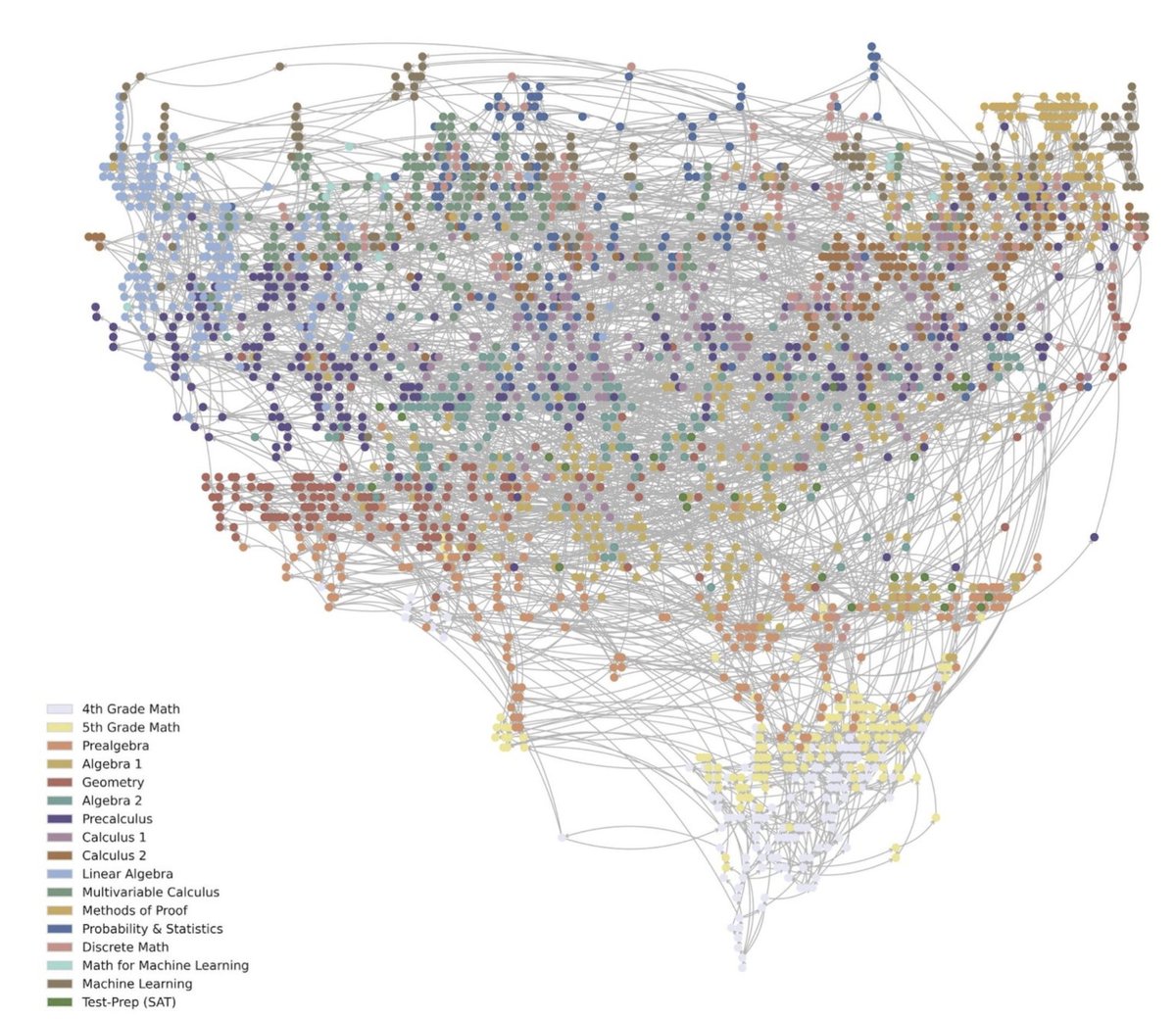
Alex Smith @ninja_mathsFor anyone wondering how a third-grader can complete six years' worth of math in a single year AND score a 5 on the AP Calculus exam. This knowledge graph spans 3,000 math topics, from 4th grade to the university level, providing the perfect basis for mastery learning. Students can go as fast or far as they want! There are no restrictions whatsoever. The only requirement is that they must demonstrate mastery of each topic before moving on to the next. Kids are capable of incredible things when given that kind of freedom and support.