Thomas Bloom

@thomasfbloom

Royal Society University Research Fellow at the University of Manchester. Mathematician and owner of https://t.co/SWVqqnq9hn. He/him/his.

108 Following6.5K Followers1.8K Posts
  1. Thomas Bloom@thomasfbloom
    The Royal Society is hosting a one day event today on "Mathematics in the age of AI", with lots of interesting talks and panel discussions. You can follow the livestream (on right now!) at
    218857.7K
  2. Thomas Bloom@thomasfbloom
    This is very impressive (and useful!). CFSG is one of the great feats of 20th century mathematics. The complexity and length of the formalisation makes me even more in awe of the humans who originally created and understood the proof, without the aid of computers...
    Axiom @axiommathai
    The largest math proof in human history is now computer-verified. Today, Axiom announces a complete Lean auto-formalization of the Classification of Finite Simple Groups, the "periodic table of symmetry." About 15,000 pages, built by over 100 mathematicians across generations.
    57934.1K
  3. Axiom✓@axiommathai
    The largest math proof in human history is now computer-verified. Today, Axiom announces a complete Lean auto-formalization of the Classification of Finite Simple Groups, the "periodic table of symmetry." About 15,000 pages, built by over 100 mathematicians across generations.
    Download
    4221.3K7.1K3.7M
  4. Thomas Bloom@thomasfbloom
    An interesting remark from Xiao Hu regarding the OpenAI Kakeya proof claim (via PDE theory): "hacking out the original formulation of the Kakeya set conjecture with some surprisingly simple and elementary PDE constructions, while looking cool... 1/
    41217139.4K
  5. Thomas Bloom@thomasfbloom
    Posts @thomasfbloom
    I disagree with Xiao about the OpenAI proof not having 'much theoretical implications' since it does give more than Kakeya (e.g. Fourier restriction), but it does seem to point to a *different* set of implications. 5/
    15586.3K
  6. Thomas Bloom@thomasfbloom
    Posts @thomasfbloom
    (Of course I, along with almost everyone else, has no real idea how the OpenAI proof works properly yet, just as we don't know the full potential scope of the Wang-Zahl (and others) approach, so lots still to explore and understand about scope here.) 6/6
    02525.9K
  7. Thomas Bloom@thomasfbloom
    Coincidentally, this morning I watched Queen Elizabeth's first televised Christmas message in 1957. This part struck me as still relevant: "That it's possible for some of you to see me today is just another example of the speed at which things are changing all around us... 1/5
    11264.2K
  8. Thomas Bloom@thomasfbloom
    Posts @thomasfbloom
    (This was because I have been watching The Crown and got curious about that period of British history. It is not usual for British people to start their day by watching old speeches by the Queen.) 4/5
    1015646
  9. Thomas Bloom@thomasfbloom
    Posts @thomasfbloom
    The Queen also went on to give religion/morality as her examples of these ageless ideals which were being discarded. I don't think the same applies here. My general point is "how do we take advantage of the new without losing the best of the old" is the right question. 5/5
    1116606
  10. Thomas Bloom@thomasfbloom
    Good arguments, I agree with the AGMAI. (Disclaimer: Tim and I have been involved as 'specific mathematicians', invited by OpenAI to view and comment on the unit distance counterexample weeks before its public release. I don't think this should happen again in the future.)
    Timothy Gowers @wtgowers @wtgowers
    AGMAI has posted a statement to clarify one aspect of its recent recommendations to AI companies, concerning whether they should nominate specific mathematicians to work on understanding their results. Tl;dr we think it's better if they don't.
    31477.5K
  11. Timothy Gowers @wtgowers@wtgowers
    AGMAI has posted a statement to clarify one aspect of its recent recommendations to AI companies, concerning whether they should nominate specific mathematicians to work on understanding their results. Tl;dr we think it's better if they don't.
    142616238.1K
  12. Thomas Bloom@thomasfbloom
    The 'paper map', or dependency graph, tool here makes it a lot easier to navigate the very long papers generated by OpenAI - worth checking out. (I haven't tried the other features it offers yet, so can't comment on how helpful those are.)
    Irena Saracay @irena_gao
    We're interested in understanding how to make AI-generated research papers more understandable for relevant research communities. If you're a mathematician reading the recent OpenAI results, check out This project aims to make these papers easier to read, through: (1) Readable Versions that rewrite them for clarity and (2) visualization/AI tools to help understand the argument. We'd love feedback from the mathematics community --- please check out the site and reach out to the team!
    13252.5K
  13. Irena Saracay@irena_gao
    We're interested in understanding how to make AI-generated research papers more understandable for relevant research communities. If you're a mathematician reading the recent OpenAI results, check out This project aims to make these papers easier to read, through: (1) Readable Versions that rewrite them for clarity and (2) visualization/AI tools to help understand the argument. We'd love feedback from the mathematics community --- please check out the site and reach out to the team!
    611669.2K
  14. Thomas Bloom@thomasfbloom
    Posts @thomasfbloom
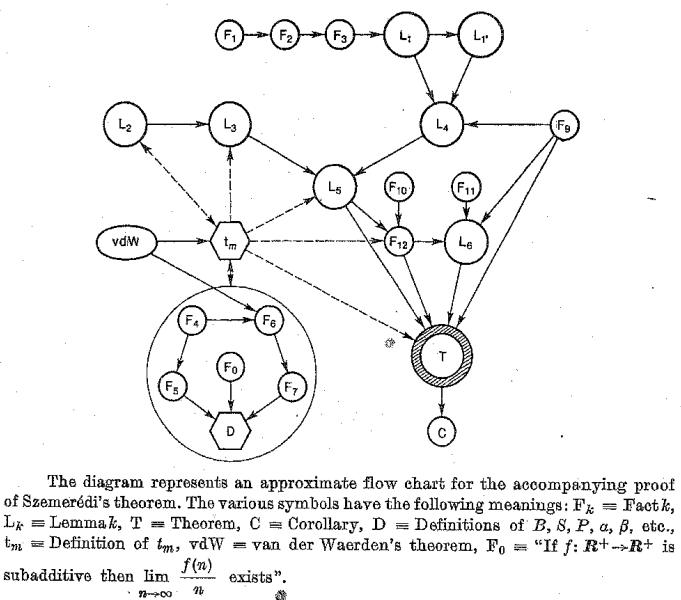
    Reminds me of the dependency graph provided to help the reader navigate Szemeredi's paper, containing the first (long and intricate) proof of Szemeredi's theorem. (Note that this paper was actually written by Graham and Hajnal, after Szemeredi explained the proof to them)
    Download
    1112930
  15. Thomas Bloom@thomasfbloom
    A great video that I recommend everyone interested in maths watch (especially those on this site who say "mathematicians are cooked" etc)
    23262.3K
  16. Thomas Bloom@thomasfbloom
    Ben Green has written a very nice version of the proof that no Siegel zeros exist - only 5 pages, and self-contained elementary arguments:
    42015814.1K
  17. Thomas Bloom@thomasfbloom
    Posts @thomasfbloom
    This is, it seems, much simpler than the original OpenAI paper (Ben found this by 'vibemathsing' with GPT starting from that original paper).
    10222.5K
  18. Thomas Bloom@thomasfbloom
    Posts @thomasfbloom
    (Not entirely self-contained to get no siegel zeros, you need a bit more to go from his sum estimate to a statement about zeros, but this step is completely standard and was well known a long time ago.)
    10242K
  19. Show more posts