Jasper✓

@zjasper

Founder and CEO @Hyperbolic_Labs. ex-@citsecurities. Finished Math PhD in 2yrs @UCBerkeley. Math Olympiad Gold Medalist. Highest honor @PKU1898

1.9K Following15.4K Followers4.8K Posts
  1. Jasper✓@zjasper
    AI is great at hitting explicit goals, but often at the cost of the hidden ones. Terence Tao just wrote about this. He points out: AI is the ultimate executor of Goodhart’s law, i.e. when a measure becomes the target, it stops measuring what we care about. Take a call center. Management sets a KPI: “shorten average call time.” Sounds reasonable: shorter calls should mean faster resolutions, happier customers. At first, it works. Agents become more efficient. But soon, people start gaming it: nudging customers to hang up when the problem is tricky, or just dropping the call themselves. The numbers look amazing. Call times plummet. But customer satisfaction? Straight into the ground. Now replace “call time” with “prove theorem X.” If human mathematicians did it, they’d refine definitions, polish lemmas, contribute back to Mathlib, train juniors, deepen the understanding of math structures, and strengthen the community. The AI, by contrast, optimizes only for the explicit goal. It might generate a 10,000-line proof in hours. Perfectly correct, but unreadable, unusable, and useless for human learning. The summit is reached but the forest along the way is gone. We need to start making our implicit goals explicit and design systems that protect the values we actually care about, not just the numbers we can measure.
    Download
    7711594986.8K
  2. Jasper✓@zjasper
    Excited to launch Flux, the next generation of Hyperbolic inference! 🚀 Efficient inference requires both optimized model serving and smart orchestration. How you allocate GPUs, place workloads, and improve utilization directly shapes the cost and performance of every token. With Flux built on Forge, we’re bringing model serving and compute orchestration together, working toward a future where inference workloads can dynamically use available capacity across our global compute grid. Huge thanks to the team for bringing this to life across engineering, product, and marketing. Proud of what we’ve shipped and excited for what comes next. Give Flux a try and let us know what you think!
    Hyperbolic @hyperbolic_labs
    Introducing Flux, Hyperbolic’s next generation of inference, built on Forge. Choose from 10 open models through one OpenAI-compatible API. Start building with Flux → Explore the models and architecture:
    20161.5K
  3. Hyperbolic@hyperbolic_labs
    Introducing Flux, Hyperbolic’s next generation of inference, built on Forge. Choose from 10 open models through one OpenAI-compatible API. Start building with Flux → Explore the models and architecture:
    Download
    01122.9K
  4. Jasper✓@zjasper
    Proud to partner with @EagleCorp as an official launch partner for EAGLE-4 - bringing their fastest spec decoding solution to @hyperbolic_labs and accelerating the future of AI!
    Hyperbolic @hyperbolic_labs
    Congrats to the @EagleCorp team on EAGLE-4, their fastest yet, hitting 961.6 tokens/s on Qwen3.8-27B! Proud to be an official launch partner, with EAGLE-4 coming soon to Hyperbolic.
    005914
  5. Hyperbolic@hyperbolic_labs
    Congrats to the @EagleCorp team on EAGLE-4, their fastest yet, hitting 961.6 tokens/s on Qwen3.8-27B! Proud to be an official launch partner, with EAGLE-4 coming soon to Hyperbolic.
    Download
    Eagle @EagleCorp
    EAGLE-4 is here. From EAGLE-1 to EAGLE-3, we’ve kept making inference faster. EAGLE-4 is our fastest yet. 961.6 tokens/s on @Alibaba_Qwen’s Qwen3.8-27B with TokenSpeed (BF16, 4× @NVIDIA B300, TP4, one request, T=0). Github:
    28116122.6K
  6. Jasper✓@zjasper
    Jasper
    RT @hyperbolic_labs: GPU costs can be locked in. Inference revenue can’t always be. New research from IOSF, in collaboration with our team, explores the “crack spread of intelligence”: the gap between GPU costs and inference revenue.
    IOSF @IOSFVC
    03054
  7. IOSF✓@IOSFVC
    1372.1K
  8. Jasper✓@zjasper
    This is exactly why we’re building Hyperbolic: to unify fragmented compute across clouds into one liquid market where anyone can buy, manage, and resell capacity. Compute should be accessible when and where you need it.
    Elon Musk @elonmusk
    What it’s like trying to rent AI/SI compute
    00121.3K
  9. Elon Musk✓@elonmusk
    What it’s like trying to rent AI/SI compute
    Download
    1.9K1.7K16.9K5.2M
  10. Jasper✓@zjasper
    AI compute demand is accelerating, and we’re seeing it firsthand at @hyperbolic_labs. Great conversation with the @blockspace team about GPU demand, supply bottlenecks, and the future of the AI compute market. Thanks for having us!
    Blockspace @blockspace
    Why $NVDA GPUs Sell Out In Hours Blockspace sat down with @hyperbolic_labs. The SemiAnalysis rated neocloud is one of the fastest growing companies in compute. We discuss: • Velocity on B300 sales • Bottlenecks for AI Labs & neoclouds • Trends in compute sales from the front lines
    05283.3K
  11. Blockspace✓@blockspace
    Why $NVDA GPUs Sell Out In Hours Blockspace sat down with @hyperbolic_labs. The SemiAnalysis rated neocloud is one of the fastest growing companies in compute. We discuss: • Velocity on B300 sales • Bottlenecks for AI Labs & neoclouds • Trends in compute sales from the front lines
    Download
    41225.7K
  12. Jasper✓@zjasper
    Many neoclouds are essentially hardware leasing businesses, taking on massive debt and long-term commitments while having limited software differentiation. That creates significant risk when GPU prices decline. This is exactly why we’re building Hyperbolic differently. Rather than betting on the value of hardware, we’re building the software and market infrastructure to unify fragmented compute supply, improve utilization, and provide liquidity across the global GPU market. We believe the long-term winners won’t necessarily be those who own the most GPUs, but those who can most efficiently allocate, orchestrate, and monetize compute. In fact, declining GPU prices could benefit platforms like ours by making compute more accessible and expanding overall demand.
    darrennn @genzzztrade
    Ben Horowitz explains why a16z doesn't invest in neoclouds after living through the dotcom bubble "If you get into a pathological debt situation, that can wreck anybody. It's why, by the way, we're not invested in any of these neoclouds, for that reason. That whole thing scares me, having been through it." "It can end up being a very dangerous arbitrage business where you can get upside down easily." "You look at Loud Cloud just as an example, here's a simple thing that happened to us in 1999. Bandwidth was $1,500 a megabit. And you couldn't get it, it was very hard to get. And so you had to get a long-term contract, three years." "By 2001 it was $50 a megabit. So if you were holding bandwidth, you were just dead." "So that kind of thing is so out of the control of the entrepreneur. And so different than what we'd like to fund. That, you know, it just scared me to death."
    112596.2K
  13. darrennn✓@genzzztrade
    Ben Horowitz explains why a16z doesn't invest in neoclouds after living through the dotcom bubble "If you get into a pathological debt situation, that can wreck anybody. It's why, by the way, we're not invested in any of these neoclouds, for that reason. That whole thing scares me, having been through it." "It can end up being a very dangerous arbitrage business where you can get upside down easily." "You look at Loud Cloud just as an example, here's a simple thing that happened to us in 1999. Bandwidth was $1,500 a megabit. And you couldn't get it, it was very hard to get. And so you had to get a long-term contract, three years." "By 2001 it was $50 a megabit. So if you were holding bandwidth, you were just dead." "So that kind of thing is so out of the control of the entrepreneur. And so different than what we'd like to fund. That, you know, it just scared me to death."
    Download
    3747702251K
  14. Jasper✓@zjasper
    What does market-making look like for AI compute? Today, GPUs are financed for years, while AI workloads often need them for just weeks. This mismatch highlights one of the biggest challenges in AI infrastructure: a fundamental lack of liquidity. AI compute is becoming an increasingly important asset class, but the market infrastructure supporting it is still in its early stages. At Hyperbolic, we want to provide liquidity to the global AI compute market, enabling capacity to be dynamically allocated, traded, and managed across heterogeneous infrastructure. Excited to share our latest white paper on compute market-making, and how we think physical delivery, financial markets, and infrastructure will come together to shape the future of AI compute.
    Hyperbolic @hyperbolic_labs
    GPUs are financed for years. AI workloads run for weeks. Our Compute Market-Making White Paper explores that gap: 1. Financing shapes the short-term premium. 2. Not everyone can capture this premium. 3. Hedging reduces tail risk, but comes at a cost.
    1231128.7K
  15. Hyperbolic@hyperbolic_labs
    GPUs are financed for years. AI workloads run for weeks. Our Compute Market-Making White Paper explores that gap: 1. Financing shapes the short-term premium. 2. Not everyone can capture this premium. 3. Hedging reduces tail risk, but comes at a cost.
    236514.4K
  16. Jasper✓@zjasper
    Posts @zjasper
    When one of the sharpest investors in AI infrastructure likes your take on compute market-making 👀 Appreciate the love, @GavinSBaker!
    Download
    000181
  17. Jasper✓@zjasper
    Jasper
    RT @hyperbolic_labs: We’ll be at @NVIDIAGTC Berlin! Join us for cocktails and light bites at a private indoor rooftop 🍸 We’re bringing together neoclouds, AI founders, developers, and infrastructure operators for Rooftop Cocktails & Compute. Meet fellow builders, reconnect with friends, and swap notes on open models, inference, and the compute powering AI. 🗓 October 20 · 5:30–7:30 pm Berlin time 📍 Berlin | Address shared with approved guests RSVP here: #GTCBerlin
    03061
  18. Jasper✓@zjasper
    Great time at @ChronoScaleCorp’s launch party last Friday. Cool hanging out with Lawrence Lam, ChronoScale’s CTO; Sandy Gupta, VP of the Global Software Companies Ecosystem at @Microsoft; Tarkan Maner, Chair of the Board of Directors at @SVLeadershipGrp. One idea that stuck with me: bringing AI to every company takes an ecosystem. That resonates with what we’re building at @hyperbolic_labs. Excited to keep building alongside this community.
    Download
    2191.1K
  19. Jasper✓@zjasper
    Managed Kubernetes is now live in beta on Hyperbolic! We’re building a unified platform that makes fragmented, heterogeneous compute easy to access, manage, and orchestrate. This launch is another step toward that vision. You can now launch GPU-backed Kubernetes clusters directly from the Hyperbolic console. We handle control-plane provisioning, GPU worker setup, and cluster add-ons so your team can focus on running workloads with the Kubernetes tools you already use. Proud of the team for bringing this to life. If you’re running AI workloads on Kubernetes, give it a try and tell us what you’d like to see next!
    Hyperbolic @hyperbolic_labs
    Managed Kubernetes is now in beta on Hyperbolic. Launch GPU clusters from the console. We handle the control plane, worker setup, and add-ons. You deploy with standard Kubernetes tools. Explore the launch here:
    20141.2K
  20. Hyperbolic@hyperbolic_labs
    Managed Kubernetes is now in beta on Hyperbolic. Launch GPU clusters from the console. We handle the control plane, worker setup, and add-ons. You deploy with standard Kubernetes tools. Explore the launch here:
    Download
    0083.5K
  21. Jasper✓@zjasper
    Jasper
    RT @stevehou: Great to catch up (and interview) with my friend @zjasper @hyperbolic_labs! There’s a rumor that all I do is going around taking selfies with everyone. I’d like to confirm that it’s true! 😂
    010100
  22. Jasper✓@zjasper
    Excited to be one of the launch partners! We’re building toward a future where compute is easier to access, manage, and trade. Congrats on the launch. Looking forward to what we’ll build together!
    Brett Harrison @BrettHarrison
    Introducing Liquid Inference by Architect, a new LLM model router where inference providers compete dynamically to offer lowest-cost tokens. Providers onboard in minutes, not weeks. Buyers have full price visibility and receive 20% of referred fees in free inference. More info: Liquid Inference can be used in place of any OpenAI or Anthropic API-compatible backend. Behind it, our team has leveraged our experience trading and building financial exchanges to create real-time two-sided price discovery for inference. Benefits for buyers and providers: INFERENCE BUYERS • Fully compatible with agentic coding tools: Claude Code, Codex, OpenCode, Cursor, Pi, Cline, and many more. Full multi-modal support. • Hundreds of open- and closed-weight models. Create routing rule presets or use our Auto routing algorithms. • Providers compete dynamically on price for every prompt, offering the lowest marginal cost. • Sign up for free with email, first 500 users get $20 of free inference. • Receive 20% of referred fees as free inference, 10% for second-level referrals. INFERENCE PROVIDERS • Onboard through the Liquid Inference app. We verify new providers in minutes, not weeks. • All prompts are OpenAI API standard. Simple REST/Websocket API to register models and quotes. • Update quotes dynamically based on your own costs. Monetize GPU capacity only when you want. • Standardize payouts via Stripe, full itemized records of all jobs performed.
    13262.4K
  23. Brett Harrison✓@BrettHarrison
    Introducing Liquid Inference by Architect, a new LLM model router where inference providers compete dynamically to offer lowest-cost tokens. Providers onboard in minutes, not weeks. Buyers have full price visibility and receive 20% of referred fees in free inference. More info: Liquid Inference can be used in place of any OpenAI or Anthropic API-compatible backend. Behind it, our team has leveraged our experience trading and building financial exchanges to create real-time two-sided price discovery for inference. Benefits for buyers and providers: INFERENCE BUYERS • Fully compatible with agentic coding tools: Claude Code, Codex, OpenCode, Cursor, Pi, Cline, and many more. Full multi-modal support. • Hundreds of open- and closed-weight models. Create routing rule presets or use our Auto routing algorithms. • Providers compete dynamically on price for every prompt, offering the lowest marginal cost. • Sign up for free with email, first 500 users get $20 of free inference. • Receive 20% of referred fees as free inference, 10% for second-level referrals. INFERENCE PROVIDERS • Onboard through the Liquid Inference app. We verify new providers in minutes, not weeks. • All prompts are OpenAI API standard. Simple REST/Websocket API to register models and quotes. • Update quotes dynamically based on your own costs. Monetize GPU capacity only when you want. • Standardize payouts via Stripe, full itemized records of all jobs performed.
    Download
    604232639.1K
  24. Jasper✓@zjasper
    Building AI is increasingly becoming a cash flow management and risk management problem. A few years ago, software companies could mostly treat infrastructure as a variable expense. Swipe a credit card, spin up some cloud instances, and scale as you grow. AI is different. Companies are now signing multi-year GPU contracts, making large upfront payments, and committing to capacity long before they know exactly what they will need. That creates a completely new set of questions: • How much compute should we commit to? • How long should we commit for? • How much cash should we put down? • What happens if demand changes? • What happens if GPU prices fall? • How do we keep committed GPUs utilized? • What do we do with capacity we no longer need? • How do we hedge our future compute exposure? At some point, every serious AI company will need to do some form of compute asset management. Not just buying compute. Managing commitments, utilization, pricing, liquidity, and risk across the entire lifecycle of that compute. And eventually, I think that also means hedging. If you know you will need a lot of compute six or twelve months from now, you may want to protect yourself against prices going up. If you already committed to more capacity than you need, you may want a way to reduce that exposure rather than simply leaving GPUs idle. For many companies, compute may become one of the largest financial commitments on the balance sheet. Managing it well can have a meaningful impact on growth, margins, and cash flow. At Hyperbolic, we’re striving to build both the physical infrastructure and the market infrastructure to make this work better. Better access to compute. More flexibility around commitments. Higher utilization. Better ways to manage and hedge exposure. And ultimately, the ability to buy, use, and sell compute much more dynamically. If you’re dealing with these questions today, feel free to reach out. Happy to compare notes.
    Download
    100653
  25. Jasper✓@zjasper
    If you're a VC/investor and you're trying to get your portfolio unblocked on compute I want to talk to you I might delete this in like an hour cr. @brexton
    43213K
  26. Jasper✓@zjasper
    Posts @zjasper
    We have some on-demand GPUs here. Grab them before they are gone
    002255
  27. Jasper✓@zjasper
    Today, there’s a liquidity gap between compute supply and demand. Providers need upfront capital and long-term commitments. AI teams need flexibility in how much compute they buy and for how long. We’re hiring a Capital Markets Lead at Hyperbolic to help build the financing behind the world’s compute. At Hyperbolic, we’re turning fragmented, heterogeneous compute into one liquid AI platform. We view GPUs as valuable assets and want to provide liquidity to the people who own them and the people who need them. You’ll work directly with me and our Head of Finance to: • Structure debt and credit facilities that fund GPU capacity. • Build relationships with banks, private credit funds, and institutional investors. • Turn compute contracts into financeable assets. The goal: make capital an accelerator for growth. If you’ve built financing structures, raised institutional capital, and want to apply that experience to AI infrastructure, I’d love to chat.
    94534.4K
  28. Jasper✓@zjasper
    We’re hiring a Quantitative Researcher at Hyperbolic. Compute is becoming a tradable asset, but much of the market structure still needs to be built. There is no established forward curve for GPUs. There is no liquid spot or derivatives market. Pricing varies across GPU types, regions, contract lengths, and availability. We want to change that. You’ll build pricing models that dynamically set spot and term rates across GPU types and regions on our platform. You’ll hedge our compute portfolio using conventional derivatives and nontraditional instruments, and design new, innovative financial products on top of our infrastructure. If you’ve worked in quantitative research, market making, commodities, power, derivatives, or other illiquid markets and you’re excited about applying that thinking to a completely new asset class, I’d love to talk.
    111929633.6K
  29. Jasper✓@zjasper
    If you need on-demand GPUs, feel free to grab them at We also have an API, so your agents can programmatically access GPUs directly:
    Ivan Burazin @ivanburazin
    @zjasper Thanks, Jasper. I have a feeling we suck up a lot of it no :D
    1162.5K
  30. Ivan Burazin✓@ivanburazin
    Posts @zjasper
    @zjasper Thanks, Jasper. I have a feeling we suck up a lot of it no :D
    1024.6K
  31. Jasper✓@zjasper
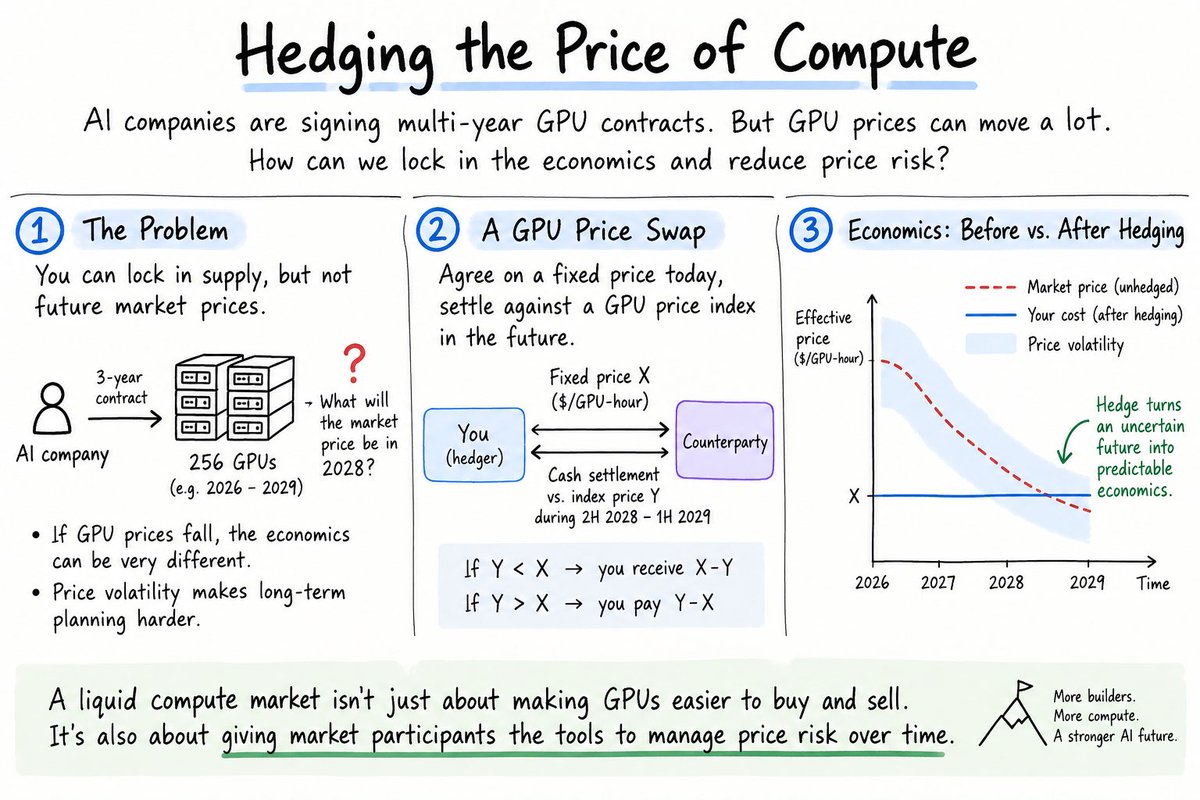
    What does it take to hedge the price of compute? AI companies are increasingly signing multi-year GPU contracts. But GPU prices can move significantly over the life of those contracts. That creates a simple problem: you can lock in your cost of compute, but you often can’t lock in its future market value. Imagine committing today to 256 GPUs for three years. You know what you’ll pay in year three, but you don’t know what those GPUs will be worth by then. If market prices fall faster than expected, the economics of the contract can change dramatically. In mature commodity markets, this is exactly what derivatives are designed to solve. We’ve been thinking about what a GPU price swap could look like. Suppose you want to hedge GPU prices for 2H 2028 to 1H 2029. Today, two parties agree on a fixed price of X per GPU-hour. During the hedged period, a GPU price index determines the realized market price Y. The swap is cash settled: If Y < X, the hedger receives X − Y. If Y > X, the hedger pays Y − X. Economically, this lets you separate the physical compute contract from the price risk. But the interesting problem isn’t actually the settlement. It’s everything that happens between today and 2028. How do you mark the swap to market when there isn’t a liquid GPU forward curve? Should there be initial margin? Should collateral only be posted when MTM exposure exceeds a threshold? Could collateral sit in a segregated account rather than being transferred? Should you avoid MTM entirely until the underlying pricing period gets closer? And how do you construct a credible forward price from physical reservations, spot transactions, dealer quotes, and other market data? These are largely solved problems in oil, power, rates, and other mature markets. They’re still being figured out for compute. As compute contracts get larger and longer, I think the ability to hedge forward price risk will become an important part of the market infrastructure. If you’re building in this area, whether it’s GPU indices, swaps, forwards, or other compute derivatives, we’d love to collaborate. We’re happy to be one of the parties on the hedging side and help develop these markets through real transactions. A liquid compute market isn’t just about making GPUs easier to buy and sell. It’s also about giving market participants the tools to manage compute price risk over time.
    Download
    64413.3K