Agility✓

@agilityrobotics

Industrial humanoids hard at work.

1.8K Following40.4K Followers1.2K Posts
  1. Agility✓@agilityrobotics
    Majority staff from the @EdWorkforceCmte visited RoboFab, our factory in Salem, Oregon, for a firsthand look at what it takes to build an American humanoid robot that is Made for Work®. We discussed our engineering, how customers are using Digit to address workforce challenges, and the education and workforce development needed to support America's growing robotics industry. Thank you for the visit and thoughtful conversation.
    Download
    40322.1K
  2. Agility✓@agilityrobotics
    Congratulations to Agility's CEO Peggy Johnson for making @AIMagazine_BC's AI Top 250 Leaders list! 🤖 🎉 See the full list:
    Download
    21231.9K
  3. Agility✓@agilityrobotics
    Humanoid safety standards are still being written — and Agility is helping write them. Our Sr. Director of Robotics Safety Kevin Reese is Project Leader of ISO 25785-1, the first safety standard for dynamically stable industrial mobile robots 👇 #Agility #Safety #Digit
    Download
    83382.3K
  4. Agility✓@agilityrobotics
    Agility
    RT @CTATech: Robotics is transforming industries. Tomorrow, find out what Physical AI means for manufacturing, logistics, healthcare and consumer tech with @AgilityRobotics, EY and @IntuitionRobo:
    010419
  5. Agility✓@agilityrobotics
    We’re hiring a Senior Deployment Specialist to put Digit to work in the field — deployment, operation, support, and demos across real customer environments. Strong mechatronics background required. Hybrid, 75–100% travel. Come build with us: #Agility
    Download
    50412.9K
  6. Agility✓@agilityrobotics
    GXO was the first company to put Digit to work. Now it’s expanding to two more U.S. warehouses, starting in early 2027. @johnkoetsier @Forbes covers why repeat customers are the signal that matters in humanoid robotics:
    Download
    1199383.3K
  7. Agility✓@agilityrobotics
    Agility
    RT @ST_BoardroomX: Presented by our partners at @agilityrobotics: CEO Peggy Johnson joins Boardroom Exclusives to talk about addressing industrial labor shortages with commercially deployed humanoid robots, the safety and technological advancements of their new Digit 5 model, and preparing the company for its upcoming public listing under the ticker $AGLT.
    0120424
  8. Agility✓@agilityrobotics
    Today, we announced an expanded partnership with GXO and detailed three previously unannounced enterprise manufacturing customers. This builds on our active pipeline of more than 30 prospective customers in manufacturing, automotive, aerospace, defense, logistics, and consumer products. CEO Peggy Johnson discusses our commercial progress at 12 p.m. ET. Watch her remarks: Read more: #Agility #Digit #MadeToWork
    Download
    910685.9K
  9. Agility✓@agilityrobotics
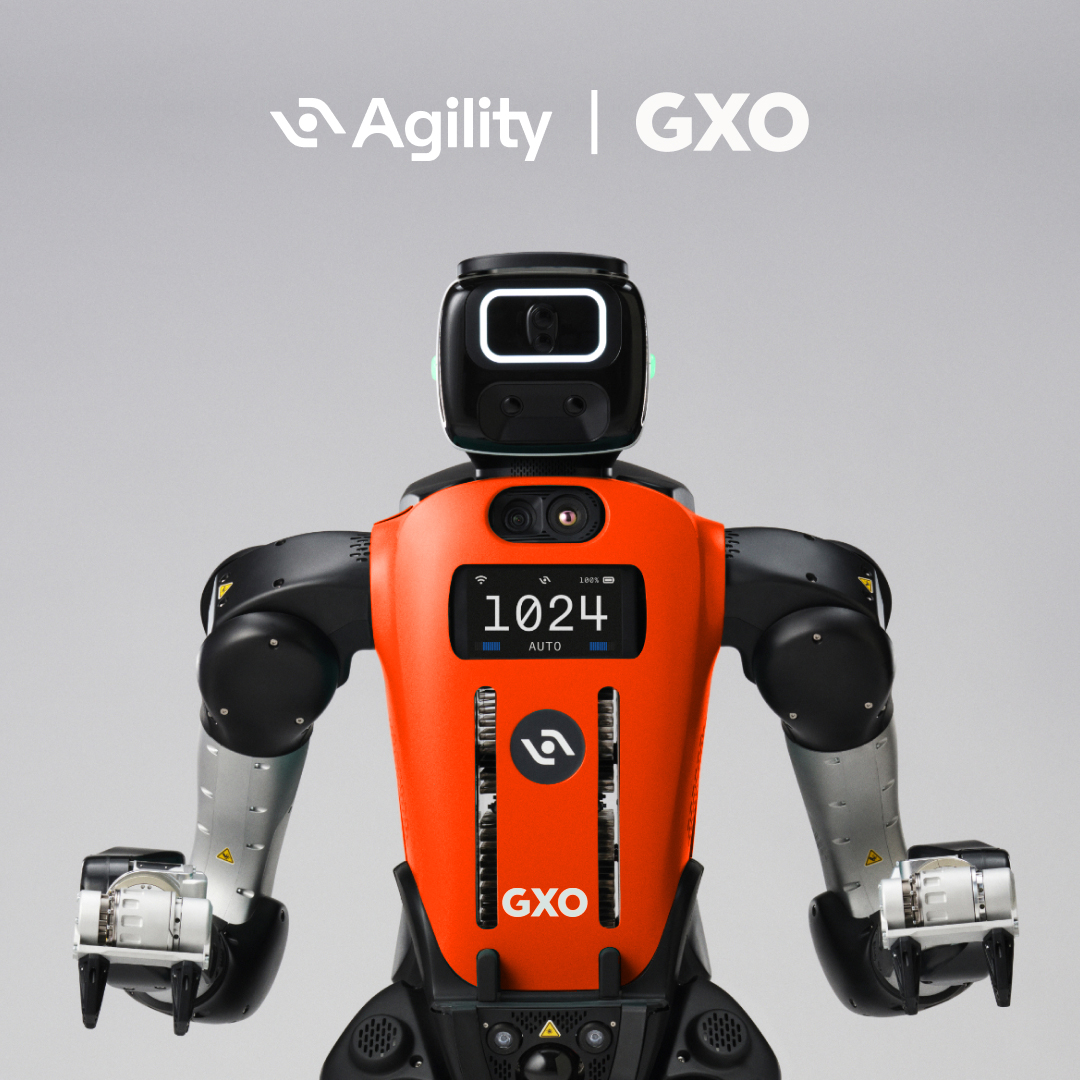
    GXO announces an expanded partnership with Agility. Digit is headed to @GXOLogistics sites in Statesville, NC, and Lebanon, TN, with deployments expected to begin in early 2027 — building on more than 100,000 totes moved at Flowery Branch, GA. #Agility #Digit #MadeToWork
    Download
    29141119.8K
  10. Agility✓@agilityrobotics
    Digit carries its safety envelope on board. It operates independently of connectivity — so no network condition, remote command, or external access can override what its safety system knows it must not do. Our CTO Pras Velagapudi on one of the most important design decisions behind deploying a humanoid 👇 Full episode: #Agility #DataSecurity #Digit #MadeForWork
    Download
    102395K
  11. Agility✓@agilityrobotics
    Our co-founder and Chief Robot Officer Jonathan Hurst answered your questions about the engineering behind Digit 5. Read the AMA exactly as posted: #Agility #MadeForWork #AMA
    Download
    02172.7K
  12. Agility✓@agilityrobotics
    .@Damion Shelton, our co-founder and Chairman, will speak on robotics performance at the Foxconn Investment Summit in Taipei on Oct. 31. Foxconn is leading the PIPE for our proposed business combination with Churchill Capital Corp XI. #HHTD26 #HHTD26 #Agility #MadeForWork
    Download
    12232.8K
  13. Agility✓@agilityrobotics
    Jonathan Hurst, our co-founder and Chief Robot Officer, is here to answer your questions about Digit’s hardware and engineering for the next hour. We’ve already received some that we’ll dive into to get this started. Welcome, Jonathan!
    1744266.9K
  14. Agility✓@agilityrobotics
    Posts @agilityrobotics
    JH: That's time. Thanks for the questions, especially the hard ones. I couldn't get to all of them. We'll post a recap here tomorrow.
    107792
  15. Agility✓@agilityrobotics
    Posts @agilityrobotics
    From @Shelly38499228: as Digit moves toward broader deployment, which mechanical parts changed the most between versions, and which did you deliberately freeze to make production and service easier? Nearly every part changed between Digit 4 and Digit 5. Digit 4 was the first commercially deployed humanoid robot, and with that time in the field, we learned so much about customer requirements. We were able to do a full, formal product design process, involving hundreds of customer requirements that translated into hundreds of engineering requirements. We retained many features and engineering solutions, but the components are nearly all different and updated. Many include new design-for-manufacture, such as sheet metal, casting, or other high-volume manufacturing processes. Digit 5 will be easier to build and easier to service because of engineering changes made based on learnings from Digit 4.
    105293
  16. Agility✓@agilityrobotics
    Posts @agilityrobotics
    From @Chama1176: I love Cassie. What were the trade-offs involved in transitioning from leaf springs (in Digit 3) to rigid links (incorporating torque or force sensing?) in Digit 4? Leaf springs are great for handling harsh impacts during a running gait, but they add complex dynamics (and of course mechanical complexity) when you’re trying to stand and manipulate things. Cassie was optimized for walking and running; Digit is optimized for locomanipulation. And now with Digit 5, the human-style leg configuration is designed so the robot will have the ability to lift heavy things while getting low to the ground.
    006411
  17. Agility✓@agilityrobotics
    Posts @agilityrobotics
    From @RoboPromoEvents: what was the hardest part of getting Digit to move so naturally around people? Big fans of the work. JH: The hardest part is priorities: We know how to do the dynamics and how to create beautiful, natural gaits. And it’s especially straightforward with a smaller, lighter robot, like Cassie. Now, with Digit 5 at over 120kgs, it requires special actuators and leg configurations to get the power and strength at the same time as the natural dynamic motion. In addition, the team is so focused on customer use cases, improving manipulation capabilities, reliability, active deployments, safety, and more, that dialing in the gait dynamics just isn’t a priority and won’t be the thing keeping Digit 5 from doing its job well. This is part of why Agility and Digit 5 are special - we are focused on solving customer applications, not just doing demonstrations, and achieving dynamic locomotion will be part of that focus. The hardest part around people was safety, and what I learned is that predictability matters more than grace. A coworker needs to know what the robot will do next. So Digit 5 is designed to detect people, react in real time and move predictably, with lights and sounds that signal its intent. That took us two years, and I still want it to move beautifully.
    004298
  18. Agility✓@agilityrobotics
    Posts @agilityrobotics
    From @asiagigi: Reflected inertia always shatters kinematic idealism. Warehouses don't care about sleek CAD renders if high-ratio gearboxes lag on sudden heel strikes 🍏 Defend Digit 5's tradeoff: pure compliance or raw payload? JH: For physical interaction with the world, we believe Digit 5 will need to move in a fundamentally different way from traditional position-control robots, and instead more like the way animals move. Meaning with exceptional force control and compliant interactions with the environment. One way to achieve this is “transparency” in the actuator, which means basically that you can get whatever force you want from the actuator instantly. But this is an impossible task. Two major things that get in the way of transparency are reflected inertia (the spinning rotor going very fast behind the large gear reduction, which then feels like a huge rotational inertia on the gearbox output) and friction in the gearbox, which can be quite large for some technologies. To achieve best possible transparency, people use very low gear reductions, usually quasi-direct-drive with planetary gears. But you cannot achieve high torques this way. For a robot as large as Digit 5, which will have 50 lb lifting capacity, quasi-direct-drive is not really feasible and we must have higher gear reductions. We will do this with our proprietary cycloidal transmissions, which will achieve better efficiency and eliminate the friction as a problem so we can control our torque very effectively using the current control of the motor windings. To deal with the inertial problem, we need to zoom out beyond the actuator, to the leg and foot or arm and hand configuration. Initial impact with the ground will be handled with a small compliant section of the heel, accelerating a relatively small and low-inertia ankle motor. This ankle motor, as the toe approaches the ground, then applies force to accelerate the large, powerful motors at the knee, which then can control the acceleration of the robot center of mass. It’s a scaled impact approach that we believe will insulate the largest actuators from the impact, and overall, create a fluid, natural motion. It’s capturing physics we see from animals, but doing it uses approaches better suited to technology rather than biology.
    105450
  19. Agility✓@agilityrobotics
    Posts @agilityrobotics
    From @TaoBuildsRobots earlier today: how do you deal with robot-to-robot variation across a fleet? Calibrate every Digit individually, or train policies robust enough not to care? JH: Both. Minor variations exist in motor constant or robot component mass, that remain consistent once a robot is built, but may vary across the fleet; we believe these can be calibrated. But other features vary with time or temperature or other factors, and for those we must create policies that can handle the random variation. It is important to note, though, that one cannot train a policy to be robust to everything. We, as engineers, have to decide what is likely to vary, and be choosy about what we require the policy to be robust to; mostly, that should be things that will be outside of our control, like ground height, or mass of a bin, or friction coefficients.The more robust a policy is, generally, the lower the performance. For example: If we truly have no idea what the ground friction will be, then the robot always has to walk as if it were walking on ice. If we do have some confidence in the range of uncertainty of the ground friction, we can increase our confidence appropriately for the robot performance.
    107522
  20. Agility✓@agilityrobotics
    Posts @agilityrobotics
    A question from @agnostoxxx earlier today: a) How does an existing model like Digit V5 adjust for improving compute (guessing there are physical weights / thermal limits to adjust for)? b) With the new battery needing only 9 minutes charging time, is there battery degration / thermal safety to adjust operations for? JH: The great thing about Digit 5 is that it will really be a platform for us where we can readily upgrade components and parts. Almost all of the compute will be contained in a box right up at the top of the torso at the top of the backpack. So as we want to upgrade and change, we can just change the compute box there on Digit 5 without really significantly changing the rest of the robot. In terms of the battery, we've actually sized the battery and charging time for a battery that is already a year old and already operating in a really hot environment. As a result, when they're brand new we anticipate that they will be able to perform better than required. If the battery does start to degrade to the point where we're not getting enough life, then of course we can replace the battery, which is a fairly quick and easy procedure for us to do. But that is intended to be a regular maintenance process for the robot.
    107661