Travis Zack✓

@TravisZack2

Chief Medical Officer, OpenEvidence

  • Joined
39 Following205 Followers24 Posts
  1. Travis Zack✓@TravisZack2
    Travis Zack
    RT @OpenEvidence: Over 85% of oncologists at Memorial Sloan Kettering Cancer Center use OpenEvidence. Together, @MSKCancerCenter and OpenEvidence have built OncoKB, MSK’s expert interpretation of a tumor’s genetics, directly into OpenEvidence, putting it in the hands of oncologists across the United States. As Dr. Anaeze Offodile puts it: “Our mission is to end cancer for life.” As of today, we are widening OncoKB’s reach so that patients everywhere benefit from the same rigor as patients at MSK. Watch the story.
    06101.2M
  2. Travis Zack✓@TravisZack2
    thank you so much for having me. What a great discussion facilitated by Dr. St. George. Had a great time
    WCM Emergency Medicine @WCMEmergency
    Dr. Travis Zack from @OpenEvidence delivers his talk on "Synthesizing Medical Literature: The New Era of AI-Driven Evidence" at our Virtual Healthcare in the Mainstream Symposium & Research Forum.
    006145
  3. WCM Emergency Medicine@WCMEmergency
    Dr. Travis Zack from @OpenEvidence delivers his talk on "Synthesizing Medical Literature: The New Era of AI-Driven Evidence" at our Virtual Healthcare in the Mainstream Symposium & Research Forum.
    Download
    016751
  4. Travis Zack✓@TravisZack2
    Travis Zack
    RT @zakkohane: A good comparator indeed "Compared with what?" @NEJM "As part of this process, investigators should be careful to compare outcomes associated with the use of AI with outcomes in the health care systems we have, rather than the ones we wish we had."
    Harlan Krumholz @hmkyale
    3 in 10 U.S. adults use AI chatbots for health information. Almost 1 in 5 say they cannot afford to see a provider. @FDA asked how it should judge these systems. My answer starts w/the comparator. Comments close today. My @JACCJournals Editor’s Page:
    0802K
  5. Harlan Krumholz@hmkyale
    3 in 10 U.S. adults use AI chatbots for health information. Almost 1 in 5 say they cannot afford to see a provider. @FDA asked how it should judge these systems. My answer starts w/the comparator. Comments close today. My @JACCJournals Editor’s Page:
    Download
    315415.5K
  6. Travis Zack✓@TravisZack2
    Travis Zack
    RT @JAMA_current: Among US #clinicians, use of an #AI-enabled clinical information platform increased substantially over 2.5 years, with sustained use across #physician and nonphysician groups. Queries most often focused on #treatment and #management rather than #diagnosis, indicating that these tools are being used primarily to support #clinical decision-making at the point of care.
    053022.6K
  7. Travis Zack✓@TravisZack2
    Travis Zack
    RT @georgoff: The most influential clinical AI adjunct +++ ever made. Period. @OpenEvidence has transformed daily hospital workflows + surgical education into something entirely new. Thrilled to partner with the team building the future of medical knowledge ⚡️🔬
    OpenEvidence @OpenEvidence
    It happened. We got Behind the Knife. @BehindTheKnife's surgical education library will feed into OpenEvidence answers, and OpenEvidence will be built into their ABSITE and oral board prep. @AmbarMehta, a vascular surgeon who leads surgery initiatives at OpenEvidence, puts it this way: the toughest surgical decisions live between the lines of the evidence.
    0603.2K
  8. Travis Zack✓@TravisZack2
    Travis Zack
    RT @OpenEvidence: It happened. We got Behind the Knife. @BehindTheKnife's surgical education library will feed into OpenEvidence answers, and OpenEvidence will be built into their ABSITE and oral board prep. @AmbarMehta, a vascular surgeon who leads surgery initiatives at OpenEvidence, puts it this way: the toughest surgical decisions live between the lines of the evidence.
    0150401K
  9. Travis Zack✓@TravisZack2
    Really excited for the opportunity to work with Dr. Murray, Dr. Desai, Josh and the whole JHU team on projects around medical education and improved integration of clinical intelligence within workflows!
    OpenEvidence @OpenEvidence
    Johns Hopkins established the model for American medical education more than a century ago. Today @HopkinsMedicine and OpenEvidence announced a collaboration to define what that education should look like in the AI era, and to ground clinical care in the latest evidence. As AI learns to synthesize the world's medical knowledge in seconds, the clinician's role moves toward clinical judgment, first-principles reasoning, and the human work of caring for patients. The education model Johns Hopkins and OpenEvidence will design builds on those foundations, with a deeper grounding in pathophysiology and evidence-based medicine. Knowing why an ACE inhibitor works is understanding a physician carries through an entire career. Together we'll also build human-first AI that puts the best available evidence in the context of each patient's medical history and Johns Hopkins' best practices, so clinicians can reason through that information faster and make the best decision for their patient. Sanjay Desai, Vice Dean for Education at Johns Hopkins Medicine, says AI "invites us back to the bedside." For the educators here: which skills do you want every trainee to keep sharp?
    027987
  10. OpenEvidence@OpenEvidence
    Johns Hopkins established the model for American medical education more than a century ago. Today @HopkinsMedicine and OpenEvidence announced a collaboration to define what that education should look like in the AI era, and to ground clinical care in the latest evidence. As AI learns to synthesize the world's medical knowledge in seconds, the clinician's role moves toward clinical judgment, first-principles reasoning, and the human work of caring for patients. The education model Johns Hopkins and OpenEvidence will design builds on those foundations, with a deeper grounding in pathophysiology and evidence-based medicine. Knowing why an ACE inhibitor works is understanding a physician carries through an entire career. Together we'll also build human-first AI that puts the best available evidence in the context of each patient's medical history and Johns Hopkins' best practices, so clinicians can reason through that information faster and make the best decision for their patient. Sanjay Desai, Vice Dean for Education at Johns Hopkins Medicine, says AI "invites us back to the bedside." For the educators here: which skills do you want every trainee to keep sharp?
    Download
    11151313.4M
  11. Travis Zack✓@TravisZack2
    Travis Zack
    RT @OpenEvidence: Summed up perfectly.
    Jim Siegler, MD, FAHA @JimSiegler
    Evidence that AI won’t replace us 👇🏼 Generative, evidence-based AI still requires CLINICIAN SCIENTISTS to produce original research to provide high quality syntheses of information. Thank you @OpenEvidence @NEJM! @ShadiYaghi2 @RichaSharmaMD
    0404.4K
  12. Travis Zack✓@TravisZack2
    Travis Zack
    RT @PaulSaxMD: PowerPoint deadline season in academic medicine, w/ an inbox overflowing with "friendly reminders" to submit slides and other stuff weeks before my talks! Naturally, instead of finishing those slides, I wrote this to complain about it. Free link in replies. @NEJM
    026035.4K
  13. Travis Zack✓@TravisZack2
    YES! Absolutely. We have been working with societies and expert groups (such as @JACCJournals ) to create a virtuous cycle of knowledge gap identification --> knowledge creation. This pulse on the clinical knowledge requirements, paired with the evidence gaps uncovered by our engine is truly one of the projects @IAmSamFin and I have been most passionate about working on
    Download
    illiquid @lefttailguy
    Rough back of the envelope math: if 40% of US physicians are OpenEvidence DAUs (60%+ are registered users) and there's ~22 workdays a month, 42m queries in August implies ~5 queries per workday day per physician (Google is ~4.2 searches per day and ChatGPT is ~2.5 queries per day). This kind of pulse on real-time clinical uncertainty is remarkable. Imagine you could now categorize those queries to create a map of the frontier of knowledge / know-how in medicine, and what's missing. By doing so, OpenEvidence is creating the closest thing to a universal ledger of medical problems and solutions. OpenEvidence can see for which flavors of clinical uncertainty existing knowledge / know-how / solutions are most scant (or don't exist at all). They can then find and plug in that knowledge / know-how, create it by funding studies / initiatives, and eventually even discern the best heuristics / simulation environments to train the judgement of the next generation of human capital in the life sciences. You start to see how OpenEvidence's flywheel will start to spin a lot faster than the labs in terms of medical capabilities. The general lesson here is that it's all about your product sensing and enumerating demand in some valuable subset of economic reality faster than competitors. In this case, OpenEvidence enumerates physician demand for medical knowledge / know-how that can help solve patient problems. They do this faster and with higher fidelity than anyone else. This is incredibly valuable.
    27293.4K
  14. illiquid✓@lefttailguy
    Rough back of the envelope math: if 40% of US physicians are OpenEvidence DAUs (60%+ are registered users) and there's ~22 workdays a month, 42m queries in August implies ~5 queries per workday day per physician (Google is ~4.2 searches per day and ChatGPT is ~2.5 queries per day). This kind of pulse on real-time clinical uncertainty is remarkable. Imagine you could now categorize those queries to create a map of the frontier of knowledge / know-how in medicine, and what's missing. By doing so, OpenEvidence is creating the closest thing to a universal ledger of medical problems and solutions. OpenEvidence can see for which flavors of clinical uncertainty existing knowledge / know-how / solutions are most scant (or don't exist at all). They can then find and plug in that knowledge / know-how, create it by funding studies / initiatives, and eventually even discern the best heuristics / simulation environments to train the judgement of the next generation of human capital in the life sciences. You start to see how OpenEvidence's flywheel will start to spin a lot faster than the labs in terms of medical capabilities. The general lesson here is that it's all about your product sensing and enumerating demand in some valuable subset of economic reality faster than competitors. In this case, OpenEvidence enumerates physician demand for medical knowledge / know-how that can help solve patient problems. They do this faster and with higher fidelity than anyone else. This is incredibly valuable.
    Download
    41024828.1K
  15. Travis Zack✓@TravisZack2
    Travis Zack
    RT @RBMD1982: This is such a great perspective on how the doctor’s role will evolve as AI evolves. Harlan nails it: so much discomfort is about how AI challenges physician authority, but we should not feel that that authority is the basis of our purpose and usefulness
    Harlan Krumholz @hmkyale
    Search engines gave patients documents. LLMs give them an interpretation and a plan. The information asymmetry that reinforced the physician's authority is eroding. Where that leaves physicians, in my Editor's Page (free to read): @JACCJournals
    0402.1K
  16. Harlan Krumholz@hmkyale
    Search engines gave patients documents. LLMs give them an interpretation and a plan. The information asymmetry that reinforced the physician's authority is eroding. Where that leaves physicians, in my Editor's Page (free to read): @JACCJournals
    Download
    9205219.1K
  17. Travis Zack✓@TravisZack2
    Travis Zack
    RT @zakkohane: "I started medical school 20 years ago. Every day since, I have looked something up, skimmed a journal article or talked through a case with a colleague — medicine is a phone-a-friend profession." makes @RBMD1982 impressively non-average and predictably makes good use of AI.
    David Shaywitz @DShaywitz
    Timely @RBMD1982 NYT on how AI (looking at you, @OpenEvidence) has made her a better doctor, while increasing her concern about the doctors-in-training perhaps leaning too heavily on the technology. @AdamRodmanMD quoted. @zakkohane @goldbergcarey
    0908.8K
  18. Travis Zack✓@TravisZack2
    Travis Zack
    RT @dr_nikhilshah: Agree with Travis. Information was always there and with programs like Up-to-date it was often at the point of care as well. If not Uptodate, Google was and still is always there right? For my residents, I would love them to look up @OpenEvidence in fact I actually encourage them, as asking OE also provides the papers they could/should read, but to prevent deskilling or never skilling, I will ask the resident to gate their query with some EFFORT (#AIEffortGate) - 1. WRITE down your question (pen/paper) - this helps synthesize the query in their own head. 2. EXPLAIN the response to a colleague, student or preceptor. With these simple steps deskilling and neverskilling may be prevented.
    01089
  19. Travis Zack✓@TravisZack2
    My thoughts echo these in so many ways. For the longest time, MD identity has been tied to being walking reference manuals, but with evidence at your fingertips, that is less and less necessary. However, background understanding of phys/pathophysm and ability to reason over information, remains more important than every. In my view, access to information is never a bad thing; it just is about how it is used. I see trainees’ learning being accelerated by rapid access to knowledge, as long as that knowledge is being actively used with the intent of self-improvement and the benefit of future patients in mind, not just to accomplish daily tasks.
    Rachael Bedard @RBMD1982
    I think @ZekeEmanuel and others are wrong about AI replacing physicians, but AI is already playing an important role in my clinical life. I’ve come to rely on @OpenEvidence enormously, and I believe it’s making me a better doctor. At the same time, I worry that frictionless access to clinical decision support is making my learners worse. I wrote about this for @nytopinion:
    4114719.9K
  20. Rachael Bedard✓@RBMD1982
    I think @ZekeEmanuel and others are wrong about AI replacing physicians, but AI is already playing an important role in my clinical life. I’ve come to rely on @OpenEvidence enormously, and I believe it’s making me a better doctor. At the same time, I worry that frictionless access to clinical decision support is making my learners worse. I wrote about this for @nytopinion:
    123417589.7K
  21. Travis Zack✓@TravisZack2
    Travis Zack
    RT @Papa_Heme: All over this app and conferences I hear about oncologist researching disparities in healthcare. Why don’t you just come work in Nevada and actually try and fix it by just taking care of patients?
    Al-Ola A Abdallah MD (USMIRC) @Abdallah81MD
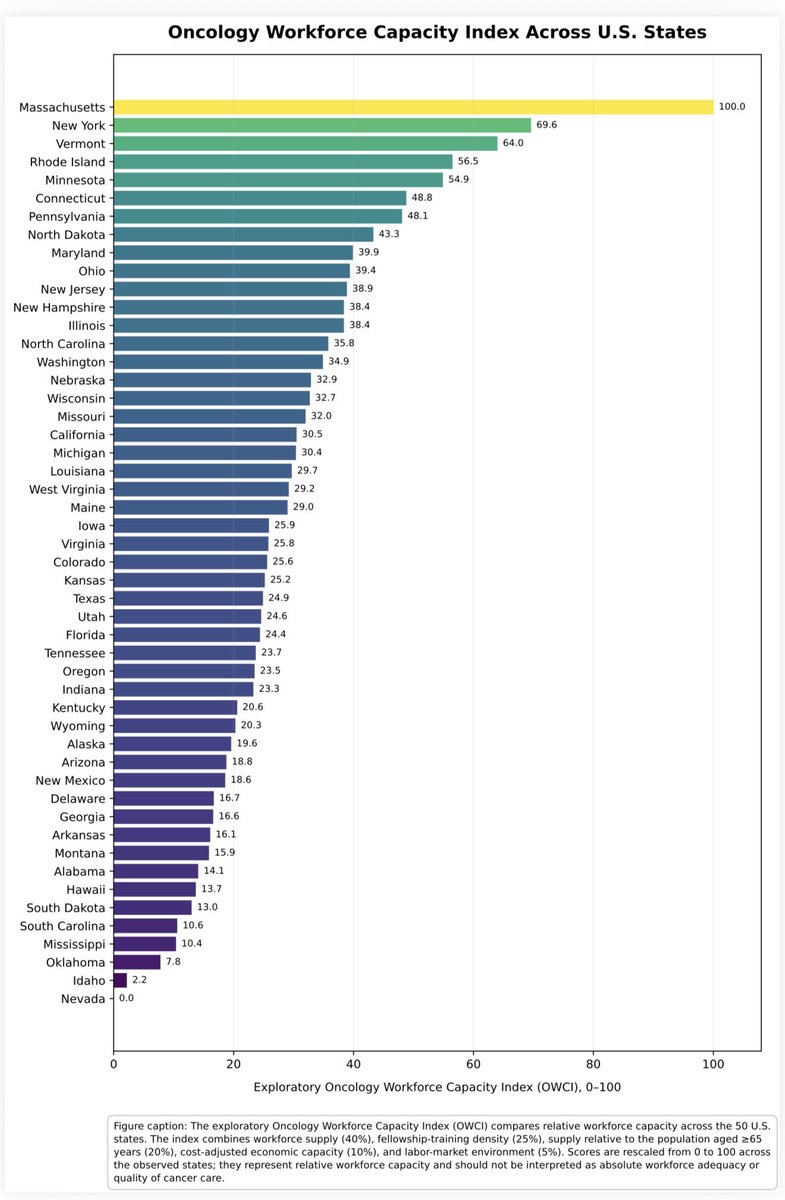
    🇺🇸 Where is the strongest oncology workforce capacity in the U.S.? We developed an exploratory Oncology Workforce Capacity Index (OWCI) integrating Hem/Onc physician supply, fellowship training, demographic need, economic capacity, and labor environment. The striking finding: oncology workforce capacity varies dramatically across states. This isn’t a measure of cancer-care quality—it highlights how differently oncology resources and infrastructure are distributed across the country. Could this help identify where future workforce investment is needed most? 🩸🎗️ #Hematology #Oncology #CancerCare #HealthcareWorkforce #HealthPolicy #MedEd #USMIRC
    07020K
  22. Al-Ola A Abdallah MD (USMIRC)✓@Abdallah81MD
    🇺🇸 Where is the strongest oncology workforce capacity in the U.S.? We developed an exploratory Oncology Workforce Capacity Index (OWCI) integrating Hem/Onc physician supply, fellowship training, demographic need, economic capacity, and labor environment. The striking finding: oncology workforce capacity varies dramatically across states. This isn’t a measure of cancer-care quality—it highlights how differently oncology resources and infrastructure are distributed across the country. Could this help identify where future workforce investment is needed most? 🩸🎗️ #Hematology #Oncology #CancerCare #HealthcareWorkforce #HealthPolicy #MedEd #USMIRC
    Download
    12102728.5K
  23. Travis Zack✓@TravisZack2
    Travis Zack
    RT @dr_nikhilshah: @OpenEvidence is phenomenal. I keep discovering new ways to learn! #dotflow maxxing. .topicreview>>.topicreviewflashcards .topicreview → brief topic name, pick learner level, depth, format .topicreviewflashcards → same chat, type “this review” + level → 20 flashcards + 10 board-style MCQs Flashcards generated in a table format- just export to any chatbot of your choice or flashcard app. Always verify with original material.
    020450
  24. Travis Zack✓@TravisZack2
    Travis Zack
    RT @hoperugo: Camizestrant approved in patients with emerging mESR1 by ctDNA in the absence of PD. @OncoAlert @OncBrothers
    Hope Rugo @hoperugo
    Finally!! Sheparding in a new era. FDA Grants Accelerated Approval to a New Breast Cancer Treatment @oncoalert
    0703.7K
  25. Hope Rugo@hoperugo
    Finally!! Sheparding in a new era. FDA Grants Accelerated Approval to a New Breast Cancer Treatment @oncoalert
    018497.5K
  26. Show more posts