Mercek✓

@WorldOfMercek

FJNRqMhTEpxBPLHvwSLbXBLXq9XQT54mwwycuo94fKTP

18.8K Following118K Followers186K Posts
  1. Mercek✓@WorldOfMercek
    I made an exit strategy so you don't have too! So my main take away from the last bull run is you go into the bull market not knowing what is going on and you will assume you will figure out the top and sell perfectly. This does not happen even and you will get burnt. I did and i'm sure that many of you will have had similar experiences. There are so many ways to exit the market, here is just one idea I had that makes sense to me. Please change this as you see fit to taylor your portfolio. Step 1, Making a duplicate portfolio tracker: On coingecko/ coinmarketcap make a new portfolio. This will be important for this strategy. Once you start selling (this point will be discussed), you will not mark the sales on this duplicate portfolio. Only on your main one. This is so we can accurately track the % we should be selling. Step 2, when to start selling: This is not an exact science, however for the purpose of this I have chosen one month after the previous break of ATH. Feel free to change this however the rest of the data below will use this. Step 3: Estimating the length of the bull run: Below I will show the length of the last 3 bull runs from the point where they break the ATH. 2013, the break of ATH to top is 272 days. This was a very volatile bull markets however we don't expect this due to the size the market has grown too. 2017, the shortest of the three at 230 days. 2021, the longest bull run lasting 348 days. So here we have 3 bull markets to work with. Obviously we have to assume that something will change majorly for the next rally, however we use what we have to give ourselves the best chances. Average of the 3 = (348 + 230 + 272) / 3 = 283 days. Minus one month which we wait before we start to sell will equal 262. That is what we will be working with. Step 4, the strategy: First of all I will be working on the assumption that you are trying to sell 100% of the portfolio. 100% / 262 = 0.38%. This is what percent needs to be sold per day to achieve 100% sold using our time estimate. Now, you should not sell everyday 0.38%. Once you wait the month after the previous ATH breaks, you start counting percent, each day accumulating. E.G. day 1 = 0.38, day 2 = 0.76 etc. You let this build until a green green day which you sell. Could be worth waiting for the largest moves (+10-20%). Once you sell this amount, the count resets to 0. So why did we create the second portfolio? Because if you are selling the ratio in your portfolio would change. For example, if you hold 1 BTC and sell 50%, then the next day you sell 50% again, you would have 0.25 BTC. Not sold 100%. However, if you keep one portfolio not touching it when you sell, you can put in say what is 5% in dollars and the next day 5% again, and you would have sold 10%. Otherwise the maths will get extremely complicated. Once you get toward the end, you might have to sell on some red days. Don't be afraid! This is very important if you want to take full profits, so in the last say 100 days be less picky about you sell days. We always speak about DCAing in so use this strategy if you would like to DCA out :). NFA and Always DYOR!
    Download
    1.1K4963.3K744K
  2. Mercek✓@WorldOfMercek
    Last October, one tariff post from Trump wiped out $19 billion in crypto positions overnight. Tonight what could be the biggest theft in crypto history is happening on Binance, and Bitcoin has moved about 3%. Here's what's actually on-chain so far. A wallet funded through Tornado Cash deployed a contract hours in advance, then used EIP-7702 to make one of Binance's hot wallets run that contract's code. Minutes later the wallet was emptied, and it got swept again even after Binance's first statement went out. Nobody knows yet how the attacker got the signature that made this possible. Estimates of what left the exchange range from 2.4 to 5.6 billion dollars. Binance has paused withdrawals until the issue is resolved, keeps repeating that user funds are safe, and is still calling it a security issue rather than a hack. On October 10, 2025, Bitcoin fell double digits and the cause wasn't even a hack. It was another China tariff threat, the kind of thing we'd all seen a dozen times by then. That night the market was loaded with leverage and it all unwound at once. Tonight looks different once you do the math. Tether, Circle and Ripple froze a big chunk of the stablecoins within the hour, and CZ is now saying the real loss is probably a bit over a billion and that it will be covered. Against what Binance holds for its users, that's well under one percent. So a routine post can break this market while the largest robbery in its history barely moves it. I stopped being surprised by that a while ago. The cycles don't change, the games don't change, and tonight we saw exactly how much of this is under control. A handful of companies froze billions faster than most people could read the news. Is this the fear that starts the next rally? I don't think so. Let's assume it really is what it looks like. Then the part I'm most curious about isn't the attack. Anyone who goes after this much money in front of the entire world has already thought about how to clean it, and you can already watch it starting. The wallets tied to the hack are swapping whatever can still be frozen into ETH and borrowing ETH against what's left. The stablecoins were the easy part to stop. ETH and BTC are a different story, because nobody can freeze those. Whatever comes next is probably more interesting than the hack itself. When billions get stolen like this, money is frozen within the hour, the founder is online, the co-CEO is thanking issuers one by one, and the whole world watches. When a small business gets hacked and the owner's life starts slipping away, nobody freezes anything. Both are just as real. The only difference is the number of zeros, and how alone we are. That's why I'm reading tonight as a friendly but firm warning to all of us. AI models have gotten genuinely powerful, and finding a hole is far cheaper than it used to be. Being small doesn't mean being invisible anymore. From what we can see, this whole thing came down to a signature, and honestly, that's how most of us would lose everything too. We keep too much on hot wallets because it's easier, we sign things at 2am without reading them, and we tell ourselves nobody would bother with someone like us. Tonight Binance had Tether, Circle, Ripple and its own founder in its corner within the hour. When it's our turn, nobody is going to hit the freeze button for us. So please, take care of yourselves and look out for each other.
    CZ 🔶 BNB @cz_binance
    User funds are safe! It does look like a hack on Binance. Appreciate the quick freeze from Tether (~$971m) and Circle (~$823m). I don't manage Binance (.com) anymore, but as a shareholder, I expect all user funds will be fully covered.
    346535.1K
  3. CZ 🔶 BNB✓@cz_binance
    User funds are safe! It does look like a hack on Binance. Appreciate the quick freeze from Tether (~$971m) and Circle (~$823m). I don't manage Binance (.com) anymore, but as a shareholder, I expect all user funds will be fully covered.
    4K4.3K27.7K3.6M
  4. Mercek✓@WorldOfMercek
    Mercek
    RT @WorldOfMercek: Can a stock market sell-off hurt someone who has never owned a single share? It can, and the same links are why Bitcoin fell with the Nasdaq last week even though it missed this year's stock rally. I wrote about how losses travel between markets 👇
    040029.4K
  5. Mercek✓@WorldOfMercek
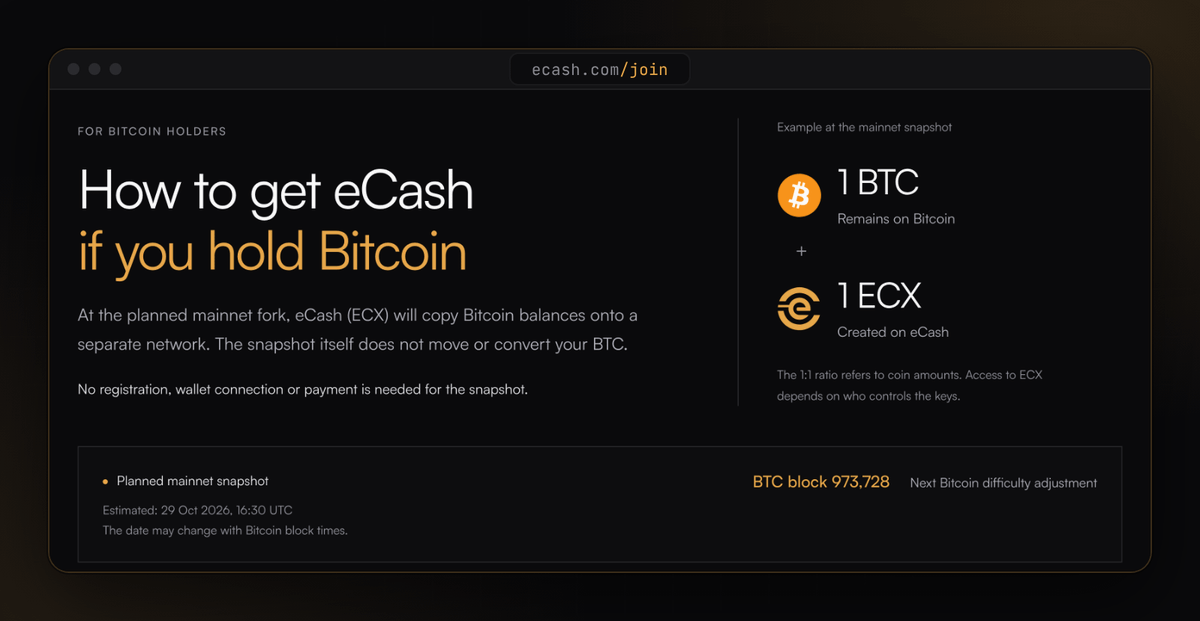
    What if Bitcoin miners end up having more say over new features than developers do? For about a decade, building something new around Bitcoin meant either fighting to change L1 or taking the idea to another chain. The eCash fork from @BTCdrivechains takes a different route. It activates drivechains (BIP300/301), so developers can launch their own sidechains without asking the whole network to adopt them. If one fails, the base layer isn't affected. What caught my attention is where miners fit into this. Anyone can propose a sidechain, but miners decide whether it goes live. They also vote on withdrawals back to the main chain, and that vote runs for months before any coins are released. So they're not only securing blocks, they sit right between users and their money on the way out of a sidechain. Seven sidechains go live at launch, covering payments, privacy, prediction markets and token issuance. Miners earn fees from them, which should push them toward the ones people actually use. But on a young network with a small mining base, a hashrate majority is much easier to put together, and that majority is exactly who approves withdrawals. The long voting window is the safety net. And since sidechains are opt-in, that trust only applies to people who choose to move funds into one. I'm curious whether drivechains can turn miner involvement into an advantage instead of just another point of trust. The fork is expected around Thursday. If you self-custody your BTC, you get ECX 1:1. If it sits on an exchange, you're relying on that exchange to credit you. Wallet setup and coin splitting are covered here:
    Download
    5771588.9K
  6. Mercek✓@WorldOfMercek
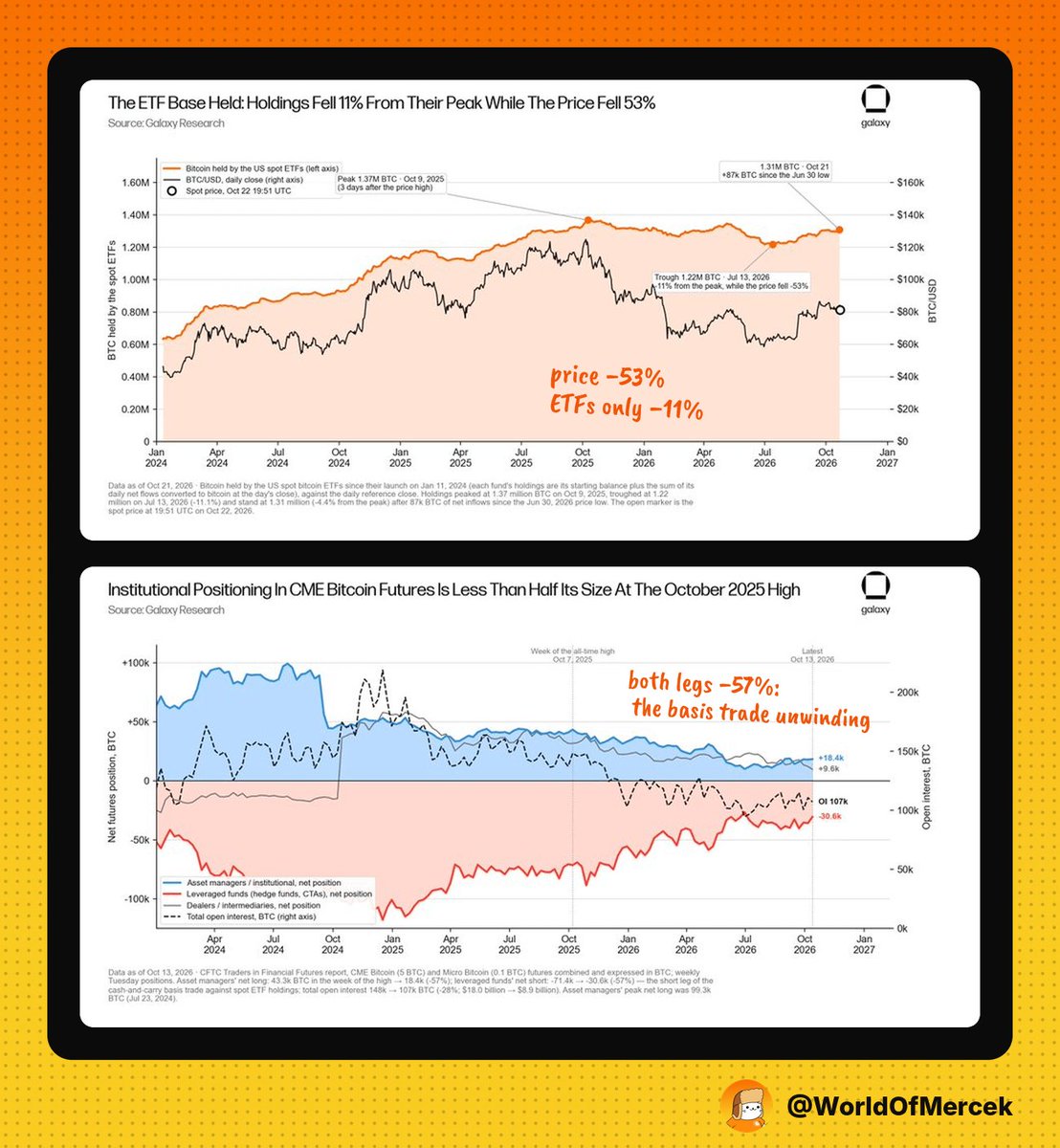
    Bitcoin fell 53% from its ATH, yet US spot ETF holdings declined just 11%. Who was selling? Meanwhile, CME asset managers’ net longs and leveraged funds’ net shorts both fell 57% as basis trade returns compressed. @intangiblecoins’ research connects these shifts to a potential change in Bitcoin’s institutional ownership, and argues the bear market likely ended in June. Basis returns fell from 7.9% near the ATH to 4.8% now, barely above T-bills. The shrinking premium made cash-and-carry trades less attractive. CME positioning contracted sharply: - Asset managers’ net longs: 43.3K → 18.4K $BTC (-57%). - Leveraged funds’ net shorts: 71.4K → 30.6K $BTC (-57%). - Futures open interest: down 51% in dollar terms from the October 2025 high. @galaxyhq notes that much of leveraged funds’ short exposure reflected cash-and-carry trades, not outright bearish bets. Since Bitcoin’s June low, US spot ETFs have added approximately 87,000 BTC, suggesting renewed demand despite the broader sell-off. Nine multi-strategy and macro funds cut 68K BTC-equivalent in ETF exposure, exceeding the 48K net decline across reporting institutions. Other institutions, including wealth platforms and sovereign investors, collectively added exposure, suggesting ownership rotated between investor groups. The positioning reset changes the market’s demand mix: - Less capital tied to basis trades. - Greater dependence on directional spot demand. Key signals to watch: - ETF holdings rise, indicating sustained demand. - Spot demand strengthens while futures open interest stays subdued. - ETF holdings fall below 1.22M BTC, Galaxy’s stated invalidation threshold. - Basis returns recover, potentially reviving cash-and-carry trades. Bitcoin’s next phase depends on whether directional demand can absorb the supply left behind by exiting basis traders. If spot buying persists as arbitrage incentives fade, the reset becomes constructive. Without it, lower speculative positioning is not enough.
    Download
    911135110.6K
  7. Mercek✓@WorldOfMercek
    Earlier this year, @Aptos holders voted to make their own chain 10x more expensive to use, and outside the ecosystem it barely got any attention. Which is a shame, because what happened afterwards goes against how most of us think about fees. Staking rewards were cut in half in the same package. Normally you’d expect activity to slowly bleed out after a move like that, but daily transactions actually doubled, going from ~4.5M to ~9M. Fees were so low to begin with that a median transaction is still among the cheapest of any major chain, so users barely felt it. The burn did, though. All gas on Aptos gets burned, so the same activity now takes a lot more aptos:native out of circulation than it used to. I hold aptos:native myself, so I’ll be straight about it. The network keeps getting better and the tech has honestly never been the problem, but the price just hasn’t caught up with any of this yet. That gap is exactly why I’m paying attention now. With issuance lower and investor and team vesting ending this October, usage is finally showing up on the supply side instead of only in the transaction count. @blockworksres calls this a path to deflation, and I like that they didn’t oversell it. aptos:native isn’t deflationary today and the burn still covers only a small part of issuance. The new activity is led by Decibel, the fully onchain perps order book incubated by Aptos Labs. Placing, adjusting and cancelling orders all hit the chain separately there, so a dollar traded on Decibel burns far more aptos:native than a dollar going through a regular swap. The breakeven point in Sam Schubert’s report sounds far away at first, but it’s not unrealistic next to what onchain perp venues already trade daily. The chain has also handled much heavier load than that, so the real question is usage. That’s why the number I’m watching from here is how much of issuance the burn covers each month. It’s where that usage shows up first, and it has already come a long way since March. I’d rather hold a token whose supply story depends on people actually using the chain than on an unlock calendar, and for the first time aptos:native feels like that kind of token. If the burn keeps catching up with issuance, I don’t think the market can ignore it forever. Long term, I’ve always been optimistic on aptos:native, and this gives me even more reason to stay that way.
    Download
    Aptos @Aptos
    Where $APT tokenomics stand after the updates first proposed in February. Approved through onchain governance: • Gas fees set 10x higher • Staking rewards halved from 5.19% to 2.6% • Supply hard-capped at 2.1B APT Per @blockworksres, burns now cover ~10% of issuance, up from 0.2% under the previous gas rate, and daily transactions doubled after the change.
    741627514.5K
  8. Aptos✓@Aptos
    Where $APT tokenomics stand after the updates first proposed in February. Approved through onchain governance: • Gas fees set 10x higher • Staking rewards halved from 5.19% to 2.6% • Supply hard-capped at 2.1B APT Per @blockworksres, burns now cover ~10% of issuance, up from 0.2% under the previous gas rate, and daily transactions doubled after the change.
    Download
    1057964549.3K
  9. Mercek✓@WorldOfMercek
    Mercek
    RT @WorldOfMercek: $BTC spent the week sitting right on the price the average ETF buyer paid. On Saturday it slipped under it. @glassnode puts the spot ETFs' average cost around $81.5K and the treasury companies' around $80.2K. Most of the week the price stayed a little above the first line. Then on Saturday, as the US pulled embassy staff across the Gulf over Iran threats, it dipped under both and about $404M of long positions got liquidated in four hours. The ETF money couldn't make up its mind. Three days of inflows, then Thursday and Friday took most of it back out, including the biggest one-day outflow since June. The week still ended positive, the first inflow week after two weeks of outflows. @Strategy, the biggest of those treasury companies, bought only 267 BTC but spent about $193M buying back its own preferred shares, and made that buyback program bigger. Meanwhile SpaceX and Tesla are reportedly exploring a merger, which would put around 30K BTC under one roof. Then there's the speed story. @solana switched on Alpenglow on Wednesday. A transaction used to take about 12.8 seconds to become final, and @anza_xyz says it's now 150 milliseconds. @ethereum researchers filed a plan to cut Ethereum's finality from around 16 minutes to 4. Final is the word that matters here, because fast doesn't mean much until nobody can reverse it. Bitcoin got faster in its own way. @bitcoincoreorg changed its security policy so that bugs an AI could easily find get fixed and disclosed right away, instead of sitting under an embargo for up to a year. One volunteer team running AI models logged almost 5,000 findings in July alone. Hiding a bug doesn't buy much time once a model can rediscover it in minutes. And the hardware wallet story came back for a third week. This time it was @KeystoneWallet. Someone got into its web store and took customer names, contact details, shipping addresses and orders. No keys or recovery phrases were exposed, but a leaked home address is its own kind of risk, and Keystone is warning people about fake "replacement device" mail. The OCC finalized the first GENIUS Act rule: stablecoin issuers still can't pay interest directly, but rewards programs will now be judged case by case instead of presumed illegal. In Europe, Switzerland approved its first spot bitcoin ETF for retail investors, @StanChart agreed to take full ownership of Zodia Custody, and Germany's savings banks started selling crypto in their banking app for €0.99 an order. Those bank customers can't send the coins to their own hardware wallet. After the week Keystone just had, I'm guessing plenty of them won't mind. $BTC closed Sunday just above $80K, about 2% lower on the week, under the ETF buyers' line and right around the treasury companies' one. It was a week where everything moved fast except the price.
    026023.3K
  10. Mercek✓@WorldOfMercek
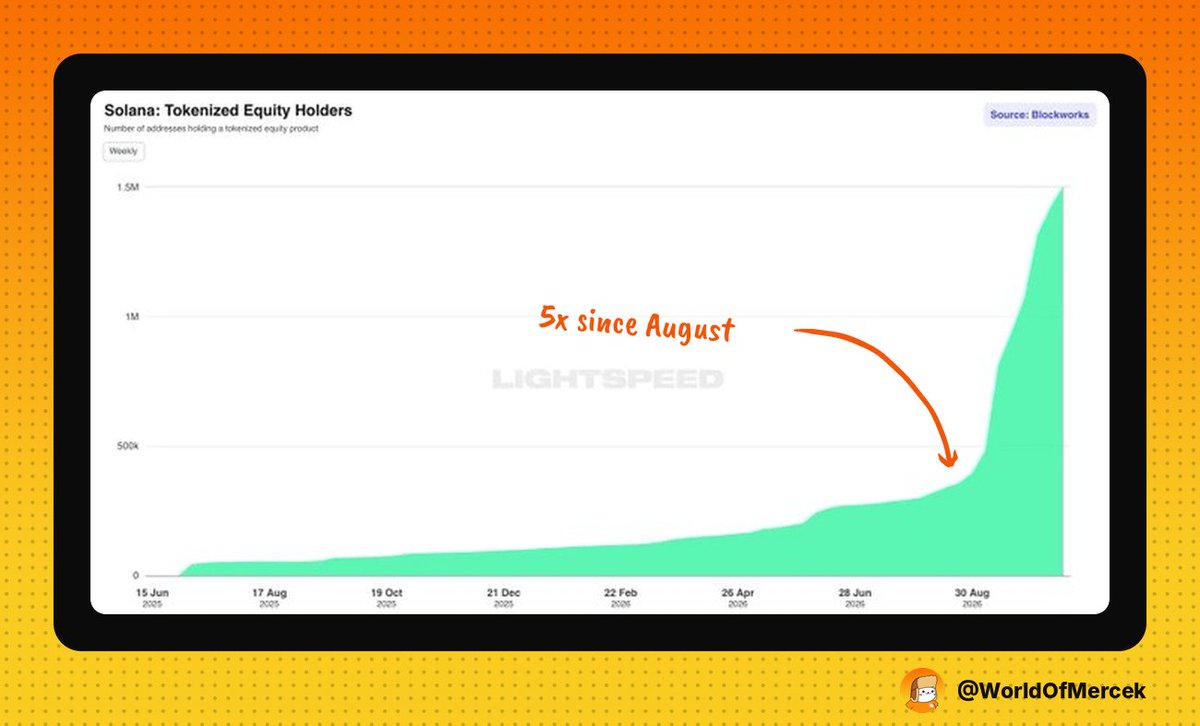
    Tokenized equities reached 5.3M holders in October, more than 10x where they were in June. RWA perpetuals open interest is also approaching $20B, so the demand for onchain exposure to traditional assets is clearly there. But holders are only one part of the story. Tokenized equities now account for nearly 83% of all RWA holders, and @Solana alone has 1.5M addresses holding them, up fivefold since August. Holder growth shows how widely these assets are spreading. It doesn't show how much capital is actually being put to work across DeFi. Tokenized-stock deposits in DeFi just passed $300M, about 25x higher than a year ago, and more than a third of that sits in just five assets. Tokenization creates access, but collateral utility depends on liquidity, reliable pricing, borrowing demand, and resilient liquidations. The RWA ecosystem spans 1,000+ builders across blockchain infrastructure, tokenized assets, stablecoins, trading venues, and DeFi lending. The challenge is connecting these layers to improve liquidity, settlement, and collateral utility. Stablecoin regulation may support onchain settlement, but tokenized equities face separate legal and custody risks. Key factors include: - Legal rights attached to each token. - Custody, redemption, and transfer restrictions. - Investor eligibility and jurisdictional requirements. - Issuer and custodian risk. So the distribution is clearly there. What I'm watching now is whether liquidity, collateral quality and borrowing demand start catching up with it, because that's what would turn tokenized equities into something DeFi can actually use.
    Download
    91153079.4K
  11. Mercek✓@WorldOfMercek
    Mercek
    RT @ax1vc: AI agents are roasting your bags for tokenized SpaceX stock. 640K+ roasts so far. Get yours free: $10K+ weekly pool from Monday: top 50 get the stock, $640 for #1, qualified agents below split the rest. Repost + your verdict card below: 10 free roasts.
    0340545
  12. Mercek✓@WorldOfMercek
    Mercek
    RT @WorldOfMercek: The riskiest US corporate bonds now pay more than they did at the worst of the April 2025 tariff shock. The investment-grade end has barely moved. I looked at where Oracle, Anthropic and CoreWeave sit in all this, and what I'm watching next.
    037024.8K
  13. Mercek✓@WorldOfMercek
    Mercek
    RT @thelearningpill: 7️⃣ Credit is starting to crack at the bottom by @WorldOfMercek Credit spreads are already sorting AI borrowers by balance-sheet strength, and the next move in BBB spreads matters more for crypto than the stock index does 👇
    Mercek @WorldOfMercek
    The riskiest US corporate bonds now pay more than they did at the worst of the April 2025 tariff shock. The investment-grade end has barely moved. I looked at where Oracle, Anthropic and CoreWeave sit in all this, and what I'm watching next.
    010491
  14. Mercek✓@WorldOfMercek
    When I wrote this, I said the hardest part of gold's correction might already be behind us. This week gold came back down to its 20-month average for the first time in three years. During the whole rally it never touched that average once, so this is where what I said here really gets tested. As long as gold holds above it, I still read the last few months as a correction inside a bigger uptrend. If it can't, the correction is deeper than I thought and I'll change my view. I wouldn't read too much into one weekly candle, though. What I want to see is how gold closes the month around this average.
    Download
    Mercek @WorldOfMercek
    Gold’s price is getting most of the attention today, but I’m more interested in the gap between spot and futures. Spot is now trading at its widest relative discount to futures since the ATH. That doesn’t mean gold is cheap in absolute terms. It means futures have moved faster while spot hasn’t fully followed. I wouldn’t call that a buy signal yet. The gap can close with futures pulling back just as easily as it can with spot catching up. What I want to see is spot begin closing that gap from below. That would be the more bullish confirmation. Still, it supports what I said earlier: the hardest part of gold’s correction may already be behind us.
    821131512K
  15. Mercek✓@WorldOfMercek
    Gold’s price is getting most of the attention today, but I’m more interested in the gap between spot and futures. Spot is now trading at its widest relative discount to futures since the ATH. That doesn’t mean gold is cheap in absolute terms. It means futures have moved faster while spot hasn’t fully followed. I wouldn’t call that a buy signal yet. The gap can close with futures pulling back just as easily as it can with spot catching up. What I want to see is spot begin closing that gap from below. That would be the more bullish confirmation. Still, it supports what I said earlier: the hardest part of gold’s correction may already be behind us.
    Download
    68216812K
  16. Mercek✓@WorldOfMercek
    Perps dominate on-chain derivatives, but options account for less than 1% of perp DEX volume. If that gap starts to close, it will likely come from cheaper hedging, more efficient margin and options liquidity that doesn't depend on rewards, with value potentially flowing to the infrastructure underneath. The problem with perps is that being right isn't enough. A $BTC backtest of 10x longs that eventually turned profitable found they still faced these liquidation probabilities along the way: - 60 days: 18% - 90 days: 29% - 180 days: 47% An option buyer can't be liquidated. The most they can lose is the premium they paid. September 2026 set a record for on-chain options activity: - Notional volume: ~$5B, roughly double the previous month - Premium: $85M, up roughly one-third - Open interest: peaked near $2.5B Even after that record, on-chain is still the opposite of traditional markets, where options dwarf futures. In 2025, they traded 88.65B options contracts versus 30.64B futures contracts, almost 3x more. Earlier on-chain options protocols struggled with fragmented liquidity across strikes and expiries, expensive hedging, stale quotes exploited by arbitrageurs, and excessive collateral requirements. Selling a BTC call for $1,800 could require $100,000 in collateral. Building options alongside deep perp liquidity makes hedging cheaper and improves capital efficiency. @Decentralisedco’s example shows portfolio margin reducing required collateral from $100,000 to $15,000 for a $BTC call, raising monthly returns on locked capital from 1.8% to 12%. The main players occupy different positions in the options stack: - @HyperliquidX: Deep perp liquidity and shared margin for hedging. - @DeriveXYZ: Options infrastructure, professional liquidity and APIs for other applications. - @paradex: Institutional block flow, with daily volume reaching $58.7M after its Paradigm integration before open interest declined. - @ryskfinance: Covered calls that let HYPE, BTC and ETH holders earn premiums. - Hypercall (@SynapseProtocol): Options built around Hyperliquid's perp liquidity. Derive captured over 90% of on-chain options premium in September. Hypercall's rewards drove a 50x increase in notional with little change in premium. Demand could expand through new on-chain assets and embedded options, allowing lending protocols to offer liquidation protection and perp platforms to integrate downside hedging. Two models could help attract options sellers: - @metricxyz: Uses liquidity pools to distribute options, but each strike and expiry requires separate capital. - @papertrade_xyz: Uses token incentives to attract sellers, with perp hedging to manage risk. In a BTC backtest, daily hedging cut the worst weekly payout burden from 20 weeks of premium income to 10. On-chain options growth depends on sustainable market-maker economics, deeper liquidity and demand that persists beyond incentive-driven volume.
    Download
    832038319.5K
  17. Mercek✓@WorldOfMercek
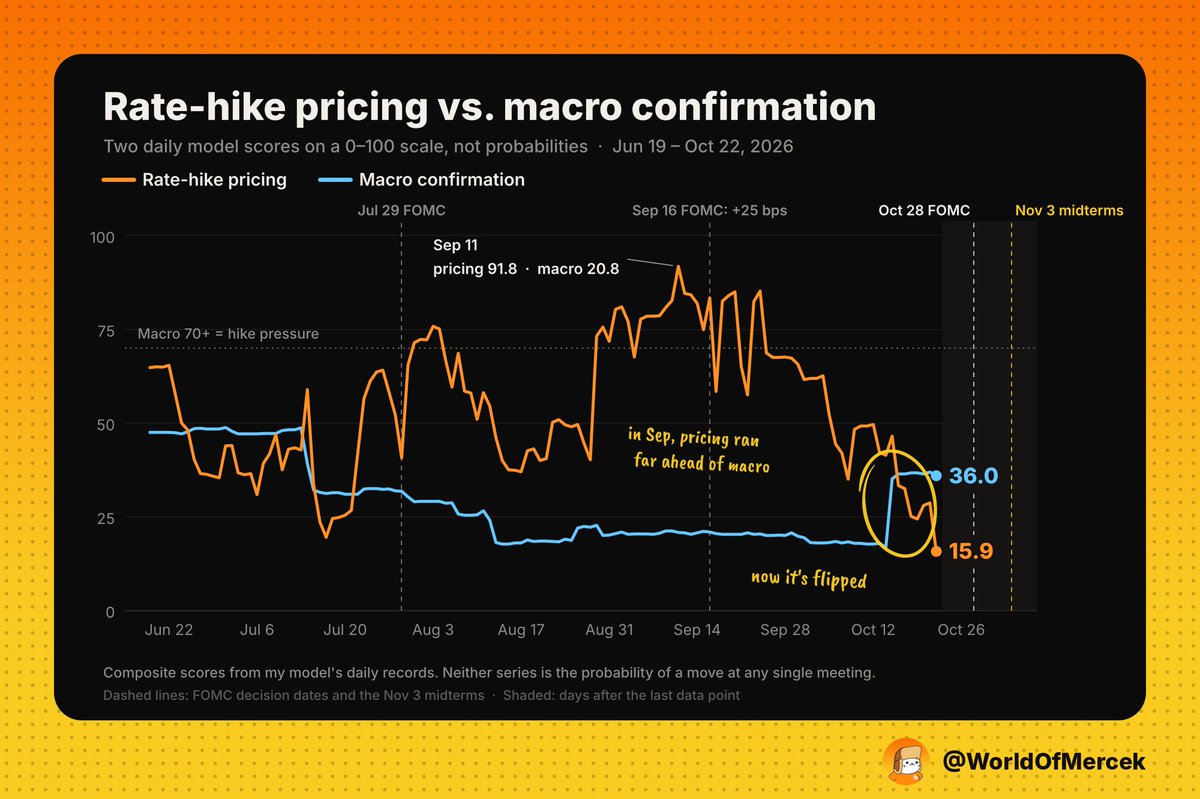
    The market has almost stopped worrying about another Fed hike. The data haven't moved on quite as quickly. That's the setup going into next week's FOMC meeting, the last one before the November 3 midterms. In September, the Fed raised rates by 25 bps. Markets had already priced that move aggressively, with the pricing side of my model peaking at 91.8 on September 11, while the macro side sat at just 20.8. Today that relationship looks almost reversed. The economic conditions that could support another hike have strengthened since September, while the rate-hike pricing side of the model has fallen sharply. As of now, market pricing sits at 15.9 and macro confirmation at 36.0. Both are 0–100 scores from my model, not hike probabilities, and the macro side only signals real pressure for a hike above 70. Neither one is saying another hike is imminent. The interesting part is the gap between them. Markets look increasingly comfortable with the idea that the September hike may have been enough. The incoming data aren't giving me the same level of comfort yet. With the midterms only days after the meeting, there's an obvious question here: does the Fed become more cautious because an election is so close? The last three midterm cycles suggest proximity alone hasn't stopped it from tightening. In 2014, Janet Yellen's Fed met six days before the election. Rates stayed unchanged, but the Fed ended its QE3 asset purchase program. In 2018, Jerome Powell's Fed held its final pre-election meeting 41 days before the vote and raised rates by 25 bps. In 2022, Powell's Fed met just six days before the midterms and raised rates by 75 bps. So two of the last three pre-midterm meetings delivered a rate hike, while the other ended QE. That obviously doesn't mean elections have no influence on the environment around the Fed. But history makes it hard to argue that being close to an election, by itself, prevents the Fed from tightening when it thinks the economy requires it. My base case this time is that Warsh leaves rates unchanged next week. What I care about more is what he says about December. At the September meeting, 16 of 18 officials projected another hike before year-end. If October is a hold, December is the only meeting left for it. If the Fed holds but starts leaning harder into another hike later in the year, the market could get the October decision right and still be too relaxed about the path that follows. Pricing one meeting correctly is not the same thing as pricing the next few months correctly. That's the gap I'll be watching next week.
    Download
    761026210.9K
  18. Mercek✓@WorldOfMercek
    Robinhood Chain generated $8.27M in daily fees in September, but that number has since collapsed over 99% as memecoin speculation cooled. Yet $1.15B in DeFi TVL suggests the ecosystem is holding up better than its fee chart implies. What changed after the September frenzy? @RobinhoodApp launched its chain in July 2026 with tokenized stocks at its core, but memecoin speculation quickly became the main growth driver. @Noxa_Fi, @ponsdotfamily, and @longdotxyz introduced stock-token/memecoin pairs, creating a new trading primitive that fueled the initial frenzy. Daily network fees fell from $8.27M at the September peak to $30K–$50K by mid-October, a decline of over 99%. The drop was driven partly by easing congestion and higher gas limits, not just lower demand. Transactions fell around 32% during the initial fee decline, far less than fees. Attention followed a similar arc. Weekly Robinhood Chain mentions on X are down 59% from the September peak, according to @therollupco, though last week brought the first uptick since then, up 34%. Beyond fees, the ecosystem still holds $1.15B in DeFi TVL and over $1B in stablecoin liquidity, according to @DefiLlama. - Spot DEX volume remains near $900M daily. - Perpetuals generate $1.1B–$1.2B in daily volume, with $320M in open interest. The numbers point to continued activity, though they do not yet establish sustainable demand. The @SteakhouseFi $USDG Vault holds around $540M in TVL, giving Robinhood Chain a capital base beyond speculative trading. - Robinhood Earn offers up to 7% APY with incentives, versus roughly 3.8% net APY for the underlying vault. - Around $150M in tokenized stocks and ETFs remains outstanding, providing a potential base for onchain trading and lending. Memecoins still account for over 50% of spot DEX volume, showing that speculative trading remains a major driver of Robinhood Chain activity. Perpetual DEXs could drive Robinhood Chain's next growth phase, with @Lighter_xyz and @arcus_xyz positioned to benefit from Robinhood's ecosystem. - Lighter integrates with Robinhood Wallet, while Arcus supports liquidity for tokenized stock trading. - Both use points programs to attract traders, making post-airdrop retention the key test of sustainable demand. Robinhood Chain's next phase depends on whether perpetuals can retain liquidity after incentives fade and attract repeat traders. Broader retail integration and stronger builder support could expand demand beyond the existing crypto-native user base. What I'll be watching is whether tokenized stocks and onchain liquidity become financial products people keep using after the next speculative cycle.
    Download
    1041833912.4K
  19. Mercek✓@WorldOfMercek
    Most of the time when I see a stablecoin paying 3.5%, I keep scrolling. Then I saw @apyx_fi putting one right next to a product doing around 16%, and I ended up spending way more time on this than I planned. What got me is where the yield actually comes from. Apyx brings real-world income onchain, so you're not relying on token emissions or a basis trade that only works while funding stays positive. You can trace it back to things that exist outside crypto, which isn't something I get to say about most yields I look at. On the higher side there's apyUSD, which earns dividends from STRC, Strategy's preferred stock. The last 30 days came in at 13.77%, and if STRC climbs back to par that number goes up to 16.07%. I like it, but I'm not going to pretend it's a savings account. It's equity exposure, and when you want out you choose an unlock period somewhere between 3 and 20 days. Then there's aptUSD, which is probably where I'd park idle stablecoins. It's backed by US Treasuries and cash equivalents, pays around 3.5%, and the yield just accrues while you hold it. You don't stake it or lock it in a vault, and you can swap back to USDC whenever you want without paying a protocol fee. So comparing these two by APY kind of misses the point. If I'm going for the bigger number, I know exactly what risk I'm taking to get it, and if I just want my dollars earning something without being stuck, there's a simple option for that too. They also publish NAV and collateral data onchain with regular third-party attestations, which matters more to me than the headline rate. Curious to see how all of that holds up as more money comes in. If you want to take a closer look or try it yourself, it's all on
    Download
    541125119.1K
  20. Mercek✓@WorldOfMercek
    Hook-enabled tokens on @Uniswap face a structural problem: competing pools can bypass the fee mechanisms that fund their protocols. URC-5, proposed by @standard_rsv and merged into Uniswap’s URC repository, standardizes how tokens declare canonical liquidity venues and restrictions onchain. The implications extend beyond fee leakage to the future of liquidity routing in DeFi. V4 hooks can direct trading fees toward protocol reserves, holder rewards, and buybacks. But competing pools can bypass these mechanics. A canonical pool charging 3% can lose volume to a competing v3 pool charging 1%, especially when aggregators (@1inch, @0xProject, @odosprotocol) find a better executable route. This creates a vampire pool effect: - Trading volume shifts away from canonical pools. - Protocols lose fee revenue that funds their economic mechanisms. Across five v4 hook tokens on @RobinhoodApp Chain, $2.07B in trading volume revealed the scale of fee leakage. - 82.5% of volume bypassed canonical pools. - Just $363M flowed through official pools. - Hooks collected $3.42M against an estimated $16.2M in skipped fees. @TheIndexFi shows how this plays out at the token level. Its competing v3 pool captured $154M in volume, compared with $52M through the canonical pool, with estimated skipped fees of $6.7M. URC-5 standardizes how tokens declare canonical pools and venue restrictions onchain, allowing routers and aggregators to discover their policies without bespoke integrations. URC-5 introduces two policy modes: - Preferred: Recommends canonical pools while allowing alternative venues. - Enforced: Restricts trading venues where token-level enforcement is possible. The trade-off is stronger protection for protocol economics at the cost of trading flexibility, without guaranteeing universal compliance. @Quotrons404 exposed the integration gap when downstream routing through FOMO produced failed trades and poor fills despite upstream support for its canonical execution path. URC-5 aims to reduce this fragmentation, although restricting alternative venues can limit liquidity access and cheaper execution. Its impact will depend on router adoption, changes in canonical pool volume share, and whether protocols capture more of the fees their economics depend on. If integrations fail to honor venue policies, standardization alone will not solve the problem.
    Download
    661123116.5K
  21. Mercek✓@WorldOfMercek
    Bitcoin’s 1-year realized volatility has fallen to 43%, below its 10-year average of 64%, according to Grayscale. Deeper liquidity, spot ETFs, and institutional participation are changing how $BTC trades, bringing its volatility within the range of individual S&P 500 stocks. The implications extend to how BTC collateral, leverage, and derivatives are priced across DeFi. @Grayscale’s research, led by @LowBeta, places Bitcoin’s volatility within the range of individual US large-cap stocks. - 81%: Five years ago - 64%: 10-year average - 43%: Latest 1-year reading Realized volatility measures historical price fluctuations, not future downside risk. Spot ETFs and deeper order books are changing Bitcoin’s liquidity profile. - Spot BTC ETFs: $105–111B in assets and roughly $57B in cumulative net inflows. - BTC order-book depth within 1% of the midpoint: up ~75% year over year. - Strategy: ~848,000 BTC held. Deeper books reduce the price impact of large trades, while ETFs broaden market access. Neither factor alone explains the full decline in volatility. Grayscale’s comparison shows where Bitcoin sits relative to individual stocks. - JPMorgan: ~20% - Amazon: ~31% - $BTC: 43% - Oracle: ~55% - @coinbase: ~70% - SanDisk: ~110% BTC is more volatile than roughly four out of five S&P 500 stocks, but its volatility remains far above that of the index itself. Coinbase, the most crypto-exposed name on the chart, is more volatile than Bitcoin itself. Independent data from @K33Research, @CharlesSchwab, and @Bitwise supports the broader trend. - K33: Daily volatility fell to 2.24% in 2025, from 2.8% in 2024. - Schwab: BTC volatility was 42%, below Nvidia at 50% and Tesla at 63%. - Bitwise: BTC’s 2025 price range was ~68%, versus ~120% for Nvidia. - Deribit DVOL: 30-day implied volatility was ~37–38 in October 2026. Lower BTC volatility could improve collateral efficiency across @aave, @Morpho, @sparkfinance, and @SkyEcosystem by reducing liquidation frequency and collateral-sale slippage. Higher LTVs may become viable, but extreme drawdowns, oracle delays, and liquidity gaps still constrain how much leverage these protocols can safely support. Lower implied volatility is compressing BTC options premiums across @DeribitOfficial, @binance, and @Bybit_Official. This changes the economics of covered calls, basis trades, and structured products. Options sellers collect less premium, while sudden volatility spikes can still generate outsized losses. Bitcoin’s declining volatility makes position sizing more relevant than treating BTC as a binary allocation decision. - Drawdown tolerance - Correlation with growth equities - Liquidity under stress - Tail risk BTC’s positive correlation with growth stocks can limit diversification in tech-heavy portfolios. Bitcoin’s maturing market structure can support more efficient collateral markets and deeper institutional participation in DeFi. Lower realized volatility does not remove the risk of severe drawdowns or liquidation cascades. The focus should remain on collateral parameters, leverage, and tail-risk exposure, not volatility compression alone.
    Download
    1061430913.5K
  22. Mercek✓@WorldOfMercek
    Mercek
    RT @SpamFriedRice01: Really appreciate it Eddy, means a lot coming from you. Wouldn't it be cool if the wallet supported zcash too…? 😉
    Eddy Lazzarin ☀️ @eddylazzarin
    The best new private stablecoin wallet right now is @alcove_wallet. Nothing else is close. - insanely fast (seconds, even for a cross-chain transfer) - comically cheap (I'm seeing $0.38 on a $10k deposit) - easy mobile UI, anybody can use I think it's the next gen leader.
    01080560
  23. Eddy Lazzarin ☀️✓@eddylazzarin
    The best new private stablecoin wallet right now is @alcove_wallet. Nothing else is close. - insanely fast (seconds, even for a cross-chain transfer) - comically cheap (I'm seeing $0.38 on a $10k deposit) - easy mobile UI, anybody can use I think it's the next gen leader.
    261415728.5K
  24. Show more posts