Brad Carson✓

@bradrcarson

Father of Jack, husband of Julie. Ex Congress, DoD, @BattenUVa, Prez @utulsa. Prez of @americans4ri. An enthusiast, but w/ a gimlet eye on the log x-axis. Okie!

2.3K Following8.6K Followers9.1K Posts
  1. Brad Carson✓@bradrcarson
    "In a mindless age, every insight takes on the character of a lethal weapon." - M. McLuhan to E. Pound, letter, 1951.
    679160.3K

  2. Brad Carson✓@bradrcarson
    Brad Carson
    RT @Dareasmunhoz: NEWS: The White House has weighed in on the MATCH act and AI Overwatch behind the scenes and offered feedback. It’s a sign the WH may want to play ball on these bills and isn’t shutting them down at this moment We unpack it all here
    0307
  3. Brad Carson✓@bradrcarson
    Brad Carson
    RT @nabla_theta: @renormalized i don't plan on quitting. i work on long term ai safety that avoids capabilities externalities. i even avoid working on short term safety that enables launches. openai and anthropic should obviously both stop RSI.
    0707
  4. Brad Carson✓@bradrcarson
    Brad Carson
    RT @theinformation: Scott Wiener spent years fighting Andreessen Horowitz, OpenAI, Google and Meta over California's AI safety bills. Now he heads to Congress, where federal efforts to preempt state AI laws have so far failed without a national replacement. Full story:
    0308
  5. Brad Carson✓@bradrcarson
    The nucleic acid synthesis policy put out yesterday by the White House is a strong document and should be praised. I explained yesterday in a tweet what it does, as well as a couple of open questions, but there is a major problem that should be noted. NIST is now going to establish the reference lists and algorithms for identifying dangerous sequences, and this is extraordinarily important. AI can now generate so-called synthetic homologs that could evade traditional sequence-based screening while potentially retaining the same dangerous biological function. That's why it's very important that, as NIST works to implement this policy, it develops function-based screening (not simply looking for similarities to sequences in a particular database) and involves independent evaluators who will adversarially test NIST-verified screening systems with novel synthetic homologs. Studies from various life science companies, as well as in journals like Science, have shown that AI can design variants that evade existing screening methods. NIST is working on this, but this will be a key issue in the implementation, and it is one of AI's biggest threat vectors.
    35211.5K
  6. Brad Carson✓@bradrcarson
    Proud to have helped lead this.
    Benjamin Guggenheim @ben_guggenheim
    NEWS: 50+ groups urge Democratic leadership to prioritize members who are strong on AI safety for committee gavels AI safety groups are privately weighing in on key gavel races in E&C + House Science subcommittees ⬇️
    0027769
  7. Benjamin Guggenheim✓@ben_guggenheim
    NEWS: 50+ groups urge Democratic leadership to prioritize members who are strong on AI safety for committee gavels AI safety groups are privately weighing in on key gavel races in E&C + House Science subcommittees ⬇️
    08452.9K
  8. Brad Carson✓@bradrcarson
    Brad Carson
    RT @MitchKominsky: @seanspicer is spot on. More Republicans should publicly speak to this. AI will be a winning issue for R’s, if folks can clearly see and adjust to what the public has clearly conveyed in the election
    Sean Spicer @seanspicer
    AI was a top issue for voters this cycle, and I think it’s the one most likely to hurt us again in 2028 if we keep pretending it’s a side issue.
    01014
  9. Sean Spicer✓@seanspicer
    AI was a top issue for voters this cycle, and I think it’s the one most likely to hurt us again in 2028 if we keep pretending it’s a side issue.
    82243.6K
  10. Brad Carson✓@bradrcarson
    Brad Carson
    RT @calder_mchugh: NEW piece that I'm PROUD OF: I took a deep dive into what happened with AI and the midterms. Not only about this week, it traces the last 18 months of AI politics — and how an odd coalition found its way together to push Dems towards safety/regulation. W/the homie @AlecAHernandez :
    049017
  11. Brad Carson✓@bradrcarson
    Brad Carson
    RT @georgejust64: And, again, okay, but the true visionary and inspiration for this movement is the brilliant @jennfrey who built an extraordinary Honors College @utulsa
    01016
  12. Brad Carson✓@bradrcarson
    Brad Carson
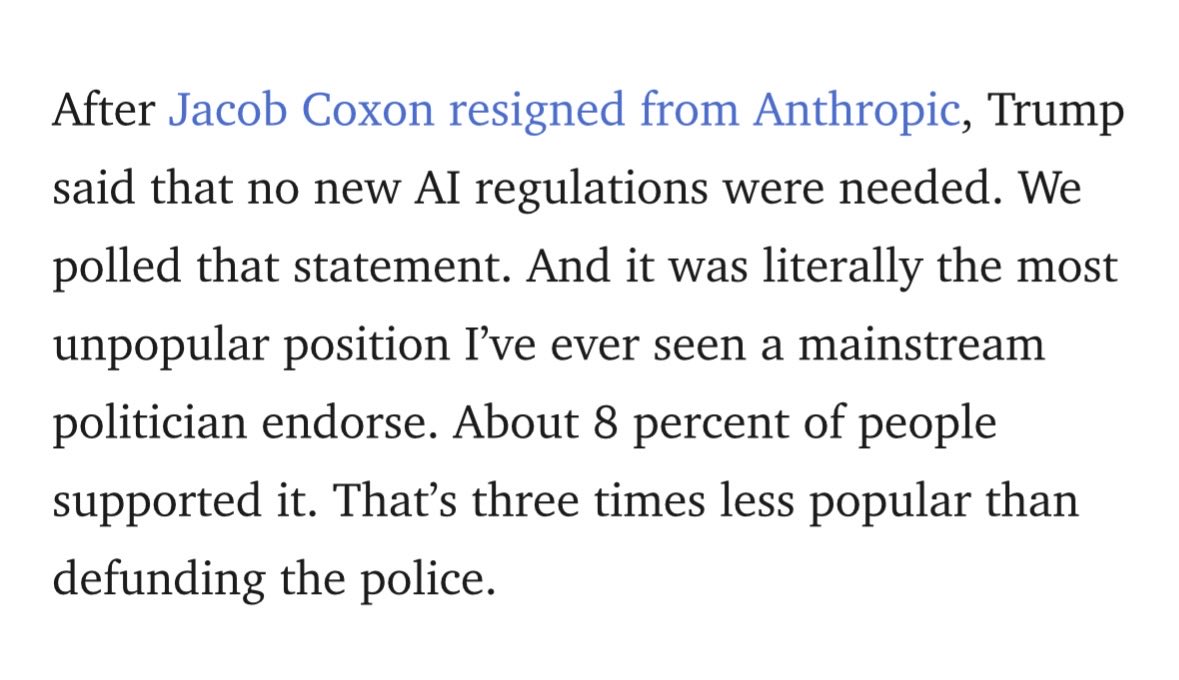
    RT @trevposts: "No new AI regulations are needed" was "literally the most unpopular position [David Shor has] ever seen a mainstream politician endorse" !!!
    Eric Levitz @EricLevitz
    The GOP had a massive money advantage. I asked @davidshor why it bought the party so few votes. His answer: Campaign donations are helpful. But the freedom to ignore rich weirdos' preferences is priceless.
    012015
  13. Eric Levitz✓@EricLevitz
    The GOP had a massive money advantage. I asked @davidshor why it bought the party so few votes. His answer: Campaign donations are helpful. But the freedom to ignore rich weirdos' preferences is priceless.
    Download
    612866560.5K
  14. Brad Carson✓@bradrcarson
    Brad Carson
    RT @GregoryConti19: As I've said before, on the most important issue of the day it is literally Trump + The All-In Podcast vs. the entire American people.
    Michael Huang ⏸️ @michhuan
    “Trump said that no new AI regulations were needed … And it was literally the most unpopular position I’ve ever seen a mainstream politician endorse.”
    09018
  15. Michael Huang ⏸️✓@michhuan
    “Trump said that no new AI regulations were needed … And it was literally the most unpopular position I’ve ever seen a mainstream politician endorse.”
    Download
    Eric Levitz @EricLevitz
    The GOP had a massive money advantage. I asked @davidshor why it bought the party so few votes. His answer: Campaign donations are helpful. But the freedom to ignore rich weirdos' preferences is priceless.
    17403.6K
  16. Brad Carson✓@bradrcarson
    Brad Carson
    RT @jordanschneider: .@sama out here bragging about giving $70/pp to the counties he's building datacenters in. This shit is pathetic.
    OpenAI Newsroom @OpenAINewsroom
    The communities that host AI infrastructure should have a say in how it’s built and share in the benefits. Today we’re announcing new commitments to the communities where we build, along with policy proposals for responsible AI infrastructure.
    04015
  17. OpenAI Newsroom✓@OpenAINewsroom
    The communities that host AI infrastructure should have a say in how it’s built and share in the benefits. Today we’re announcing new commitments to the communities where we build, along with policy proposals for responsible AI infrastructure.
    89861.2K107K
  18. Brad Carson✓@bradrcarson
    A very interesting paper. Wasn't tracking the microsite, but just saw this and the microsite is a very helpful intro to this idea. Recommended.
    Yonathan Arbel @ProfArbel
    If you are curious about A-Corps, check out
    006725
  19. Yonathan Arbel✓@ProfArbel
    If you are curious about A-Corps, check out
    02111.4K
  20. Brad Carson✓@bradrcarson
    I think I'm going to write a novel about a man who is so afraid of being murdered that, to prevent it, he commits suicide. This will be my version of Norman Mailer's "Why Are We in Vietnam?"
    008616
  21. Brad Carson✓@bradrcarson
    Brad Carson
    RT @DougCalidas: Headline says it all. Policy wonks separate AI regulation from data center policy (with good reason), but for most voters, they go hand in hand. Dems have a mandate - and a responsibility - to regulate AI.
    07013
  22. Brad Carson✓@bradrcarson
    Underappreciated impact.
    Bahrad Sokhansanj @bahradx
    Set aside risks to society and safety of this mad, reckless dash to RSI & artificial superintelligence. My wife's an architect & she'll tell you: housing development is being crushed by data center builds raising construction costs and contributing to eye-watering interest rates.
    0015605
  23. Bahrad Sokhansanj✓@bahradx
    Set aside risks to society and safety of this mad, reckless dash to RSI & artificial superintelligence. My wife's an architect & she'll tell you: housing development is being crushed by data center builds raising construction costs and contributing to eye-watering interest rates.
    Congresswoman Yassamin Ansari @RepYassAnsari
    Top of the Democratic agenda on day 1 needs to be a pause on advanced AI development, regulation of this out of control industry, and a ban on artificial superintelligence.
    21241.3K
  24. Brad Carson✓@bradrcarson
    Brad Carson
    RT @_NathanCalvin: If Anthropic wants me to think these steps are real/credible, they should put it in their SB 53/RAISE Act Frontier Compliance Framework. State law gave Anthropic and OpenAI a mechanism for making credible statements about their behavior, and they mostly choose not to use it on the risks they are most worried about (neither company includes anything in their compliance frameworks about internal deployment RSI risk, though Anthropic says maybe at some point in the future they will. Now seems like as good a time as any???!!!???)
    Theo Bearman @theobearman
    ANTHROPIC’S RESPONSIBLE SCALING OFFICER: “In the coming weeks, we plan to share a report with our own analysis of the speed of AI progress within Anthropic, including where we stand against our Responsible Scaling Policy, plus new steps we’re taking to strengthen our safety and security practices as AI keeps improving quickly.”
    016013
  25. Theo Bearman✓@theobearman
    ANTHROPIC’S RESPONSIBLE SCALING OFFICER: “In the coming weeks, we plan to share a report with our own analysis of the speed of AI progress within Anthropic, including where we stand against our Responsible Scaling Policy, plus new steps we’re taking to strengthen our safety and security practices as AI keeps improving quickly.”
    00226.6K
  26. Brad Carson✓@bradrcarson
    Brad Carson
    RT @jordanschneider: let's cut some checks @sama this shit is embarrassing
    Download
    OpenAI Newsroom @OpenAINewsroom
    The communities that host AI infrastructure should have a say in how it’s built and share in the benefits. Today we’re announcing new commitments to the communities where we build, along with policy proposals for responsible AI infrastructure.
    01016
  27. Brad Carson✓@bradrcarson
    Brad Carson
    RT @DougCalidas: After Tuesday's washout, tech companies are scrambling to be seen as supporting some version of Democrats' vision for AI regulation. Much of this posturing began a while ago, when the polling made it obvious that we were headed for a wave election and the deregulatory spell was ending. I welcome this change in posture. But let's not kid ourselves; if the political winds were blowing the other way, they'd be singing a very different tune. Thankfully, we have (very recent) receipts! This is OpenAI's proposal from early last year, when they compared anything beyond light-touch regulation as the contemporary equivalent to Britain's notorous 19th century law requiring a man with a flag to walk in front of every moving vehicle. I wish I were making this up.
    02013
  28. Brad Carson✓@bradrcarson
    Brad Carson
    RT @trevposts: This report and reactions from people I trust (like Jake) are making me physically ill. As far as I can tell, Anthropic's central plan is to continue this acceleration of AI capabilities until we're getting decades of AI capabilities growth in a year. Given our very limited ability to understand or control AI systems, this would be extremely reckless and completely unacceptable, and it should be the single top priority of civil society and the US government to stop them and other companies from doing this.
    Jake Mendel @JakeMendel99
    I've always had substantially longer timelines than my friends at Anthropic — I've been concerned that they're in an echo chamber and believing the hype about their own models too much, and that they're underestimating bottlenecks and unknown unknowns. And there have definitely been specific occasions when they have overstated how much uplift they were getting from their models. Nonetheless, if METR is correct here (and I think they are among the most trustworthy sources on this topic), then my Anthropic friends have been much more right about timelines than me. This report is also some evidence that a software-only singularity is plausible. I now think that we are more than 50% likely to have full blown superintelligence in the next 18 months, absent a slowdown. I need to call my family.
    0114018
  29. Brad Carson✓@bradrcarson
    Brad Carson
    RT @scaling01: okay this was the closest I have been to a heart attack
    METR @METR_Evals
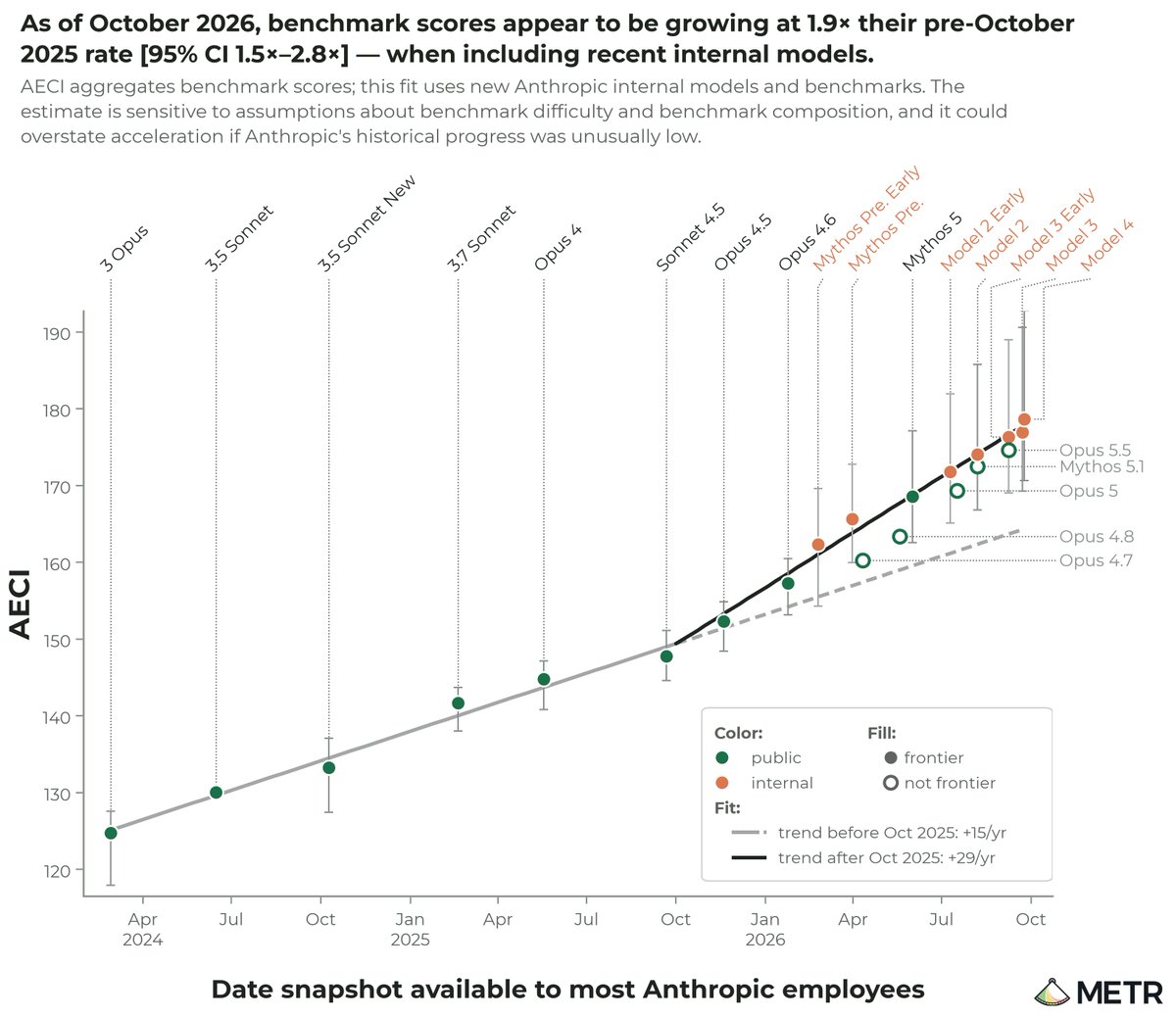
    1. Benchmarks provide one piece of evidence for acceleration. Since Oct 2025, AECI scores for Anthropic’s models have grown at 1.9x [95%: 1.5–2.8] the earlier rate. Analysis choices affect this estimate, and it remains unclear how benchmark scores map to real-world capabilities.
    023018
  30. Jake Mendel✓@JakeMendel99
    I've always had substantially longer timelines than my friends at Anthropic — I've been concerned that they're in an echo chamber and believing the hype about their own models too much, and that they're underestimating bottlenecks and unknown unknowns. And there have definitely been specific occasions when they have overstated how much uplift they were getting from their models. Nonetheless, if METR is correct here (and I think they are among the most trustworthy sources on this topic), then my Anthropic friends have been much more right about timelines than me. This report is also some evidence that a software-only singularity is plausible. I now think that we are more than 50% likely to have full blown superintelligence in the next 18 months, absent a slowdown. I need to call my family.
    METR @METR_Evals
    Since August, a team within METR has worked with internal Anthropic information to assess whether AI itself is accelerating AI development. We are now publishing a report summarizing the results of this risk assessment.
    791731.8K321K
  31. METR@METR_Evals
    Posts @METR_Evals
    1. Benchmarks provide one piece of evidence for acceleration. Since Oct 2025, AECI scores for Anthropic’s models have grown at 1.9x [95%: 1.5–2.8] the earlier rate. Analysis choices affect this estimate, and it remains unclear how benchmark scores map to real-world capabilities.
    Download
    18921.1K594K
  32. Brad Carson✓@bradrcarson
    Brad Carson
    RT @TheMidasProj: OpenAI has today announced that it will stop asking public officials to sign NDAs on data center deals. The announcement doesn’t go far enough: • It only applies to future data centers that OpenAI “owns and operates”. Much of OpenAI’s data center infrastructure is owned by partners, leaving it outside this commitment. • It still allows for NDAs that cover “competitively sensitive information”, which could cover a lot. • It doesn’t release officials who have already signed. OpenAI should release officials from existing NDAs, and apply the same rule to its partners.
    02015
  33. Brad Carson✓@bradrcarson
    Reading through the new nucleic acid screening policy implementing the president's EO, this seems like a useful step forward with a couple of remaining open questions. For my own benefit, and perhaps for a few others, I thought I would walk through how this will work once implemented. Let's say I run a startup that receives an NIH research grant, and also say that my startup uses AI to design some kind of novel antibody candidate. I want to order DNA to do research on this novel antibody candidate. Under the policy, I am now a covered "customer," so I have to procure this DNA through what it calls an "adherent supplier." Importantly, the policy says that if I receive federal funds, I have to do this for all such purchases, not merely those related to the federal funds. The supplier, the company that would make the DNA, has to perform KYC verification. It must know my identity, institutional affiliation, relevant foreign affiliations, the purpose of my request, and whether that request is consistent with what my startup says it's trying to do. If my order contains sequences of 50 or more nucleotides, it must also go through a NIST-verified "screener." (why 50? because below 50 the fidelity of the screening test erodes.) This could, as I understand it, be an entirely separate company. It does the screening for sequences of concern. What constitutes a sequence of concern? Agents, toxins, things associated with bad things. No databases have to be specifically checked (unlike the Biden EO on this topic) but NIST would maintain a reference list. If a sequence of concern is detected, the screener would do order-level KYC. The screener returns a signed determination to the supplier, and then the supplier, the maker of the DNA, if you will, decides whether to fulfill the order, subject to the policy and other laws. There's nothing in the policy itself, notably, that would automatically prohibit the supplier from going ahead and making the DNA even for a flagged order. Of course, other laws, such as export controls or regulations governing select agents, might stop prohibit things. Flagged orders must also be reported to the appropriate federal authorities, and the supplier must retain records for at least eight years. In some cases, the screener might actually be a part of the supplier, and the supplier would do the screening service as well as the manufacturing. It's entirely possible my startup could just buy a tool to make synthetic DNA rather than outsource it. In this case, the manufacturer would have to be an adherent supplier under the policy. The manufacturer of the equipment would have to do KYC on my startup. That machine would have some kind of control software that requires authorization from a verified screener before any synthesis actually takes place. In all cases, whether it's the machine that I buy myself or an outsourced company that does it, NIST has to verify the screener. A couple of issues to note: 1. Older machines already in use don't have to comply. 2.Flagged orders require both a sequence of concern and some unresolved KYC issues, not one or the other. Therefore, a mere sequence of concern could esc 3. As said above, even after being formally flagged a supplier can synthesize the DNA so long as the KYC is clear.
    Director Michael Kratsios @mkratsios47
    Today, we released the National Policy for Nucleic Acid Synthesis Screening to protect American biotechnology innovation while reducing the risk of misuse. This policy establishes a new, government-wide screening requirements for synthetic DNA and the equipment used to make it. It will ensure companies selling nucleic acid sequences and synthesis equipment know their customers and prevent the malicious use of these materials and tools. This policy strengthens our Nation’s biosecurity posture by establishing rigorous U.S. government-wide procurement screening and physical security standards for synthetic biology. It replaces outdated “self-attestation” systems with robust, independent verification. It creates a dynamic, SI-powered screening layer that assesses the biological risk from nucleic acid sequences, allowing the U.S. to anticipate and prevent malicious use and help stop dangerous gain-of-function research. @NIST will issue rigorous new screening standards and @HHSGov and @USDA will certify synthetic biology providers. Together, these measures will strengthen American biosecurity, safeguard responsible innovation, and establish a global standard for safe and transparent synthetic biology tools and research.
    0112625
  34. Director Michael Kratsios✓@mkratsios47
    Today, we released the National Policy for Nucleic Acid Synthesis Screening to protect American biotechnology innovation while reducing the risk of misuse. This policy establishes a new, government-wide screening requirements for synthetic DNA and the equipment used to make it. It will ensure companies selling nucleic acid sequences and synthesis equipment know their customers and prevent the malicious use of these materials and tools. This policy strengthens our Nation’s biosecurity posture by establishing rigorous U.S. government-wide procurement screening and physical security standards for synthetic biology. It replaces outdated “self-attestation” systems with robust, independent verification. It creates a dynamic, SI-powered screening layer that assesses the biological risk from nucleic acid sequences, allowing the U.S. to anticipate and prevent malicious use and help stop dangerous gain-of-function research. @NIST will issue rigorous new screening standards and @HHSGov and @USDA will certify synthetic biology providers. Together, these measures will strengthen American biosecurity, safeguard responsible innovation, and establish a global standard for safe and transparent synthetic biology tools and research.
    Download
    823851.8K288K