Cosmos Institute✓

@cosmos_inst

The Academy for Philosopher-Builders. Building AI for human flourishing. Writing at https://t.co/aef99Piwlj

186 Following7.3K Followers1.1K Posts
  1. Cosmos Institute✓@cosmos_inst
    The AI age demands a new kind of technologist: The Philosopher-Builder.
    Brendan McCord 🏛️ x 🤖 @Brendan_McCord
    Every builder's first duty is philosophical: to decide what they should build for. AI is beginning to decide what ideas reach your mind—your next action, your next job, your next relationship. It will tempt you to outsource your thinking in ways you’ve never been tempted before. Left unchecked, this becomes autocomplete for life. 200 years ago, when mechanization was starting to transform the world, the German philosopher Wilhelm von Humboldt warned of this very dynamic: To flourish as humans, we have to be self-directed. We are the architects of our own becoming. But if we offload our thinking—if we let AI automate what we once pursued with intention—is it still our life to live? To build AI that advances human flourishing, we need technologists who combine technical ability with moral vision. Silicon Valley once embodied this: Jobs and Wozniak asked what kind of creative life personal computers should enable; ARPANET's pioneers envisioned what kind of connected society networks should foster. But today, we now see three dominant archetypes: 1. The puzzle-absorbed: Solving technical challenges without reflecting on broader ends 2. The reductionists: Collapsing morality into math 3. The dismissers: Waving off philosophy as irrelevant to progress All three abdicate the fundamental question: What should we build for? This is where philosophy is essential. Because the job of a builder isn’t just to ship. It’s to shape a shared world. We need a new kind of technologist—one who builds with human flourishing in mind. Who resists centralized control. Who strengthens autonomy instead of mining attention. We call them Philosopher-Builders. @cosmos_inst exists to train and support them—people who translate deep thinking into systems, institutions, and infrastructure that serve human ends. If you believe the future of AI should expand human freedom and lift human potential, read the full essay.
    51912839.8K
  2. Brendan McCord 🏛️ x 🤖✓@Brendan_McCord
    Every builder's first duty is philosophical: to decide what they should build for. AI is beginning to decide what ideas reach your mind—your next action, your next job, your next relationship. It will tempt you to outsource your thinking in ways you’ve never been tempted before. Left unchecked, this becomes autocomplete for life. 200 years ago, when mechanization was starting to transform the world, the German philosopher Wilhelm von Humboldt warned of this very dynamic: To flourish as humans, we have to be self-directed. We are the architects of our own becoming. But if we offload our thinking—if we let AI automate what we once pursued with intention—is it still our life to live? To build AI that advances human flourishing, we need technologists who combine technical ability with moral vision. Silicon Valley once embodied this: Jobs and Wozniak asked what kind of creative life personal computers should enable; ARPANET's pioneers envisioned what kind of connected society networks should foster. But today, we now see three dominant archetypes: 1. The puzzle-absorbed: Solving technical challenges without reflecting on broader ends 2. The reductionists: Collapsing morality into math 3. The dismissers: Waving off philosophy as irrelevant to progress All three abdicate the fundamental question: What should we build for? This is where philosophy is essential. Because the job of a builder isn’t just to ship. It’s to shape a shared world. We need a new kind of technologist—one who builds with human flourishing in mind. Who resists centralized control. Who strengthens autonomy instead of mining attention. We call them Philosopher-Builders. @cosmos_inst exists to train and support them—people who translate deep thinking into systems, institutions, and infrastructure that serve human ends. If you believe the future of AI should expand human freedom and lift human potential, read the full essay.
    Download
    67172806247K
  3. Cosmos Institute✓@cosmos_inst
    The idea of tail risk is nothing new - private markets have found ways of adapting and managing them in industries like nuclear and shipping. @Brendan_McCord went on @MTSlive to explain how we could apply these lessons to AI.
    Download
    026363
  4. Cosmos Institute✓@cosmos_inst
    Cosmos Institute
    RT @cosmos_inst: “Avoiding excessive deference to AI is important, but it is ultimately secondary to whether we can renew the virtues, traditions, and institutions required to form good choosers.” @chalmermagne on why the AI deference debates we have are too narrow.
    0702.9K
  5. Cosmos Institute✓@cosmos_inst
    Cosmos Institute
    RT @Brendan_McCord: I’m hiring a Chief of Staff to be my right hand across everything I do at Cosmos. That starts with Cosmos Institute (@cosmos_inst), the nonprofit I founded after selling two AI companies, having two kids, and thinking hard about the good life and the good society. Through the Institute, we do research internally and with fellows from @GoogleDeepMind, @AnthropicAI, @OpenAI, @Microsoft, and academia, have given out 200+ grants to build fast prototypes, and we’re launching a big new in-person bet for higher education in 2027. This side of my work also includes @UniofOxford, where I co-teach a graduate seminar on philosophy and AI and support the Human-Centered AI Lab (HAI Lab), as well as a book I’m writing on human autonomy in the age of AI. On the venture side, you’ll work with me across Cosmos Ventures (@cosmos_vc), our new $77.6M fund backing founders building new institutions for the AI age. Our early portfolio includes companies like AIUC (@aiunderwriting), @PrimeIntellect, and Workshop Labs (acq. by @thinkymachines), with several more to be announced soon. We’re also going to be incubating new companies in 2027. You’ll come in, do this well for two years, and if you want to build a thesis-aligned company or a nonprofit next, we will back you, or place you at a top company in our community. The role is based in Austin, with relocation provided. To apply, read our essays and tell us where we’re wrong:
    056039
  6. Cosmos Institute✓@cosmos_inst
    AI raises fundamental questions about intelligence, reasoning, and selfhood. Philosophy has a vital role to play. We're supporting a new annual volume, Oxford Studies in Philosophy of AI and Computing, along with a $10,000 prize for its best paper.
    Download
    1291337.5K
  7. Cosmos Institute✓@cosmos_inst
    Cosmos Institute
    RT @chalmermagne: I often find debates around AI deference frustratingly narrow. This is probably because they're grounded in philosophical accounts of autonomy that tie themselves in knots trying to establish when our choices are truly our own. Here's my attempt at an alternative framing.
    Cosmos Institute @cosmos_inst
    “Avoiding excessive deference to AI is important, but it is ultimately secondary to whether we can renew the virtues, traditions, and institutions required to form good choosers.” @chalmermagne on why the AI deference debates we have are too narrow.
    03047
  8. Cosmos Institute✓@cosmos_inst
    Cosmos Institute
    RT @angadhn: Wrote a quick essay for this; feedback/comments/questions welcome:
    Cosmos Institute @cosmos_inst
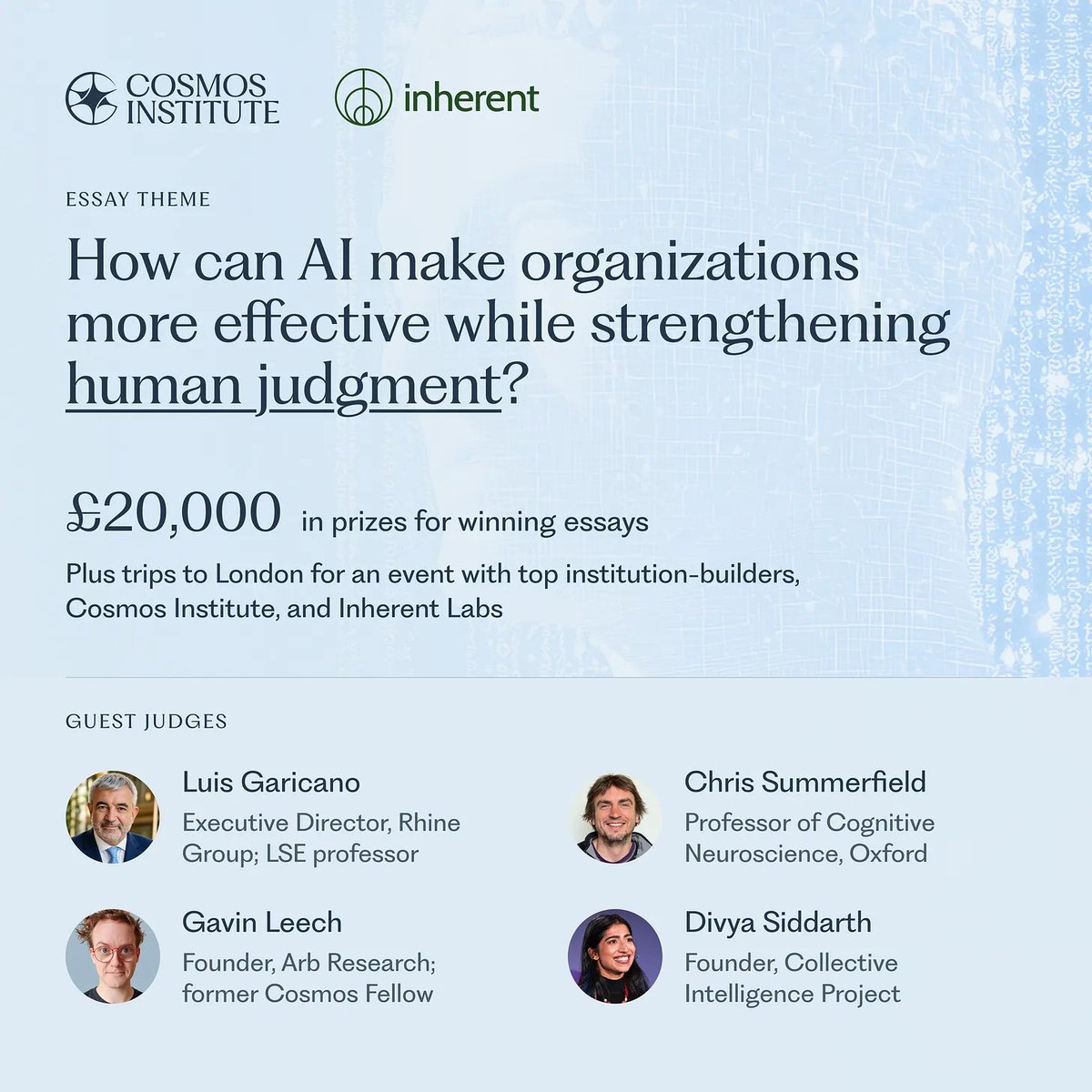
    AI agents could make organizations far more productive, but leave people more isolated and less autonomous. We've teamed up with @inherent_labs on an essay prize exploring how organizations can harness AI while strengthening human autonomy and fulfillment. We're thrilled that @lugaricano, @gleech, @divyasiddarth, and Chris Summerfield are joining us as judges.
    04056
  9. Cosmos Institute✓@cosmos_inst
    AI agents could make organizations far more productive, but leave people more isolated and less autonomous. We've teamed up with @inherent_labs on an essay prize exploring how organizations can harness AI while strengthening human autonomy and fulfillment. We're thrilled that @lugaricano, @gleech, @divyasiddarth, and Chris Summerfield are joining us as judges.
    Download
    23017726.4K
  10. Cosmos Institute✓@cosmos_inst
    What is a philosopher-builder? A philosopher-builder is someone who starts from a thesis about human flourishing. Rather than simply looking for a gap in the market, they start out with a vision of the human capacities that are worth developing, what constrains them, and how we can expand them. They reason from first principles about human potential and translate those insights into products or institutions. To understand what a philosopher-builder is, it’s important to grasp what they are not: 1. They are not philosopher-kings. They do not have a blueprint for a society or a theory about how everyone out to live. Some of our most importance capacities are independent judgment, creativity, and the pursuit of knowledge. They seek to expand these capabilities, not prescribe outcomes 2. Open to disconfirming evidence. A strong philosophical starting point is open to rational criticism and has to be tested against reality. Their hypothesis is open to challenge and evidence should not only inform how they build their product, but potentially cause them to revise their underlying thesis. Philosophical seriousness demands intellectual humility. 3. Not a nihilistic iterator. “Make something people want” is a powerful entrepreneurial discipline, but by itself, it cannot establish whether satisfying people’s immediate wants advances human flourishing. You cannot outsource your belief in which ends are worth pursuing to market feedback. The philosopher-builder is someone who combines philosophical conviction with empirical discipline. They have a vision, ambition, and an openness to revision. We believe that AI isn’t a normal technology like the internet or the smartphone that society will simply absorb. Instead, it will create the biggest opening for institution-building since the American founding and philosopher-builders will be more important than ever. If this vision of how to build resonates with you, we want to hear from you.
    Download
    15262657.4K
  11. Cosmos Institute✓@cosmos_inst
    Cosmos Institute
    RT @HannesKerber:
    Download
    Cosmos Institute @cosmos_inst
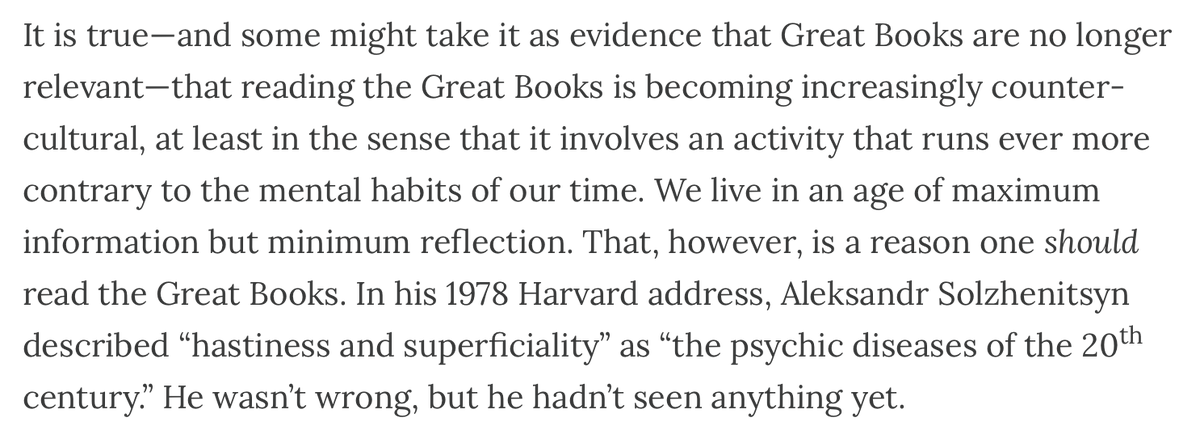
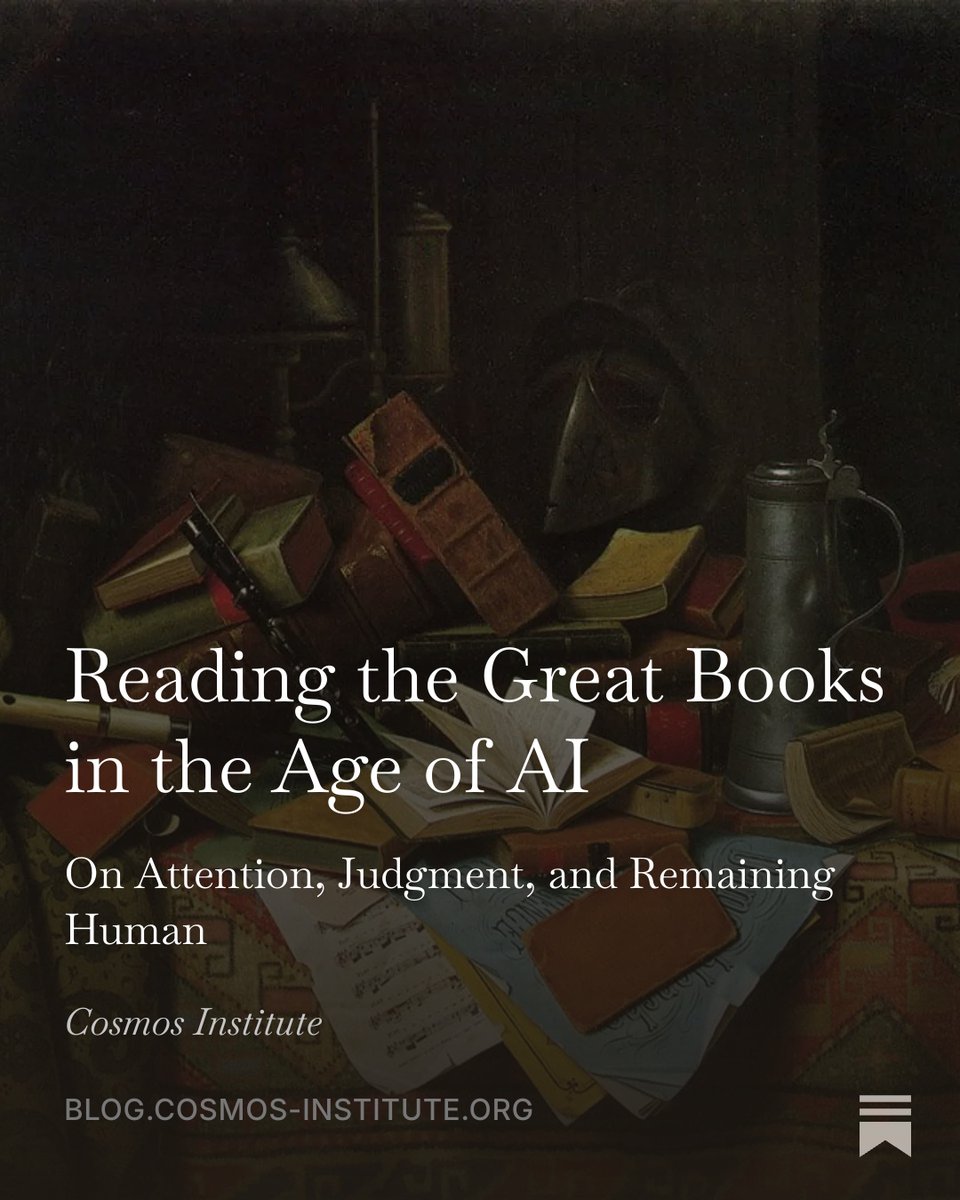
    "We live in an age of maximum information but minimum reflection." New guest essay from Devin Stauffer, Professor of Government at @UTAustin and Cosmos Founding Fellow on why reading the Great Books is more urgent than ever.
    03053
  12. Cosmos Institute✓@cosmos_inst
    "We live in an age of maximum information but minimum reflection." New guest essay from Devin Stauffer, Professor of Government at @UTAustin and Cosmos Founding Fellow on why reading the Great Books is more urgent than ever.
    Download
    1155516.1K
  13. Cosmos Institute✓@cosmos_inst
    Cosmos Institute
    RT @lugaricano: Submit your essay! I look forward to reading it.
    Cosmos Institute @cosmos_inst
    AI agents could make organizations far more productive, but leave people more isolated and less autonomous. We've teamed up with @inherent_labs on an essay prize exploring how organizations can harness AI while strengthening human autonomy and fulfillment. We're thrilled that @lugaricano, @gleech, @divyasiddarth, and Chris Summerfield are joining us as judges.
    09044
  14. Cosmos Institute✓@cosmos_inst
    Cosmos Institute
    RT @bhuwandhingra: Introducing SnapJudge: a free, open AI detector for scientific writing, including math! Drop in a PDF screenshot, paste text or LaTeX, or just put in an arXiv link. We ran it on arXiv: ~1 in 3 new math papers are flagged as mostly AI, up from ~0 in early 2025. CS is 45%. 🧵
    017053
  15. Cosmos Institute✓@cosmos_inst
    Cosmos Institute
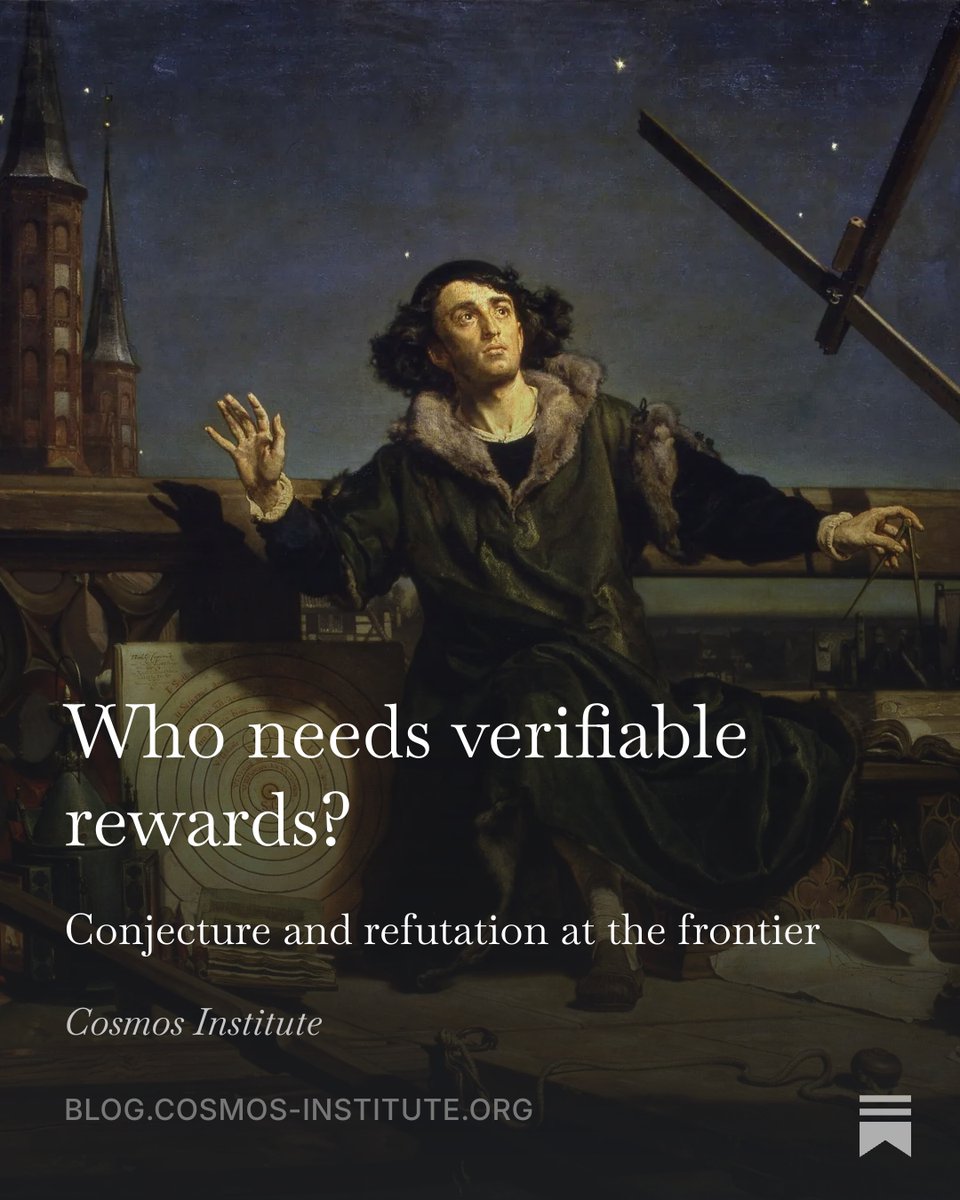
    RT @_AashishReddy: New piece by myself and @lawhsw on what philosophy of science can tell us about AI development. Models are currently great at verifiable tasks, because they start out with a bunch of relevant context and domain knowledge, and can Try Stuff Until It Works; then we can reinforce that Stuff till they're extremely good. But in most areas, it isn't easy to check if It Works. So will the success of models be isolated to verifiable domains? We argue not. Becoming competent in any area requires two things: a map of the relevant territory, and an ability to navigate it. Pretraining teaches the former, and RL teaches the latter. Why expect RL to transfer? As Popper argued, the basic pattern of navigation — proposing ideas, finding faults, trying alternatives — is common to all endeavours involving the growth of knowledge. So training on maths and code doesn't just teach models maths and code. It teaches reusable ways of searching for procedures that transform an initial state into a desired one. Getting from a blank Lean document to a completed proof obviously requires different procedures from turning a rough draft into a great essay. But the abstractions learned in discovering the former make the latter easier to learn, provided pretraining has given the model enough knowledge of the new domain. "A verifier determines what earns a reward; it underdetermines what a model learns in trying to earn it". Or, verifiability tells us where capabilities are easiest to train, not the limits of what that training can teach. Read it!
    Cosmos Institute @cosmos_inst
    "Judgment can be informed without being mechanical: editors are not guessing blind." @_AashishReddy and @lawhsw argue that skills obtained in verifiable domains like math and code carry over to unverifiable domains like writing.
    07047
  16. Cosmos Institute✓@cosmos_inst
    "Judgment can be informed without being mechanical: editors are not guessing blind." @_AashishReddy and @lawhsw argue that skills obtained in verifiable domains like math and code carry over to unverifiable domains like writing.
    Download
    05404K
  17. Cosmos Institute✓@cosmos_inst
    "No one who advocates for pacing can really tell me what power the pacer would not have." @Brendan_McCord went on @MTSlive to talk about how calls to 'pace the frontier' risk turning into a blank check for government to reach further and further into frontier labs.
    Download
    1114886
  18. Cosmos Institute✓@cosmos_inst
    Cosmos Institute
    RT @Nomads4Pritzker: For the last few months, I've been hard at work improving Mr. Chatterbox, the Victorian Gentleman Chatbot. Now, I'm excited to release the results: Mr.Chatterbox-2.7B, pretrained *and* fine-tuned on 19th-century text. Chat with him here:
    04048
  19. Cosmos Institute✓@cosmos_inst
    Thank you to the researchers, founders, investors, and academics who joined us in Brooklyn for our dinner with ex/ante founder @zweinberg. We discussed whether AI will centralize or decentralize, how it will shape our character, and the importance of democratic renewal.
    Download
    03432.3K
  20. Cosmos Institute✓@cosmos_inst
    Cosmos Institute
    RT @sethlazar: Announcing the Call for Papers for Oxford Studies in Philosophy of AI and Computing! Rapid AI progress is raising *so many* philosophical questions; but philosophers aren't as involved in the conversation as they should be, for many different reasons. One is that, aside from some work in logic and philosophy of mind, philosophy of AI and computing has often sat on the margins of the discipline. One reason for *that* is that so many philosophers working on AI have had to do so basically on their own, figuring things out for themselves as they go along, without a real community around them. OSPAIC is going to help fix this! We're going to have an annual conference and volume. The conference (in DC! where much of the future of AI will be decided) is especially important as we think about the nature of intellectual life in a world where AI systems can one-shot a superficially-plausible philosophy paper. OSPAIC sees philosophical progress as being about more than just the accumulation of true claims. The conference is a big part of our vision for how we contribute to philosophical progress. And our aim is also to help philosophers be part of the broader public conversation! To that end we're also going to be launching, soon, a subcode on arXiv for philosophical foundations of AI (cs.pfai), and encouraging everyone who submits to OSPAIC to also upload their draft to arXiv (at present, use keyword PFAI). We're also partnering with @cosmos_inst, who will be sponsoring an annual prize for the best paper on philosophy and AI, as well as helping fund the first round of the conference and Open Access publication for the volume. And with Cosmos we'll be highlighting some of the most interesting submissions to cs.pfai as they come in. I'm the executive editor; Jeff Howard (UCL) and Rachael Sterken (University of Hong Kong) are associate editors; Ned Howells-Whitaker (JHU and Pittsburgh) is the assistant editor. We're grateful for the support of a wonderful advisory editorial board, including brilliant philosophers and computer scientists from academia, industry, and civil society. The deadline for submissions is 11.59pm Feb 14, 2027, anywhere on earth. All details are at
    066043
  21. Show more posts