
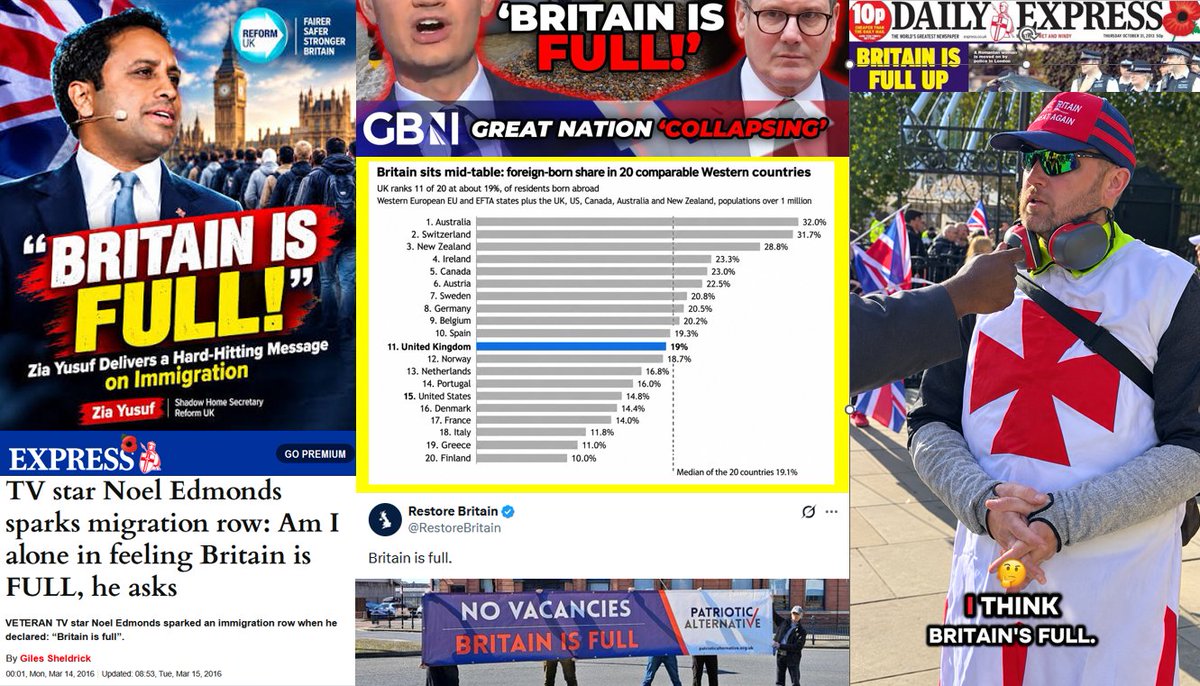
🚨 “Britain is full” is a refrain heard again and again from Reform UK, Restore Britain, far-right groups such as Patriotic Alternative, parts of the right-leaning press and protesters at anti-immigration rallies.
Senior Conservatives, from Thatcher to Braverman, have made the same case using other words. The claim behind it is that Britain has taken more than its fair share of migrants, and more than the countries it is usually compared with.
But is that really the case? Below, I take a close look at the evidence...
Rupert Lowe, the Great Yarmouth MP who now leads Restore Britain, puts it bluntly. “The bath is full, and it is overflowing,” he wrote on @X on 13 May 2025. “Slowing that flow is futile. It needs to be almost entirely shut off, and we need to start rapidly emptying the tub.”
Two months later, Restore Britain’s own account used the slogan itself: “Britain is full. For the foreseeable future, more people need to leave than settle. Net negative.”
The party’s immigration policy states that “Britain does not have the money or space to accommodate the destitute of the world at this moment”, and promises to reverse immigration: “If that means millions go, then millions go.”
Reform UK has since taken up the phrase. At a press conference in Kent on 12 October 2026, its unelected “shadow home secretary” Zia Yusuf told the audience: “The Tories imported 5 million net new people and left the country with fewer hospital beds. More people, fewer beds. Today we must be frank. Britain is full.” A minute later he added: “And nobody can argue Britain hasn’t taken its fair share.” The party published the speech under the headline “Britain is full”.
A month earlier, on 16 September 2026, Yusuf posted on X that “13.1 million foreign-born people lived here in 2024. That’s up 143% in a decade”, adding that it was an “unprecedented betrayal.” @FullFact found that the 143% figure compared 2004 with 2024, a span of twenty years.
Nigel Farage, speaking before him at the same press conference, recalled warning in 2020 that small boat crossings were “the beginning of an invasion”, and told the room that “the invasion is happening not just across the channel but in the back of lorries, cars and in many, many other ways”.
Three years earlier, as Home Secretary, Suella Braverman told the Tory Party conference that recent migration was “a mere gust compared to the hurricane that is coming”.
Every one of these statements assumes that Britain is an outlier. What counts as a “fair share” is partly a matter of judgement, but the comparison with other countries can be tested.
The idea is also far older than Reform UK, which I’ll come to. First, though, the numbers: how does the UK compare with the countries it is usually measured against?
On the most recent figures, just under one in five UK residents (about 19%), were born abroad. Set against 20 comparable Western countries, that puts Britain 11th: almost exactly at the median, effectively level with Spain and Norway.
The comparison covers the Western European members of the EU and EFTA, plus the UK, US, Canada, Australia and New Zealand, excluding countries with populations under one million. It leaves out the former Eastern bloc states, whose migration histories differ sharply from Britain’s. In some, the foreign-born figures partly reflect redrawn borders: people born in another Soviet or Yugoslav republic count as foreign-born today without ever having migrated in the usual sense. Australia, Canada, New Zealand and the US are included as the other long-established Western democracies with comparable histories of immigration.
The countries above Britain are hardly a list of nations that have lost control of their borders. Australia, at 32%, has a foreign-born share two-thirds higher than ours. Switzerland, New Zealand, Ireland, Canada, Austria, Sweden, Germany and Belgium all sit above the UK too.
Nor does the result depend on the choice of comparison. Adding the Central and Eastern European members of the EU leaves Britain 11th of 31. Including microstates such as Luxembourg, Malta and Monaco, or using broader definitions of “Western democracies”, moves it down to between 16th and 19th. On no reasonable definition is it near the top.
The same is true of asylum. At the Kent press conference, Farage claimed that “since the Brexit vote, half a million people have been given asylum here. That is higher than virtually any other country in the world.” A Home Office answer to a parliamentary question in November 2025 put grants of protection or other leave at initial decision, including dependants, at 230,003 over the ten years from October 2015 to September 2025. That period starts eight months before the referendum and ends a year before Farage spoke, but it leaves initial grants well short of half a million.
Successful appeals and resettlement schemes would add to the total, but they would need to account for roughly as many people again to reach his figure. To get anywhere near half a million, he would have to be counting people who came under the Ukraine schemes or the Hong Kong visa route. None of them were given asylum: they arrived on separate visa routes.
The comparison is easier to test, and it fails. In 2024, the UK ranked fourth in Europe for grants of protection at initial decision, with about 39,600; Germany granted about 133,700. However, per head of population the UK ranked 14th, with six grants per 10,000 residents. In 2023, counting resettlement as well, it was fifth in Europe in absolute terms and 21st per head. Earlier years tell the same story: in 2018, Germany, Italy, France, Austria and Sweden all granted protection to more people than the UK.
But Farage did not say Europe: he said “the world”. And he chose the loosest phrase available: “given asylum”. Taken at his word, the claim is even further from the truth.
The UN refugee agency, UNHCR, counts the refugees and others in need of international protection that each country is hosting, not individual grants of asylum. According to its Global Trends report, at the end of 2025 Colombia was hosting 2.8 million refugees and others in need of international protection, Germany 2.7 million, Türkiye 2.4 million, Uganda 1.9 million, Iran 1.7 million, Chad 1.5 million and Pakistan 1.3 million.
Every one of those countries hosts far more than Farage’s half a million, most of them several times over, and the UK is not among them. Nor are they typically rich: UNHCR found that 68% of the world’s refugees were hosted by low- and middle-income countries, and 65% by countries neighbouring the one they had fled.
None of this means the figures are beyond argument, and the caveats matter. The sources are not identical: European countries report to Eurostat, mostly from population registers, while the UK and US rely on surveys, and the reference dates run from 2021 to mid-2025. Countries within about a percentage point of each other should be treated as level. Canada’s figure, from its 2021 Census, leaves out temporary residents and is almost certainly an undercount today.
It is also worth being clear about what “foreign-born” means. It counts everyone born outside the country, including people who have long since become citizens. In the US, for example, about half of the foreign-born population are naturalised Americans. A large foreign-born share is a measure of a country’s history of migration, not a count of recent arrivals or of people without a right to remain.
So if the claim fails against the evidence, why does it keep returning? Part of the answer is that “Britain is full” has never really been a claim about numbers.
As the historian Lauren Pikó has shown, the idea of Britain as a finite container at risk of overflowing ran through post-war politics, from planners “decanting” city “overspill” into new towns to the language of immigration control. And it was never confined to the right. Labour’s 1965 white paper on Commonwealth immigration set out to control entry “so that it does not outrun Britain’s capacity to absorb them”. Rupert Lowe’s overflowing bath is the same image, sixty years on.
In January 1978, when around 6% of the UK’s population had been born abroad, Margaret Thatcher told Granada’s World in Action that “people are really rather afraid that this country might be rather swamped by people with a different culture”. By then, Pikó argues, the image of a finite, embattled nation had become a form of “common sense” that Thatcher was able to draw upon.
The phrase “common sense” is worth exploring briefly. Stuart Hall, following Gramsci, spent much of his career showing how contested and often divisive ideas come to pass as common sense, placed beyond the need for argument. The label still does that work. In November 2019, Jacob Rees-Mogg told LBC that leaving a burning building, whatever the fire brigade advised, “just seems the common sense thing to do”, a remark widely criticised for blaming those who died in Grenfell Tower after being told to stay in their flats. He later apologised. Yet it is equally “common sense” to follow the fire service’s instructions during a fire. Calling something common sense settles nothing. It is a way of declaring the argument over.
By the 2000s the phrase “Britain is full” was in common use, and not only on the right. In December 2002 an Observer investigation set out the restrictionist case under the heading “We’re full up, we just can’t take any more”, describing a vision of Britain “full to bursting point”, while noting that the official population estimates behind those projections had just been cut by a million after the 2001 census.
In 2003 a Times column ran under the headline “It’s not just Gatwick, the whole of Britain is full”. In 2007, when the Labour MP Margaret Hodge argued that British-born families should take priority over new migrants for social housing, the BNP came out in support, saying that “Britain is full and there is no more room for any economic migrants”. In 2008 an Observer column ran under the headline “The time has come to say Britain is full”.
On 19 April 2010, in the middle of the general election campaign, @BBC Panorama, presented by Jeremy Vine with John Ware reporting, asked “Is Britain Full?”, telling viewers that “aside from Malta, England is already the most densely populated country in Europe”. Four days later, launching the BNP’s manifesto, Nick Griffin declared: “We still say what we have always done. We say Britain is full. It is the most overcrowded country in Europe and it is time to shut the doors.” It was not: the UK was less densely populated than both the Netherlands and Belgium. His own manifesto put the share of residents born abroad at 10.9%.
Writing for the Institute of Race Relations after the election, the Sheffield campaigner John Grayson argued that a “common sense” consensus on immigration had become “a climate in which some of the BNP slogans begin to look mainstream”.
In September 2013, Farage told the BBC that David Cameron should go to Brussels and say: “We can’t do it, Britain is full.” Six weeks later, on 31 October 2013, the Daily Express front page declared “Britain is full up and fed up” and invited readers to join its “Crusade to stop new flood of Romanian and Bulgarian migrants”: the same language of flooding that Pikó traces through the post-war decades.
At the end of December 2013, Farage told BBC Radio 2: “I’ve never ever said Britain is full, I’ve never ever used that term.” Yet when the linguist Piotr Cap analysed Farage’s speeches from 2013 to 2016, he found them built around exactly that image of Britain as a container, in words such as “full up”, “burst” and “wave”. The phrase is now his party’s headline. The claim was made when the foreign-born share was around 6%, again at around 13%, and now at 19%. Whatever level is supposed to count as “full”, it keeps moving.
Pikó notes something else worth noting. When David Lane, chairman of the Commission for Racial Equality, answered Thatcher in 1978, he did so by pointing out that immigration was falling. He did not question whether a country could be “swamped” at all. Statistics alone tend to leave that kind of frame intact, and this piece is no exception: ranking Britain against its neighbours shows it is no outlier, but it cannot tell us what a “full” country would look like, because those who use the word rarely say.
The pressures people point to are real enough. Housing is short, services are stretched, and the pace of change in some towns has been rapid. But as a July 2026 Migration Policy Institute report puts it, “structural issues such as rising living costs, housing shortages, and crime do not stem from immigration, but rapid population change often exacerbates them”. That is an argument about planning and investment, and it applies as much to Australia, Ireland or Germany as to Britain.
Other pressures point the opposite way. Fertility in England and Wales fell to 1.39 children per woman in 2025. The ONS projects that at some point this year, deaths will exceed births in the UK, leaving net migration as the only source of population growth, and that the number of people aged 85 and over will roughly double, to 3.6 million, by 2049. A country ageing this fast faces hard questions about who will work and who will care, and “full” has no answer to them.
Whether the current level of migration is right for Britain is a legitimate political question, and reasonable people will answer it differently. But it is a question about choices: how many people to admit, where to build, and how much to invest in homes, schools, hospitals and transport. “Britain is full” recasts it as a matter of physics, as though the country were a container with a fixed capacity that has simply been reached.
That is simply not true. On the most recent figures, Britain sits squarely in the middle of the pack, 11th of 20 comparable Western countries, behind Australia, Canada, Germany and Ireland among others. Per head of population, it ranks 14th in Europe for grants of protection. And, as its history shows, the point at which Britain is supposedly full keeps moving.
What the phrase tries to do is close the argument down. If a country is full, there is nothing left to discuss: no case for planning, investment or integration, only for shutting the door, or, in Restore Britain’s words, “if that means millions go, then millions go”. That is why it is worth testing. Measured against its peers, Britain is not full. It is ordinary.
Restore Britain @RestoreBritainBritain is full. For the foreseeable future, more people need to leave than settle. Net negative.
111322.5K