
Twitter thread coming on what @adamcifu @VPrasadMDMPH @AndrewFoy82 and I think is the BEST approach to pt care. This is ...
The Case for Being a Medical Conservative.
Thanks to the @amjmed for publishing this.

114251994

@drjohnm
Heart rhythm doc, writer for @Medscape, host of This Week in Cardiology podcast, editor of Sensible Medicine. The more you see, the harder medicine gets.
JAMA @JAMA_currentAmong patients with #AtrioventricularBlock, preserved left ventricular ejection fraction, and anticipated high ventricular pacing burden, left bundle-branch area pacing reduced the 24-month composite of all-cause death, heart failure events, or upgrade to biventricular pacing vs right ventricular pacing. Device-related complications were similar between groups, supporting clinical consideration of left bundle-branch area pacing for patients expected to require frequent ventricular pacing.

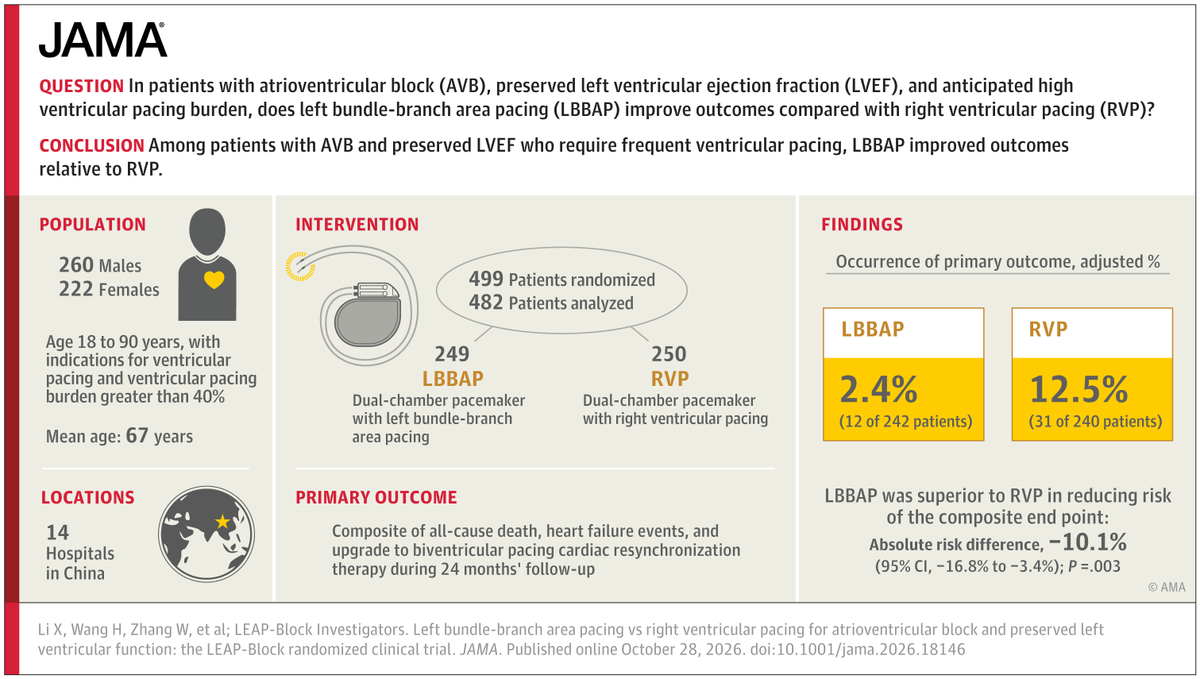
darius chapman @DariusChapmanLEAP BLOCK study!! Time and time again LBBAP is coming up superior to RVA.

Robert Herman, MD, PhD @RobertHermanMDAny more takers before we post the results here?

Greg Harris @drgregharris@drjohnm @peterkistler3 Another sensational headline with no context. How did they define recurrence? Any atrial arrhythmia >30 seconds. Not uncommon to see 30 seconds of atrial arrhythmia in anyone. We need to stop setting our afib metric based on the notion we can cure afib.


Peder L. Myhre MD, PhD @pmyhreAt the Norwegian Society of Cardiology 🇳🇴 annual meeting we had the most amazing line up of speakers this year including: ⭐️@AndrewPAmbrosy on worsening HF ⭐️@drjohnm on 5 worst trials that changed practice ⭐️#LarsKøber on ESC HFA 2026 GL Brilliant talks. We are so greatful 🙏🏻





Jeffrey Goldberger @DrJGoldbergerThanks to @drjohnm for reviewing the @JACCJournals Viewpoint on the status of EP in his weekly @Medscape podcast. Agree that now is an inflection point and we need to brainstorm to address this properly.

Jeffrey Goldberger @DrJGoldbergerCardiac Electrophysiology at a Crossroads: Building on Dr. Josephson's 20 years of observations. Is EP science, procedure or both? What is the future of EP science? #EPeeps #CardioX @ACCinTouch @HRSonline
Anish Koka, MD @anish_kokaThe Elizabeth Holmes story doesn’t happen without an enabling media ecosystem that doesn’t actually open a new book to realize the pages inside have a nonsensical / incomplete word salad. Check out this clip from an October 2015 media event that is ostensibly journalism but is clearly just a PR campaign for the new hot thing. Q: “Even though you’re going above and beyond with the FDA approvals how do you answer the critics who aren’t just attack dogs for the lab industry that say you’re being too secretive about the technology ?” The theme that repeats constantly with most science journalists is an inability to even make a passing attempt at interpreting primary data. They need trusted ppl to parse it for them. The lab ppl with questions ? — they’re conflicted so nothing they say can be taken at face value. Ok sure.. but why this default assumption that Holmes with MASSIVE conflicts is trustworthy? But he does mention that there are other non conflicted thoughtful ppl with questions as well about Theranos.. Holmes answers by first saying all the reports and questions in the media are seeded by the lab industry .. and then talks about clearing the FDA approval bar and that the FDA decision memo on her technology is all public. Herper, the journalist, actually interrupts her and looks to the audience and “teaches” the audience about the fact that all decision memos on approved products are public and can be looked up .. he joking says “its hours of fun”. The implication being that he’s a serious journalist who routinely reads these memos and the implication is that he’s read the Theranos memo. But the public FDA decision memo from July 2015 that Herper is ostensibly chuckling about covers ONE Theranos test for herpes simplex virus 1 (HSV-1), along with the Theranos platform as used for that specific test. It was a standard 510(k) clearance. The FDA judged the test substantially equivalent to Focus Diagnostics' HerpeSelect assay, and it described the test as a chemiluminescent immunoassay, which is not a novel technology. This was not a de novo review of a new platform, so nothing the FDA did constituted a verdict on the breakthrough Holmes was selling. A 510(k) is a paper review. The FDA reads data the sponsor generated and decides whether the device is substantially equivalent to an existing approved tech. Theranos tested the samples and sent the results to the CDC to confirm agreement. The CDC supplied the samples and checked the answers, but I’m pretty sure it didn’t run the samples on the Theranos device. The easy pushback in this interview —- actually the FDA approved one of your tests, and the FDA or anyone hasn’t been able to evaluate your propriety box. That follow up never comes. The FDA actually visited some Theranos sites months after the decision letter and rapped the company for marketing an unapproved device. This 483 FDA document came to light in October only in response to a FOIA request. So by the time Herper sat down for this interview the FDA knew there was a wide gap between what Holmes was saying about clearing the FDA bar and what was actually true. As Herper admiringly says in this interview Theranos had a $9billion valuation that put it on par with QUEST. The valuation was based on nothing. The patents she talks about in the interview didn’t describe anything actually new. It was an aspirational diagram of a patch that could monitor and deliver therapeutics. It would be like me having a patent for the Star Trek tricorder. 10 days after this interview by Herper, WSJ reporter John Careyrou wrote a whistleblower sourced story that began the great unraveling. The whole interview is a must watch because you realize how much of what’s happening right now is theater- a movie scripted by firms and their investors.


Greg Marcus @gregorymmarcusWe have known about #WPW and accessory pathways as a common cause of SVT for >100 years and have effective procedures to address them, but we still have NO IDEA why some patients are born with these extra slivers of muscle that electrically connect atria to ventricles. Medicinal use of lithium in pregnant women leads to heightened risk of a particular form of congenital heart disease associated with these pathways. Might variable levels of lithium in drinking water affect the chance a growing fetus will be born with such a pathway? @jclinicalinvest @UCSF @UCSFHospitals @stopafib @DrDave01 @KnowYourPulse JCI - Elevated lithium levels in drinking water are associated with higher prevalence of Wolff-Parkinson-White diagnoses


Jeffrey Goldberger @DrJGoldbergerCardiac Electrophysiology at a Crossroads: Building on Dr. Josephson's 20 years of observations. Is EP science, procedure or both? What is the future of EP science? #EPeeps #CardioX @ACCinTouch @HRSonline


