Peter Fedichev✓

@fedichev

A physicist in drug discovery land. On a mission to significantly extend human lifespan | Founder of https://t.co/0uofVKVgKB @hacking_aging) | WEF Tech Convergence group

146 Following5.4K Followers5.1K Posts
  1. Peter Fedichev✓@fedichev
    thank you, @EleanorSheekey for your questions and @agingdoc1 for spreading the link. Here and here are the popular and academic versions of the narrative discussed on the podcast. Friends, help please, as usual, spread the story with your likes and reposts. It's a lot better having a bad theory than none at all - let's get to the core of this.
    Agingdoc🩺Dr David Barzilai🔔MD PhD MS MBA DipABLM @agingdoc1
    How We Should Target Aging | Peter Fedichev Love what @EleanorSheekey is doing with @SheekeyScience. One of the sharpest geroscience #scicomm channels around, and @fedichev always brings the fire 🧪
    193513.3K
  2. Peter Fedichev✓@fedichev
    9 in 10 drugs fail in trials. Most fail because the target was wrong. At Gero we built and now open sourced a tool to score any target list against the only ground truth there is: clinical trial outcomes. Paper out in Bioinformatics (see the refs below, the code is open). A few things we found: – The famous “genetic support = 2.6x more likely to reach approval” reproduces, with open data, no Citeline needed. – More clinical data makes the benchmark worse. Pool every open registry and 2.6x collapses to 1.5x. Curated beats aggregated. We use this on our own models. Use it on yours. pip install ct-validation More info on my substack – this is a bit more reliable way to get updates like this. As usual, please follow, like and repost - more interesting stuff to come.
    55432K
  3. Peter Fedichev✓@fedichev
    You know I have a soft spot for extreme-value theory and its applications to aging (some of you know our work on the Gumbel distribution and the rate of aging; another one, on the Weibull distribution, goes online next week). Here is more. Enter Rényi's record theorem: the chance that your next great night after the night n beats your best one ever is 1/(n+1). Any distribution. Total universality. So a body with zero damage, living long enough, still stops wanting. A meal that once would have made a good night. Nothing has worsened: senses intact, food the same, body recovered by morning. The only change is that a better meal is on file. Tonight is a miss. The effort of going out is priced against a bar that is harder and harder to meet. Days fill with things that no longer clear it. Quality of life falls while every biomarker of youth stays perfect. Read on my Substack why life extension needs new Stoics, not just better repair: Please take a moment to share, like and follow here as well!
    506629
  4. Peter Fedichev✓@fedichev
    Everyone building AI for drug discovery is chasing the same scarce thing: 3D structures of protein–ligand complexes. There are fewer than 30,000 of them, piled on the same few well-studied targets. I think that scarcity is the most instructive bottleneck in the field, because nearly everyone treats it as a law of nature rather than a choice. It isn't. The real signal is activity data — which molecule actually acts on which target — and there is vastly more of it than there will ever be structures. ProtoBind-Diff learns to design binders from protein sequence alone, no structure ever. From sequence, it gave us confirmed sub-micromolar kinase inhibitors — chemotypes never annotated against any kinase. But most of that activity data sits in the dark, locked in pharma patents no database ever read. So we built HARVEST to free it: 3 million bioactivity records from 165,000 patents, at 11 cents a document — 50 years of expert curation done in under a week. Structure was never the bottleneck. Data was. Both papers just got into NeurIPS 2026. Read more on my Substack ( <- please subscribe!). Help with likes, follow and repost here please!
    81517412.2K
  5. Peter Fedichev✓@fedichev
    João Pedro de Magalhães has published a history of the hyperfunction theory of aging, arguing that aging is “programmatic” — developmental programs that keep running past their usefulness, with molecular damage demoted to a downstream symptom. It is a careful piece and worth reading (@jpsenescence on X). I also think its central inference is the most instructive mistake in the field, because nearly everyone makes it, including people who would never call themselves programmed-aging theorists. The inference rests on six observations, and all six are real. Individuals of a species go through the same changes in roughly the same order, on a timetable characteristic of that species and sharply different between species — a mouse gets three years, we get eighty. The hallmarks move together, across tissues and across systems. Single genes have outsized effects; daf-2 doubles a worm’s lifespan. Aging runs continuously out of development, with no seam between them. And some of it reverses, under parabiosis, reprogramming, restored youthful factors. Damage does none of that. Damage is random, unsynchronised, and does not care what species it is in. So: aging is not damage; aging is program. The premises are correct. The conclusion does not follow. Read more on my Substack ( <- please subscribe!). Help with likes, follow and repost here please!
    1414617.4K
  6. Peter Fedichev✓@fedichev
    John Archibald Wheeler — Feynman's doctoral advisor at Princeton, and the man who named the black hole and the wormhole — had a habit of naming things by what they lacked: mass without mass, charge without charge, law without law. Each was a case where some familiar quantity turned out to be produced by something that did not contain it. Wheeler's suggestion was that regularity itself might emerge from underlying randomness, so that what looks like a law requires no law behind it. Aging is program without program. See another sacred caw slayed on my Substack ( <- please subscribe). As always, please like, repost or follow to see more like this.
    Download
    01111.4K
  7. Peter Fedichev✓@fedichev
    What is aging? What is aging not? Forget it. Great things can only be appreciated from afar. So drop whatever you’re doing and go listen to @HardcoreHistory’s show 74 — Mania for Subjugation IV:
    1071.1K
  8. Peter Fedichev✓@fedichev
    Friends, this year I’m keeping conference travel light (time to build or what they say :) ). I’ll be speaking at the Biomarkers of Aging Consortium 2026 Conference, October 5–6 at the Joseph B. Martin Conference Center, Harvard Medical School. Hoping to make it to ARDD as well — see you there!
    Download
    14211.3K
  9. Peter Fedichev✓@fedichev
    Nobody asks which molecule causes glass to age. The question is category-confused: glass aging is a property of the configurational landscape, not of any molecular species. Human aging is the same. The "which hallmark is upstream?" debate dissolves once you see damage as configurational entropy — many microstates, one macroscopic variable, and an arrow of time you can't reverse without paying the information cost. Aging is a thermodynamic drift, not a parts failure. Follow, like and repost — read the full argument on Substack this week and subscribe.
    54262.3K
  10. Peter Fedichev✓@fedichev
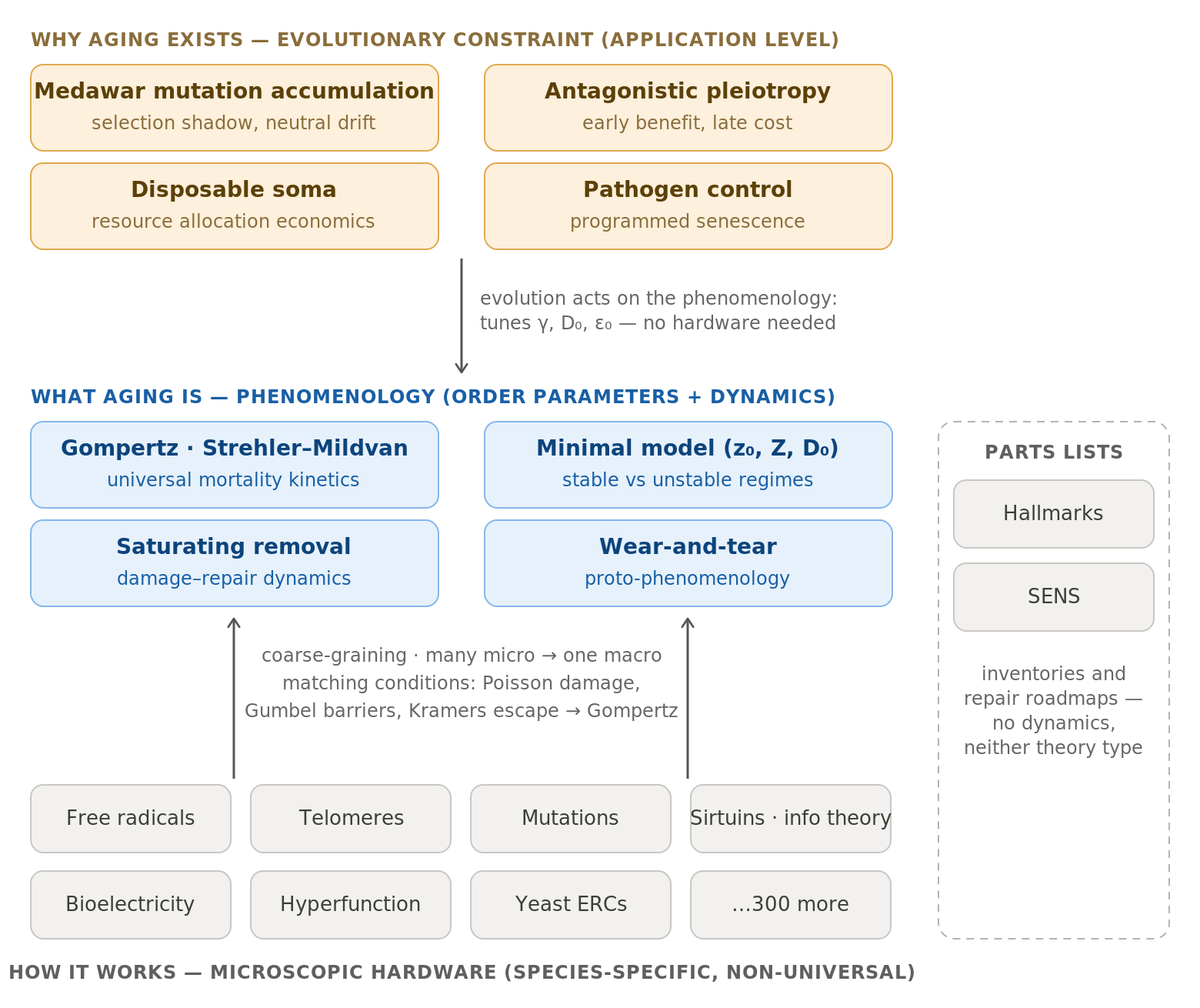
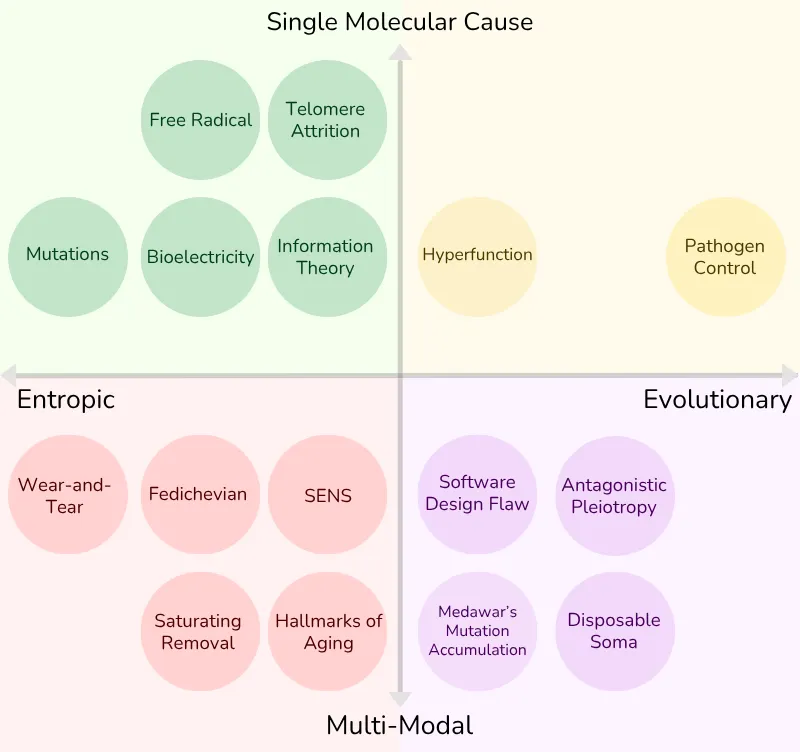
    Alan Tomusiak has written one of the better surveys of aging theories (“The Great Landscape of Aging Theories”) I have seen — honest about falsification history, generous to positions he does not hold, and admirably explicit about the limits of his own map. I recommend it (see the link by @alantomusiak in the first comment). The confusion is the word theory. The sixteen objects on Alan’s landscape are not sixteen answers to one question. They are answers to at least three different questions — why aging exists, what aging is, and how aging works — and these questions live at different levels of description. For a complex system, a theory can be one of at least two types. A phenomenological theory is a minimal set of variables and their relations that compresses a large corpus of observations. It classifies and explains without attempting microscopic reduction. Landau-Ginzburg theory of superconductivity is the canonical example: an order parameter, a free energy, a handful of coefficients — and an enormous range of phenomena falls out. Such theories are compressed representations of what happens. A microscopic theory explains how it happens mechanistically — and, crucially, it earns that status only by being shown to recover the phenomenology in the macroscopic limit. BCS theory is not the theory of superconductivity because it involves electrons and phonons; it is the theory because Gor’kov demonstrated that Landau-Ginzburg emerges from it. The derivation is the price of admission. The phenomenological theories of aging are the ones with equations: Gompertz mortality kinetics, Strehler-Mildvan, Uri Alon’s saturating removal (yes, it’s a phenomenological effective theory, though the authors confront such classification!), and our own resilience-loss (actually a lot more complete recent work with Jan Gruber) models at Gero. Few effective variables, explicit dynamics, compression of mortality curves and biomarker trajectories. These are the Landau-Ginzburg candidates. The Hallmarks of Aging — the most cited framework in the field — is the interesting failure case: it is neither. No dynamics, no compression, no recovered macroscopic law. It is a parts inventory. Which is exactly why it feels simultaneously comprehensive and inert: everything is on the list, and the list explains nothing. Follow, like and repost — read the full argument on Substack this week and subscribe.
    Download
    42353K
  11. Peter Fedichev✓@fedichev
    Posts @fedichev
    see original post our minimal model preprint
    Alan Tomusiak @alantomusiak
    I've written my love letter to the longevity community. When I entered the field, I had a difficult time finding a sense of direction within the vast world of ideas about how and why we age. I wrote a piece to make this easier for newcomers, mapping the landscape in detail.
    014625
  12. Alan Tomusiak✓@alantomusiak
    I've written my love letter to the longevity community. When I entered the field, I had a difficult time finding a sense of direction within the vast world of ideas about how and why we age. I wrote a piece to make this easier for newcomers, mapping the landscape in detail.
    Download
    93414K
  13. Peter Fedichev✓@fedichev
    In most long-lived species, evolution strongly selects for longevity because more years = more offspring. But in humans, menopause breaks that link. It’s rare in nature and may have evolved through the “grandmother hypothesis” — older females stopping reproduction to invest in grandchildren, especially useful in species with long childhoods. Using our AI platform on massive human datasets, we can now study both the shared aging mechanisms and the ones unique to reproductive aging. Menopause affects every woman in modern societies and has a massive impact on healthspan. The scientific, commercial, and humanitarian case is exceptionally clear. It’s a perfect example of how cracking aging biology can deliver therapies that are both deeply fundamental and immediately life-changing. Thank you, @athenabiorg, for the conversation. Friends, learn more below about how we’re working toward treating menopause as an aging problem.
    AthenaBIO @athenabiorg
    There are 100+ drugs in development for erectile dysfunction. There are 0 for menopause beyond symptom management. Only 4% of women even use the one hormone therapy that exists. We're trying to fix that. Read 👇
    510607.9K
  14. AthenaBIO✓@athenabiorg
    There are 100+ drugs in development for erectile dysfunction. There are 0 for menopause beyond symptom management. Only 4% of women even use the one hormone therapy that exists. We're trying to fix that. Read 👇
    Download
    102111928.1K
  15. Peter Fedichev✓@fedichev
    A reply to @ydeigin regarding my take on why epigenetic rejuvenation won't give us radical life extension: Yuri argues that serial cloning (one cell → trillions → one cell, repeated 57 times) is an extraordinarily harsh mutational stress-test — far tougher than a normal lifetime — yet the cloned mice maintained normal lifespans for decades of generations. This, he says, suggests somatic mutation load isn’t the primary limit on lifespan and weakens the idea that unrepaired damage caps what epigenetic rejuvenation can achieve. Fair point on the severity of the bottleneck. But let’s look at what the experiment actually falsifies. The stronger claim (often bundled with “information theory of aging”) is that a full epigenetic reset — complete nuclear reprogramming + embryogenesis — returns biological age to zero with essentially no irreversible residue. Serial cloning is about as rigorous a real-world test of that exact claim as exists: every single generation receives a total reset, repeated across 57 generations, with full developmental selection. Yet the damage accumulated monotonically anyway, until the lineage failed at generation 58. One clear counter-example is sufficient to reject the universal “reset erases everything, zero leftover” assertion. I’m not claiming mutation load is the dominant driver of normal mouse lifespan, nor that 58 generations is a hard biological ceiling. Only that even the most powerful reset conceivable left a residue it could not eliminate. This fits a broader pattern. Dose-ramped in vivo OSKM plateaued far short of top longevity interventions and raised cancer risk. Caloric restriction and heterochronic parabiosis both improve the reversible (regulatory noise) component but leave the entropic/irreversible trajectory flat. Four structurally unrelated interventions — full genetic reset, transcription-factor overexpression, dietary, and circulatory — all hit a similar floor. That convergence points toward a thermodynamic flavor: stress drives regulatory noise, which over time seeds irreversible entropic drift. We can slow the process. We cannot simply rewind it.
    70176.6K
  16. Peter Fedichev✓@fedichev
    Posts @fedichev
    Read Yuri's reply: to my Substack piece:
    Yuri Deigin @ydeigin
    Shots fired against my beloved partial reprogramming! 🙂 But it’s a complete misunderstanding of the serial cloning paper on Peter’s part… It actually SUPPORTS partial reprogramming as a means of extending lifespan, because it shows that somatic mutations are a remarkably minor constraint on normal lifespan. I mean, remember what their experiment put cells through. Each generation began from a single somatic cell, which then expanded into the TRILLIONS of cells making up an entire mouse. The next generation was bottlenecked back down to one cell, fixing that cell’s accumulated mutations into the founder genome of the next animal. They repeated this 57 times: from one cell to a whole organism, then back to one cell, over and over. That is a mutational stress test orders of magnitude beyond anything an adult organism would ever experience. Even if you lived for thousands of years, your tissues would accumulate only a fraction of the mutational burden these mice carried. And yet the mice continued to have normal lifespans across generations. Also, 58 generations was not some fundamental biological ceiling. It was one unscreened lineage (one path through the mutational landscape) that likely failed because of just a couple of major chromosome-scale lesions: the near-whole-chromosome 4 loss of heterozygosity, followed in one late branch by a Chr4–Chr11 translocation. That methodology had none of the quality control built into sexual reproduction: no recombination, no competition between gametes, no embryo selection, and no systematic screening to advance the cleanest lineage. If they had used PGT-like genomic screening at each generation and advanced only the cleanest nuclei, I strongly suspect serial cloning could have continued far beyond 58 generations. So yes, epigenetic reprogramming does not repair DNA mutations. But the remarkable finding here is that mice tolerated an enormous inherited mutational burden while continuing to age at a normal rate. That weakens, rather than supports, the claim that unrepaired somatic mutations impose a low ceiling on epigenetic rejuvenation. And invoking the second law of thermodynamics does not rescue the argument. Living organisms are open systems that continuously expend energy to repair DNA, replace proteins, heal tissues and maintain local order while exporting entropy into the environment. Thermodynamics just tells us that repair has an energetic cost, not that repair is impossible. Whether a particular age-associated lesion can be reversed is an empirical and engineering question. Calling it “entropy” does not make it irreversible. PS: people have been dissing partial reprogramming for close to a decade because the earliest OSKM studies did not produce dramatic lifespan extension. But that is a strange standard to apply to the first generation of an entirely new therapeutic paradigm. OSKM was discovered to create pluripotent stem cells, not as the optimal combination for safely rejuvenating every cell type. Partial reprogramming is ultimately much broader than OSKM: the goal is to shift old or dysfunctional cells toward younger, more functional gene-expression patterns without erasing their identity. That will likely require cell- and tissue-specific factors, doses and delivery systems, as I’ve been saying forever. BUT despite all the naysaying, the field has continued making steady progress toward the clinic! Life Bio has now dosed the first patient, NewLimit is advancing a liver-targeted, cell-specific reprogramming therapy toward human trials, and at YouthBio we are advancing our neuron-targeted, inducible partial reprogramming therapy for Alzheimer’s following our FDA INTERACT meeting. None of this guarantees clinical success, but it makes one thing clear: partial reprogramming is NOT a failed idea. Its first therapeutic generation is already reaching patients while a more precise, cell-specific second generation is being built.
    1002.3K
  17. Yuri Deigin✓@ydeigin
    Shots fired against my beloved partial reprogramming! 🙂 But it’s a complete misunderstanding of the serial cloning paper on Peter’s part… It actually SUPPORTS partial reprogramming as a means of extending lifespan, because it shows that somatic mutations are a remarkably minor constraint on normal lifespan. I mean, remember what their experiment put cells through. Each generation began from a single somatic cell, which then expanded into the TRILLIONS of cells making up an entire mouse. The next generation was bottlenecked back down to one cell, fixing that cell’s accumulated mutations into the founder genome of the next animal. They repeated this 57 times: from one cell to a whole organism, then back to one cell, over and over. That is a mutational stress test orders of magnitude beyond anything an adult organism would ever experience. Even if you lived for thousands of years, your tissues would accumulate only a fraction of the mutational burden these mice carried. And yet the mice continued to have normal lifespans across generations. Also, 58 generations was not some fundamental biological ceiling. It was one unscreened lineage (one path through the mutational landscape) that likely failed because of just a couple of major chromosome-scale lesions: the near-whole-chromosome 4 loss of heterozygosity, followed in one late branch by a Chr4–Chr11 translocation. That methodology had none of the quality control built into sexual reproduction: no recombination, no competition between gametes, no embryo selection, and no systematic screening to advance the cleanest lineage. If they had used PGT-like genomic screening at each generation and advanced only the cleanest nuclei, I strongly suspect serial cloning could have continued far beyond 58 generations. So yes, epigenetic reprogramming does not repair DNA mutations. But the remarkable finding here is that mice tolerated an enormous inherited mutational burden while continuing to age at a normal rate. That weakens, rather than supports, the claim that unrepaired somatic mutations impose a low ceiling on epigenetic rejuvenation. And invoking the second law of thermodynamics does not rescue the argument. Living organisms are open systems that continuously expend energy to repair DNA, replace proteins, heal tissues and maintain local order while exporting entropy into the environment. Thermodynamics just tells us that repair has an energetic cost, not that repair is impossible. Whether a particular age-associated lesion can be reversed is an empirical and engineering question. Calling it “entropy” does not make it irreversible. PS: people have been dissing partial reprogramming for close to a decade because the earliest OSKM studies did not produce dramatic lifespan extension. But that is a strange standard to apply to the first generation of an entirely new therapeutic paradigm. OSKM was discovered to create pluripotent stem cells, not as the optimal combination for safely rejuvenating every cell type. Partial reprogramming is ultimately much broader than OSKM: the goal is to shift old or dysfunctional cells toward younger, more functional gene-expression patterns without erasing their identity. That will likely require cell- and tissue-specific factors, doses and delivery systems, as I’ve been saying forever. BUT despite all the naysaying, the field has continued making steady progress toward the clinic! Life Bio has now dosed the first patient, NewLimit is advancing a liver-targeted, cell-specific reprogramming therapy toward human trials, and at YouthBio we are advancing our neuron-targeted, inducible partial reprogramming therapy for Alzheimer’s following our FDA INTERACT meeting. None of this guarantees clinical success, but it makes one thing clear: partial reprogramming is NOT a failed idea. Its first therapeutic generation is already reaching patients while a more precise, cell-specific second generation is being built.
    Peter Fedichev @fedichev
    Just published on Substack: Why Epigenetic Rejuvenation Won’t Give Us Radical Life Extension — Lessons from 58 Generations of Cloned Mice. This is my take at the results of a landmark Nature Communications paper (20+ years, 1,200+ mice, 58 generations of serial cloning with full epigenetic reset) shows it still collapses. Mutations accumulated 3× faster. Epigenetic reprogramming works… until it doesn’t. There is an irreducible level of damage that cannot be undone. To my taste, this is a very important study. Popular literature claims cloning erases aging signatures. In short-lived species it may look that way — the entropic damage simply doesn’t have time to kill. In longer-lived animals we expect the picture be very different (and there is an anecdotal evidence for that with a lot fewer generation before the collapse). This is also why I dislike the language of “information theory of aging.” Flipping the sign on entropy and calling that "information" (changing from the Boltzmann to Shannon equation) doesn’t repeal thermodynamics. Of course, you can still hope for better Yamanaka factors or else. My interpretation of the experiment is not yet a proof of anything - certainly not. However, the experiment removes a lot of ground under proponents of epigenetic rejuvenation. If you want to keep your identity, better to stop aging than try to reverse it. Challenge me. Subscribe, Like & repost. Link:

    10159611.8K
  18. Peter Fedichev✓@fedichev
    Posts @fedichev
    See full response: &lt;-- Please subscribe, like, and repost
    0041.1K
  19. Peter Fedichev✓@fedichev
    Just dropped a deep dive with @MHealthspan on why aging is more physics than biology — and how we're turning that into real drugs. Aging isn't a bug we can "reprogram" away with fancy epigenetics. It's entropic drift in a complex system: stress hits, regulatory noise builds, and irreversible damage accumulates. Thermodynamics sets the rules — we can slow the clock, not rewind it. That's the path past the ~120-150 year resilience limit. Key highlights: GLP-1s are the proof-of-concept the field needed: one mechanism, massive multi-disease impact. Imagine better versions that also touch core aging processes. Our 3-layer model (Stress → Regulatory Noise → Irreversible Damage) + physics-informed AI for target identification and design experimental therapeutics. Watch here: If you want to understand why we focus on slowing rather than reversing, and how we're building the next class of medicines, this is worth your time. What we do now matters — resilience is everything. Let's push the limits. #Longevity #Gerophysics #GeroAI
    Download
    22292.4K
  20. Peter Fedichev✓@fedichev
    We have just reached $34M in total funding, with new money coming to advance our preclinical pipeline. Now, we’re accelerating our transition from science and discovery engine to a preclinical-stage drug developer, on track to pioneer a new class of medicines targeting aging and chronic diseases in humans. Our theories and models can now be put to a test and see translation into therapeutics that could dramatically affect lifespan in our species. Read more on this news:
    Download
    221412623.9K
  21. Peter Fedichev✓@fedichev
    Just published on Substack: Why Epigenetic Rejuvenation Won’t Give Us Radical Life Extension — Lessons from 58 Generations of Cloned Mice. This is my take at the results of a landmark Nature Communications paper (20+ years, 1,200+ mice, 58 generations of serial cloning with full epigenetic reset) shows it still collapses. Mutations accumulated 3× faster. Epigenetic reprogramming works… until it doesn’t. There is an irreducible level of damage that cannot be undone. To my taste, this is a very important study. Popular literature claims cloning erases aging signatures. In short-lived species it may look that way — the entropic damage simply doesn’t have time to kill. In longer-lived animals we expect the picture be very different (and there is an anecdotal evidence for that with a lot fewer generation before the collapse). This is also why I dislike the language of “information theory of aging.” Flipping the sign on entropy and calling that "information" (changing from the Boltzmann to Shannon equation) doesn’t repeal thermodynamics. Of course, you can still hope for better Yamanaka factors or else. My interpretation of the experiment is not yet a proof of anything - certainly not. However, the experiment removes a lot of ground under proponents of epigenetic rejuvenation. If you want to keep your identity, better to stop aging than try to reverse it. Challenge me. Subscribe, Like & repost. Link:
    Download
    282614031.8K
  22. Peter Fedichev✓@fedichev
    Gero has just been selected as a 2026 Technology Pioneer by the World Economic Forum (@wef). For over a decade I've approached #aging as a physicist: not as a collection of isolated diseases to treat after they appear, but as a macroscopic process driven by the accumulation of entropic damage and the loss of resilience in a complex system. That framework is what led us to found @hacking_aging. At Gero, we use physics-informed models on large-scale clinical data to separate aging itself from specific disease trajectories. Our goal is straightforward: identify ways to slow the underlying rate of functional decline before reversible stress turns into irreversible collapse. Stop the clock where it matters most — on the processes that erode healthspan. This recognition from the WEF is a strong validation of that direction. Looking forward to connecting with the other pioneers and pushing these ideas further. ➡️Read the full announcement:
    Download
    53212.8K
  23. Peter Fedichev✓@fedichev
    congrats @lex_sviridov - it's a monumental work!
    Aleksandr Sviridov @lex_sviridov
    Over the past few months, I've been collaborating with @socialcapital (@chamath's investment vehicle) on a two-part deep dive into the current state of Longevity Biotech and Aging Research. This deep dive aims to be a solid introduction to the field. It assumes no background in biology, medicine, or biotech. If you've been wondering what science knows about aging, what makes us believe aging can be slowed or reversed, or which companies are making real progress toward developing therapies against aging, this is for you! Part 1 is out now. It's a foundation for understanding the biology of aging and the current state of longevity biotech. Part 2 follows shortly, covering the strategies researchers, companies, and investors are pursuing to slow or reverse aging. Thank you, @chamath and @socialcapital team, for the opportunity to work with you on it. And thank you to all contributors who helped to make this deep dive objective and engaging, and who are making anti-aging interventions a reality: @Andrei_Tarkhov, @elimohamad, @fedichev, @KarlPfleger, @MarkHamalainen, @MartinBJensen, @MaxUnfried, @mkaeberlein, @omri_drory, @RaianyRomanni, @realnathancheng, @sebastiangiwa, @shappiron, @shoylev, @statto, @strygah, @ydeigin If any errors are to be found in this deep dive, I own them.
    00111.4K
  24. Aleksandr Sviridov✓@lex_sviridov
    Over the past few months, I've been collaborating with @socialcapital (@chamath's investment vehicle) on a two-part deep dive into the current state of Longevity Biotech and Aging Research. This deep dive aims to be a solid introduction to the field. It assumes no background in biology, medicine, or biotech. If you've been wondering what science knows about aging, what makes us believe aging can be slowed or reversed, or which companies are making real progress toward developing therapies against aging, this is for you! Part 1 is out now. It's a foundation for understanding the biology of aging and the current state of longevity biotech. Part 2 follows shortly, covering the strategies researchers, companies, and investors are pursuing to slow or reverse aging. Thank you, @chamath and @socialcapital team, for the opportunity to work with you on it. And thank you to all contributors who helped to make this deep dive objective and engaging, and who are making anti-aging interventions a reality: @Andrei_Tarkhov, @elimohamad, @fedichev, @KarlPfleger, @MarkHamalainen, @MartinBJensen, @MaxUnfried, @mkaeberlein, @omri_drory, @RaianyRomanni, @realnathancheng, @sebastiangiwa, @shappiron, @shoylev, @statto, @strygah, @ydeigin If any errors are to be found in this deep dive, I own them.
    8157117.8K
  25. Peter Fedichev✓@fedichev
    When most people think about aging, they think biology. Cells, genes, proteins, damage. That's not wrong — but it may be missing the level at which the problem actually lives. I'm a physicist working on aging. The question I get most often: why physics? Biology is chemistry, chemistry is physics — but chemists don't need quantum mechanics, and biologists don't need to revisit Schrödinger. Fair point. Except it misses something deep. P. W. Anderson said it in 1972: more is different. Complex systems are hierarchically organized, and at each scale, genuinely new laws emerge — laws that are largely indifferent to what's happening below. Temperature. Superconductivity. Turbulence. None visible in any single particle. All real, all governed by rules that only exist at scale. The corollary is uncomfortable: information does not flow upward. Macro behavior is insensitive to micro details. This is why drugs mostly fail — not bad chemistry, but a structural mismatch between the scale of intervention and the scale of the outcome you care about. You pull a molecular lever; the organism-level trajectory shrugs. It also means there is no unified molecular theory of aging. And there never will be — not because we haven't found it yet, but because physics tells us it can't exist. Yeast ages through extrachromosomal DNA circles; mammals through telomere attrition and proteostatic collapse. Completely different mechanisms, convergent macroscopic phenomenology. Different species have different microscopic theories of aging. Physics has seen this before: Landau-Ginzburg theory describes superconductivity without caring about atomic details; BCS and Anderson give microscopic accounts for their own material classes, but no unified microscopic theory exists or is expected to. The universal law lives at the macro level. Always. Darwin and Boltzmann were contemporaries, and together they produced the deepest tension in 19th-century science. Darwin showed complexity increasing over time. Boltzmann proved that disorder must increase. Two giants, pulling in opposite directions — and resolving that tension took another century. Aging sits right at the intersection: a macroscopic arrow of time in biology, driven by thermodynamic drift that repair mechanisms, themselves finite, cannot indefinitely offset. Hayflick saw it from inside biology: aging is not a disease. It is the second law operating on living matter. Physics and biology have been circling the arrow of time together for 150 years. Aging is where they finally have to converge. More on this in my Substack post. 👇
    105363.2K
  26. Peter Fedichev✓@fedichev
    Posts @fedichev
    Learn more about the role physics plays in aging on my Substack:
    026860
  27. Show more posts