Posts with #CDOs
#CDOs
Public posts on X that use #CDOs.
Related hashtags

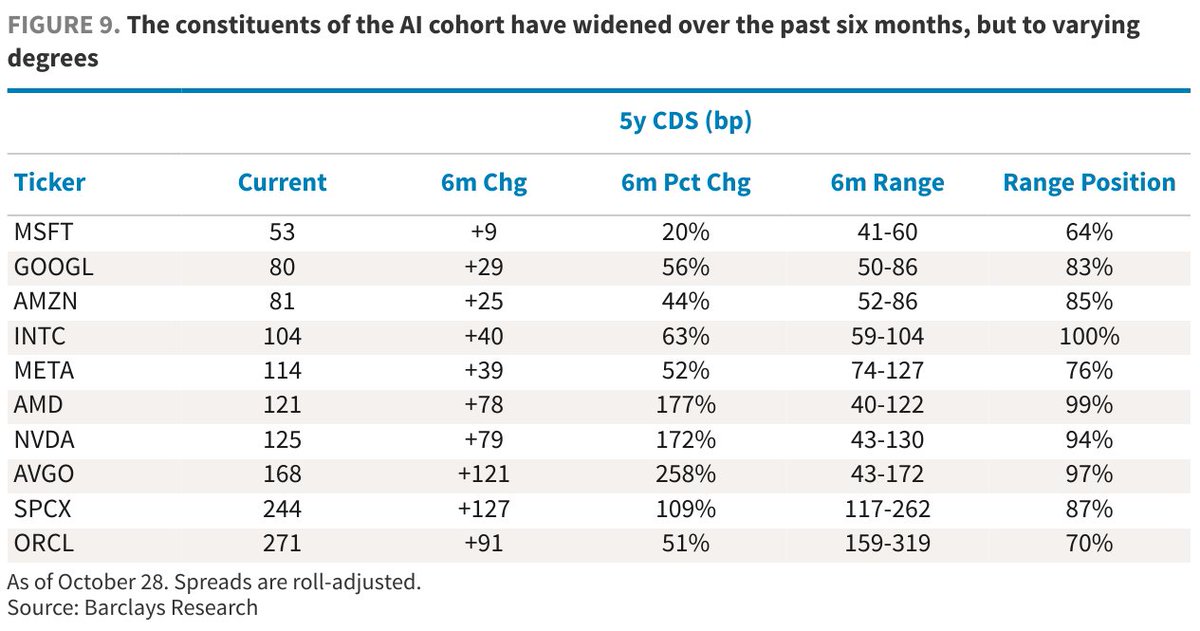
The Hottest Trade On Wall Street Gets A Field Manual: Barclays Maps The AI CDS Market, And How To Trade It1928148216K
I am never out of CDS. I put in my personal distilled drinking water daily also. At least once a month, I do several days of hourly CDS with DMSO taken orally. At the first sign of illness or infection, I do several days of CSD hourly with DMSO I’ve even been known to do a 20 mil in 1 L of distilled water CDS as a five minute enema I’m not telling anyone else to do it, I’m just telling you my choices @KalckerofficialDr. h.c. Andreas Ludwig Kalcker @KalckerofficialIsidora is 89. Months of cellulitis and varicose veins. Fourteen days in hospital, antibiotics and IV fluids — and the legs kept getting worse. The family filmed her ten days later. We don't publish this as proof. We publish it because they sent it. Isidora, in her own words — subtitles in 30 languages:143931930.4K
Isidora is 89. Months of cellulitis and varicose veins. Fourteen days in hospital, antibiotics and IV fluids — and the legs kept getting worse. The family filmed her ten days later. We don't publish this as proof. We publish it because they sent it. Isidora, in her own words — subtitles in 30 languages:82413149.5K
@VictorFromDEIn response to a few lazy and idiotic comments. CDS isn’t just chlorine dioxide. It is chlorine dioxide gas saturated in water. It is also different than “MMS” (the first chlorine dioxide protocols).017388
Notable reversal in CDS today. If credit conditions free up, we'll be off to races again.71411312.2K
@chamath@chamath says the smartest people in the world trade cds. i once geared $100 million up to about $15bn notional, buying cds on japanese and korean steel. owning cds is like being permanently early. you pay every quarter you wait, and the cost of time is unbearably heavy. lesson 1 of the hedge fund masterclass is what that wait costs you.32559.1K
NVDA CDS .. UNPRECEDENTED WIDES! NVDA CDS is trading at 128 bps .. 2 tighter from Friday's all time wide. I started trading single name CDS 30 years ago. Single name CDS started really trading in earnest in '97. NO AA RATED CORPORATE HAS EVER TRADED WIDER! AA Sovs and Fins have but not a Corp. NVDA's 5 year cum probability of default is 10.5% as priced by CDS. NVDA's realistic prob of default in next 5 years is more like < 0.5%. So why is NVDA CDS trading so wide? Because NVDA is guaranteeing GPU financing deals which are pricing wide enough spread for buyers to buy the deal and buy CDS and still earn a "riskless" spread over UST (granted def basis risk). My question is how deep is the offer on CDS? Back before GFC many ignorant AAA/AA counterparties (think AIG FP and the like, Deriv Products Companies, Levered Super Senior) sold senior tranches of synthetic CDOs at stupid tight levels. Those sellers supplied the CDS market with the "offer" side. One main reason CDS market volumes dropped so much post-GFC is that those sellers are pretty much gone. Sellers of single name (outside of index arbs) usually need a decent premium to sell CDS vs owning the bond which to me is a reason why the NVDA CDS trades so wide.1446336.1K
Benzinga@BenzingaNvidia’s ($NVDA) five-year credit default swap has more than tripled this year to 127 basis points, recently moving above Meta’s ($META). The rise comes as Nvidia takes on more exposure to AI infrastructure partners like CoreWeave ($CRWV).51115.9K
𝗪𝗵𝗼 𝗪𝗶𝗹𝗹 𝗕𝗲 𝗧𝗵𝗲 𝗢𝗳𝗳𝗲𝗿𝗲𝗱 𝗦𝗶𝗱𝗲 𝗶𝗻 𝗖𝗗𝗦? I traded CDS from the start in the late ’90s. Buyers were never the problem. Sellers were. 🧵 1) Banks hedged derivative counterparty risk and freed up RBC on undrawn revolvers, convert arbs hedged credit, and L/S funds went short. Long-only asset managers wouldn’t sell unless the basis was fat. 2) Synthetic CDOs fixed that. We built diversified IG CDS portfolios and got shadow ratings on the tranches. AIG FP and the ilk just wanted “high spread” for a AA or AAA. Then CDX tranching made sellers plentiful, and they were diamond hands who ignored marks. Volumes exploded. 3) That seller died in the GFC, and CDS volumes collapsed. Now hyperscalers and chipmakers want to issue $1trn of GPU debt, and the CDS bid is massive. Who sells? 4) Asset managers should sell at a positive basis, but they haven’t yet. Pod PMs are the offer, and they aren’t diamond hands. Expect a thin offer side, wider spreads, and more vol.141210214.5K
Question for credit guys. Does anyone model time variance? If I believe the defaults are likely to happen in 2027 and 2028 across neos for example, do people take signal from 3Y CDS or is that too unreliable? If unreliable, is anyone internally modeling time-varying hazard?Kieran Goodwin @kieranwgoodwinNVDA CDS .. UNPRECEDENTED WIDES! NVDA CDS is trading at 128 bps .. 2 tighter from Friday's all time wide. I started trading single name CDS 30 years ago. Single name CDS started really trading in earnest in '97. NO AA RATED CORPORATE HAS EVER TRADED WIDER! AA Sovs and Fins have but not a Corp. NVDA's 5 year cum probability of default is 10.5% as priced by CDS. NVDA's realistic prob of default in next 5 years is more like < 0.5%. So why is NVDA CDS trading so wide? Because NVDA is guaranteeing GPU financing deals which are pricing wide enough spread for buyers to buy the deal and buy CDS and still earn a "riskless" spread over UST (granted def basis risk). My question is how deep is the offer on CDS? Back before GFC many ignorant AAA/AA counterparties (think AIG FP and the like, Deriv Products Companies, Levered Super Senior) sold senior tranches of synthetic CDOs at stupid tight levels. Those sellers supplied the CDS market with the "offer" side. One main reason CDS market volumes dropped so much post-GFC is that those sellers are pretty much gone. Sellers of single name (outside of index arbs) usually need a decent premium to sell CDS vs owning the bond which to me is a reason why the NVDA CDS trades so wide.1226414.6K
Carl Quintanilla@carlquintanillaFEDWATCH: “.. CDS spreads on free-cash-flow-poor companies have spiked, while cash-rich balance sheets remain relatively insulated, signaling that liquidity is becoming the market's most valuable asset.”173513313.2K
credit is the part of the AI spending story I'd watch. lenders get paid before shareholders do and the CDS market is already getting nervous about the low-cash names7101723.4K
I’ve been reminding you to bank your gains all year long. Here’s what that looks like to me, I take monthly dividend profit or options profit and I: - transfer it to a broad long term US and international ETF only account that has only 5 to 6 positions - like $LVHI - transfer it to checking, then use it to pay down mortgage principal - transfer it to broad ETF only income account that kicks off more monthly dividends - like $GPIX - put gains into equal weight, non-tech sector or low beta ETFs - like $XLVI - putting gains into new fixed income - like CDs Here’s what it does not look like: - putting more and more at risk in options and raising the amt of money I’m using for options - putting more and more at risk in high beta, speculative stocks - putting more and more at risk in stocks at an all time high It means taking gains, rebalancing the risk, and reducing costs in real life. You will have another chance to bank gains. 🏦 So be ready… 💎✨The Dividend Dream on YouTube @DreamDividendDIVIDEND DREAM SCHOOL 🏫 Every month I make profits through options. But every month I also TRANSFER money out to another account to put into long term growth broad ETFs Remember to bank your gains and not continuously put them back into high risk scenarios. This process helps diversify and expand the strategy of the portfolio. Rinse and repeat and you’ll have a self funded flywheel inside of a 401k 💎✨70221.9K
DIVIDEND DREAM SCHOOL 🏫 Every month I make profits through options. But every month I also TRANSFER money out to another account to put into long term growth broad ETFs Remember to bank your gains and not continuously put them back into high risk scenarios. This process helps diversify and expand the strategy of the portfolio. Rinse and repeat and you’ll have a self funded flywheel inside of a 401k 💎✨30303.2K
My newest peer-reviewed publication, published in Biophysica, a top-tier MDPI journal. It is highly recommended for all health professionals who want to understand how and why CDS really works.11772197.3K
🚨A major new peer-reviewed paper by @Kalckerofficial just dropped in Biophysica (MDPI) explaining exactly how Chlorine Dioxide Solution (CDS) works at the molecular level. Key mechanisms: - CDS acts as a selective one-electron oxidant (not a chlorinating agent like bleach). - It targets thiol-dependent enzymes and respiratory processes in pathogens at very low concentrations (0.1–5 ppm). - Mammalian cells are largely spared because of much higher glutathione buffering capacity. - This gives it broad antimicrobial action (bacteria, viruses, fungi, biofilms) while maintaining a favorable safety window at proper low doses. This is the clearest scientific explanation yet of why CDS can be effective against a wide range of infections and why it behaves differently from harsher oxidizers. It aligns with years of clinical observations and documented protocols. CDS is a powerful, selective tool when used responsibly according to established low-dose protocols. The chemistry explains both its potency against pathogens and its relative sparing of healthy tissue. Important: Always use fresh, properly prepared CDS and follow experienced guidance. This is not medical advice — it’s an invitation to understand the science behind a tool that continues to be suppressed despite growing evidence. Full paper here: The more we understand the redox chemistry, the harder it becomes to dismiss the real-world results people are seeing. 🤘1212643513.9K
The AI trade, as I see it this weekend (1/n) TLDR: Demand for compute is fine, rents are rising and credit is underwriting structure instead of the label now, the physical buildout does not depend on what the labs IPO at. Two weeks of persistent selling and the loudest AI bear case since spring. My view has not changed at all. What the market is repricing is who pays for compute and at what cost of capital, not whether we need it. We do need more compute. As I’ve been pointing out a lot recently, the Silicon Data H100 Rental Index went from $2.00 per GPU-hour last December to $2.88 on Friday. That chip is three years old and two generations behind. NBIS raised on-demand H100 pricing about 17% at the start of the month, and Runpod went from $3.29 to $3.99 between early September and mid-October. Over the same stretch, token prices kept falling. When the price of the output falls and the rent on the machine rises, usage is growing faster than supply. The rental data has only gotten stronger. On earnings, my view is the same. UBS expects Q3 S&P 500 EPS growth of 28% year over year, with semis contributing about half. Meanwhile hedge funds reportedly just had their worst day since COVID, and the tape has been constant deleveraging and rotation. To me this looks like crowded positioning coming out. I think it’s reasonable to assume that a lot of funds, alongside retail, flipped a switch somewhere around March and April and went heavily risk-on semis. That isn’t a problem in itself, but that positioning comes out of the market at some point, and FUD gives the selling a reason. JPMorgan Private Bank’s note this week lays out how credit is tiering AI borrowers. The strongest AI balance sheets carry 5y CDS around 50 to 120bps. Established infrastructure borrowers are near 300. The weakest financing-dependent borrower is at 1,100. That matches CRWV, whose 5y CDS touched a record 1,194.5bps intraday on October 15, implying roughly a 64% 5y default probability, up from 452bps in June. UBS told clients the same week to favor well-funded hyperscalers and quality semis and to limit neocloud exposure. There’s a key distinction here, though. The CDS, and the 9.75% notes that traded down to a mid-teens yield, are claims on the corporate entity. That is very different from financing secured by the compute and an investment-grade customer’s contract, which is how CRWV’s March facility got rated investment grade in the first place. Credit is pricing unsecured leverage at the holding company. It is not saying GPUs are bad collateral. Credit has shifted to underwriting structure, and structure decides who keeps building. At GTC Berlin, Jensen priced the unit simply: a 1GW AI factory costs about $50B and generates about $40B a year, so one quarter of delay costs about $10B. He also asked lenders to treat Nvidia compute as a financeable asset class and said GPUs now have a useful life of eight years or more. Some will point to Nvidia's other claim from the same week, up to 30x the throughput per MW of GB300 NVL72 on an agentic workload. Read the curve, though. The advantage is about 2x at 110 tokens per second per user, 10x at 130, and 30x at 160. The big gap only exists at the very top of the interactivity range. Below that, older silicon is still productive, and that’s where it ends up. Prefill and premium latency tiers go to the newest racks. Decode, batch and cheaper tiers move to hardware that’s already paid for. Old GPUs don’t just get retired. They move down the stack until the next generation of “old” silicon replaces them. This will happen eventually but that does not break the case that GPUs last a lot longer than the market initially assumed. A lot of the bear case right now leans on the labs as well. Whether OpenAI’s ARR is $70B or approaching $50B, what Anthropic or OpenAI IPO at, or whether they IPO at all. Those questions matter for how lab equity gets priced, but they don’t determine whether the buildout continues. The buildout is driven by usage, and usage is showing up in GPU rents. The technological shift we’re in the middle of isn’t driven by how a private company annualizes a month of revenue. If a lab IPO prices below its last round, the tokens still get served. Falling token prices aren’t deflationary for compute, either. Efficiency is what makes the higher rent payable. Every gain at the model layer lowers the cost of a token and pulls in more usage. That’s why token prices and GPU rents have been moving in opposite directions (see the chart I posted yesterday). The real advances are happening below the model layer, in physical problems. At the hardware layer, that is the 30x per MW above. At the rack level, power delivery is moving to 800V DC and liquid cooling is becoming standard, because racks at these densities can’t be fed or cooled the old way. Nvidia’s DSX POD pitch cuts onsite deployment from 6 months to 14 days and runs warm-water closed loops so evaporative towers aren’t needed. At the power layer, grid connection queues in Europe’s major markets can run longer than the 6 months that design saves. None of that work stops because a lab’s valuation multiple compresses. If anything, a higher cost of capital rewards whoever turns a MW into tokens most efficiently at a given level of model quality. The real link between the labs and the buildout is narrower than the headlines make it sound. If a major lab can’t raise, its compute commitments get renegotiated, and that would hit backlog. That’s a real risk. A lab pricing its IPO lower, or its ARR coming in "lower than consensus," isn't.16819825.7K
The Broadcom CDS is really amazing for a top-10 company in the SPX with a 16% default prob.67295.3K
Antonio Rojilla@arojillaLatest protoype of Crazy DOS, the card game mixing Crazy Eights with MS-DOS #CDOS #boardgames #DOSGaming #Cards #NERDS #sysadmin #theITcrowd258
Anna Stuyvesant 🤔💬🗨️🤫😁👀😉@StuyvesantAnnaDangerous, struck off nurse is trying to harm or kill people again. DMSO & CDS can cause harmful side effects.59381.6K- Show more posts