Posts with #ContinualLearning

#ContinualLearning

Public posts on X that use #ContinualLearning.

Related hashtags

  1. Toshitake Asabuki@TAsabuki
    AI forgetting is a “traffic jam” inside the network. 🚦 In #ContinualLearning for RNNs, shared weight update directions overwrite learned dynamics. We show that simple feedback switching guides plasticity into task-specific manifolds. With @Lewieliu987, @ac_kurth, @OsakoYuma
    Download
    Toshitake Asabuki @TAsabuki
    How can RNNs learn continuously without forgetting? 🧠 Our new preprint shows how a predictive learning rule organizes recurrent dynamics into orthogonal manifolds, reducing task interference. Congrats Zihan @Lewieliu987!
    32820718.3K
  2. Toshitake Asabuki@TAsabuki
    How can RNNs learn continuously without forgetting? 🧠 Our new preprint shows how a predictive learning rule organizes recurrent dynamics into orthogonal manifolds, reducing task interference. Congrats Zihan @Lewieliu987!
    43112925.6K
  3. Google AI✓@GoogleAI
    Introducing Learning to Prompt (L2P), an #ML model training method that uses learnable task-relevant prompts to guide pre-trained models through training on sequential tasks and results in high performance in the #ContinualLearning setting. Read more →
    Download
    985318
  4. Anirban Mukhopadhyay@anirbanakash
    Our guide for the techies feeling lost in the NEW #continuallearning regulations for #healthcare #AI. Regulation made easy, with the support of @BMG_Bund. Vielen Dank @Karl_Lauterbach🙏
    Camila González @camgbus
    The EU AI Act and FDA PCCP emphasize essential building blocks for adaptive AI in healthcare: ✅ Privacy protection ✅ Real-world performance monitoring ✅ Bias mitigation ✅ Transparency and traceability These measures aim to improve the safety 🦺, performance 📈, and sustainability 🔄 of AI systems 🏥🔍
    029864
  5. Camila González@camgbus
    @camgbus
    The EU AI Act and FDA PCCP emphasize essential building blocks for adaptive AI in healthcare: ✅ Privacy protection ✅ Real-world performance monitoring ✅ Bias mitigation ✅ Transparency and traceability These measures aim to improve the safety 🦺, performance 📈, and sustainability 🔄 of AI systems 🏥🔍
    Download
    1281.1K
  6. empac✓@empac2058569834
    Google Research gave LLMs an offline sleep phase. sleep framework The sleep-enhanced base model scored 79.2% on AIME24. I want this wake/sleep loop in production models (@GoogleResearch). #AI #ContinualLearning
    Download
    10017
  7. Sungmin Cha✓@_sungmin_cha
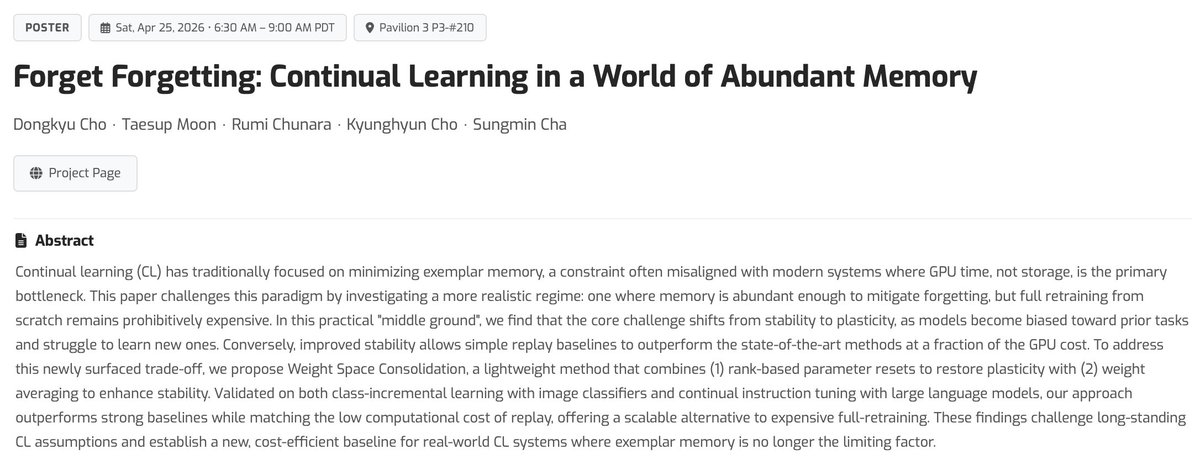
    In #ContinualLearning, we have long assumed extreme memory constraints. But in today's era of large models where compute is the real bottleneck, is catastrophic forgetting still our biggest problem? Our #ICLR2026 paper, "Forget Forgetting: Continual Learning in a World of Abundant Memory", challenges this view. We found that in practical settings with abundant memory, models actually struggle more with a loss of plasticity rather than forgetting. They become biased toward past data and fail to absorb new knowledge. To address this, we introduce Weight Space Consolidation. This lightweight method uses rank-based parameter initialization (using merging) to restore plasticity and weight averaging to maintain stability. The result is high efficiency and performance in both #LLM continual instruction tuning and vision models, avoiding the massive cost of full retraining. While I cannot attend the conference in Rio de Janeiro in person, the first author will be presenting our poster. If you are working on the practical limits of Continual Learning or LLMs, please stop by our session for a discussion. Presentation Details: ICLR 2026, Poster Session 5, Pavilion 3 (Saturday, April 25 at 09:30 EDT) Project Page: GitHub:
    Download
    03334.1K
  8. Viet Anh Khoa Tran@VietAnhKhoaTran
    New #NeuroAI preprint! #ContinualLearning methods struggle in mostly unsupervised environments with sparse labels (e.g. parents telling their child the object is an 'apple'). We propose that in the cortex, predictive coding of high-level top-down modulations solves this! (1/6)
    Download
    1271.2K
  9. Martin Mundt@mundt_martin
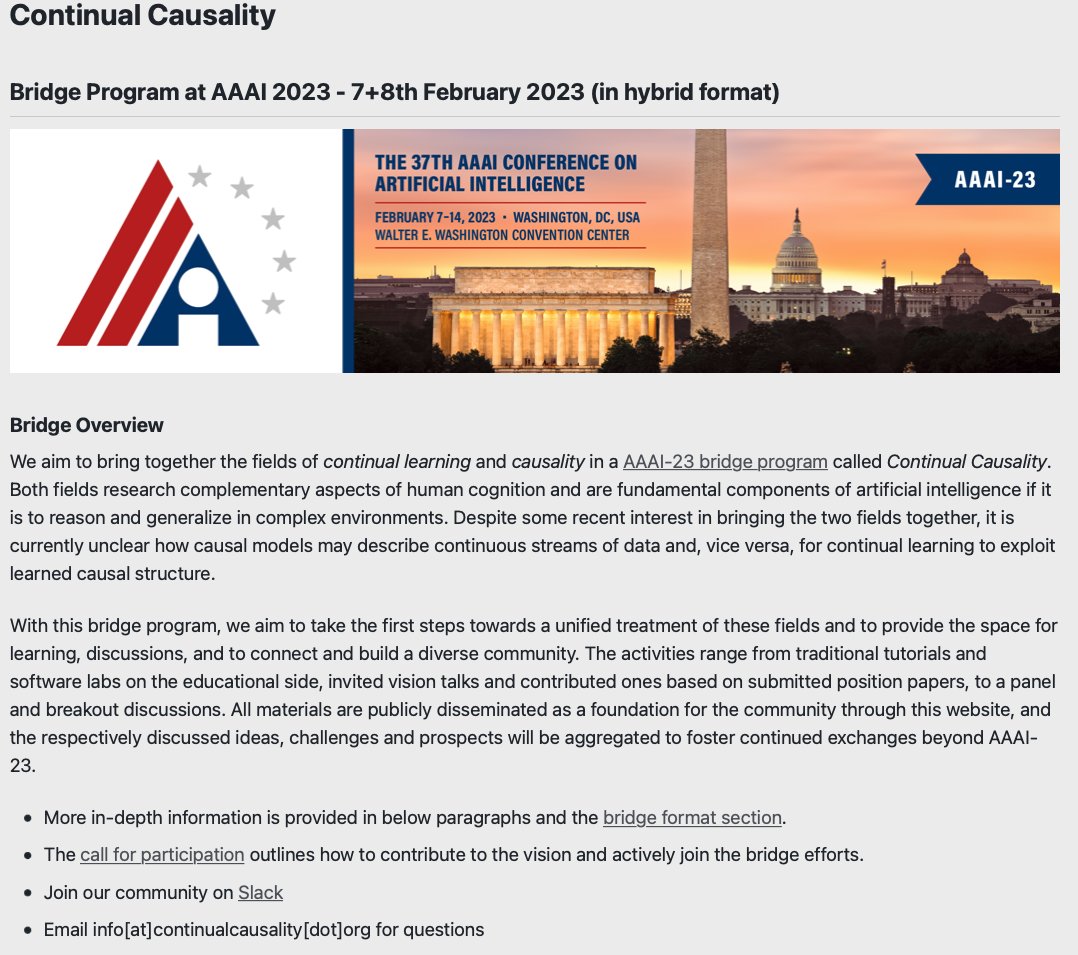
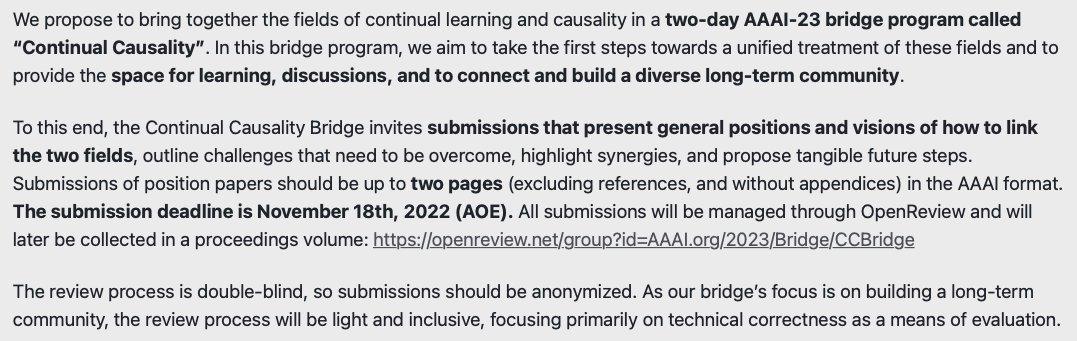
    Interested in the intersection of #Causality & #ContinualLearning? 🚨Our Continual Causality Bridge is back for round 2 at @RealAAAI AAAI-24 on Feb 20+21 in Vancouver! * info: * join Slack + check out last year👆 * Call for 4-page papers - Nov 24th AOE
    Download
    17246.7K
  10. Haizhong Zheng✓@haizhong_zheng
    We’re excited to open-source Hermit! 🐚 A harness evolution framework for continual learning and RSI: train reusable adapters without changing your model or harness. Multiple methods, one framework. GitHub: #HarnessEvolution #ContinualLearning #RSI #Agent
    Haizhong Zheng @haizhong_zheng
    116144427.9K
  11. Huan Sun✓@hhsun1
    The awesome @xue_tianci @osunlp led a great effort to enable #ContinualLearning of #ComputerUse agents in specific environments and build more stable and efficient RL infrastructure to support that. Check out our recent work, "Autonomous Continual Learning of Computer-Use Agents for Environment Adaptation", and more updates are on the way!
    Tianci Xue @xue_tianci
    Definitely a post worth reading. Building reliable & efficient infrastructure is one of the biggest pain points for RL in agentic settings — especially when your environment is heavily computer/mobile-based. If you’re struggling with deploying CUA environments, you might want to check out our recent infra: It can reliably host hundreds of Linux environments on a single server, with super simple management via API calls. We also use environment preloading to reduce initialization idle time to near zero. Infra matters more than people think.
    05181.7K
  12. Tianci Xue@xue_tianci
    Definitely a post worth reading. Building reliable & efficient infrastructure is one of the biggest pain points for RL in agentic settings — especially when your environment is heavily computer/mobile-based. If you’re struggling with deploying CUA environments, you might want to check out our recent infra: It can reliably host hundreds of Linux environments on a single server, with super simple management via API calls. We also use environment preloading to reduce initialization idle time to near zero. Infra matters more than people think.
    Download
    32015519.2K
  13. Sungmin Cha✓@_sungmin_cha
    Is #ContinualLearning research focused on the wrong bottleneck? For years, the goal has been to save #memory cost, but in modern systems, #GPU cost is the true constraint. In our new paper, we explore this "abundant memory" regime. We find that when forgetting is mitigated with abundant memory, models lose plasticity and struggle to learn new tasks. Simple replay becomes strong, but the plasticity problem remains. We propose Weight Space Consolidation, a lightweight method that combines parameter resets and weight averaging to create a scalable and cost-efficient alternative to full retraining for continual learning with both CNNs and LLMs.
    Download
    310959K
  14. Fartash Faghri✓@FartashFg
    In the era of continued pretraining and continued fine-tuning, loss of plasticity means leaving future gains on the table. We need a better theoretical understanding of loss of plasticity. See a great thread unpacking the dynamics. 👇 #ICLR2026 #ContinualLearning #DeepLearning
    Amir Joudaki @AmirJoudaki
    Neural nets don’t just forget. Sometimes, after long training, they lose the ability to learn at all. In our #ICLR2026 poster, we model Loss of Plasticity as gradient dynamics trapped in invariant manifolds: 🔴 frozen units, 🔵 cloned units. The video makes the traps visible.
    04122.3K
  15. Amir Joudaki✓@AmirJoudaki
    Neural nets don’t just forget. Sometimes, after long training, they lose the ability to learn at all. In our #ICLR2026 poster, we model Loss of Plasticity as gradient dynamics trapped in invariant manifolds: 🔴 frozen units, 🔵 cloned units. The video makes the traps visible.
    Download
    1651595102K
  16. Camila González@camgbus
    I am very excited about this work, which we will present in October! 🇲🇦 ♾ #ContinualLearning methods for medical image segmentation that reply scans from previous training stages often perform the best, yet storing patient data is usually not feasible 👉 Pseudo-rehearsal instead proposes to generate images similar to those seen in the past, but this brings its own challenges, such as high computational demands, privacy leakage, and failure to capture edge cases 👉We instead propose generating pseudo-features in the latent space with a small VAE, conditioned on the learning stage and scan positioning 👉These pseudo-features help us prevent #CatastrophicForgetting, and by observing the reconstruction error of the VAE we can detect out-of-distribution samples during inference at no additional cost!
    Martin Mundt @mundt_martin
    🎉 Our paper “Distribution-Aware Replay for Continual MRI Segmentation” has been accepted at PILM @MICCAI_Society -> we use a small VAE to model UNET latents to get continual learning + OoD detection! Very exiting colab with @camgbus & @anirbanakash
    11251.1K
  17. Martin Mundt@mundt_martin
    🎉 Our paper “Distribution-Aware Replay for Continual MRI Segmentation” has been accepted at PILM @MICCAI_Society -> we use a small VAE to model UNET latents to get continual learning + OoD detection! Very exiting colab with @camgbus & @anirbanakash
    Download
    32213.9K
  18. empac✓@empac2058569834
    Google Research 给大模型加了离线“睡眠”巩固阶段。 sleep framework 睡眠增强的基础模型在 AIME24 上拿到 79.2%。 我更想看到这套清醒/睡眠循环进到正式产品里(@GoogleResearch)。 #AI #ContinualLearning
    Download
    10011
  19. Sungmin Cha✓@_sungmin_cha
    For years, I thought the central challenge in #ContinualLearning was how to do more with less memory. In this new work, "Memory Is Not the Bottleneck: Cost-Efficient Continual Learning via Weight Space Consolidation", we ask: what if memory isn’t the bottleneck anymore?
    Download
    12191.3K
  20. yuyang liu@yuyang1124
    🎉 Excited to share our latest survey paper: Continual Learning for VLMs: A Survey and Taxonomy Beyond Forgetting! In this work, we offer the first focused and systematic review of the VLM-CL field. 📖Paper: #ContinualLearning #VLM
    Download
    31397
  21. Amii@AmiiThinks
    It’s a deep learning problem that was ‘hidden in plain sight:’ A new Nature paper by Amii researchers explores why continual learning models can all of a sudden stop working, and what to do about it: #AI #ContinualLearning #MachineLearning
    111415.3K
  22. Sungmin Cha✓@_sungmin_cha
    Is #ContinualLearning evaluation giving us a false sense of progress? For years, the CL community has relied on a conventional but flawed protocol: tuning and evaluating algorithms on the same scenario. This is unrealistic (future data is inaccessible) and leads to a significant overestimation of an algorithm's true capacity. In our TMLR 2025 paper, we propose the Generalizable Two-phase Evaluation Protocol (GTEP) to fix this. The core idea is to evaluate CL algorithm's generalizability: 1. Phase 1 (Tune): Find the best hyperparameters on a seen scenario. 2. Phase 2 (Eval): Apply these fixed HPs to evaluate performance on a separate, unseen scenario. Today, we've released the official code for GTEP! This isn't just for reproduction—it's a concrete guide to implement this protocol. Based on this code, we strongly encourage the CL community to adopt GTEP for a more rigorous and realistic assessment of CL algorithms in diverse domains!
    Download
    15153.1K
  23. Show more posts