✨ 𝐈𝐂𝐌𝐋 2026 𝐒𝐩𝐨𝐭𝐥𝐢𝐠𝐡𝐭✨
In
#DataSelection, a common practice is to use
#DataValuation methods (e.g.,
#DataShapley,
#Semivalues) to compute the worth of each data point, and select the top-m data points. But more than often, the selection is not even better than random.
#DataValuation researchers can only demonstrate on limited datasets and settings.
Is
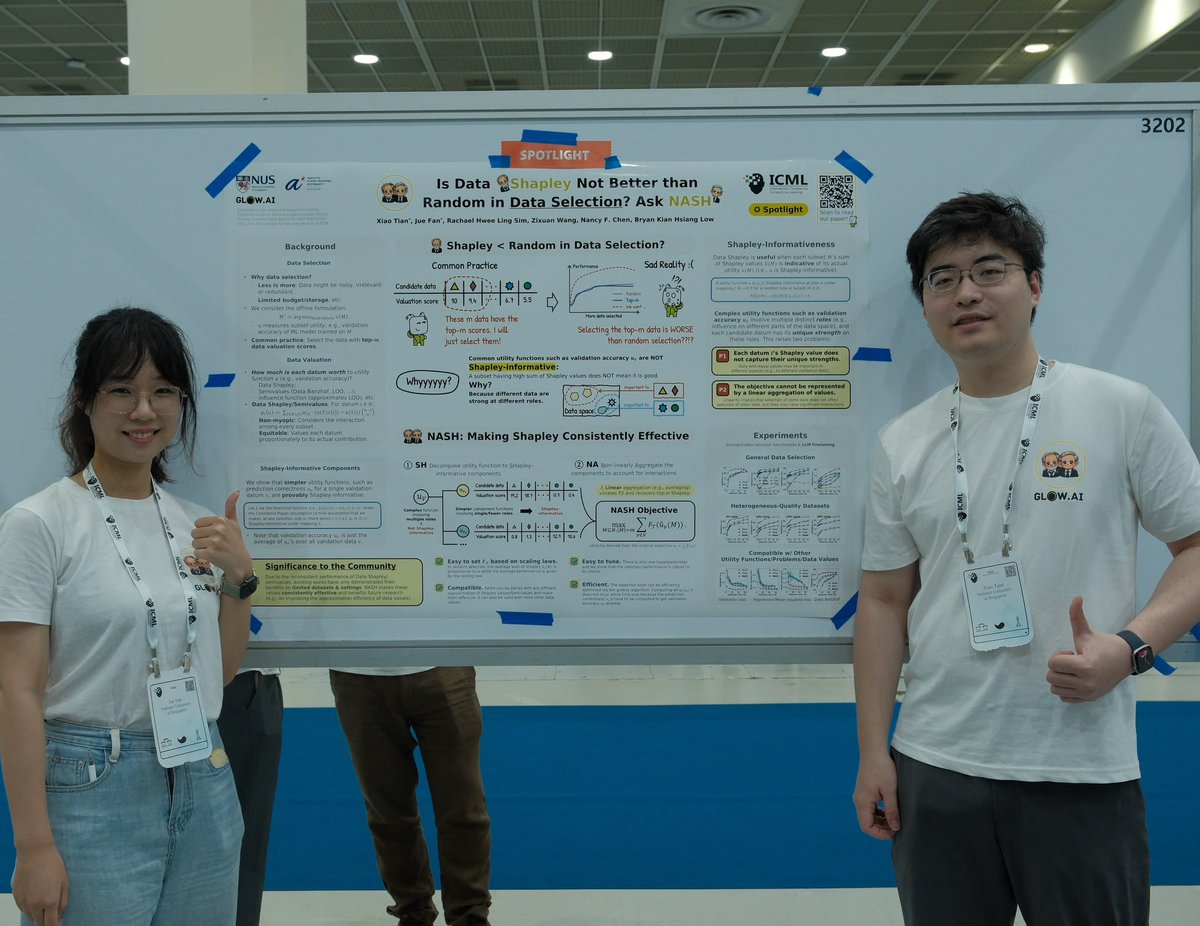
#DataShapley really not better than random in data selection? Our
#ICML2026 Spotlight paper, NASH, answers NO 🙅♀️.
What’s the problem? Imagine a company hiring from applicants who each receive an overall score. If the company simply hires the highest-scoring candidates, it may end up with a team full of excellent coders, but no product managers, salespeople, or designers. Top-m applicants ≠ complete team 🙅♂️, which needs to fulfil a variety of roles.
NASH addresses this by
(1) breaking down the complex objective function to multiple simpler components (≈ roles) so that the data values on these components accurately reflect each data point’s unique strengths and weaknesses 📊;
(2) forming a new objective which non-linearly aggregates these components so that a data point is preferred when its strengths complement the other selected data points 🧑🧑🧒🧒.
NASH consistently and substantially boosts the performance of Data Shapley with minimal additional runtime cost. Future research on
#DataShapley would not need to limit their datasets and settings any more 😁.
Drop by our poster to say hi or discuss more 🤝!
📍 Poster:
#3202 | Hall A
🕔 Time: 8 July 2026 (Wed), 5:00 - 6:45 pm
📖 OpenReview:
📝 Authors:
@snoidetx @YvonneFan12 @RachaelSim2 Zixuan Wang, Nancy F. Chen,
@bryanklow
#DataSelection #DataValuation #MachineLearning #LLM